
TL;DR
Anthropic’s $65 billion Series H isn’t just about valuation—it’s a compute war. The company is investing heavily in infrastructure to meet soaring demand for Claude and future models. This signals that compute capacity, not just money, now rules the AI race.
Imagine pouring billions into a single resource—more than most startups spend in a decade. That’s what Anthropic just did. The headline? A $965 billion valuation, the biggest private financing ever. The real story? A fierce, secret war over AI compute capacity that’s just heating up. The real story? A fierce, secret war over AI compute capacity that’s just heating up.
This isn’t about building flashy new features or marketing campaigns. It’s about securing the raw horsepower—thousands of GPUs, massive data centers, energy—that powers the future of AI. If you thought AI was about clever algorithms, think again. It’s about who controls the machines that run them.
In this article, we break down what this massive raise really signals—why compute is now king, and what that means for AI’s next chapter. Buckle up. The race for capacity has just become the most important game in tech history.
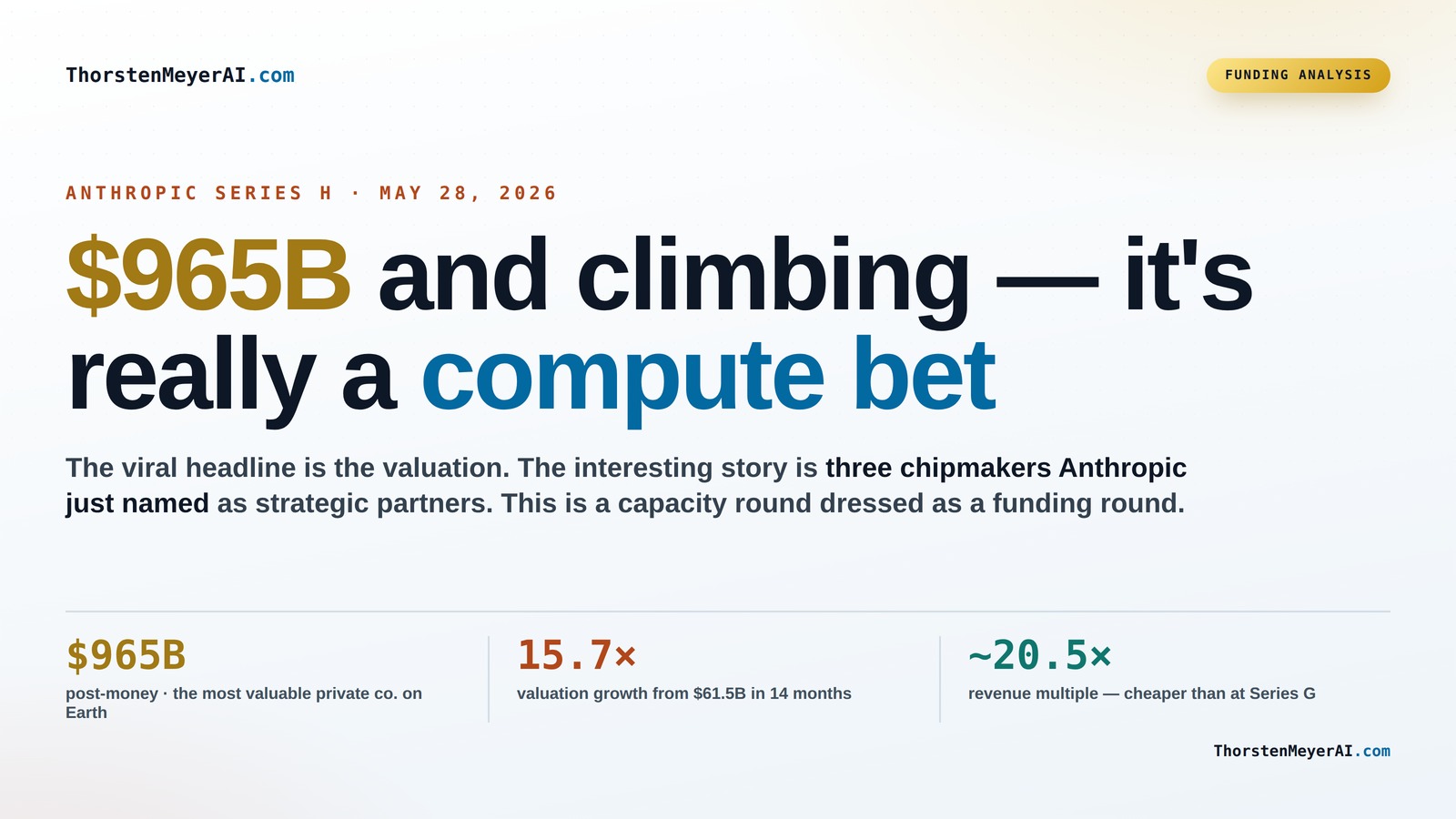
$965B and climbing — it’s really a compute bet
The viral headline is the valuation. The interesting story is in the press release’s middle paragraphs — and in three chipmakers Anthropic just named as strategic partners. This is a capacity round dressed as a funding round.
The numbers nobody can quite parse in sequence
Read together they describe a trajectory with no precedent in enterprise software. Read individually, each looks like a typo.
From $61.5B to $965B in fourteen months
Salesforce took roughly two decades to reach revenue numbers Anthropic just blew past. The sequence below is the part most coverage skips — it’s not the size, it’s the shape.
Anthropic’s valuation ladder · Mar 2025 → May 2026
Five rounds, fourteen months. Bar height is the valuation; the climb itself is the story. Tap any milestone for context.
The multiple actually got cheaper
Bubbles look like multiples expanding while revenue lags. Anthropic’s pattern is the inverse — the valuation tripled, but revenue grew faster, and the multiple compressed.
Revenue-to-valuation multiple · Series G → Series H
Same company, three months apart. The denominator (revenue) is outrunning the numerator (valuation) — exactly the opposite of what a bubble narrative predicts.
10+ gigawatts and three chipmakers
When you name Micron, Samsung & SK hynix alongside your equity backers, you’re saying the binding constraint isn’t demand or model quality — it’s the physical supply of memory chips. The Series H is a capacity round.
Compute commitments backing Anthropic’s capacity bet
$200B+ in announced compute spend across multi-year contracts. The $65B Series H raise has to be read against that bill, not against operating losses.
A genuinely durable bet — or a structural exposure?
Both readings can be true at once. The answer arrives over the next 18–24 months as the gigawatts come online and either fill with paying demand or don’t.
Revenue growth has no precedent in B2B software ($1B → $47B in 17 months). The multiple is compressing, not expanding. Claude is the only frontier model on all 3 major clouds. Enterprise AI spend share went from ~10% to >65% in a year. Compute commitments are tied to specific contracts with capacity dates.
20× revenue is not cheap by any historical software-investing standard. Revenue is reported gross of cloud-reseller pass-throughs, which inflates the top line. Profitability is 2 years out. Amodei’s own warning: a 12-month delay in AI progress “would make him bankrupt” — the compute commitments are a structural exposure to demand persistence.
The valuation race — and the IPO context
Anthropic shipped Opus 4.8 the same morning as Series H — not a coincidence. One week after OpenAI filed confidentially for IPO. The late-2026 frame is set: two frontier AI companies racing to public markets, each pitching durability.
Key Takeaways
- The $965 billion valuation is driven more by capacity investments than profit or revenue alone.
- AI companies are now competing on access to GPU clusters, data centers, and energy—making infrastructure the new strategic asset.
- Explosive revenue growth at Anthropic is fueling a capex-intensive push to expand compute capacity.
- Safety and interpretability are becoming core R&D priorities, adding to the infrastructure burden.
- The AI race is shifting from algorithm innovation to hardware dominance—expect more capacity arms races ahead.

AI Systems Performance Engineering: Optimizing Model Training and Inference Workloads with GPUs, CUDA, and PyTorch
As an affiliate, we earn on qualifying purchases.
As an affiliate, we earn on qualifying purchases.
Why $965B Isn’t Just a Valuation—It’s a Compute Power Play
Anthropic’s $965 billion valuation sounds astronomical, but most of that number isn’t about profit or revenue. It’s a signal that investors believe the real bottleneck is access to compute—GPU clusters, data centers, and energy—more than anything else.
Think of it like a Formula 1 race. The car is crucial, but without the track and fuel, you’re not winning. Here, the ‘car’ is the AI model, but the ‘track’ and ‘fuel’ are massive compute resources.
Anthropic’s press release explicitly highlights commitments from chipmakers like Micron, Samsung, and SK hynix. Plus, a chunk of the funding is dedicated to expanding this capacity. This is a capacity round dressed up as a valuation round.
Why does this matter? Because in AI, the speed and scale at which models can be trained and deployed directly influence competitive advantage. Companies that secure more compute can iterate faster, develop larger models, and deploy capabilities that others simply can’t match. This shift implies that future AI leadership hinges on hardware access, not just algorithmic innovation or data alone. The tradeoff is clear: investing heavily in infrastructure might limit short-term profitability but promises a dominant position in the AI ecosystem.


Rittal 3305.548 Blue e cooling unit, wall-mounted, 5084 BTU/h, 400 V, 3 Phase, 50 Hz, 460 V, 3 Phase, 60 Hz, Type 3R/4, Carbon Steel, 40.2" H x 15.9" W x 14.1" D
- Cooling Capacity: 5084 BTU/h for efficient cooling
- Voltage Compatibility: Supports 400V 50Hz and 460V 60Hz
- Protection Rating: Type 3R/4 for environmental protection
As an affiliate, we earn on qualifying purchases.
As an affiliate, we earn on qualifying purchases.
How Massive Compute Needs Are Reshaping AI Business Strategies
Anthropic’s revenue shot from $9 billion at the end of 2025 to over $30 billion by April 2026. That’s a 3x jump in just four months. The secret? Soaring demand for Claude, their flagship AI model, which is driving the need for massive compute infrastructure.
But the real kicker: this demand is pushing the need for endless GPU clusters. The company is investing heavily to keep up, making the cost of inference and training skyrocket, highlighting the importance of AI tooling and infrastructure.
It’s like trying to keep a fire fed with gasoline. The more you pour in, the bigger the fire grows—fueling both growth and a fierce scramble for hardware access. This growth isn’t just about sales; it’s a direct consequence of needing more compute to serve a rapidly expanding user base and improve model capabilities. The implication? AI firms must prioritize infrastructure investments to sustain growth, often at the expense of short-term margins. This shift forces a reevaluation of business models, emphasizing hardware acquisition and operational scale as core to competitive advantage. The tradeoff involves balancing immediate profitability against long-term dominance through capacity expansion.


Tecmojo 6U Wall Mount Server Cabinet IT Network Rack Enclosure Lockable Door and Side Panels Black, Cooling Fan, Standard Glass Door, 450mm Depth, for 19” IT Equipment, A/V Devices
- Space-saving Wall Mount: 6U cabinet with compact dimensions
- Secure Lockable Doors: Glass door and side panels lockable for security
- Flexible Door Orientation: Front door can be installed on either side
As an affiliate, we earn on qualifying purchases.
As an affiliate, we earn on qualifying purchases.
Compare: Anthropic vs. OpenAI — Who’s Cheaper on the Valuation-Revenue Scale?
| Company | Valuation | Run-Rate Revenue | Multiple (Valuation / Revenue) |
|---|---|---|---|
| Anthropic | $965B | $47B | 20.5× |
| OpenAI | $852B | $13B | ~66× |
Compared to OpenAI, Anthropic trades at a *smaller multiple* despite being valued higher. This indicates that investors are placing more emphasis on capacity and demand rather than current profitability. A lower multiple suggests that Anthropic’s valuation reflects expectations of rapid scaling, where infrastructure investments are seen as the key drivers of future value. The higher valuation, despite a similar revenue base, signals a market belief that Anthropic’s focus on expanding compute capacity will generate outsized returns down the line. This shift in valuation multiples underscores a strategic pivot in AI investment—prioritizing hardware access as the new form of competitive advantage, rather than solely focusing on algorithmic innovation.


The Compute Frontier: The Reinvention of Computation in the Age of AI
As an affiliate, we earn on qualifying purchases.
As an affiliate, we earn on qualifying purchases.
What Does ‘Compute’ Actually Mean, and Why Is It So Expensive?
‘Compute’ in AI talks about GPUs, data centers, and energy—literally the raw horsepower needed for training and serving large models. Think of it like the size of the engine in a sports car.
For Anthropic, running Claude at scale costs billions in hardware, electricity, and cooling. The company is now in a capital-intensive phase where buying and maintaining this gear is becoming the main expense. These costs aren’t just about hardware purchase; they include ongoing operational expenses like power, cooling, and maintenance—factors that can escalate quickly as scale increases. This means that the economics of AI are shifting, with infrastructure costs potentially outweighing model development costs. The ability to efficiently acquire and operate this hardware becomes a strategic advantage, but it also introduces significant tradeoffs related to capital allocation, supply chain resilience, and energy consumption. The high costs can limit the pace of expansion for smaller players, creating a barrier to entry that reinforces dominance for those with deep pockets and supply chain leverage.

The Real Race: Securing Chips, Data Centers, and Power
The scramble isn’t just for more money, but for physical hardware—thousands of GPUs, special memory chips, and the energy to run them. Securing these resources involves navigating complex global supply chains, which is a key aspect of AI infrastructure development. Anthropic’s strategic partnerships with Micron, Samsung, and SK hynix underline this focus.
Imagine trying to buy every GPU in stock during a global chip shortage. That’s the scale of the challenge, emphasizing the importance of hardware supply chain resilience. The race isn’t just about funding; it’s about locking down the supply chain and ensuring reliable access to critical components. Securing these resources involves navigating complex global supply chains, competing with tech giants and governments, and managing long lead times for manufacturing and delivery. The implications are profound: companies that can lock in hardware early will have a decisive advantage in model scale and deployment speed. The capacity arms race isn’t just about money; it’s about controlling the physical hardware and ensuring supply chain resilience amidst global shortages and geopolitical tensions. This strategic positioning will determine who leads in AI’s next chapter.

Safety and Interpretability — The Costly R&D Backbone
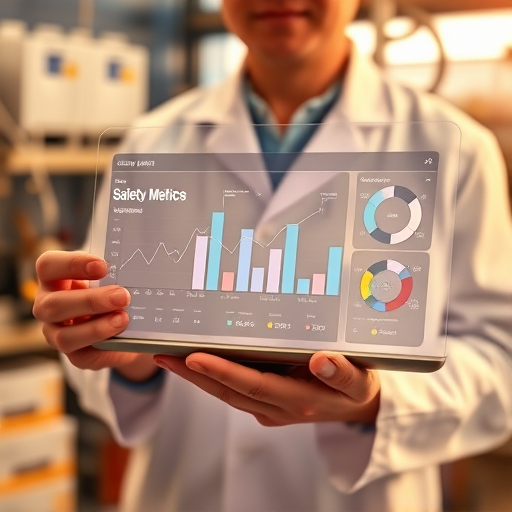
Anthropic isn’t just about bigger models; it’s about making AI safer and more transparent. This requires huge investments in safety research, testing, and interpretability tools.
Think of it like installing high-tech safety features in a racing car—costly but essential for performance and reliability. Developing these safety and interpretability features involves extensive R&D, rigorous testing, and often complex engineering efforts that can significantly increase costs. These investments are crucial for building trust and ensuring AI systems are aligned with human values, which is increasingly important as models grow larger and more capable. The strategic advantage lies in being able to demonstrate safety and transparency at scale, which can open up new markets and regulatory approvals. The tradeoff is that these safety investments divert resources from pure performance improvements, but they are becoming a non-negotiable part of the AI development landscape, especially for companies aiming for broader adoption and responsible deployment.
What This Funding Means for the Future of AI Competition
With this scale of funding, Anthropic is signaling it’s in a different league. The race now revolves around who can secure the most compute, not just who has the smartest algorithms.
This shift signifies a fundamental change in AI strategy — from prioritizing algorithmic breakthroughs to securing massive hardware infrastructure. It means that the battle for AI dominance is increasingly a hardware arms race, with supply chains, chip manufacturing, and energy capacity becoming critical determinants of success. For competitors like OpenAI, Google, and Meta, this signals a need to rethink their priorities: investing heavily in infrastructure, supply chain resilience, and energy efficiency. The winners will be those who can build and maintain vast, reliable compute farms at scale, as the size and speed of hardware become the new competitive front. This evolution could lead to a consolidation of power among a few giants capable of controlling the necessary physical resources, potentially reshaping the landscape of AI innovation and regulation.
Frequently Asked Questions
Why does Anthropic need $65 billion if it’s already making so much money?
That money isn’t for day-to-day operations or profit. It’s a massive investment in expanding compute capacity, which is essential to meet soaring demand for Claude and future models. Think of it like building a bigger engine to go faster.What does ‘compute’ mean, and why is it so expensive?
‘Compute’ refers to GPUs, data centers, and energy needed to train and run large models. It’s expensive because these resources are scarce, costly to build, and require massive ongoing power and cooling—like maintaining a fleet of supercars.Is this funding for training new models or serving existing users?
Mostly, it’s for expanding capacity—training bigger models, serving a growing user base, and improving safety. The focus is on locking in the hardware needed to keep up with demand and push AI forward.How does Anthropic’s valuation compare with OpenAI?
Despite being valued higher, Anthropic trades at a lower multiple of revenue than OpenAI. This suggests investors see more value in capacity and demand—less about current profits, more about future dominance.Will this raise change Claude’s features or pricing?
Likely yes. The focus on expanding compute means more powerful models, faster response times, and possibly new features. But the core driver remains infrastructure—more capacity to serve and innovate.Conclusion
This is no longer just about clever models or fancy features. It’s about who controls the machines that power AI’s future. Anthropic’s massive raise signals that the real frontier isn’t code—it’s capacity.
As the infrastructure battle heats up, expect the next big AI breakthroughs to be driven by hardware, not just algorithms. The winner will be the one with the biggest, fastest, and most reliable compute farms. Are you ready for the new age of AI hardware dominance?