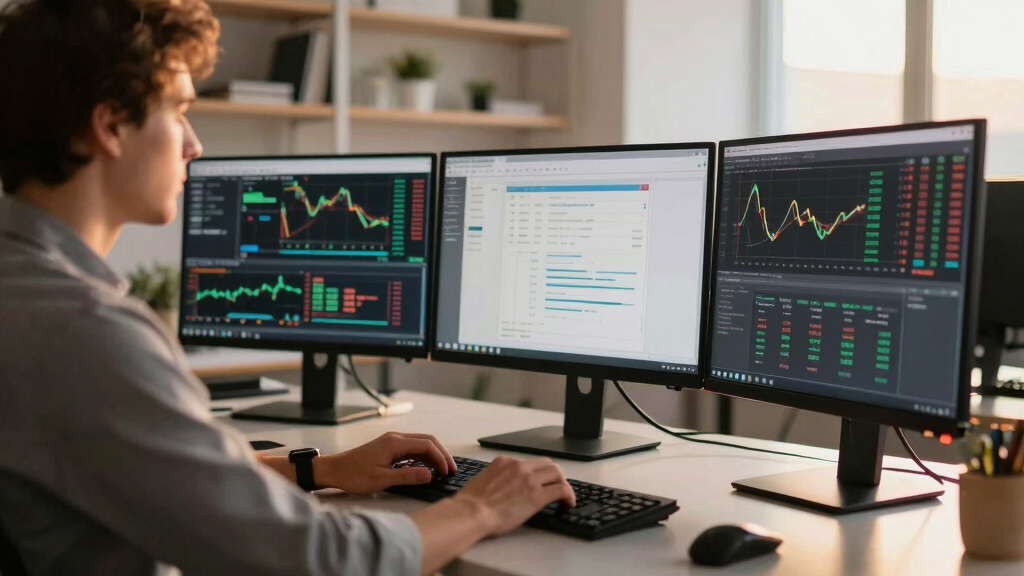

📊 Full opportunity report: Forezai · TradingAgents: A Trading Firm Made of Agents on ThorstenMeyerAI.com — validation score, market gap, and execution plan.

Prime made for students and young adults
- Fast, free delivery for dorm and study essentials
- Prime Video and Amazon Music included
- Member-only deals
TL;DR
Forezai has unveiled TradingAgents, a multi-agent research system developed privately designed to simulate a structured trading firm. It emphasizes organizational debate among AI agents to improve decision quality and accountability, marking a shift from single-model approaches.
Forezai has launched TradingAgents, a framework that organizes AI agents into a simulated trading firm with distinct roles for analysis, debate, trading, and risk management. You can learn more in Introducing Forezai · TradingAgents. This development aims to address the overconfidence and unreliability of single AI models by replicating organizational decision-making structures used in real trading desks.
The TradingAgents system segments AI into specialized analyst agents focusing on fundamentals, news, sentiment, and technical signals. These agents debate to build strong buy or sell cases, which are then proposed by a trader agent. A risk manager reviews the proposed trade, potentially vetoing or adjusting it based on exposure limits. This layered process emphasizes structured disagreement and accountability, recording every decision step for transparency.
Forezai describes TradingAgents as a deliberate architectural approach, not a collection of particularly smart agents, but a system that mimics organizational decision-making to mitigate overconfidence and improve reasoning quality. The framework is designed to be provider-agnostic and local-first, enabling different models to serve distinct roles, and is developed privately and is not publicly available.
TradingAgents — a firm made of agents
A single model is an overconfidence machine. So this isn’t one AI — it’s a whole desk: analysts, a bull and a bear who argue, a trader, and a risk manager who can say no.
Not financial, investment, legal or tax advice; not a recommendation or solicitation to trade, invest or use any software. Forezai · TradingAgents is an experimental research framework, provided “as is” without warranty of accuracy or profitability. Trading and automated trading carry a substantial risk of loss including total loss of capital; past or backtested performance does not indicate future results. Market and trading-software access is regulated or restricted in some jurisdictions — you are solely responsible for compliance with applicable law. Consult a licensed professional before any financial decision. Produced with AI assistance under human editorial oversight; independent commentary, the author’s own views. Product and company names are trademarks of their respective owners; mention does not imply endorsement.
Implications for AI-Driven Financial Decision-Making
This development matters because it shifts the focus from relying on single, overconfident AI models to a structured multi-agent system that emphasizes organizational debate, oversight, and transparency. By mimicking real trading desk roles, TradingAgents aims to produce more robust and accountable trading decisions, potentially reducing risks associated with AI overconfidence and model errors.
It also demonstrates a new approach to AI governance in finance, where layered decision-making and explicit recording could become standard practices for responsible AI deployment in markets. While still experimental, this architecture could influence future AI tools designed for high-stakes decision environments.
As an affiliate, we earn on qualifying purchases.
Evolution of AI in Trading and Organizational Structures
Recent years have seen increasing use of AI in financial markets, often relying on single models for predictions or decision support. However, concerns about overconfidence, lack of transparency, and model errors have prompted exploration of organizational approaches that incorporate multiple perspectives. Forezai’s previous work with Polybot, a single AI forecaster, highlighted the limitations of trusting one model. TradingAgents builds on this by structuring AI roles to emulate a real trading firm’s layered decision process, emphasizing debate, oversight, and accountability.
The approach aligns with broader industry trends toward transparent, explainable AI systems, especially in high-risk domains like finance. It also reflects a move toward modular, multi-model architectures that can be customized and audited.
“TradingAgents is not about creating smarter agents but about structuring their interactions to produce better, more accountable decisions.”
— Thorsten Meyer, Forezai
multi-agent trading simulation tools
As an affiliate, we earn on qualifying purchases.
As an affiliate, we earn on qualifying purchases.
Unclear Aspects of TradingAgents’ Practical Deployment
It remains unclear how TradingAgents performs in live trading environments, including its actual profitability, robustness under market stress, and how it compares to traditional or single-model AI systems. The framework is currently described as an experimental research tool, with no guarantees of accuracy or financial success. The degree to which it can be integrated into real trading operations or scaled beyond testing is still under development.
As an affiliate, we earn on qualifying purchases.
Next Steps for Testing and Adoption
Forezai plans to continue testing TradingAgents in simulated environments and potentially in limited live trading scenarios to evaluate its decision quality and risk control. Future developments may include integrating more diverse models, refining debate protocols, and developing user interfaces for better interpretability. The framework is developed privately and is not publicly available, with broader adoption contingent on demonstrated performance and stability.
automated trading analysis platform
As an affiliate, we earn on qualifying purchases.
As an affiliate, we earn on qualifying purchases.
Key Questions
How does TradingAgents differ from traditional AI trading systems?
Unlike single-model AI systems, TradingAgents employs a layered, debate-driven architecture that mimics organizational decision-making, emphasizing structured disagreement and oversight for more accountable trading decisions.
Is TradingAgents ready for live trading?
No, it is currently an experimental research framework intended for testing and development, not for deployment in live markets. Its effectiveness in real trading remains to be proven.
Can TradingAgents be customized with different AI models?
Yes, the framework is designed to be provider-agnostic and modular, allowing different models to serve as specific roles within the system.
What are the main benefits of this structured approach?
The main benefits include improved decision accountability, reduced overconfidence risk, and enhanced transparency through explicit recording of each decision step.
Will this influence future AI tools in finance?
Potentially, as it exemplifies a move toward organizational, debate-based AI architectures that prioritize transparency and layered oversight, which could become industry standards.
Source: ThorstenMeyerAI.com
Halloween Picks
halloween
As an affiliate, we earn on qualifying purchases.