Software translation looks deceptively simple from a distance. Replace one string with another, repeat across a list of languages, and ship. That model survives only until a translator quietly introduces a legal term that was never present in the source, a hyphen changes how reduplication reads in Malay or Indonesian, or a perfectly accurate sentence no longer fits inside the interface designed to display it.
Wissen & Sprache · Gewerkton field report
Shipping one product in 27 languages
Translation reproduces words. Localisation must preserve intent, evidence and operational clarity across language, interface constraints and regional infrastructure.
Capitalisation, punctuation, word boundaries and line breaking cannot safely receive the same technical treatment in every language.
This is where localisation protects meaning, controls terminology, respects character budgets and reviews language inside the actual interface.
A translator introduced a legal claim that was absent from the source. Natural language passed; traceable meaning failed.
Hyphenation changes how reduplication reads. The words can survive while the language becomes visibly wrong.
A correct string can still wrap, truncate or obscure a control. The available space belongs in the specification.
Bring-your-own keys and selectable provider regions across the EU, US and Asia—including mainland China—make model location part of multilingual product design.
software packages shipped in one night
by a solo founder directing coding agents, with negative controls and mutation tests. Speed gains value through verification.
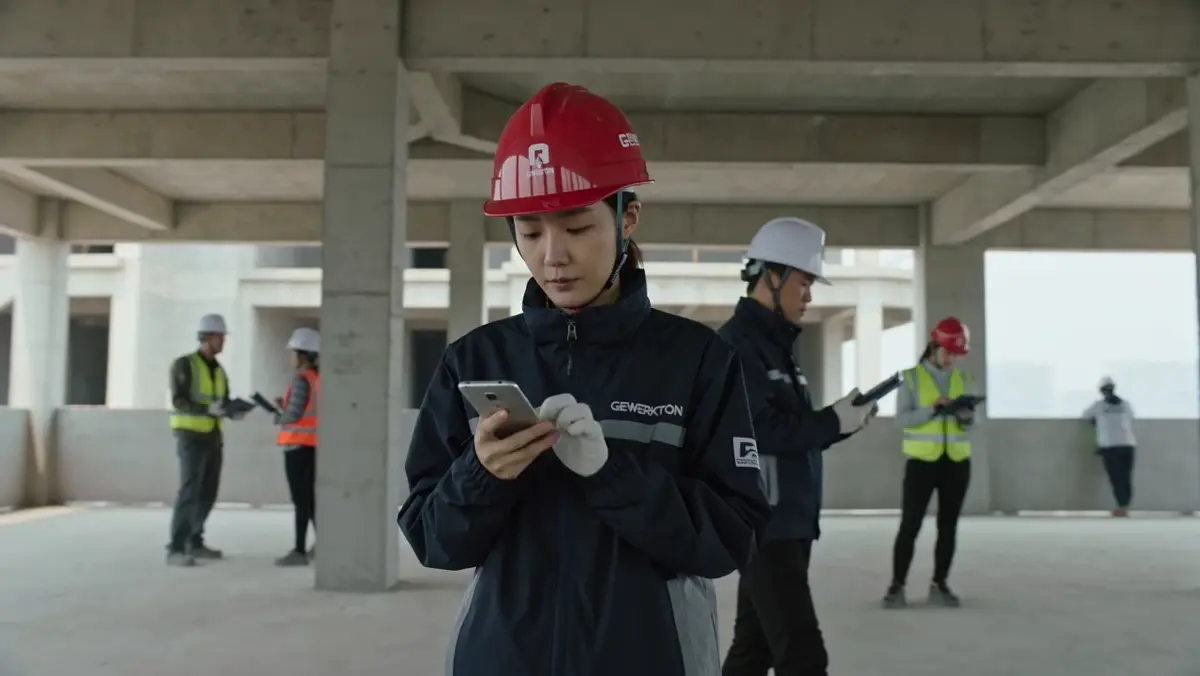
In construction records, translation should aid understanding without becoming the sole source of truth. Each operational component must remain identifiable.
These are not cosmetic problems. They change meaning, usability and, in the worst cases, what a product appears to promise. They also reveal why localisation is not a final editorial pass. It is an engineering discipline concerned with language, interface constraints, regional infrastructure and the structure of the information itself.
Gewerkton offers a useful field report. It is a voice-first construction documentation and defect management platform for global markets, born in the German market and now carrying content in 27 languages. The product is in beta now, with a public beta planned for fall 2026.
The experience behind those 27 languages points towards a larger lesson: translation can reproduce words, but localisation must preserve intent, evidence and operational clarity. When people on the same project work in different languages, the difficult final ten per cent is precisely where that distinction matters most.

DeepL Made Simple: A Practical Guide to Professional AI Translation (Wish I Knew This Sooner)
As an affiliate, we earn on qualifying purchases.
As an affiliate, we earn on qualifying purchases.
The legal term that appeared from nowhere
The KVKK incident is a compact example of why fluent output is not necessarily faithful output. A translator quietly invented legal terminology. The translated language may have looked polished and authoritative, but the authority was artificial: the source did not contain the legal claim that the translation appeared to make.
This is a particularly dangerous class of error because it does not announce itself with broken grammar. An awkward sentence attracts attention. A confident legal phrase may pass unnoticed, especially when reviewers are checking whether the language sounds natural rather than whether every assertion remains traceable to the source.
Localisation therefore needs two different tests. The first asks whether the target text reads naturally. The second asks whether it still says only what the source says. A version can pass the first test while failing the second completely.
The distinction applies beyond formal legal language. Any translated product text can accidentally strengthen a possibility into a guarantee, turn a general description into a regional claim, or replace a deliberately broad term with one carrying a narrower institutional meaning. These shifts may be tiny at sentence level and substantial at product level.
The practical lesson from the KVKK incident is not that specialised terminology should be avoided. It is that terminology must remain controlled. A translator, human or machine, should not be allowed to fill an apparent gap by inventing precision. Where the source is general, the translation must not become more specific merely because specificity sounds convincing.

Detekt® Indoor Air Quality Test Kit – 6 Mold + 6 Bacteria Test – Home/HVAC
- Made in USA: Trusted quality and customer service
- Includes Species Guide: Comprehensive guide and free expert consultation
- Multi-Location Testing: Tests indoor air, surfaces, and HVAC
As an affiliate, we earn on qualifying purchases.
As an affiliate, we earn on qualifying purchases.
Small punctuation, different language systems
Malay and Indonesian reduplication expose another weakness in the idea that localisation is just word replacement. Hyphenation is not a neutral formatting choice when repetition is part of how a language forms meaning. A system that treats punctuation as detachable decoration can produce text that is recognisable yet visibly wrong to the people expected to use it.
The issue is instructive because it sits at the boundary between linguistic knowledge and software behaviour. Translators may understand the construction, while automated processing, style normalisation or interface code may treat the hyphen according to rules inherited from another language. The words survive, but the language does not.
This kind of problem is easy to dismiss as minor if a product is reviewed from a single-language perspective. For a multilingual user, however, punctuation, spacing and repetition are part of the product’s competence. They signal whether the interface was designed to accommodate the language or whether the language was poured into an interface built for something else.
A 27-language system multiplies such boundaries. The challenge is not merely maintaining 27 collections of equivalent sentences. It is recognising that the same technical treatment cannot always be applied safely to all 27. Capitalisation, word boundaries, punctuation and line breaking are not universal behaviours with different dictionaries attached.
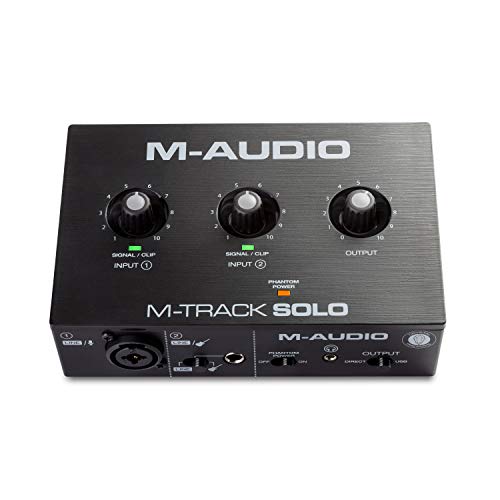
M-AUDIO M-Track Solo USB Audio Interface
- High-Resolution Audio: 48kHz pristine recording quality
- Versatile Input Options: XLR, line, and instrument inputs
- Comprehensive Monitoring: Headphone and RCA outputs with direct monitoring
As an affiliate, we earn on qualifying purchases.
As an affiliate, we earn on qualifying purchases.
Character budgets are product requirements
Even a translation that is accurate, natural and terminologically disciplined can fail when it reaches the screen. Interfaces have physical limits. Buttons, navigation labels, form controls and status messages occupy bounded spaces, while translated text expands or contracts according to the language and the phrase.
A character budget is therefore not an editorial preference imposed at the end. It is part of the specification. If a control can hold only a short label, the localisation process needs to know that before producing a sentence that belongs in a paragraph. If the complete meaning cannot fit, the interface may need to change rather than forcing the language into an unnatural abbreviation.
This is where translation and design become inseparable. A string can be correct in a table and broken in the product. It may wrap over another control, disappear behind truncation or become so compressed that its function is unclear. None of those failures is visible if review stops at the source and target text.
Character budgets also expose a deeper question: which meaning is essential? Shortening a label is not simply deleting words until it fits. The editor must know what the user needs at that precise moment, what context the surrounding interface already supplies and which distinction cannot be lost.
That judgement cannot be delegated entirely to a generic translation process. It requires knowledge of where the text appears and what action follows it. Localisation becomes reliable only when strings are treated as components of an interface rather than isolated lines of prose.
legal translation validation tools
As an affiliate, we earn on qualifying purchases.
As an affiliate, we earn on qualifying purchases.
Why an LLM struggles with the final ten per cent
Large language models can make multilingual work remarkably fast. They can also produce fluent mistakes, overconfident terminology and plausible language that ignores the dimensions of the interface. “Just run it through an LLM” addresses the volume of translation without resolving the final ten per cent of localisation.
That last portion contains the difficult work: protecting meaning, enforcing terminology, respecting character budgets, checking language-specific punctuation and reviewing text in its actual context. It is also where errors are least likely to look like errors. Fluency can conceal divergence.
Gewerkton itself was built by a solo founder directing a fleet of coding agents using Codex and Claude. In one night, that fleet shipped 21 software packages, verified with negative controls and mutation tests. The example shows how much automated agents can accomplish when their output is subjected to deliberate verification. Speed and scrutiny are not opposing ideas; the value of speed depends on the quality of the checks around it.
The same principle applies to language. Generated output is not finished output. It needs controls capable of detecting unsupported additions, inconsistent terminology and formatting behaviour that a model may regard as negligible. A model can propose a translation, but the product still needs a way to determine whether that translation is faithful and usable.
Gewerkton’s bring-your-own-AI approach offers another dimension to the problem. The platform supports 13 AI providers, allows users to bring their own keys and makes the provider region selectable across the EU, US and Asia, including mainland China. The aim is to avoid vendor lock-in. In multilingual software, model selection is not merely a question of abstract language quality; provider region and project requirements can matter too.
Structured evidence travels better than prose
The localisation problem becomes sharper in construction because a site record is not ordinary copy. It may need to preserve what was observed, where it happened, what type of item it is, who needs to act and which evidence belongs with it. A long prose note can contain all of that, yet leave every reader to reconstruct the structure.
Structured evidence beats prose notes because its parts remain identifiable. A photo is still a photo. A deadline is still a deadline. Original audio remains available as original audio. Translation can help each person understand the record without turning the translated paragraph into the sole source of truth.
This is the documentation logic behind Gewerkton’s three product lines. Gewerkton Field is the voice-first construction site app, covering dictation to evidence, defects, daywork reports, takt and portal access. Gewerkton Studio is the browser workspace for plans and models; where no model exists, the site team creates one in the browser. Gewerkton Cloud handles operations and model or data coordination between Field, Studio and third parties.
The language layer matters across all three, but it does not replace the underlying evidence. This is especially important for cross-border teams in the EU, US and APAC working on the same project. Each person can work in their own language while the evidence original remains unambiguous.
That arrangement is more robust than repeatedly rewriting free-form notes for different audiences. Translation aids access; structure preserves identity. The distinction echoes Gewerkton’s marketing line: “On site, what counts is what’s proven.”
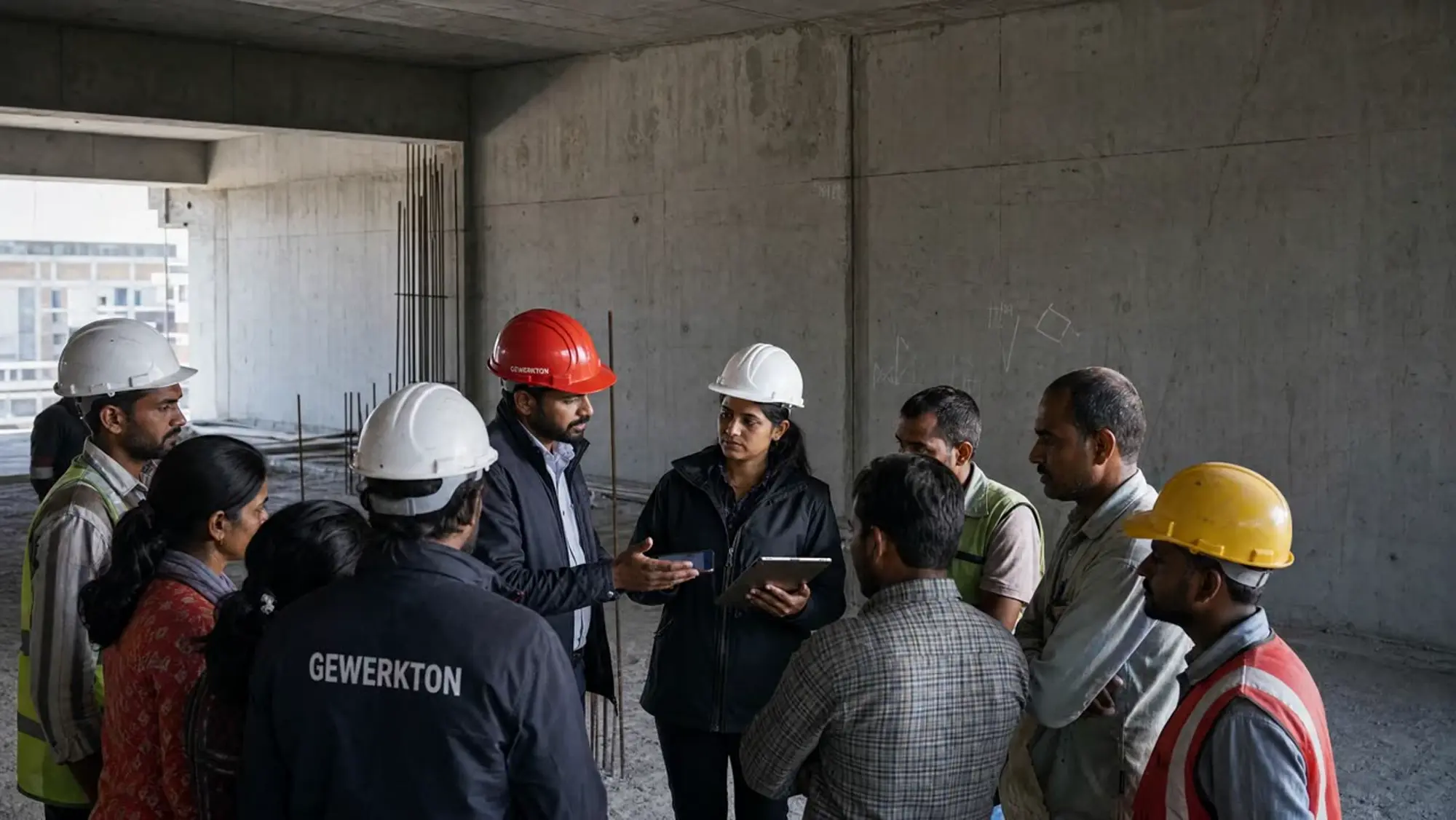
Different sites create different language pressures
Localisation cannot be separated from the environments in which records are created. Construction projects do not present one universal workflow translated into 27 vocabularies. Different deployment fields create different pressures on capture, coordination and evidence.
- Wind farms and renewable-energy projects involve distributed sites, rotating crews, field acceptance and offline capture in dead zones.
- Data centres and industrial plants bring many trades together in parallel under tight deadlines; meeting decisions become trade-sorted task lists.
- Housing and building construction require defects with a photo and deadline, dictated daywork reports and a signature on the device at handover.
- Infrastructure and tunnel projects run for long periods, produce many change orders and need instructions backed by original audio.
- Cross-border teams may span the EU, US and APAC on one project, with each participant working in their own language while the evidence original remains clear.
- Projects in Asia may include Chinese, Korean and Vietnamese crews, requiring multilingual handling from capture to report and a choice over data residency.
These are not merely translation scenarios. They are information-architecture scenarios. A meeting decision that becomes a trade-sorted task list must preserve its assignment logic. A defect needs to remain connected to its photo and deadline. An instruction backed by original audio must not be reduced to an unsupported translated paraphrase.
The less structured the record, the more interpretive work every translation must perform. The more structured the evidence, the easier it becomes to render the relevant information in another language without obscuring what the original record actually contains.
Language choice and infrastructure choice
Global localisation also reaches below the visible interface. Gewerkton offers an EU cloud or deployment on the user’s own infrastructure. Its regional AI-provider choice covers the EU, US and Asia, including mainland China. These choices recognise that a multilingual product may operate across regions whose project requirements are not interchangeable.
The marketing site applies the same restraint in a different form. It serves 27 languages with zero trackers, no cookie banner and a fully egress-free architecture. A media bank contains more than 51 self-produced clips and posters. Together, those elements make localisation broader than translated paragraphs: the surrounding media, delivery architecture and regional choices are part of how information reaches an audience.
Germany remains the product’s deepest commercial integration, with GAEB, REB, XRechnung and DATEV. That starting point matters, but it does not justify treating every other market as a renamed version of the first. Global software must retain what is genuinely specific while resisting the urge to manufacture local authority through invented terminology.
What 27 languages ultimately reveal
Shipping in 27 content languages does not produce a triumphant endpoint at which localisation is “done.” It reveals a continuing set of constraints that monolingual products can ignore: terminology can acquire claims, punctuation can carry grammar, layouts can reject accurate wording and fluent machine output can conceal small but consequential deviations.
The answer is not to reject translation technology. It is to give that technology a narrower and more testable role. Language output should be checked against the source, the interface and the structured record it represents. Where the source contains no legal assertion, none should emerge. Where a language uses a meaningful typographic pattern, processing should preserve it. Where a label has a budget, review must happen inside that budget.
Most importantly, multilingual documentation should not depend on prose alone. Prose is useful for explanation, but a construction record becomes more dependable when its evidence, assignments, deadlines, photos, audio and report elements remain distinct. Translation can then serve understanding without pretending to be the evidence itself.
That may be the clearest lesson from Gewerkton’s beta: localising a product is less about making every screen sound as if it originated everywhere, and more about keeping meaning stable while people, languages, interfaces and infrastructure change around it. The first ninety per cent can look like translation. The final ten per cent is language engineering.