
📊 Full opportunity report: Securing AI Agents On MCP Servers: Best Practices And Layers on IdeaNavigator AI — validation score, market gap, and execution plan.

Prime made for students and young adults
- Fast, free delivery for dorm and study essentials
- Prime Video and Amazon Music included
- Member-only deals
TL;DR
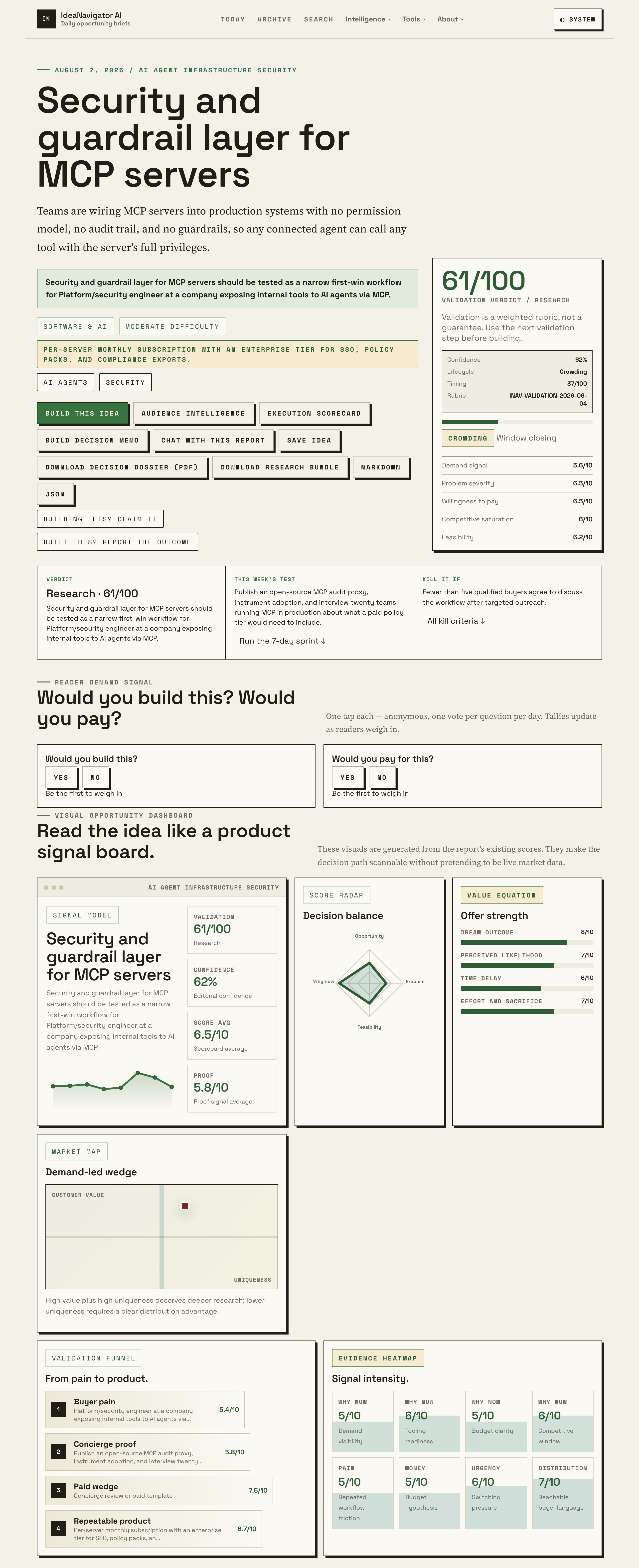
A new approach to securing MCP servers involves deploying a proxy that enforces permission models, audit trails, and human approval, addressing rising security risks. This development is critical as enterprises rapidly adopt MCP for AI agent integration amid increasing attack vectors.
Security teams are now actively testing a proxy-based security layer for MCP servers, aimed at adding permission controls, audit logging, and human approval gates. This development responds to growing security concerns as enterprises accelerate MCP deployment for AI agents without sufficient safeguards, risking tool abuse and security breaches.
Recent security assessments highlight that many organizations wiring MCP servers into production systems lack proper permission models, audit trails, and guardrails. This exposes internal tools to potential misuse by AI agents with full privileges, creating vulnerabilities. The proposed solution involves deploying a proxy that sits in front of existing MCP servers, enforcing per-tool allowlists, per-agent identity verification, human approval for destructive actions, rate limiting, and maintaining a searchable audit log of all tool calls, according to IdeaNavigator AI.
Initial validation involves open-source development of an MCP audit proxy, with plans to instrument adoption across multiple teams. Experts suggest that this layered approach can significantly reduce attack surfaces by preventing prompt-injection-driven tool abuse, a documented attack class that has gained prominence in 2025-2026 as MCP becomes the standard for AI tool integration.
Why Layered Security for MCP Matters Now
This development is crucial because it addresses a rapidly emerging security gap as enterprises deploy MCP servers at scale. Without proper guardrails, AI agents can invoke any internal tool with full privileges, risking data leaks, system compromise, or operational disruptions. Implementing layered protections—such as permission controls, audit logs, and human approvals—can prevent malicious or accidental misuse, safeguarding enterprise assets and maintaining compliance.
As MCP adoption accelerates, security teams face increasing pressure to implement scalable, effective controls. The proxy solution offers a practical, incremental step toward comprehensive security, enabling organizations to monitor and control AI agent activity in real-time while maintaining operational flexibility.
As an affiliate, we earn on qualifying purchases.
Background on MCP Security Challenges
Since its rise to prominence in 2025, MCP has become the de facto standard for integrating AI agents with internal tools. However, security assessments reveal that many organizations have wired MCP servers directly into production without establishing permission models, audit trails, or guardrails. This lack of controls has led to documented cases of prompt-injection attacks and tool abuse, prompting urgent calls for layered security solutions.
In response, security experts have advocated for a proxy-based approach that enforces policies and provides visibility. The concept gained traction as enterprises seek scalable methods to mitigate risks without disrupting existing workflows. Pilot implementations are currently underway, with initial testing focusing on adding allowlists, identity verification, and human approval mechanisms.
“Deploying a proxy that enforces per-tool allowlists and human approval can significantly reduce the attack surface of MCP servers.”
— an anonymous researcher
MCP server permission control tools
As an affiliate, we earn on qualifying purchases.
As an affiliate, we earn on qualifying purchases.
Unresolved Questions About Proxy Effectiveness
It is not yet clear how well the open-source MCP audit proxy will perform in large-scale, real-world deployments. The long-term effectiveness of human approval gates and allowlists in preventing sophisticated attacks remains to be validated through broader adoption and testing.
Additionally, questions remain about the integration complexity, potential performance impacts, and how organizations will balance security with operational flexibility as they implement these layered protections.
As an affiliate, we earn on qualifying purchases.
Next Steps for MCP Security Layer Deployment
Security teams plan to publish the open-source MCP audit proxy within the coming months and gather feedback from early adopters. Further development will focus on refining policy controls, enhancing audit capabilities, and integrating with existing security tools. Broader testing across diverse enterprise environments will inform best practices and potential commercial offerings, including enterprise-tier features like SSO, policy packs, and compliance exports.
As an affiliate, we earn on qualifying purchases.
Key Questions
What is the main purpose of the MCP audit proxy?
The MCP audit proxy is designed to enforce permission controls, provide audit logging, and implement human approval gates to prevent tool abuse and enhance security for MCP servers used in AI agent deployment.
How does this security approach address prompt-injection attacks?
By implementing per-tool allowlists, identity verification, and approval workflows, the proxy limits what actions AI agents can perform, reducing the risk of prompt-injection-driven tool abuse.
When will these security measures be widely available?
Initial testing is underway, with open-source release expected within a few months. Broader enterprise adoption will follow as organizations evaluate and customize the solution.
Will this solution impact system performance?
Performance impacts are still being assessed, but the proxy is designed to operate with minimal latency. Further optimizations are planned as adoption progresses.
Are there commercial options for enhanced security features?
Yes, enterprise tiers are planned to include features like SSO, policy packs, and compliance exports, tailored for organizations with advanced security needs.
Source: IdeaNavigator AI
Fall Picks
fall essentials
As an affiliate, we earn on qualifying purchases.