
🔍 Read the full analysis: How AI Is Reshaping Jobs Across The Economy on ThorstenMeyerAI.com

Prime made for students and young adults
- Fast, free delivery for dorm and study essentials
- Prime Video and Amazon Music included
- Member-only deals
TL;DR
A November 3, 2026, essay uses agriculture’s long shift from labor-intensive work to mechanized production to frame questions about AI and employment. Its historical figures show that farm employment shares fell over generations while food production rose, but the essay’s suggestion that AI could automate up to 90% of a sector is a thesis, not an established forecast.
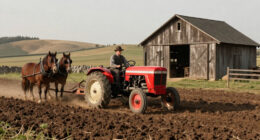
In a November 3 essay, Thorsten Meyer argues that agriculture’s centuries-long shift away from human labor offers a useful historical comparison for considering AI’s possible effects on jobs. The account traces how farming’s share of employment fell as tools, crop breeding and fertilizer increased output, while stressing that this transformation unfolded over generations—not in a single technological leap.
Meyer cites estimates that 73.7% of the U.S. labor force worked in agriculture in 1800, based on economic historian Stanley Lebergott’s series later published by the U.S. Census Bureau. The figure is an estimate, not a census count, and includes enslaved people. The essay says the U.S. farm workforce continued growing until about 1910, reaching 11.8 million, even as agriculture’s share of employment eventually fell.
The account describes several stages of change: John Deere’s steel plough in 1837, later machinery, synthetic ammonia fertilizer and higher-yield crop varieties. It cites Indian official figures showing wheat production rose from 12.3 million tonnes in 1964–65 to 26.4 million tonnes in 1971–72, a period when dwarf wheat varieties were introduced alongside fertilizer and irrigation. Those figures show a production increase; they do not isolate the effect of any one technology.
Meyer also points to the continuing scale of agricultural work. An International Labour Organization estimate cited in the essay puts the number of people working in agriculture worldwide at 928 million in 2025, or about one in four workers. The essay gives sharply different national shares, including about 1.5% in the United States and 43% in India, underscoring that the shift is not complete or uniform.
Agriculture Offers a Long-Run Comparison
The history matters because it complicates claims that automation immediately eliminates a whole category of work. In the account, agricultural employment declined as a share of the workforce over a long period, while the number of American farm workers first continued to rise. Workers’ movement out of farming was therefore not a single event, and the figures do not establish what happened to every person who left the sector.
For readers weighing AI’s labor effects, the comparison highlights two separate questions: how much work technology can perform, and how quickly workers and institutions adapt. Farming’s history shows that higher output can accompany a lower employment share. It does not establish that AI will follow the same path, on the same timetable, or with similar effects on wages and job quality.
Meyer’s estimate that automation could encompass as much as 90% of a sector within a decade or a few decades is presented as his thesis. The essay provides no measured basis or forecasting method for that figure, so it should not be read as a verified prediction about AI or employment.
Popular right now

De'Longhi Dinamica Plus Fully Automatic Espresso Machine

Dyson W1 PencilWash Wet and Dry Cleaner with Dok Cordless Wet Floor Cleaner

Dyson Car+Boat Cordless Handheld Vacuum
As an affiliate, we earn on qualifying purchases.
From Farm Labor to Higher Output
The essay begins with the contrast between early U.S. agriculture and current employment: roughly three in four workers farmed around 1800, compared with fewer than two in 100 today, according to the estimates it cites. Its historical examples also include Japan, China, India and Germany, although the underlying figures come from different periods and sources and are not directly comparable.
Technology’s contribution came in stages. Steel ploughs addressed difficult soil conditions; mechanized equipment later changed planting and harvesting; industrial ammonia provided a source of usable nitrogen; and crop breeding produced short-straw wheat that could support more grain. The account emphasizes that these developments worked alongside other inputs, including irrigation, labor, land and changes in farming practice.
The essay’s food-production comparison is that global cereal harvests grew 4.2-fold from 1961 while the population grew 2.7-fold. It also says U.S. farm output in 2023 was nearly three times its 1948 level with only a small rise in total inputs. These are measures of output and inputs, not direct evidence about the distribution of gains or the causes of each change.
““The share fell long before the headcount.””
— Thorsten Meyer, essay author
AI’s Employment Path Is Unknown
The agricultural record is historical evidence, not a forecast of AI’s effect on current occupations. Meyer’s source material does not provide projections of job losses, new roles, wage changes or adoption rates across industries. It also does not specify how the proposed 90% automation figure is defined—whether it refers to tasks, jobs or a sector’s total work.
The essay’s cross-country figures come from different years and methods, and some early employment totals are explicitly estimates. Its production comparisons show changes over time but do not by themselves determine how much was caused by technology rather than other factors. The future pace of AI adoption and the scale of its labor-market effects remain unclear.
Further Episodes Trace the Shift
Meyer identifies the essay as episode two of a series on how the economy is built. He says the next episode will cover mechanical reapers, threshers and tractors, extending the agricultural timeline before the series turns to other parts of the economy.
For a clearer assessment of AI and work, future reporting would need current, comparable evidence on which tasks are being automated, how employers are changing staffing, and what happens to workers’ earnings and job opportunities. The essay establishes a historical analogy; it does not resolve those present-day questions.
Key Questions
What is the essay’s main point about AI and jobs?
Meyer uses agriculture’s long transition as a comparison for thinking about automation. The history shows that a sector can employ a much smaller share of workers while producing more, but it does not prove AI will have the same effects.
How many people still work in agriculture worldwide?
The essay cites an ILO estimate of 928 million people in 2025, or about one in four workers worldwide. It presents this as a global estimate, not a count specific to one country.
Did agricultural employment fall as soon as new technology appeared?
No. The essay says agriculture’s share of U.S. employment declined over time while the number of farm workers kept rising until about 1910. The two measures—share and headcount—did not peak at the same time.
Does the essay establish that AI will automate 90% of a sector?
No. The figure is Meyer’s stated thesis, not a verified forecast in the supplied material. The essay does not define the measure or provide a method supporting the estimate.
Source: ThorstenMeyerAI.com