🔍 Read the full analysis: The Rise Of Tractors And The Decline Of Working Animals on ThorstenMeyerAI.com

Prime made for students and young adults
- Fast, free delivery for dorm and study essentials
- Prime Video and Amazon Music included
- Member-only deals
TL;DR
U.S. farm horses and mules peaked at 26.7 million in 1918, then declined to 3.1 million by 1960 as tractors and other machinery replaced animal power. Farm employment also fell while the wider labor force grew, but the scale and pattern of that shift do not establish that automation will affect human workers in the same way.
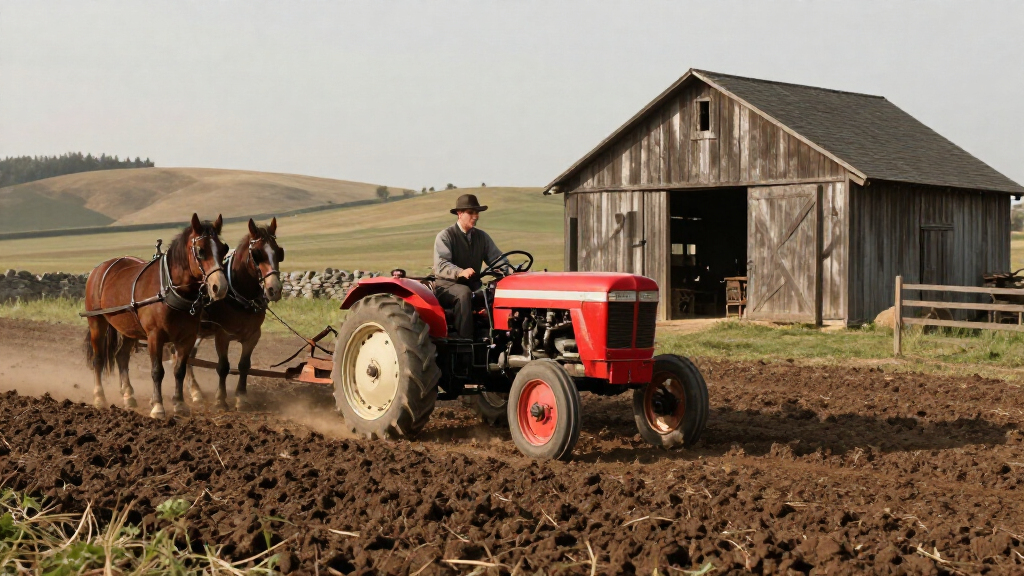
A new historical report traces how tractors and other farm machinery displaced working animals on U.S. farms, with the number of horses and mules falling from a peak of 26.7 million in 1918 to 3.1 million in 1960. The shift reshaped farm work and land use, but the report treats comparisons with automation today as an analogy, not a prediction.
Figures reproduced in the U.S. Census Bureau’s Historical Statistics of the United States, Colonial Times to 1970 show the scale of the change. Horses and mules were estimated on farms each January; horses alone peaked at 21.4 million in 1915, while the combined count reached 26.7 million in 1918. By 1960, the combined total was 3.1 million, a decline of almost 90% from its peak.
The machines spread over the same period. The source puts the U.S. farm tractor count at about 1,000 in 1910, 246,000 in 1920 and 4.69 million in 1960. Around 1955, tractors first exceeded horses and mules in the reported counts. The figures come from census and agriculture series with differing dates and methods, so they are a historical overview rather than perfectly comparable annual measurements.
Animals also required substantial land for feed. In 1915, an estimated 93 million acres of harvested cropland grew feed for horses and mules, out of 340 million acres harvested. The report says that feed acreage had fallen to about five million by 1960. Other machinery contributed to the transformation: combine harvesters rose from about 4,000 in 1920 to more than one million in 1960, alongside corn pickers, balers and milking machines.
Farm Labor After Animal Power
The replacement of working animals was part of a broader rise in farm productivity, not a change limited to the tractor. A U.S. Department of Agriculture series cited in the report estimates that each farm worker supplied 7.1 people in 1910, 10.7 in 1940 and 47.1 in 1970. The 1970 figure includes people abroad supplied through exports.
Farm employment fell from a reported peak of 13.6 million in 1916 to 4.5 million in 1970, while the overall U.S. labor force doubled. The report says new jobs were concentrated in cities and that people had to move to reach them. These figures describe a large economic and social adjustment; they do not, by themselves, establish how much of the change was caused by tractors alone or how workers’ experiences varied.
The history is relevant to current automation debates because it shows that a technology can replace a form of work while changing what land and labor are used for. But horses and mules were not human workers, and the historical comparison cannot establish what will happen to people affected by newer machines.
Popular right now

Dyson Big Ball Multi Floor Canister Vacuum, Yellow

KitchenAid 5.5-Qt Bowl-Lift Stand Mixer, Porcelain White (KSM55SXXX)

TCL 65-Inch T7 Series 4K QLED Smart Google TV, 144Hz (65T7)
As an affiliate, we earn on qualifying purchases.
From Fordson to Farm Machinery
Tractors existed before World War I, but early models were heavy and expensive. The report describes the 1917 Fordson as a turning point in access for smaller farms. The Henry Ford museum calls it “the first mass-produced and inexpensive lightweight tractor” and says it was built to meet small farmers’ needs. On February 21, 1920, the 100,000th Fordson left the assembly line.
The shift was gradual rather than a single event. Tractor numbers rose sharply across the following decades, while farmers stopped breeding replacement work animals. As older animals died, their population declined. The report says there was no mass retraining or single moment when the horse economy ended; the change took place across a generation.
The report also links the history to more recent machinery. It cites a February 2025 John Deere announcement about a 16-camera autonomy kit for tillage on select large tractors. It also reports that China said mechanization covered about 74% of ploughing, sowing and harvesting in 2023. Those figures are tied to specific claims and settings, not proof that all farm work is automated.
Limits of the Horse Comparison
The historical counts document a major decline in farm horses and mules, but the source does not establish a single cause for every change in farm employment. Tractors were one part of a wider set of developments that included combines, other equipment, fertilizer and improved seed. The reported employment totals also do not show which workers found new jobs, how quickly they moved, or what happened to their earnings.
It is also unclear how far the experience of working animals can be used to forecast the effects of automation on people. Leontief’s comparison highlights displacement, but people can organize politically and make choices horses could not. The report offers no definitive forecast for jobs affected by current machinery, and its examples of autonomy and mechanization cover particular technologies, places and tasks.
Tracking Automation on Farms
The next evidence to watch is whether autonomous equipment expands beyond the select large tractors and tillage uses cited in the February 2025 John Deere example, and how widely farmers adopt it. More information would be needed on cost, tasks performed, farm sizes and effects on employment before drawing broad conclusions.
For the historical record, the report notes that the U.S. Department of Agriculture ended its annual horse and mule estimates soon after the count had dropped sharply. Any comparison with current farm technology will depend on clearly dated data that distinguish machinery adoption, labor changes and other factors. No specific future milestone is identified in the source material.
Key Questions
When did tractors outnumber horses and mules on U.S. farms?
The historical series cited in the report places the crossover at around 1955, with 4.35 million tractors and 4.31 million horses and mules. The figures use census counts with differing dates and methods.
How many farm horses and mules were there at the peak?
The combined estimate peaked at 26.7 million on January 1, 1918. Horses alone had reached their reported peak of 21.4 million in 1915.
Why did farmers replace working animals?
The source points to tractors and other machinery, as well as the land required to grow animal feed. It estimates that 93 million acres of harvested cropland grew feed for horses and mules in 1915. The report presents several contributing changes, not a single-cause explanation.
Does the history predict that automation will replace human workers?
No. The report presents the horse comparison as an analogy, not a law or forecast. Historical farm employment fell as productivity rose, but the figures do not establish what will happen to workers affected by present-day automation.
Source: ThorstenMeyerAI.com