For teens who want more than a one-step demonstration, the National Geographic Amazing Chemistry Set is my best overall pick: its 100-plus experiments offer the broadest range of hands-on chemistry in this lineup. The ELEGOO UNO R3 Smart Robot Car Kit is a standout for teens ready to work with coding and robotics, while the National Geographic Circuit Kit suits learners drawn to practical electronics. The main tradeoff is breadth versus depth: large experiment collections offer variety, while focused kits can build a more sustained skill in one area. Age labels also matter less than a teen’s patience, reading confidence, and interest in guided assembly or open-ended projects. Read on for how all 11 options compare and which one fits your teen best.

Prime made for students and young adults
- Fast, free delivery for dorm and study essentials
- Prime Video and Amazon Music included
- Member-only deals
Key Takeaways
- The Amazing Chemistry Set leads on breadth: its 100-plus experiments give curious teens more variety than the 45-experiment chemistry set, though the larger scope may mean more setup and sorting.
- Robot kits split into different skill paths: the ELEGOO car leans into programmable robotics, while the Sillbird solar kit emphasizes mechanical assembly and solar power.
- The circuit kit offers a more direct electronics route: its 120 projects make it a stronger match for teens who want repeated practice with electrical concepts rather than a mix of unrelated science activities.
- Large experiment counts do not guarantee teen-level depth: several kits are labeled for children, so older beginners should check whether instructions and challenges feel engaging rather than just accessible.
- Focused builds can beat broad collections for motivated makers: the Bluetooth speaker and wooden robotic arm center on a finished project, while crystal growing provides a slower, display-worthy result.
| National Geographic Amazing Chemistry Set, 100+ Experiments |  | Best Chemistry Set for Repeat Projects | Brand: Blue Marble | Age range: 8 years and up | Experiments: 100+ total: 15 with included materials and 85 using household items | VIEW LATEST PRICE | See Our Full Breakdown |
| National Geographic Chemistry Set with 45 Experiments for Kids 8-12 |  | Best for Guided Chemistry Activities | Brand: National Geographic | Age range: 8 years and up | Experiments: 45 | VIEW LATEST PRICE | See Our Full Breakdown |
| Sillbird 12-in-1 Solar Robot Building Kit, 190 Pieces |  | Best for Solar Engineering | Brand: Sillbird | Model number: US-SB-SolarRobot | Piece count: 190 | VIEW LATEST PRICE | See Our Full Breakdown |
| Discovery Super Reactions Science Kit, 66 Experiments, Ages 8+ |  | Best for Chemistry Variety | Brand: Discovery | Age range: 8 years and up | Experiments: 66 total: 26 guided and 40 DIY | VIEW LATEST PRICE | See Our Full Breakdown |
| ELEGOO UNO R3 Smart Robot Car Kit V4 with Camera |  | Best for Coding and Robotics | Brand: ELEGOO | Model: US-EL-KIT-012 | Controller: UNO R3 | VIEW LATEST PRICE | See Our Full Breakdown |
| National Geographic Circuit Kit for Kids with 120 Electrical Projects |  | Best for Exploring Circuits | Project count: 120+ | Tools required: None | Instructions: Illustrated instructions and QR-linked videos | VIEW LATEST PRICE | See Our Full Breakdown |
| UNGLINGA 150-Experiment Science Kit for Kids | 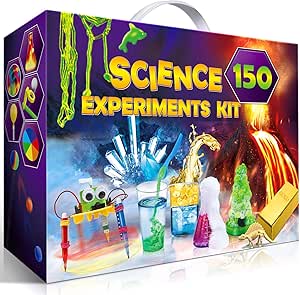 | Best for Broad Topic Coverage | Experiments: 150 | Recommended age: 8 years and up | Topics: Chemistry, physics, earth science, and surface tension | VIEW LATEST PRICE | See Our Full Breakdown |
| 4M Crystal Growing Science Kit with Display Domes |  | Best for Crystal Growing | Experiments: 7 | Recommended age: 10 years and up | Themes: Chemistry and geology | VIEW LATEST PRICE | See Our Full Breakdown |
| DIY Bluetooth Speaker STEM Kit |  | Best for a Useful Electronics Build | Brand: CYOEST | Model: speaker2.0 | Materials: Wood and electronic components | VIEW LATEST PRICE | See Our Full Breakdown |
| DIY Wooden Robotic Arm Kit |  | Best for Mechanical-Electronics Builds | Brand: ANNISOKA | Material: Wood | Recommended age: 8 years and up | VIEW LATEST PRICE | See Our Full Breakdown |
| National Geographic Mega Science Lab with 75 Experiments for Kids |  | Best for Broad Topic Variety | Brand: Blue Marble | Age range: 8 years and up | Experiment count: 75 | VIEW LATEST PRICE | See Our Full Breakdown |
| science kits for teen | Brand | Dimensions |
|---|---|---|
| National Geographic Amazing Ch | Blue Marble | 8.78 x 3.19 x 11.93 inches |
| National Geographic Chemistry | National Geographic | 8.78 x 3.19 x 11.93 inches |
| Sillbird 12-in-1 Solar Robot B | Sillbird | 10.24 x 7.87 x 2.56 inches |
| Discovery Super Reactions Scie | Discovery | — |
| ELEGOO UNO R3 Smart Robot Car | ELEGOO | 8 x 7 x 6 inches |
| National Geographic Circuit Ki | — | — |
| UNGLINGA 150-Experiment Scienc | — | 11.42 x 8.67 x 3.94 inches |
| 4M Crystal Growing Science Kit | — | 8.5 x 9.5 x 3.25 inches |
| DIY Bluetooth Speaker STEM Kit | CYOEST | — |
| DIY Wooden Robotic Arm Kit | ANNISOKA | 6.8 x 4.48 x 4.3 inches |
| National Geographic Mega Scien | Blue Marble | — |
More Details on Our Top Picks
National Geographic Amazing Chemistry Set, 100+ Experiments
The strongest case for this set is its split between ready-to-run experiments and longer-term variety. It includes materials for 15 activities, with tools such as test tubes, beakers, and pipettes; a guide adds 85 more ideas that use household items. That makes it a better fit for teens who want to keep experimenting after the supplied materials are used, rather than a single afternoon of projects. Compared with the National Geographic Chemistry Set with 45 Experiments, this kit puts more of its activity count in the household-materials category, while the other set emphasizes a larger number of guided experiments. The tradeoff is that the advertised 100-plus activities do not all come with ingredients, and its age guidance starts at eight, so older teens seeking advanced chemistry may find the projects introductory.
Pros:- Includes materials for 15 hands-on chemistry experiments.
- Adds 85 activities that can extend use with household items.
- Supplies test tubes, beakers, and pipettes for lab-style activity.
Cons:- Ingredients for the 85 bonus activities are not included.
- The age recommendation of eight and up may signal an introductory level for older teens.
Best for: Teens who want basic chemistry tools and are happy to source common household ingredients for additional projects.
Not ideal for: Teens seeking mostly ready-to-go experiments or advanced chemistry; only 15 experiments include materials, and the stated age range begins at eight.
- Brand:Blue Marble
- Age range:8 years and up
- Experiments:100+ total: 15 with included materials and 85 using household items
- Included tools:Test tubes, beakers, and pipettes
- Dimensions:8.78 x 3.19 x 11.93 inches
- Weight:1.8 pounds
- Model number:NGMEGACHEMAR
- Educational objective:STEM
Our verdict“Choose this set for repeat chemistry activities and basic lab tools if you are willing to provide household supplies for most of its extra experiments.”
National Geographic Chemistry Set with 45 Experiments for Kids 8-12
This set suits teens who prefer a defined sequence of chemistry activities over a kit built around extending projects with household supplies. Its 45 experiments include showier activities such as volcano eruptions, geysers, and rocket launches, while illustrated instructions help make each reaction easier to follow. Compared with the National Geographic Amazing Chemistry Set, this one lists more experiments as part of its core activity offering, while the Amazing set clearly separates 15 supplied-material experiments from 85 household-item ideas. The activities here are aimed at younger learners, though, so teens wanting more open-ended or challenging chemistry may outgrow the approach. Adult supervision is recommended, and messy reactions can add cleanup to the activity. I’d choose it for a teen who values guided demonstrations more than extending a kit with extra household-material projects.
Pros:- Offers 45 hands-on experiments, including volcano, geyser, and rocket activities.
- Illustrated instructions support step-by-step project work.
- Activities introduce chemistry and STEM concepts through reactions.
Cons:- Adult supervision is recommended when working with the chemical materials.
- Some reactions can create cleanup work.
- The stated age range of eight and up may leave older teens wanting more challenging projects.
Best for: Younger teens or adult-and-teen pairs who want illustrated directions and a varied set of guided chemical reactions.
Not ideal for: Older teens looking for advanced or open-ended chemistry, or households seeking low-mess projects that need little supervision.
- Brand:National Geographic
- Age range:8 years and up
- Experiments:45
- Featured activities:Volcano eruptions, geysers, and rocket launches
- Educational objective:STEM
- Model number:NGMEGACHEMX
- Dimensions:8.78 x 3.19 x 11.93 inches
- Weight:2.9 pounds
Our verdict“Pick this for a younger teen who wants guided, dramatic chemistry activities, but choose a more advanced option if independent challenge is the priority.”
Sillbird 12-in-1 Solar Robot Building Kit, 190 Pieces
For a teen more interested in building than mixing reactions, this kit shifts science into mechanical design and solar power. Its 190 pieces form 12 models, including robots and cars, with instructions that move across different difficulty levels. Compared with the ELEGOO UNO R3 Smart Robot Car Kit V4 with Camera, the Sillbird kit offers multiple simpler model builds powered by sunlight or strong artificial light; ELEGOO is the more involved choice for sensors, camera functions, and programming. That makes Sillbird a more approachable way to explore how light can power a mechanism, but it does not offer the same coding depth or electronic features. Its biggest practical limitation is the power source: dim indoor conditions can prevent the models from running. The age recommendation is 10 and up, so younger builders may need help with assembly.
Pros:- Supports 12 different builds from 190 pieces.
- Models introduce solar power and engineering through assembly.
- Step-by-step instructions include varying difficulty levels.
Cons:- Operation depends on sunlight or a strong artificial light source.
- Does not offer the camera, sensors, or programming features found in the ELEGOO robot car kit.
Best for: Teens who enjoy assembling multiple mechanical models and want a hands-on introduction to solar energy without a coding-focused project.
Not ideal for: Teens who want programmable robotics, camera features, or reliable indoor operation without a strong light source.
- Brand:Sillbird
- Model number:US-SB-SolarRobot
- Piece count:190
- Build options:12 models
- Power source:Solar power or strong artificial light
- Material:ABS
- Age recommendation:10 years and up
- Dimensions:10.24 x 7.87 x 2.56 inches
Our verdict“Choose Sillbird for varied solar-powered building projects, and choose ELEGOO instead if your teen wants coding and sensor-based robotics.”
Discovery Super Reactions Science Kit, 66 Experiments, Ages 8+
Discovery’s clearest advantage is the balance between supplied experiments and extra ideas. It includes materials for 26 guided activities, plus 40 more that use household items, with tools and ingredients for projects involving slime, volcanoes, and other reactions. Compared with the National Geographic Amazing Chemistry Set, Discovery includes materials for more guided experiments, while both extend their activity counts with projects that need supplies from home. The included volcano mold, tornado connector, and test tubes also give the kit a broader mix of activity props. That variety comes with a caveat: not every activity is ready to start from the box, and adult supervision is recommended. Like the 45-experiment National Geographic set, its age guidance starts at eight, making this a better match for introductory chemistry than for a teen seeking advanced laboratory work.
Pros:- Includes ingredients for 26 guided experiments.
- Provides 40 additional activity ideas using household items.
- Supplies a volcano mold, tornado connector, test tubes, and other tools.
- Covers several approachable chemistry activities, including slime and reactions.
Cons:- Some of the 40 additional activities require supplies from home.
- Adult supervision is recommended.
- The stated age range begins at eight, so older teens may want more demanding chemistry.
Best for: Teens who want a mix of supplied chemistry activities and household-item experiments, with adult help available.
Not ideal for: Teens seeking advanced chemistry or a kit where every listed activity includes all required materials.
- Brand:Discovery
- Age range:8 years and up
- Experiments:66 total: 26 guided and 40 DIY
- Included components:Volcano mold, tornado connector, slime powder, citric acid, red baking soda, balloons, test tubes, tools, ingredients, and instruction guide
- Model number:1019069
- UPC:840397510511
Our verdict“Choose Discovery for a broad introductory chemistry mix with more supplied guided activities than the Amazing Chemistry Set, provided adult help and household supplies are available.”
ELEGOO UNO R3 Smart Robot Car Kit V4 with Camera
This is the most technically involved pick here, turning science-kit time into assembly, programming, and robot control. Teens build a car around an UNO R3 controller, then explore features such as line tracking, obstacle avoidance, app control, and first-person video. Compared with the Sillbird 12-in-1 Solar Robot Building Kit, ELEGOO focuses on one sensor-rich vehicle rather than a set of 12 model builds; the payoff is a more direct introduction to coding and robotics, while the Sillbird kit offers a simpler solar-energy concept. The illustrated tutorial, keyed connectors, and example programs help structure the build, but they do not remove the need to assemble and program the car. First-time builders may need adult guidance, and teens seeking quick experiments rather than a sustained build should choose a chemistry kit instead.
Pros:- Combines an UNO R3 controller with a camera, sensors, and motors.
- Supports line tracking, obstacle avoidance, auto follow, and FPV video.
- Offers both app and IR remote control.
- Includes an illustrated tutorial, keyed connectors, and example programs.
Cons:- Requires assembly and programming before the robot can be used.
- First-time builders may need adult guidance.
- Its single vehicle build offers less model variety than the 12-build Sillbird kit.
Best for: Teens aged 12 and up who want to assemble and program a robot, experiment with sensors, and use app or remote control.
Not ideal for: Teens seeking ready-to-run experiments or builders unwilling to troubleshoot assembly and programming; beginners may need adult guidance.
- Brand:ELEGOO
- Model:US-EL-KIT-012
- Controller:UNO R3
- Camera and Wi-Fi module:ESP32-WROVER-based
- Features:FPV video, line tracking, obstacle avoidance, auto follow, app and IR control
- Battery:2000 mAh rechargeable lithium-ion
- Recommended age:12 years and up
- Dimensions:8 x 7 x 6 inches
- Weight:1.23 kg
Our verdict“Choose ELEGOO for a teen ready to spend time on coding and sensor-based robotics, not for someone seeking quick, guided chemistry experiments.”
National Geographic Circuit Kit for Kids with 120 Electrical Projects
I’d pick this kit for a teen who wants to explore how circuits behave through repeated, varied builds rather than focus on one finished model. Its 120-plus projects range from a keyboard and light show to a copter and sound amplifier, giving learners several ways to connect electricity to familiar devices. Snap-together components need no tools, while illustrated directions and QR-linked videos offer two ways to follow the steps. Compared with the DIY Bluetooth Speaker STEM Kit, this one provides more experiments and broader circuit practice, but it doesn’t culminate in a single speaker to keep using. The tradeoff is that projects still require connecting components with wires, so teens who want a completely self-guiding build may need help at first. I’d also check that the intended teen is comfortable with a kit marketed to kids.
Pros:- More than 120 projects provide a wide range of circuit activities.
- Snap-together components require no tools.
- Illustrated instructions and QR-linked videos offer different forms of guidance.
- Projects connect circuit concepts to devices such as a keyboard and sound amplifier.
Cons:- Projects require connecting components with the included wires.
- The many-project format does not center on one lasting build like the DIY Bluetooth Speaker STEM Kit.
- Its kids-focused positioning may feel young to some teens.
Best for: Teens who want many guided opportunities to experiment with basic electricity and circuits.
Not ideal for: Teens seeking one polished device to assemble and use afterward, or learners who would rather avoid connecting wires between components.
- Project count:120+
- Tools required:None
- Instructions:Illustrated instructions and QR-linked videos
- Components:Snap-together electrical components and wires
- Example projects:Keyboard, light show, copter, and sound amplifier
- Activity type:Electrical circuit projects
Our verdict“Choose this for a teen who wants a large, guided collection of circuit experiments rather than a single electronics build.”
UNGLINGA 150-Experiment Science Kit for Kids
This is the broadest pick here for a teen who wants to sample several branches of science instead of concentrating on electronics or crystal growth. The 150 experiments cover chemistry, physics, earth science, and surface tension, and the illustrated step-by-step manual gives activities a clear route from setup to result. Compared with the National Geographic Circuit Kit for Kids with 120 Electrical Projects, UNGLINGA ranges across more subjects, while the circuit kit offers more focused practice with electrical connections. That breadth suits curious beginners, but it also means the kit is less specialized for a teen ready to pursue one topic in depth. Some experiments call for household items that aren’t included, so the stated experiment count does not mean every activity can start straight from the box. Its recommended age is eight and up, which may also shape how mature the activities feel to older teens.
Pros:- Offers 150 experiments across chemistry, physics, earth science, and surface tension.
- Illustrated manual provides step-by-step guidance.
- Includes experiment tools and materials.
- Some activities use common household items.
Cons:- Some household materials needed for projects are not included.
- Its broad topic mix offers less focused practice than the National Geographic Circuit Kit.
- The recommended age starts at eight, so some older teens may want more advanced activities.
Best for: Younger teens and science-curious beginners who want guided activities across several subjects and can gather some household supplies.
Not ideal for: Teens seeking advanced, subject-specific work or families who want every experiment’s materials included in the kit.
- Experiments:150
- Recommended age:8 years and up
- Topics:Chemistry, physics, earth science, and surface tension
- Instructions:Illustrated step-by-step manual
- Included components:Science experiment tools and materials
- Material type:Plastic
- Dimensions:11.42 x 8.67 x 3.94 inches
- Set name:150 Experiments
Our verdict“Choose UNGLINGA for a younger teen who values variety across science topics and doesn’t mind collecting a few extra supplies.”
4M Crystal Growing Science Kit with Display Domes
I’d choose this kit for a teen who would rather watch a small number of experiments develop than race through a large activity book. Its seven crystal-growing experiments connect chemistry and geology to visible results, and the seven display domes give the finished crystals a place to go after the activity. That keeps the project feeling more like a collection than the temporary builds in the National Geographic Circuit Kit for Kids with 120 Electrical Projects, though the circuit kit offers far more variety and repeatable experimentation. This focused format is the main tradeoff: it won’t suit a teen seeking a wide survey of science, and growing crystals depends on preparation rather than instant results. The kit requires hot water, and distilled water is recommended, so an adult may need to help with setup and water handling.
Pros:- Seven experiments introduce crystal growth through hands-on activities.
- Covers chemistry and geology in a focused format.
- Seven display domes let users keep and show the crystals.
- Includes crystal compounds, stirring supplies, and instructions.
Cons:- Requires hot water, so setup calls for care and possibly adult help.
- Distilled water is recommended but is not listed among the included components.
- Seven activities offer less variety than the UNGLINGA 150-Experiment Science Kit.
Best for: Teens interested in chemistry or geology who enjoy patient, visually rewarding projects and want to display the results.
Not ideal for: Teens who want many different science topics, quick activities, or a project that needs no hot-water preparation.
- Experiments:7
- Recommended age:10 years and up
- Themes:Chemistry and geology
- Included components:Crystal compounds, seven display domes, stirring supplies, and instructions
- Water requirements:Hot water needed; distilled water recommended
- Dimensions:8.5 x 9.5 x 3.25 inches
- Weight:1.1 pounds
- Warranty:30 days against manufacturer defects
Our verdict“Pick this for a teen who prefers a focused, displayable crystal project over a broad collection of experiments.”
DIY Bluetooth Speaker STEM Kit
For a teen who wants electronics to lead to a device they can use, this speaker kit offers a clearer end goal than the activity-based National Geographic Circuit Kit for Kids with 120 Electrical Projects. Building a wooden Bluetooth speaker introduces circuits, electronics, and audio technology, while no soldering is required. The finished shell is compact, measuring 4.9 × 2.9 × 3.2 inches, and the 3 W-per-channel speaker spec gives the project a concrete audio outcome. The tradeoff is less experimentation: this is one assembly project, not a long sequence of circuit challenges. It also needs four AA batteries, sold separately, so it isn’t ready to build straight from the box. Compared with the wooden robotic arm, the speaker focuses more on audio and circuits than mechanical movement, making it a better fit for teens drawn to sound and electronics.
Pros:- Connects a hands-on build with circuits, electronics, and audio technology.
- No soldering is required.
- Includes assembly instructions.
- Compact wooden speaker design provides a practical end result.
Cons:- Requires four AA batteries that are not included.
- Assembly is required, so it is not a ready-to-use speaker out of the box.
- Offers one main build rather than the repeated projects in the National Geographic Circuit Kit.
Best for: Teens who like music and want to assemble a compact, functional electronics project with guidance from an adult or classmate.
Not ideal for: Teens who want many separate experiments, or buyers who need a complete kit that includes its power source.
- Brand:CYOEST
- Model:speaker2.0
- Materials:Wood and electronic components
- Speaker power:3 W per channel
- Shell size:4.9 × 2.9 × 3.2 inches
- Power source:4 AA batteries, not included
- Assembly:No soldering required
- Recommended age:10 years and up
- Warranty:2-year limited warranty
Our verdict“Choose this for a teen who wants to build and use a small speaker, and is prepared to supply four AA batteries.”
DIY Wooden Robotic Arm Kit
This kit suits a teen who wants to see electronics produce physical movement, not just lights or sound. The wooden robotic arm combines motors, circuit boards, and wires, introducing basic electronics and mechanics through a build that must be assembled and then operated. Compared with the DIY Bluetooth Speaker STEM Kit, the arm puts more emphasis on mechanical movement and problem-solving, while the speaker delivers a more familiar finished device. That makes the arm a more distinctive fit for teens curious about robotics, though neither option offers the repeated experiments found in the UNGLINGA 150-Experiment Science Kit. Assembly relies on an included tutorial, and the project needs six AA batteries that are not included. Those requirements add preparation and build time, so this is a weaker choice for teens who want a quick, ready-to-run activity.
Pros:- Combines a wooden construction project with motors, circuit boards, and wires.
- Introduces basic electronics and mechanical movement.
- No soldering is required.
- Tutorial-supported assembly encourages hands-on problem-solving.
Cons:- Requires six AA batteries that are not included.
- Assembly takes more effort than a ready-to-use activity.
- Focuses on one robotic arm rather than the broad experiments in the UNGLINGA kit.
Best for: Teens interested in beginner robotics who want to assemble a moving mechanism and can follow a tutorial through a multi-part build.
Not ideal for: Teens who prefer a ready-made activity, want a wide range of experiments, or don’t have six AA batteries available.
- Brand:ANNISOKA
- Material:Wood
- Recommended age:8 years and up
- Included components:Robot arm kit
- Assembly:No soldering required; tutorial-guided assembly
- Batteries:6 AA batteries required, not included
- Dimensions:6.8 x 4.48 x 4.3 inches
- Manufacturer part number:A-48
Our verdict“Choose this for a teen who wants a guided, hands-on introduction to moving mechanisms and is ready for assembly.”
National Geographic Mega Science Lab with 75 Experiments for Kids
I’d choose this kit for a teen who wants to sample several kinds of science rather than focus on one subject. Its mix of Earth science, chemistry, and science magic ranges from volcano and bubbling-reaction activities to rock, mineral, crystal, and fossil specimens. That variety gives it a wider scope than the National Geographic Amazing Chemistry Set, 100+ Experiments, which centers on chemistry, though the Mega Science Lab has fewer listed experiments and less depth in any single topic.
The package includes 45 hands-on experiments and a guide to 30 more activities using common household items, so the full count doesn’t mean every activity is ready to start straight from the box. Its age guidance starts at 8, which may make some activities feel young to older teens. I’d pick it for variety and guided exploration, not advanced or sustained study of one branch of science.
Pros:- Covers Earth science, chemistry, and science magic in one kit
- Includes 45 hands-on experiments plus 30 suggested activities using household items
- Rock, mineral, crystal, and fossil specimens add tangible material to explore
- Combines experiments with activities that encourage observation and critical thinking
Cons:- The listed age range of 8 and up may feel young to older teens
- The 30 additional activities require common household items
- Its broad subject mix offers less focused chemistry practice than a dedicated chemistry set
Best for: Families seeking a varied introduction to Earth science and chemistry for a teen who enjoys short hands-on activities and science demonstrations.
Not ideal for: Teens looking for advanced experiments, a focused chemistry curriculum, or activities that rely only on materials included in the box.
- Brand:Blue Marble
- Age range:8 years and up
- Experiment count:75
- Subjects:Earth science, chemistry, science magic
- Educational objectives:Critical thinking, observation skills, STEM
- Included components:Earth science kit, chemistry kit, science magic kit, experiment guide
- Hands-on experiments:45
- Additional household-item activities:30
- Model number:NGMEGASCIKIT
Our verdict“Choose this for a teen who values variety across science topics; pick a dedicated chemistry set instead for deeper practice in one subject.”
How We Picked
I compared these kits by the kind of learning they support, how much meaningful activity they offer, and how well their format fits a teen rather than a younger child. I looked at project variety, the balance between instructions and independent problem-solving, the skills practiced, and whether the kit leads to repeatable experiments or a single build. I also weighed practical fit: assembly demands, likely adult help, space, and whether a project produces something a teen may want to keep using or display.
The ranking favors kits with a strong match between teen interests and sustained hands-on learning, not simply the highest activity count. That puts the broad chemistry set first for its range, while specialized options rank well for clear interests such as robotics, circuits, or making a speaker. Kits with child-focused age labels can still suit younger teens or beginners, but they rank lower for teens seeking greater challenge or more independent work. Since individual experience depends on age, skill, and available support, buyers should check the project instructions and materials before choosing.
Factors to Consider When Choosing Science Kits For Teens
Before choosing from these science kits for teens, start with the kind of activity your teen will actually return to. A high experiment count can be appealing, but the right fit may be a focused build, a coding challenge, or a slower project that develops over several days. These broader checks can help you avoid buying a kit that looks impressive on the box but does not match the learner.
Match the challenge to the teen, not just the age label
Age ranges are a rough guide, not a reliable measure of difficulty for every teen. A younger teen with experience building models may enjoy a more demanding robotics kit, while an older beginner may prefer clear, guided experiments. Check whether instructions explain why each step works or simply tell the user what to do. Too much scaffolding can feel juvenile to an experienced learner; too little can turn a first project into a stalled one. If possible, look for sample instructions or a project list before buying. Choose a kit that leaves room for the teen to predict, modify, or troubleshoot something on their own.
Decide between variety and a skill-building sequence
Large collections can keep a curious teen sampling different topics, but individual activities may not build on one another. A focused electronics or robotics kit may offer fewer project types while developing a more coherent set of skills. Think about whether your teen likes switching tasks or prefers to master one system over time. A common mistake is treating a high activity count as proof of depth; some experiments are brief demonstrations rather than substantial investigations. For a teen who likes independent follow-up, favor projects that invite changes to a design or repeat trials with different results. For a sampler, breadth may be the better fit.
Check what the kit requires beyond the box
Some projects need household supplies, batteries, a computer, or a clear work surface, and those requirements can change how often a kit gets used. Before buying, inspect the materials list and note anything that must be supplied separately. A project that depends on a computer or coding setup may be a poor match if the teen cannot access one when needed. Chemistry activities can also call for careful cleanup and adult oversight, even when the experiments are designed for children. Make room for storage, too: small parts are easy to lose between sessions. A little preparation can prevent a promising kit from sitting unused after the first activity.
Choose a project format that fits the household
Experiment kits tend to create repeated short sessions, while build kits may require longer stretches of focused assembly. Crystal growing can involve waiting between steps, which suits a patient teen but not someone seeking an immediate result. A robotic arm or speaker build may offer a satisfying finished object, yet a difficult assembly stage can require adult help. Consider when and where the teen will work, especially if projects involve liquids, small components, or tools. If the kit is a gift, ask whether the recipient enjoys tinkering, following recipes, or displaying finished work. The format often predicts enjoyment better than the subject label alone.
Treat safety, supervision, and repeat use as part of value
Value depends on how safely and often a kit can be used, not only on the number of listed projects. Read safety guidance and age recommendations, then match them to the teen’s habits and the level of adult availability. Chemistry activities may call for closer supervision and a dedicated cleanup routine, while electronic builds bring their own small-part and tool considerations. Check whether consumable materials are likely to run out or whether the main components can support more than one session. A kit with fewer but repeatable projects can provide more lasting engagement than a larger set of one-time activities. Set expectations with the teen about putting parts away and following the instructions.
Frequently Asked Questions
Which type of science kit is a better first choice for a teen: chemistry or robotics?
Choose chemistry if the teen enjoys guided experiments, visible reactions, and trying several activities without assembling a complex device. Robotics is a better fit for someone who likes building, debugging, and seeing how parts work together. The ELEGOO kit adds a coding dimension, so it may suit a teen with access to a compatible computer and patience for setup. A solar robot kit offers a more mechanical route, though it is still a build rather than a quick experiment. If the teen has not expressed a clear preference, ask whether they would rather investigate materials or make a machine move.
Are kits labeled for ages 8–12 too simple for a teenager?
Not always, but the age label is a useful prompt to inspect the actual activities. A teen new to a subject may appreciate guided instructions, especially when learning circuits or basic chemistry. A teen who already has experience may find a child-focused kit repetitive unless it allows experimentation beyond the listed steps. Look for project complexity, explanations, and opportunities to change variables rather than relying on the box’s age range alone. For a gift, matching the teen’s experience and interests is usually more useful than choosing by age in isolation.
Should I choose a kit with many experiments or one focused build?
A broad experiment set is a good match for a teen who likes sampling topics or may not yet know which area interests them most. A focused build can be more satisfying for someone who wants to finish a device, develop a specific skill, or keep working through a challenge. Experiment counts can include activities that are brief or similar, so check the project list rather than judging by the number alone. A build may involve more setup and troubleshooting but can produce a tangible result. Think about whether the teen is more motivated by variety or by completing and improving one project.
Which kits are most likely to need adult help or extra equipment?
Robotics and electronics projects may call for help with assembly, troubleshooting, or access to a computer, depending on the teen’s experience and the kit’s requirements. Chemistry experiments can need an adult nearby for safety, workspace setup, and cleanup. Before purchase, review the materials list and instructions for batteries, tools, household supplies, or software requirements. A teen who wants to work independently may do better with a kit whose steps and supplies are clearly specified. If adult support is limited, avoid assuming that a kit is self-guided just because it is marketed to children.
What makes a science kit a good gift when I do not know the teen’s STEM interests?
Look for a format that matches what you already know about how the teen likes to spend time. Someone who enjoys puzzles and building may appreciate a robot or mechanical project, while a curious sampler may prefer a broad chemistry or experiment set. The National Geographic Mega Science Lab and UNGLINGA kit cover varied activities, but breadth does not guarantee that every topic will appeal. If the teen likes making things they can keep, a speaker or robotic arm offers a clearer end result. When preferences are uncertain, a kit with several distinct project styles reduces the chance of choosing a subject they already know they dislike.
Conclusion
My best overall choice is the National Geographic Amazing Chemistry Set for teens who want a wide range of hands-on activities. For best value in project variety, I would compare the UNGLINGA 150-Experiment Science Kit with the Discovery Super Reactions kit by checking which activities better match the teen’s interests and comfort with guided experiments. The ELEGOO UNO R3 Smart Robot Car Kit is my pick for a more advanced, coding-oriented project, while the National Geographic Chemistry Set with 45 Experiments is a more approachable starting point for a beginner who wants structured activities. For specific interests, choose the National Geographic Circuit Kit for electronics, the Sillbird solar robot for solar-powered assembly, the 4M Crystal Growing Kit for a patient display project, or the DIY Bluetooth Speaker and Wooden Robotic Arm for focused builds. Match the kit to the teen’s preferred way to learn, then check its materials, supervision needs, and project difficulty before deciding.