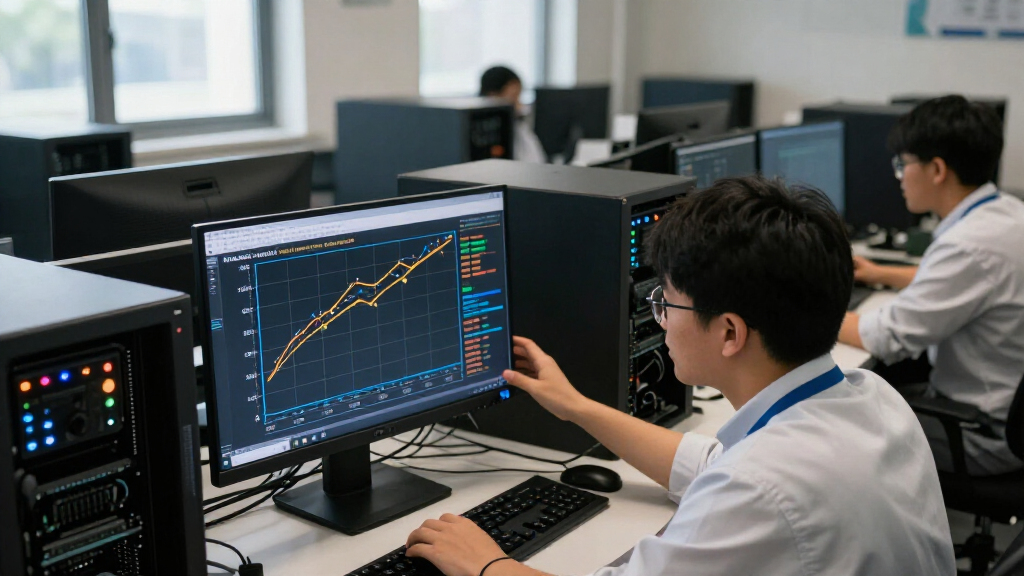

🔍 Read the full analysis: AI’s 2027 Breakneck Progress: Two Months Of Change, Then A Compute Crunch? on ThorstenMeyerAI.com

Prime made for students and young adults
- Fast, free delivery for dorm and study essentials
- Prime Video and Amazon Music included
- Member-only deals
TL;DR
A November 18, 2026 scenario from ThorstenMeyerAI.com argues that AI could help build better AI quickly enough to compress a year of progress into two months in 2027, then run into limits on chips, facilities and power. Public evidence supports faster performance on some software tasks, but does not establish that pace, a 2027 timeline or broad economic effects; the article itself presents the idea as a scenario, not a forecast.
Thorsten Meyer published a scenario on November 18 arguing that AI progress could speed up sharply in 2027 as AI systems take on more of the work involved in developing future systems, then slow when computing capacity runs into physical limits. The article labels this a possible scenario, not a forecast established by current evidence; the public measurements it reviews do not show that a year of progress will arrive in two months.
The scenario rests on a feedback loop: AI systems help with coding, experiments and other work used to develop later systems, which could in turn help improve the next generation. Meyer argues that if this loop tightens, progress could arrive in weeks rather than at its previous pace. He describes a later, physical phase in which automated laboratories, factories and robots contribute to further development, calling it embodied self-improvement. These are proposed mechanisms, not confirmed outcomes.
One public measure cited is the 80% time horizon tracked by the nonprofit METR. It estimates the length of software tasks an AI agent can complete successfully four times out of five. In the data summarized by Meyer, the measure rose from 0.89 minutes for GPT-4 in March 2023 to 185.9 minutes for an early Claude Mythos Preview in April 2026. METR’s public page was marked no longer actively updated on September 8, 2026, according to the source article.
The pace implied by a 2027 acceleration is not settled by that series. Meyer says his fit to METR measurements since 2024 implies a doubling about every 3.4 months, while a fit starting in 2019 implies a doubling about every 6.4 months. Those are different extrapolations of past measurements, not observations of future performance. The article also reports that its hyperbolic fit performed worst in its backtests, cautioning against treating the most dramatic curve as the likeliest one.
The Gap Between Capability and Deployment
The scenario matters because it links AI research speed to constraints that are expensive and slow to change. If software progress accelerates but data centres lack enough chips, buildings or electricity, the benefits may not translate into more usable computing capacity at the same pace. The source cites US data-centre construction running at an annual rate of $96.5 billion in September 2026, compared with $50.7 billion a year earlier. That is construction spending, not a direct measure of available compute or proof of an impending shortage.
Even substantial gains in model capability would not automatically mean rapid adoption across the economy. The article cites estimates that 18% of US firms used AI in a business function in late 2025 and early 2026, while 2% reported AI-related job cuts. These figures describe different aspects of adoption and employment; they do not establish what AI will do to jobs in 2027. The distinction is relevant for readers weighing predictions of rapid technical change against the slower process of deploying systems at work.
The forecast also depends on whether gains in software tasks carry over to useful work outside the benchmark. METR says its tasks are mainly in software engineering, machine learning and cybersecurity, and are cleaner than economically valuable work in real settings. A rising task horizon can indicate progress on that evaluation, but it does not directly measure productivity across the economy.
Popular right now

DREAME D20 Air Plus Robot Vacuum and Mop with 20,000 Pa Suction
Philips 5500 Series Fully Automatic Espresso Machine with LatteGo Milk System

De'Longhi Magnifica Start Automatic Espresso Machine with Milk Frother, Silver
As an affiliate, we earn on qualifying purchases.
What the Metrics Can Measure
METR defines its time horizon as the task duration, measured by estimated human completion time, at which an agent is predicted to succeed at a specified reliability. The 80% measure is the task length completed four times out of five; it is not a general rating of intelligence or a measure of all work a model can perform. The models and dates in Meyer’s comparison are historical measured results, while the proposed dates for passing longer tasks come from curve fits.
The evaluation has limits. METR says tasks are predominantly software-related and lower-context than many real jobs: a two-hour task is closer to work a new hire or freelance contractor might do than to an experienced colleague’s work. The source also notes that METR considers measurements above 16 hours unreliable with its current task suite. For tasks estimated to take humans at least eight hours, it measured human completion times for only five of 31 tasks. Those caveats make long-range projections from the metric especially uncertain.
Meyer also cites a METR estimate that Anthropic’s rate of improvement on well-specified tasks is about twice an earlier rate, while METR said it would not be surprised by a rate between 1.3 and 3 times as high. That estimate is not the same as the scenario’s proposed sixfold acceleration, which would be needed to fit a year of progress into two months. The source says OpenAI’s GPT-6.2 Astra is its first externally released model to meet the company’s “High” threshold for AI self-improvement; this is an attributed company classification, not independent confirmation that recursive improvement is already driving a rapid cycle.
“an automated flywheel pushes forward. As long as the compute limits are then removed, this becomes a big rollout of AI that affects far more labour and business.”
— Thorsten Meyer, describing embodied self-improvement
The Forecast’s Unproven Links
No public evidence cited establishes that 2027 will bring a sixfold acceleration, that AI systems will soon make the full development cycle self-reinforcing, or that an identifiable compute ceiling will halt progress at a particular point. The METR series ends with measurements summarized through April 2026, and its public page was no longer actively updated as of September 8, according to Meyer. The source does not provide a newer independent series that resolves the projection.
Several links in the proposed chain could fail separately. Task performance may not transfer to broader research or business work; faster software development may not produce proportionate gains in models; and new infrastructure, efficiency improvements or demand changes could alter when power and compute become limiting. The article cites Epoch AI’s expectation that power may be the first scaling constraint and says new power supply can take three to five years from a decision, but neither point establishes exactly when a shortage will constrain AI development.
The source is explicitly an opinion scenario and discloses that it was researched and drafted with AI assistance, including Anthropic’s Claude. It says Anthropic, OpenAI and METR did not review or sponsor the article. The timeline, the meaning of “ASI” and the scale of future economic effects remain uncertain; the source notes that there is no agreed definition of artificial superintelligence.
Signals to Watch Through 2027
The article says its scenario should be judged against future evidence, not assumed from a curve. Useful signals would include continued, independently documented gains on agent task evaluations; clearer evidence that AI systems are materially contributing to the development of subsequent systems; and evaluations showing that improvements extend beyond low-context software tasks. Updated benchmark measurements would help test whether recent trends continue, though any one metric would remain incomplete.
On the physical side, readers can watch for changes in data-centre construction, chip availability and power supply, while distinguishing announced projects from operational capacity. Evidence of AI use in firms and changes in employment would help assess whether technical capability is translating into deployment. Until those signals are clearer, the 2027 claim remains a testable scenario, with no confirmed date for an acceleration or a compute bottleneck.
Key Questions
Is AI progress confirmed to accelerate sixfold in 2027?
No. The sixfold pace is part of Meyer’s scenario, not a result demonstrated by the measurements cited in the article. Past performance trends vary depending on which years are included.
What does METR’s 80% time horizon measure?
It estimates the length of tasks, based on human completion-time estimates, that an AI agent can complete with an 80% success rate. The tasks are mainly software-related, so the measure does not represent general workplace productivity.
Why might computing capacity limit AI progress?
Advanced systems depend on chips running in data centres with buildings and sufficient electricity. The source argues that new facilities and power supply take time to build, but does not establish when those constraints will bind.
Does faster AI capability mean companies will quickly replace workers?
Not necessarily. The source cites estimates of AI use by 18% of US firms in a business function in late 2025 and early 2026, and AI-related job cuts reported by 2%. Those figures do not prove what future employment effects will be, and technical capability and adoption are different measures.
Source: ThorstenMeyerAI.com