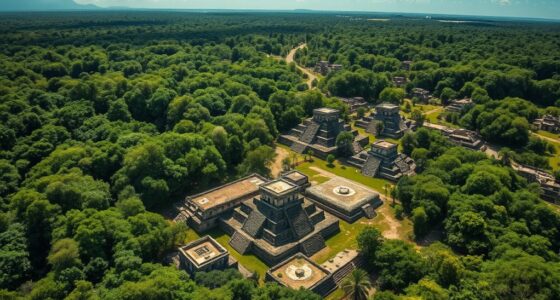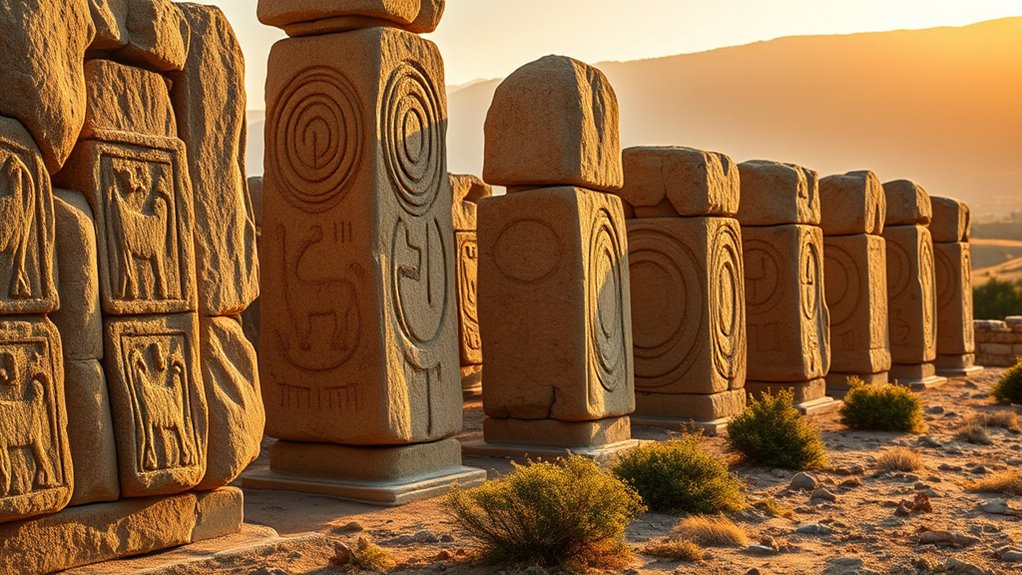

Recent discoveries at Göbekli Tepe challenge everything you thought about human origins. You’ll see massive stone pillars arranged in circles, with intricate carvings that reveal complex rituals predating farming and settled life. These structures show that early hunter-gatherers organized socially, worked together, and expressed spiritual beliefs through monumental architecture. Such findings suggest religion and social bonds started long before agriculture. If you keep exploring, you’ll uncover even more surprising insights about our earliest ancestors and their culture.
Key Takeaways
- Recent excavations at Göbekli Tepe reveal complex ritual structures predating agriculture, reshaping understanding of early civilization origins.
- Enormous stone pillars with intricate carvings suggest sophisticated symbolic and religious practices among hunter-gatherer societies.
- The monumental architecture indicates early social cooperation and planning, challenging the idea that complex societies only emerged with farming.
- Findings imply spiritual rituals played a central role before settled life, influencing social cohesion and community development.
- Göbekli Tepe’s discoveries suggest the roots of organized religion and social frameworks extend deep into pre-agricultural human history.
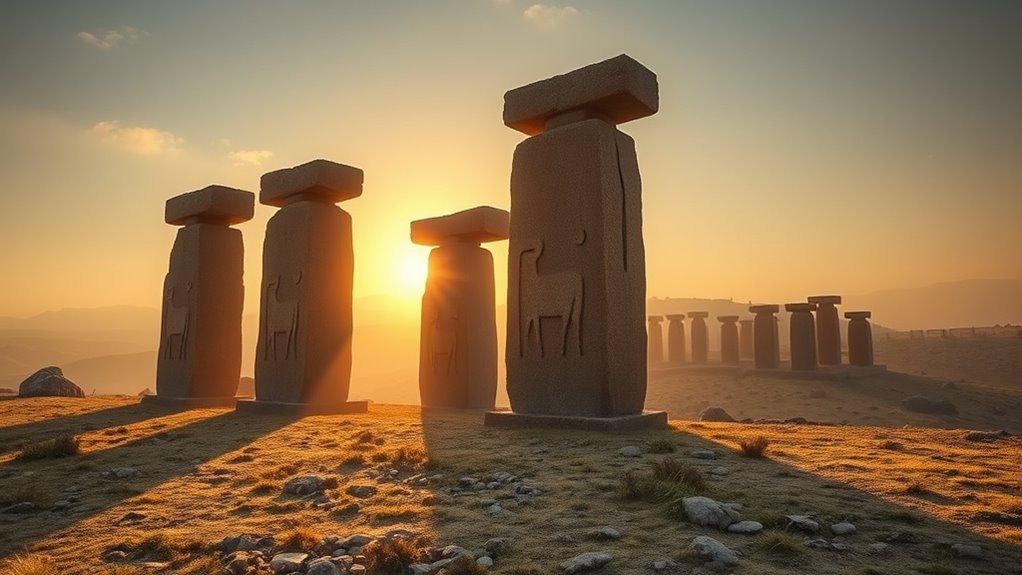
Recent excavations at Göbekli Tepe are revealing groundbreaking insights into the origins of human civilization. As you explore these ancient ruins, you begin to understand how early societies might have organized their spiritual and social lives around complex rituals. These discoveries challenge long-held beliefs about the *shift* from hunter-gatherer societies to settled communities, suggesting that spiritual or ritualistic practices could have played a central role even before the advent of agriculture.
Recent excavations suggest complex rituals predated farming, shaping social and spiritual life in early human societies.
You see enormous stone pillars arranged in circular formations, many carved with intricate symbols and animal motifs. These carvings and structures hint at ancient rituals performed by early humans, possibly to invoke divine forces or *guarantee* survival through communal ceremonies. What’s remarkable is that Göbekli Tepe predates the rise of farming, indicating that hunter-gatherer societies might have developed sophisticated religious practices long before they settled into more sedentary lifestyles.
You realize that these rituals likely served as a unifying force among early groups, fostering social cohesion and shared beliefs. Unlike later civilizations that built temples for worship, these societies created monumental structures in open landscapes. This suggests their spiritual life was deeply embedded in their daily existence, possibly to mark seasonal changes, hunt cycles, or other *vital* aspects of survival. The fact that these structures were built by hunter-gatherers challenges the idea that complex religious practices only emerged with settled, farming communities.
As you walk through the site, you recognize that the design and scale of Göbekli Tepe imply a significant communal effort, involving multiple groups working together. This points to a level of social organization and cooperation that you might not expect from societies often considered simply nomadic or primitive. Instead, it highlights their capacity for planning, shared purpose, and symbolic thinking, which are fundamental aspects of what we now call civilization.
The discovery of these ancient rituals at Göbekli Tepe forces you to rethink how humans first began to build social and spiritual frameworks. It shows that the roots of organized religion and community bonding extend far back into pre-agricultural times. You see that early hunter-gatherer societies might have laid the foundation for complex social structures, driven by shared beliefs and rituals rather than just subsistence. These insights turn previous theories on their head, emphasizing that the dawn of civilization wasn’t just about farming and settlement, but also about the deep, ritualistic practices that helped forge human identity and cooperation from the very start.

Sky-Watcher AZ5 Telescope Mount - Beginner Mount with Slow Motion Control (S20110)
15-pound payload capacity
As an affiliate, we earn on qualifying purchases.
Frequently Asked Questions
How Was Göbekli Tepe Constructed Without Metal Tools?
You might wonder how Göbekli Tepe was built without metal tools. The builders used stone carving techniques and wooden tools to shape and carve the massive pillars. They carefully chipped away at the limestone with harder stones, creating detailed carvings and precise shapes. This craftsmanship shows their impressive skill and patience, proving that even without metal, early humans could construct complex and monumental structures through ingenuity and manual labor.
What Animal Symbols Are Most Common at Göbekli Tepe?
You’ll notice that animal symbolism at Göbekli Tepe frequently features vultures, snakes, boars, and lions, reflecting prehistoric fauna. These images likely held spiritual or ritual significance for its creators. The carvings and reliefs serve as a window into their beliefs and environment, showing how animals played an essential role in their worldview. Recognizing these symbols helps you understand early human connections to nature and the importance of animals in their culture.
How Does Göbekli Tepe Compare to Other Ancient Sites?
Imagine walking through Göbekli Tepe, where ancient architecture reveals advanced craftsmanship. Compared to sites like Stonehenge, Göbekli Tepe’s archaeological significance stands out because it predates most known megalithic structures. Its intricately carved pillars and symbolic carvings demonstrate a complex spiritual society. Unlike other ancient sites, it emphasizes ritualistic purposes over tombs, offering unique insights into early human social and religious evolution.
Could Göbekli Tepe Have Been a Religious Center?
Yes, Göbekli Tepe could have been a religious center. You can see evidence of ancient rituals and the site’s spiritual significance in the elaborate carvings and shaped stone pillars. These features suggest it was a place where early people gathered for spiritual ceremonies, likely to honor deities or perform rituals. Its purpose may have been to unite communities through shared beliefs, making it a essential early religious site.
What Do Recent Discoveries Suggest About Prehistoric Social Structures?
Imagine you’re stepping into a bustling prehistoric gathering, where recent discoveries suggest social hierarchy shapes the scene. You see evidence that, despite the chaos, communal cooperation was essential, with some individuals likely holding leadership roles. These findings indicate that early societies organized themselves beyond mere survival, developing complex social structures. Your role in these communities probably involved cooperation and shared rituals, hinting at the roots of more advanced civilizations emerging from simple groups.

Tydeux Right Angle Viewfinder Metal Adapter for Polar Scope - Works Extremely Well with Viewfinder which Make Polar Alignment of Equatorial Mount Easy and Comfortable
Premium Material: All-metal construction and precise craftsmanship ensure sturdiness; which can be sturdy for ensuring long lasting use
As an affiliate, we earn on qualifying purchases.
Conclusion
Just like peeling back layers of an ancient onion, each discovery at Göbekli Tepe reveals a deeper understanding of humanity’s origins. Imagine standing there, imagining the first builders shaping massive stones with hope and purpose, centuries ago. With every new find, you realize you’re peering into the dawn of civilization itself—an unfolding story written in stone, waiting for you to uncover its secrets. The past is alive, whispering its timeless tale right beneath your feet.
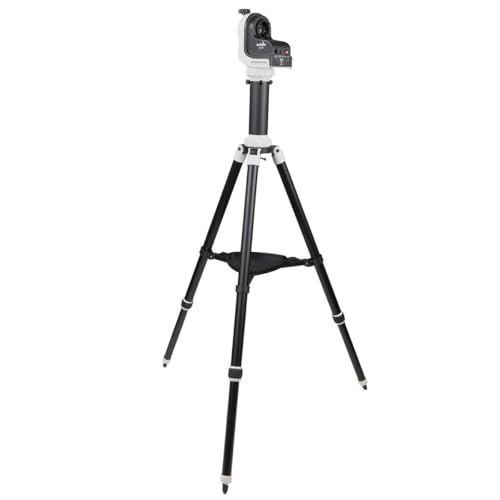
Sky-Watcher Sky-Watcher AZ-GTI – Portable Computerized GoTo Alt-Az Mount for On-The-Go Astronomy – WiFi Enabled App Controlled – Time-Lapse and Panorama Photography Capable (S21110)
TRAVEL-SIZED GOTO MOUNT: Weighing just 8. 6 pounds, this computerized Alt-Az tracking mount is perfect for portable, on-the-go,...
As an affiliate, we earn on qualifying purchases.

Celestron NexStar 4SE Computerized Telescope – 4-Inch Maksutov-Cassegrain Optical Tube – Fully Automated GoTo Mount with SkyAlign – Ideal for Beginners and Advanced Users – 40,000+ Object Database
ADVANCED TECH MEETS ICONIC DESIGN: The NexStar 4SE pairs Celestron’s legendary orange tube with a fully computerized GoTo...
As an affiliate, we earn on qualifying purchases.