
Scientists at CERN have found strong evidence of a new subatomic particle that could challenge the Standard Model. Using collider experiments, they detected anomalies that suggest the existence of particles beyond current theories. These findings may lead to revolutionary shifts in our understanding of forces, dark matter, and the universe’s fundamental structure. If you’re curious about how this discovery could reshape physics, there’s more to discover beyond the surface.
Key Takeaways
- CERN researchers have found anomalies in collision data suggesting the existence of a new subatomic particle.
- The potential discovery challenges the completeness of the Standard Model of particle physics.
- Evidence includes excess events at specific energy levels not explained by current theories.
- Confirming this particle could lead to breakthroughs in understanding dark matter and matter-antimatter imbalance.
- Further experiments are planned to verify the findings and assess their implications for fundamental physics.
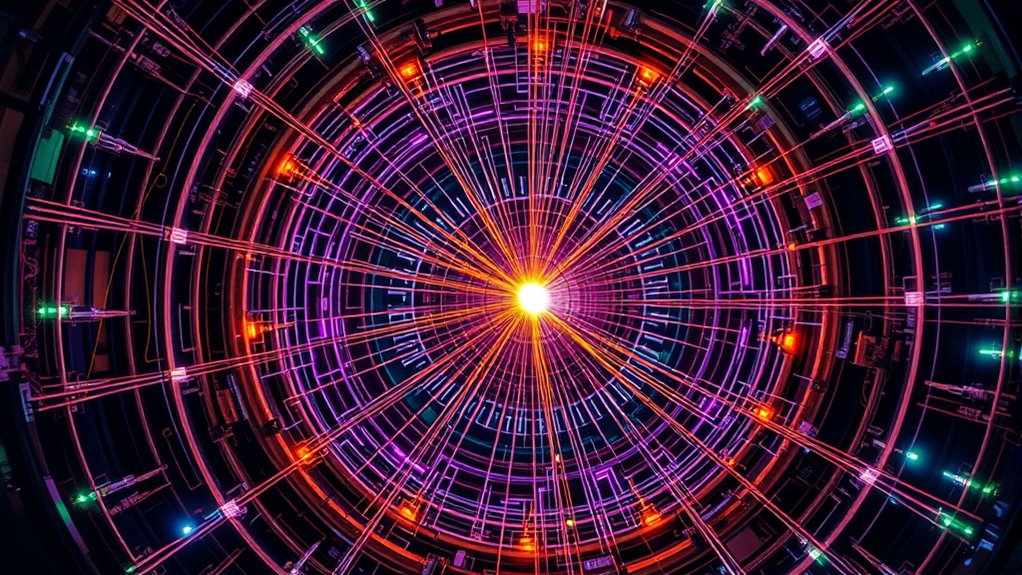
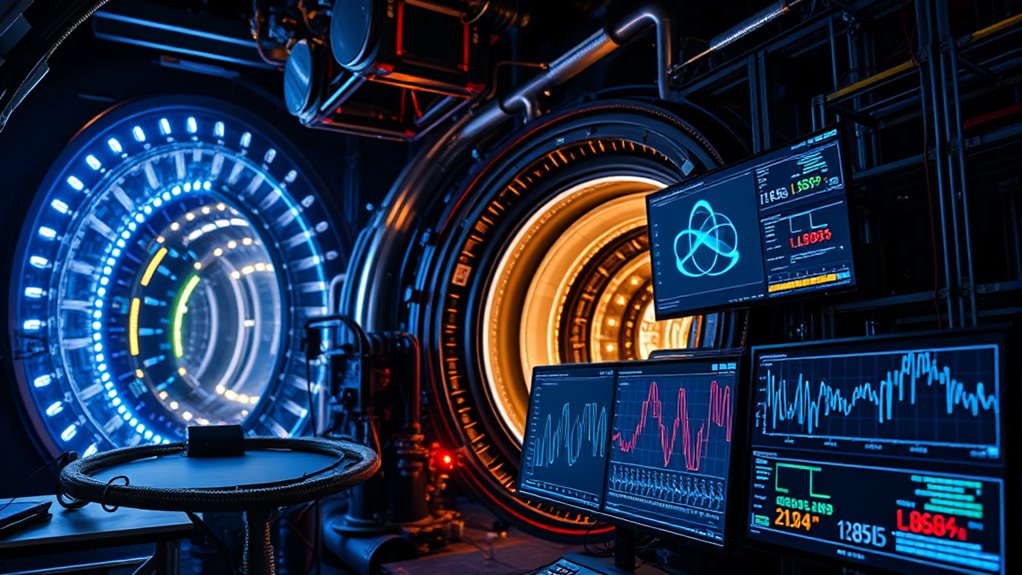
Scientists at CERN have announced evidence pointing to the discovery of a new subatomic particle, a breakthrough that could deepen our understanding of the universe’s fundamental building blocks. This discovery emerges from cutting-edge research in particle physics, where scientists use collider experiments to explore the tiniest constituents of matter. Collider experiments involve smashing particles together at high energies, allowing us to observe the resulting interactions and identify new particles. It’s through these intense collisions that unusual signals have been detected, hinting at the existence of a particle not predicted by the Standard Model. Advancements in collider technology continue to enhance our ability to uncover such phenomena.
As you follow these experiments, you realize how vital collider technology is to uncovering new physics. When particles collide at near-light speeds, they produce a burst of energy that can create previously unseen particles. Detectors surrounding the collision points capture these events, and sophisticated data analysis helps scientists differentiate genuine signals from background noise. Recently, a series of anomalies have appeared in the data—excess events at certain energy levels—that don’t match anything expected under current theories. These anomalies suggest the presence of a new particle, which could challenge long-held assumptions in particle physics.
This potential discovery is significant because it might indicate physics beyond the Standard Model, the framework that has guided our understanding of fundamental particles for decades. You need to appreciate how transformative this could be: new particles often lead to revolutionary insights about forces, symmetries, and the origins of mass. If confirmed, this particle could provide clues about unanswered questions, like the nature of dark matter or the imbalance between matter and antimatter in the universe. It’s precisely during collider experiments that such breakthroughs often occur, as the energy levels achievable at CERN allow scientists to probe deeper into the fabric of reality.
While the evidence is compelling, scientists remain cautious, emphasizing the need for further data and verification. Additional collider runs and analyses are scheduled to determine whether these signals truly indicate a new particle or if they result from statistical fluctuations. As you keep track of these developments, you’ll see how the interplay between experimental data and theoretical models shapes the future of particle physics. This discovery, if validated, might force a revision of existing theories and open new avenues for research. In essence, collider experiments continue to serve as the frontiers of scientific exploration, helping us peel back the layers of the universe and uncover its most profound secrets.
particle physics collider experiment kit
As an affiliate, we earn on qualifying purchases.
As an affiliate, we earn on qualifying purchases.
Frequently Asked Questions
Could This Discovery Lead to a New Fundamental Force?
Yes, this discovery could lead to a new fundamental force. If the new particle influences particle interactions differently from known forces, it suggests an additional fundamental force might exist. You should stay tuned, as further research could reveal how this force interacts with matter and whether it reshapes our understanding of fundamental forces. This breakthrough might open doors to new physics beyond the current Standard Model.
How Does This Particle Compare With Dark Matter Candidates?
This new particle differs from dark matter candidates because its properties, like mass and interaction strength, don’t match those expected of dark matter. While dark matter particles are usually weakly interacting and massive, this particle appears to have distinct characteristics that challenge existing models. You should consider that understanding its properties could reveal new physics, but currently, it doesn’t fit the typical profile of dark matter particles.
Will This Impact Existing Technologies or Future Experiments?
This discovery could profoundly impact particle applications and future experiments, as it may lead to new technologies or improve existing ones. You might see advancements in materials, computing, or medical imaging driven by understanding this particle’s properties. While the immediate technological impact isn’t clear, the potential for groundbreaking innovations exists, pushing the boundaries of what we can achieve in science and technology.
What Are the Potential Implications for Cosmology?
Like peering through a telescope into the night sky, this discovery could reshape your understanding of the early universe and cosmic evolution. It might reveal hidden forces that influenced the universe’s birth, offering clues about dark matter or energy. You could see new pathways for explaining how galaxies formed and evolved, deepening your grasp of the universe’s grand story and your place within it.
How Long Will It Take to Verify These Findings?
It could take several months to a few years for experimental verification, depending on how quickly researchers can replicate and analyze the findings. You should stay tuned for updates, as timeline estimates vary based on the complexity of the experiments and data collection. The scientific community will prioritize rigorous testing, so patience is key. Rest assured, thorough verification is essential before confirming this groundbreaking discovery.
scientist physics lab kit for kids
As an affiliate, we earn on qualifying purchases.
As an affiliate, we earn on qualifying purchases.
Conclusion
This discovery at CERN is like finding a new piece to a cosmic puzzle, challenging everything you thought you knew about the universe. It’s as if the Standard Model’s old map has a new, mysterious island waiting to be explored. You’re on the edge of a scientific adventure, where each discovery opens a door to even deeper mysteries. Get ready, because this new particle is just the beginning of a thrilling, universe-wide quest for answers.
As an affiliate, we earn on qualifying purchases.
As an affiliate, we earn on qualifying purchases.