
Inside an atom, a lively world unfolds—known as the “particle zoo”—where tiny particles like quarks and leptons interact through fundamental forces. Quarks form protons and neutrons, while gluons help hold everything together inside the nucleus. Force carriers transmit the interactions that keep particles linked, and their wave-like behavior adds complexity. If you keep exploring, you’ll uncover how scientists study these elusive particles and what they reveal about our universe.
Key Takeaways
- The particle zoo consists of fundamental particles like quarks and leptons that make up atoms and govern their behavior.
- Quarks and gluons inside protons and neutrons interact via the strong nuclear force, holding atomic nuclei together.
- Particles exhibit both wave and particle properties, showing interference, diffraction, and quantum uncertainty in experiments.
- Particle accelerators smash particles at high energies to discover new particles and explore their interactions.
- Understanding these tiny particles reveals the universe’s fundamental structure and drives technological innovations.
What Is the Particle Zoo and Why Does It Matter?

Have you ever wondered what makes up everything around us? That’s where the particle zoo comes in. It’s a collection of tiny particles, like quarks and leptons, discovered through experiments in particle accelerators. These machines speed up particles close to the speed of light, allowing scientists to smash them together and reveal their hidden structure. The particle zoo helps us understand the universe’s fundamental building blocks and how they interact. Quantum entanglement plays a key role here, linking particles in mysterious ways even when separated. Knowing about this zoo isn’t just academic—it helps us unearth the secrets of matter, energy, and the forces that shape everything we see. European cloud innovation is central to supporting large-scale scientific research and data analysis. Additionally, advancements in particle detection technology have significantly improved our ability to observe and analyze these elusive particles, broadening our understanding of the universe. The development of high-energy physics experiments continues to push the boundaries of our knowledge, revealing new particles and phenomena that challenge existing theories. It’s an essential step in understanding how the universe works at its smallest scale.
What Are Quarks, Leptons, and Gluons? Meet the Building Blocks
You’ll learn that quarks, leptons, and gluons are the fundamental particles making up everything around you. Quarks build protons and neutrons, while leptons include particles like electrons, and gluons help hold quarks together through the strong force. These particles and their interactions form the core of what you need to understand about the atomic world.
Fundamental Particle Types
What exactly makes up the particles inside an atom? You’re looking at fundamental particle types like quarks, leptons, and gluons. Quarks combine to form protons and neutrons, while leptons include electrons and neutrinos. Gluons act as the force carriers that hold quarks together in these particles. To identify and study these tiny particles, scientists use particle accelerators that smash particles at high speeds, creating conditions to produce and observe new particles. Experimental detection methods, such as detectors surrounding the collision points, help scientists analyze the results. These tools allow you to distinguish different particle types and understand their roles in building matter. By exploring these fundamental particles, you get closer to understanding the universe’s most basic building blocks.
Quark Properties and Roles
Quarks, leptons, and gluons are the fundamental particles that make up everything around us, acting as the universe’s most basic building blocks. Quarks combine to form protons and neutrons, while leptons include particles like electrons. These particles exist as excitations in quantum fields, which define their properties and interactions. Particle accelerators help scientists explore these properties by smashing particles together at high speeds, revealing how quarks behave and interact. Quarks have unique characteristics such as color charge, which explains how they stick together inside protons and neutrons. Understanding these properties is essential for grasping how matter holds together at the smallest scales, giving us insight into the fundamental structure of the universe itself.
Gluons and Force Mediation
Gluons are the particles that act as the force carriers, holding quarks together inside protons and neutrons. They’re essential for mediating the strong nuclear force, which keeps atomic nuclei stable. Particle accelerators help scientists observe gluons in action by smashing particles at high energies, revealing the complex interactions within protons and neutrons. Gluons constantly exchange between quarks, creating a dynamic “force field.” *Fascinatingly*, the behavior of these particles relates to quantum entanglement, where particles can become linked, affecting each other instantly across distances. This phenomenon offers insights into how forces operate at a fundamental level. Understanding gluons and force mediation helps us grasp the intricate dance of particles that form the building blocks of matter.
How Do Subatomic Particles Interact Inside the Atom’s Nucleus?

Inside the atom’s nucleus, subatomic particles interact mainly through the strong nuclear force, which binds protons and neutrons together. Quark interactions within these particles are maintained by gluons, which act as exchange particles facilitating their connection. Understanding these particle exchange mechanisms reveals how the nucleus stays stable despite the repulsive forces at play.
Strong Nuclear Force
Ever wonder how protons and neutrons stay tightly bound together in the nucleus despite their repulsive charges? The answer lies in the strong nuclear force. This force is incredibly powerful at short distances, overcoming electromagnetic repulsion. It acts like an invisible glue, holding these particles close. Particle accelerators help scientists probe this force by smashing particles together at high speeds, revealing how they interact. surprisingly, quantum entanglement plays a role, as particles inside the nucleus remain connected in ways that defy classical physics, ensuring stability. Unlike gravity or electromagnetism, the strong nuclear force is uniquely suited for maintaining the integrity of the nucleus, making it the key force behind atomic stability and the foundation of matter itself.
Quark Interactions
The strong nuclear force keeps protons and neutrons tightly bound in the nucleus, but at a deeper level, it’s the interactions between quarks that underpin this stability. Quarks, the fundamental building blocks inside protons and neutrons, interact through the exchange of gluons, which act like the glue holding them together. Particle accelerators allow scientists to probe these interactions at extremely high energies, revealing how quarks behave under different conditions. Fascinatingly, quarks can become quantum entangled, meaning their states are linked regardless of distance, affecting how they interact within the nucleus. Understanding quark interactions helps explain nuclear stability and the forces at play inside atoms, revealing a complex, dynamic world that’s far from simple.
Particle Exchange Mechanisms
Subatomic particles interact primarily through the exchange of force-carrying particles known as mesons and gluons. These exchanges enable the strong force that binds protons and neutrons in the nucleus. When particles collide in accelerators, they can produce new particles or cause existing ones to decay—a process called particle decay. These decays reveal how particles transform and interact, deepening our understanding of nuclear forces. Particle accelerators allow scientists to probe these mechanisms by smashing particles at high speeds, observing the resulting exchanges and decays. Through these experiments, you can see how force carriers like gluons facilitate interactions, ensuring the nucleus stays intact or transforms. This exchange process is fundamental to how particles communicate and react inside the atom’s tiny but complex core.

Science Fundamentals 1 - Life Science - Cells, Plants & Animals: for Middle School - a QuickStudy Laminated Reference & Study Guide
As an affiliate, we earn on qualifying purchases.
How Do Force Carriers Help Particles Communicate?
Force carriers act as the messengers that allow particles to interact and share information. They enable forces like electromagnetism and nuclear interactions to occur, making particles communicate. For example, photons carry electromagnetic force, helping particles exchange energy. Particle accelerators use these force carriers to collide particles at high speeds, revealing hidden interactions. Fascinatingly, quantum entanglement allows particles to remain connected instantaneously, regardless of distance, demonstrating a different kind of communication. Here’s a simple way to understand it:
| Particle | Force Carrier | Communication Method |
|---|---|---|
| Electron | Photon | Electromagnetic |
| Quark | Gluon | Strong Nuclear |
| Neutrino | W/Z Boson | Weak Nuclear |
These force carriers are essential for the particle zoo to stay connected and behave as they do.
What Are Particle Waves, Collisions, and Quantum Uncertainty?
Particles behave both like tiny balls and waves, depending on how you observe them. When particles act as waves, they can experience wave interference, where waves overlap and either amplify or cancel each other. This phenomenon shows that particles don’t always follow classical paths. Particle diffraction occurs when these waves bend around obstacles or pass through narrow openings, creating patterns that reveal their wave nature. These behaviors highlight quantum uncertainty, meaning you can’t precisely know a particle’s position and momentum at the same time. Collisions between particles are also unpredictable, often resulting in new particles or energy exchanges. Together, wave interference, particle diffraction, and uncertainty demonstrate that at the quantum level, particles behave in ways that challenge your everyday intuition and classical physics.
Why Studying the Particle Zoo Reveals Nature’s Secrets

Studying the particle zoo reveals the fundamental principles that govern the universe. Particle accelerators allow you to smash particles together at high speeds, unveiling hidden details about their structure and interactions. These experiments help you understand the forces that shape everything from atoms to galaxies. Quantum entanglement, another key concept, shows how particles can be connected regardless of distance, revealing the strange and interconnected nature of reality. By exploring these phenomena, you learn how matter behaves under extreme conditions and how fundamental particles give rise to the universe’s complexity. This knowledge not only satisfies curiosity but also drives technological advances, such as medical imaging and quantum computing. Understanding the fundamental particles provides insights into the very fabric of the cosmos. Ultimately, studying the particle zoo unlocks the secrets of nature, offering a glimpse into the universe’s deepest workings.
How Do Scientists Discover and Study Tiny Particles?
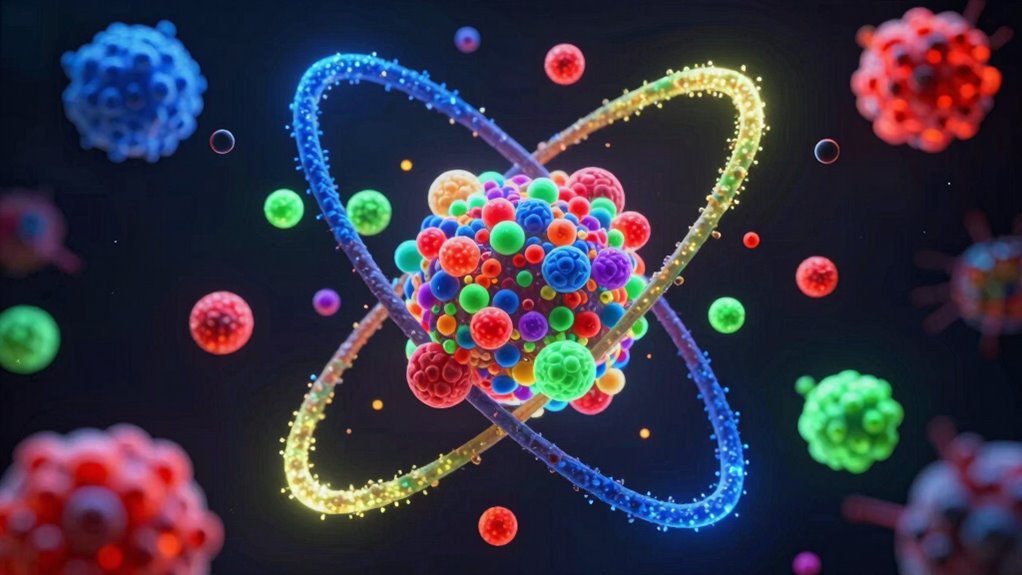
To uncover the tiny particles that make up our universe, scientists rely on sophisticated tools called particle accelerators. These devices speed up particles to nearly light speed, allowing collisions that reveal new particles. Detection methods are vital—they capture signals from these high-energy events. Here’s how it works:
- Accelerate particles to high speeds using particle accelerators.
- Collide particles to produce new, often unstable, particles.
- Use detectors to record collision byproducts and signals.
- Analyze data to identify and understand particles in the particle zoo.
Frequently Asked Questions
How Are New Particles Discovered in the Particle Zoo?
You discover new particles by analyzing data from particle collisions in accelerators. When particles smash together at high speeds, detectors capture the resulting debris. You then perform data analysis to spot unusual patterns or signals indicating unknown particles. These clues lead you to identify potential new particles, which scientists then verify through repeated experiments. This process helps you expand the “particle zoo” and understand the fundamental building blocks of matter.
What Role Do Accelerators Play in Particle Research?
Accelerators play a vital role in particle research by speeding up particles through particle acceleration, allowing you to collide them at high energies. These collisions reveal quantum entanglement and other fundamental properties, helping you discover new particles in the particle zoo. By generating extreme conditions, accelerators let you probe the universe’s smallest building blocks, advancing your understanding of matter and forces shaping our universe.
How Do Scientists Differentiate Between Similar Subatomic Particles?
You know what they say, “The devil is in the details.” To tell similar subatomic particles apart, scientists analyze quark interactions and observe particle decay processes. By studying how particles behave, interact, and decay over time, they can distinguish one from another. They use advanced detectors and collider experiments to track these subtle differences, helping you understand the complex “particle zoo” inside atoms.
Are There Particles yet to Be Discovered in the Zoo?
Yes, there are particles yet to be discovered in the zoo, like dark matter particles and exotic particles. You might not have seen them yet because they’re elusive and hard to detect with current technology. Scientists continue to search for these mysterious particles to better understand the universe’s makeup. Discovering them could reshape your understanding of physics and reveal new aspects of the particle zoo beyond what’s currently known.
How Does the Particle Zoo Impact Everyday Technology?
The particle zoo influences your daily life through advances in technology like MRI scans, which rely on quantum entanglement and particle collisions. These phenomena help scientists develop better medical imaging and quantum computers. As researchers explore these particles, they unlock new possibilities, making your gadgets faster and more efficient. So, understanding the particle zoo leads to innovations that improve health, communication, and entertainment, shaping your everyday experiences in subtle but significant ways.
Conclusion
Stepping into the particle zoo, you see a chaotic dance of tiny building blocks, like a bustling city hidden inside an atom. It’s wild, unpredictable, yet meticulously ordered by fundamental forces. Just as a storm hides a delicate balance, these particles conceal nature’s deepest secrets. Exploring this microscopic universe reveals the universe’s blueprint, reminding you that behind everyday reality, a vibrant, energetic world pulses with life—an invisible chaos waiting to be understood.