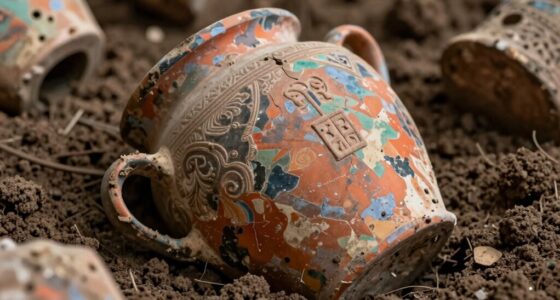
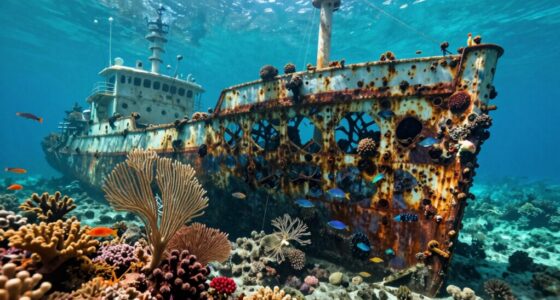
Shipwrecks act like natural freezers, preserving history by slowing decay through cold, dark, and high-pressure environments. These conditions limit microbial activity, stop corrosion, and protect artifacts from biological decay, much like how a freezer keeps perishable items intact. Structures and artifacts remain remarkably intact over centuries, revealing details about ancient shipbuilding, trade, and cultures. If you want to discover how ocean conditions turn wrecks into underwater time capsules, there’s more to learn below.
Key Takeaways
- Underwater environments naturally slow decay by limiting oxygen, microbial activity, and exposure to elements, preserving shipwrecks over centuries.
- Cold temperatures and darkness inhibit bacteria and microbes, acting as natural preservation agents similar to a freezer.
- High salinity and ocean pressure create hostile conditions for decay, helping maintain ship structures and artifacts intact.
- Shipwrecks serve as underwater museums, safeguarding artifacts that reveal historical trade, craftsmanship, and maritime practices.
- Technological advances like 3D imaging and underwater drones enable detailed, non-invasive preservation and study of submerged wrecks.
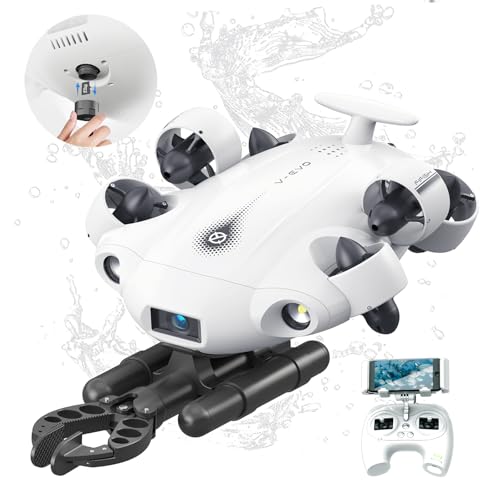
【2025 New】FIFISH V-EVO 4K60FPS Underwater Drone with Robotic Arm, with Removable SD Card, QYSEA AI Vision Lock 360° Omnidirectional Movement Underwater ROV with Depth Hold,330ft Dive
4K 60FPS High Frame-rate Camera: Create epic footage and wonderful underwater moments with V-EVO's upgraded camera system, achieving…
As an affiliate, we earn on qualifying purchases.
As an affiliate, we earn on qualifying purchases.
Why Shipwrecks Act as Natural Time Capsules
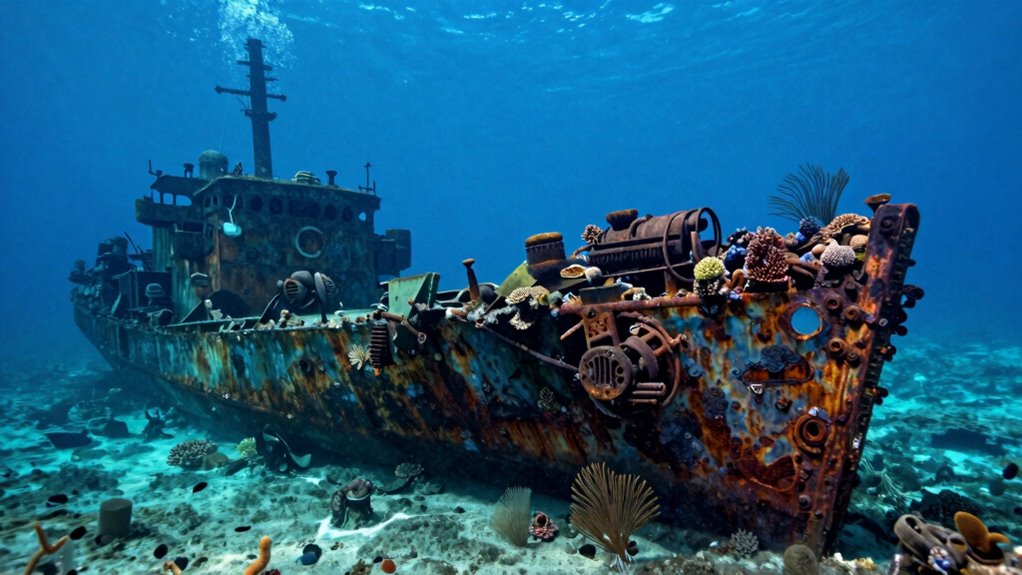
Shipwrecks serve as natural time capsules because their underwater environment slows down decay and preserves artifacts remarkably well. These submerged vessels often become part of maritime legends, fueling stories of lost treasures and heroic voyages. The oceanic mysteries surrounding shipwrecks attract explorers and historians enthusiastic to uncover secrets buried in time. The cold, dark depths create a barrier against elements that typically cause decay, such as oxygen and microbes. As a result, items like cargo, personal possessions, and even the ship’s structure remain intact for centuries. This preservation offers invaluable insight into past maritime culture, technology, and history. Because of their ability to safeguard history, shipwrecks continue to fascinate us and serve as extraordinary links to the stories of those who sailed the seas long ago. Underwater preservation plays a critical role in maintaining the integrity of these historic sites for future study. Additionally, the unique conditions of the ocean environment help prevent biological decay, further aiding in their preservation.

Lowrance 3D Fishfinder StructureScan XDCR & Module
Lowrance 3D Fish finder StructureScan XDCR & Module
As an affiliate, we earn on qualifying purchases.
As an affiliate, we earn on qualifying purchases.
Environmental Factors That Preserve Shipwrecks (Salinity, Pressure, Microbes)
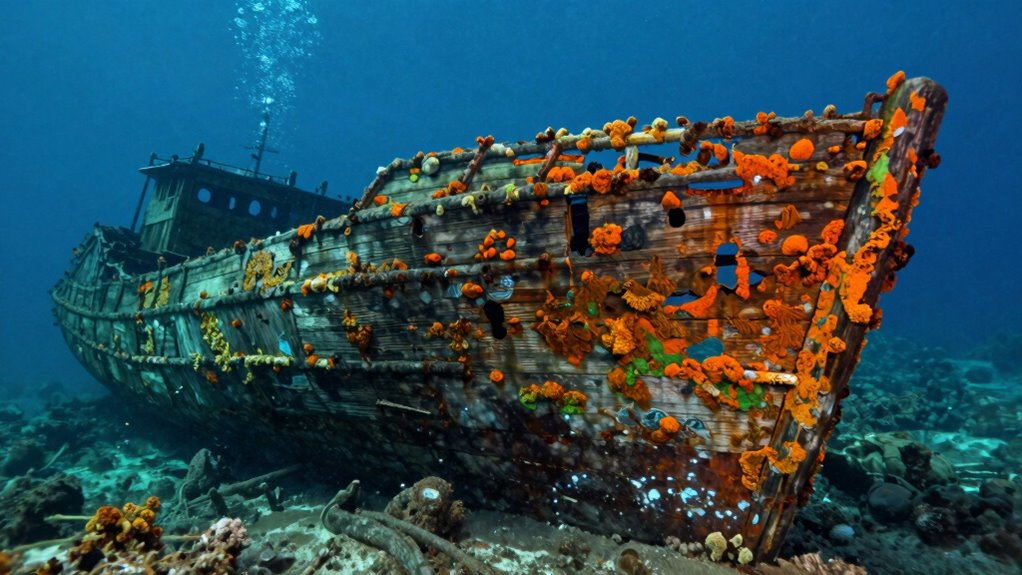
The environment underwater plays a pivotal role in how well a shipwreck is preserved over time. High salinity levels create a harsh environment for microbes that typically accelerate decay, helping preserve the wreck. Deep pressure at greater depths slows down corrosion and the activity of microbes, acting as a natural preservative. Microbes, while usually destructive, can also contribute to preservation by forming protective mineral layers on the metal surfaces. Ocean currents influence how nutrients and marine biodiversity interact with the wreck, either promoting or hindering decay. Areas with low microbial activity and stable salinity levels tend to preserve shipwrecks longer. Additionally, the secret ingredient in some preservation processes can enhance the natural protection offered by these environmental factors. By understanding these environmental factors, you can appreciate how the underwater landscape naturally safeguards these historical relics over centuries, making environmental preservation a fascinating area of study. Furthermore, recent research indicates that specific chemical processes can sometimes accelerate preservation by reinforcing mineral layers on submerged structures.
shipwreck preservation tools
As an affiliate, we earn on qualifying purchases.
As an affiliate, we earn on qualifying purchases.
How Cold and Darkness Help Halt Decay on the Ocean Floor
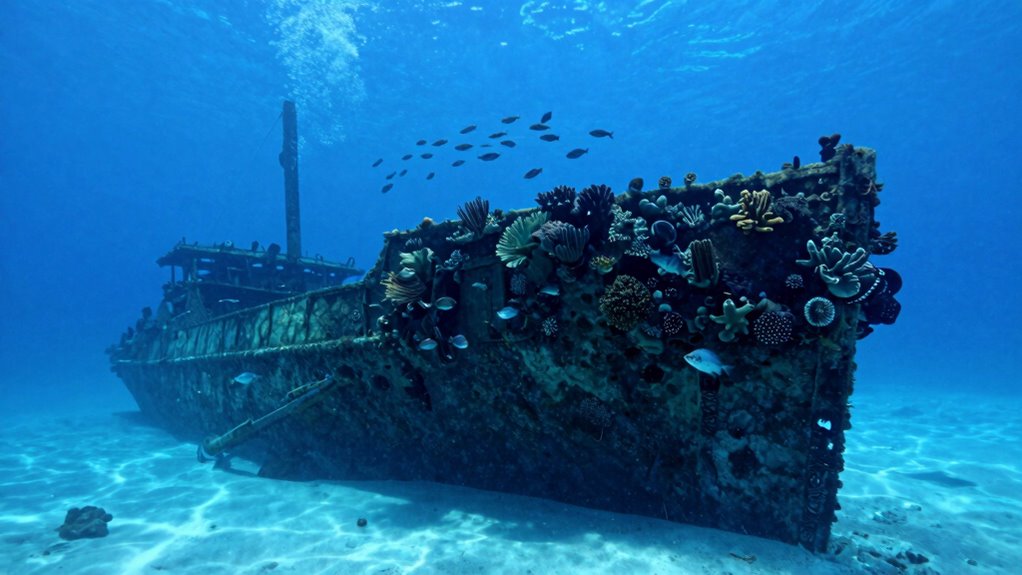
When temperatures drop and the darkness of the ocean depths set in, decay slows dramatically. Cold temperatures act like a natural freezer, preserving shipwrecks by inhibiting bacteria and microbes that cause decomposition. Darkness limits sunlight and prevents photosynthesis, further reducing microbial activity. This environment supports the preservation of delicate artifacts and even marine biodiversity around wrecks, which thrive in stable conditions. Ocean currents also play a role by transporting nutrients and maintaining low temperatures around the site. These factors work together to create an ideal preservation environment. Temperature regulation in the deep sea is a crucial factor in sustaining these conditions over long periods.

CorrosionX Heavy Duty Anti Rust Spray, Dripless Self-Healing Corrosion Inhibitor with Waterproof Barrier for Marine, Agricultural & Industrial Equipment in Harsh, Saltwater Environments, 12oz Aerosol
RELENTLESS RUST PROTECTION FOR ANY WEATHER: This self-healing barrier clings and protects metal through rain, seawater, and pressure…
As an affiliate, we earn on qualifying purchases.
As an affiliate, we earn on qualifying purchases.
What Artifacts and Structures Do Shipwrecks Reveal?
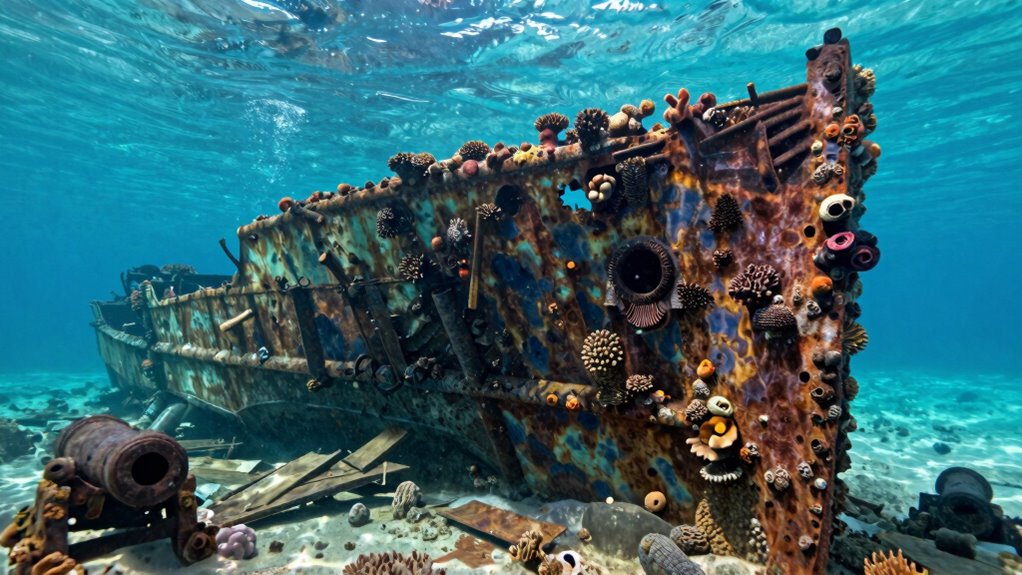
Shipwrecks uncover a wide array of artifacts and structures that tell their stories. You might find hidden cargo and goods that reveal trade routes or economic history, along with architectural remnants of the ships themselves. Personal items and stories also surface, offering glimpses into the lives of those who once sailed these vessels.
Hidden Cargo and Goods
Have you ever wondered what hidden treasures lie beneath the ocean’s surface? Shipwrecks often reveal cargo that offers insights into past maritime trade and ship design. These relics include more than just gold or jewelry—they can be crates of spices, textiles, or valuable metals that tell stories of commerce and economy. European cloud innovation techniques are now helping researchers analyze these artifacts remotely, preserving their integrity for future study. Cargo reveals trade routes and economic priorities. Unexpected items show cultural exchanges. Artifacts demonstrate technological advances. Goods preserved in cold, stable environments. Cargo size indicates ship’s capacity and design. Furthermore, underwater archaeology methods enable precise documentation and conservation of these underwater discoveries. Advances in digital imaging are also enhancing how researchers interpret and share findings from shipwreck sites.
Architectural Remnants Found
What secrets do the structural remains of shipwrecks hold beneath the ocean’s surface? These ruins reveal more than just remnants; they’re underwater time capsules. You might see the rusted hull, twisted masts, or broken cargo holds, each telling a story of the past. Marine ecology thrives here, with coral and fish colonizing these artificial reefs. Oceanography techniques help uncover how these structures influence local ecosystems. Here’s a visual glimpse:
| Structure | Material | Ecological Role |
|---|---|---|
| Rusted hull | Steel, iron | Habitat for marine life |
| Broken masts | Wood, metal | Shelter for fish |
| Cargo holds | Stone, wood | Microhabitats |
| Debris scattered | Various | Nutrient sources |
These remnants provide essential clues to history, ecology, and ocean science.
Personal Items and Stories
Beneath the ocean’s surface, personal items and artifacts offer a vivid glimpse into the lives of those who once sailed these ships. These relics reveal stories of daily life, work, and leisure, making shipwrecks a treasure trove of history. You might find:
- Personal jewelry or watches
- Food containers and utensils
- Personal letters or diaries
- Clothing remnants
- Small tools or keepsakes
Such artifacts humanize maritime legends, transforming wrecks into time capsules. They help uncover the personal stories behind shipwrecks and treasure discoveries, connecting us to the sailors’ lives. These remnants preserve intimate details, offering insight into their routines and struggles. As a result, shipwrecks serve as underwater museums, safeguarding history and inspiring curiosity about the maritime past. Additionally, the preservation of vehicle performance aspects in shipwrecks provides valuable clues for understanding historical ship design and construction techniques. The discovery of preservation techniques used in these wrecks further enhances our knowledge of maritime engineering. Furthermore, examining these artifacts can reveal cultural practices and social hierarchies of the ship’s original crew. Recognizing how technological advancements influenced shipbuilding and navigation also deepens our understanding of maritime history. Moreover, studying these preserved items can shed light on the material culture of the period, enriching our historical narratives.
Comparing Preservation of Shipwrecks to Other Archaeological Sites

Shipwrecks often offer some of the best-preserved archaeological sites because their submerged environments naturally slow decay processes. Unlike dry land sites, the water limits oxygen exposure, reducing microbial activity and corrosion. Compared to dry caves or desert sites, wrecks are less affected by temperature fluctuations and air exposure, which can accelerate deterioration. Marine biology also plays a role; certain organisms, like barnacles and corals, encrust wrecks, aiding preservation by creating a protective barrier. Ocean currents influence how quickly wrecks settle and how nutrients and organisms interact with them, affecting preservation quality. Additionally, the submerged environment provides a stable setting that reduces exposure to weather-related damage. While other sites may suffer from erosion or human interference, shipwrecks submerged in stable environments tend to remain remarkably intact, offering a unique snapshot of history preserved in the deep sea.
The Role of Salinity, Pressure, and Microbial Activity in Wreck Preservation
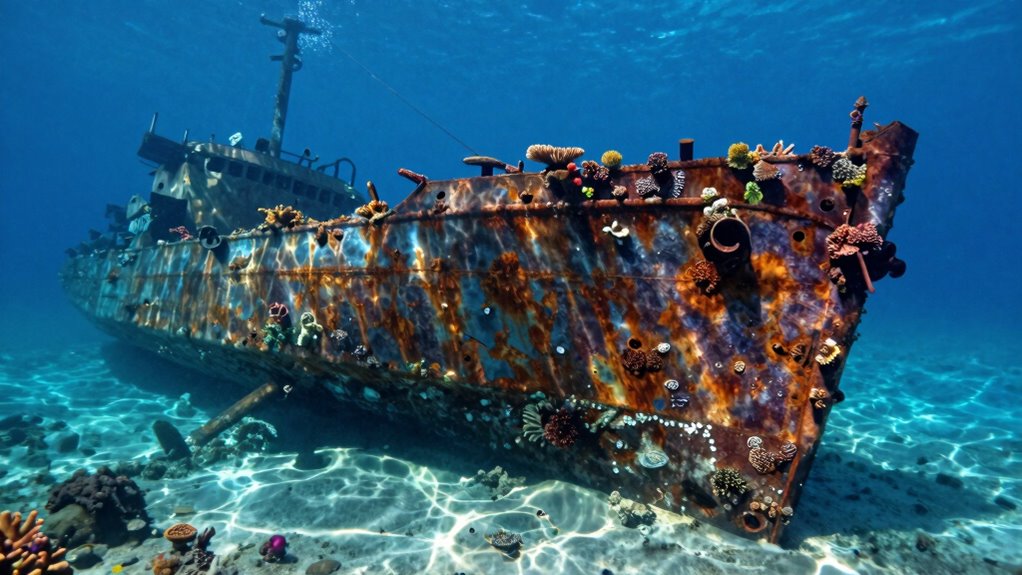
Salinity levels can markedly slow down or accelerate the decay of shipwrecks, acting as natural preservatives in certain environments. Microbial activity, on the other hand, often drives decay by breaking down organic materials, but it can also be inhibited by extreme conditions. Pressure from deep waters further influences preservation, creating a unique balance that shields wrecks from rapid deterioration. Additionally, factors like biological processes contribute to the long-term stability of submerged vessels, as microbial communities can sometimes form protective layers that help preserve the structures over time. These environmental factors work together to create a preservation environment similar to a natural freezer, which slows decomposition and maintains the wrecks’ integrity over extended periods. The presence of saline environments can also promote mineralization, further strengthening the wrecks and aiding in their preservation. Moreover, the chemical composition of surrounding waters can influence mineral deposits that naturally encase and protect the wrecks from decay.
Salinity’s Preservation Power
Salinity plays a crucial role in preserving shipwrecks by creating conditions that slow down decay. High salinity levels inhibit microbial activity and enzymatic processes that break down organic materials, making it essential in marine archaeology and preservation techniques. Salty environments act as natural preservatives, helping artifacts remain intact over centuries.
You should note:
- Elevated salinity reduces microbial growth on wrecks
- Salt crystals can reinforce fragile structures
- Salinity levels help determine preservation quality
- Salt acts as a barrier against bacteria that cause corrosion
- Preservation techniques often mimic high-salinity conditions for better conservation
Understanding salinity’s power enables archaeologists to better protect and study submerged artifacts, preserving history for future generations.
Microbial Impact on Decay
Microbial activity is a primary driver of decay in underwater wrecks, but environmental factors like salinity and pressure can markedly influence this process. Microbial biofilms form on ship surfaces, accelerating corrosion processes by creating a chemical environment that promotes metal breakdown. High salinity levels support specific microbes that thrive in salty conditions, increasing biofilm development and corrosion rates. Conversely, greater pressure at deeper depths can inhibit some microbial activity, slowing decay. These microbial communities can either hasten deterioration or, in some cases, help preserve structures by forming protective layers. Understanding how salinity, pressure, and microbial activity interact allows you to recognize why some wrecks remain remarkably intact while others decay rapidly, fundamentally turning microbial biofilms into natural preservers or destroyers of underwater history.
Why Shipwrecks Offer Unique Insights Into Maritime Technology and Culture

Shipwrecks serve as time capsules, revealing invaluable details about maritime technology and cultural practices of their era. They show how ships were built, navigated, and supplied, offering clues about the people who relied on them. As you explore wrecks, you also observe marine biodiversity thriving around these structures, which can influence local ecosystems. Additionally, oceanic currents play a role in how wrecks are preserved or moved over time.
Shipwrecks reveal maritime history, biodiversity, and the influence of ocean currents over time.
Key insights include:
- Construction techniques and materials used
- Navigational tools and methods
- Cultural artifacts and cargo
- Trade routes and economic exchanges
- Adaptations to maritime challenges
How Underwater Preservation Helps Discover Lost Maritime Cultures
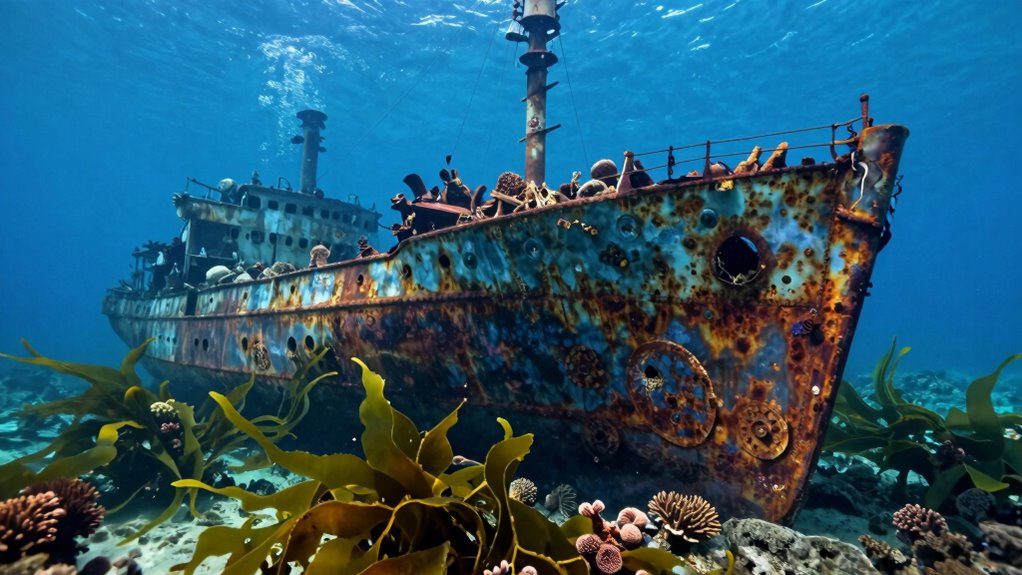
Underwater preservation maintains artifacts intact over time, allowing you to uncover details about ancient civilizations. By studying these relics, you can reveal lost trade routes and interactions between different cultures. Protecting these sites ensures that future generations can continue to learn from our maritime heritage. This preservation process also helps scientists understand the chemical and physical conditions that contribute to artifact stability underwater, including biofouling and corrosion processes. Additionally, understanding restoration techniques can aid in the long-term conservation of these invaluable historical objects. Recognizing the environmental factors involved in underwater preservation is crucial for developing better conservation methods.
Preserving Artifacts Over Time
Because they are sealed from the elements, underwater environments naturally preserve shipwreck artifacts for centuries, allowing you to study and understand lost maritime cultures. This preservation is vital for examining materials like wood, textiles, and metals that degrade quickly on land. Underwater sites often remain untouched by decay, offering a time capsule of history. This process also benefits marine biology, as artifacts become part of deep sea ecosystems, fostering unique habitats.
- Protects fragile artifacts from weathering and corrosion
- Maintains original context for archaeological study
- Offers insights into ancient shipbuilding techniques
- Supports long-term conservation efforts
- Enhances understanding of deep sea ecosystems’ role in preservation
Revealing Ancient Trade Routes
When a ship sinks, it often leaves behind a trail of artifacts that reveal the trade routes it once traveled. Maritime archaeology uses these submerged sites to map ancient maritime networks, offering insights into historic commerce and cultural exchanges. Underwater conservation preserves these shipwrecks, allowing researchers to study the context of cargo, navigation methods, and trading hubs. By examining cargo remains, navigation tools, and ship construction, you can piece together how different civilizations interacted across seas. These discoveries shed light on long-lost trade routes, revealing connections that shaped historical development. Without underwater preservation, many of these clues would be lost to corrosion and decay. As a result, shipwrecks become invaluable time capsules, helping you understand the complexities of ancient maritime cultures and their far-reaching influence.
Protecting Cultural Heritage
Shipwrecks serve as underwater museums that preserve the cultural identities of lost maritime communities. They offer a rare glimpse into ancient lives, traditions, and technologies, helping you uncover stories often buried by shipwreck myths. Ocean currents influence how wrecks settle and remain preserved, shielding them from decay. Underwater preservation allows you to study artifacts in their original context, safeguarding cultural heritage from looters and natural erosion. By exploring these sites, you can discover the craftsmanship, trade practices, and daily routines of long-gone civilizations.
- Protects fragile artifacts from weathering
- Preserves authentic maritime environments
- Reveals detailed shipbuilding techniques
- Offers insight into ancient trade networks
- Helps differentiate myths from historical facts
Challenges and Limitations of Using Shipwrecks as Historical Evidence
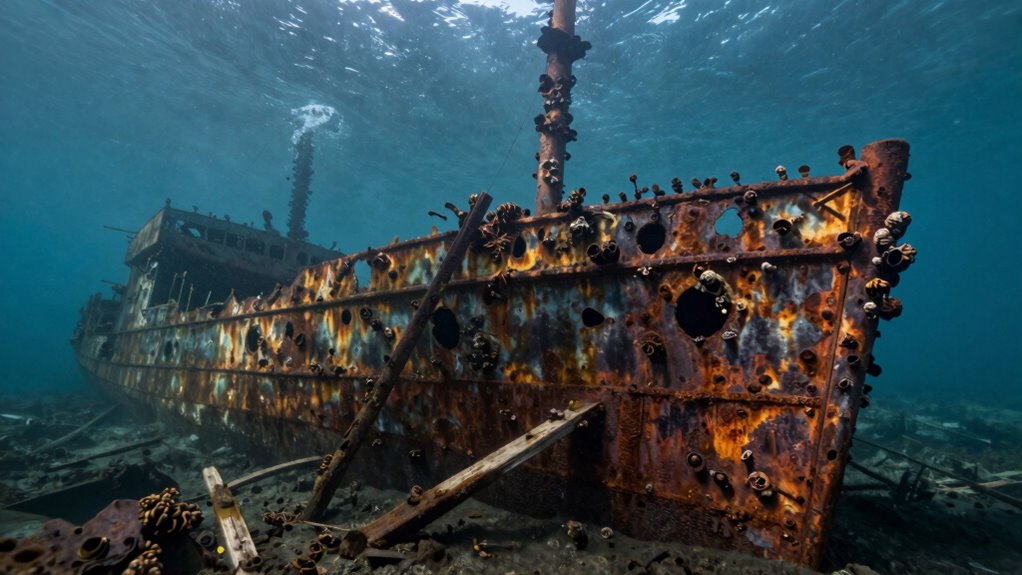
While shipwrecks serve as valuable time capsules, they also present significant challenges for historians. One major issue is the prevalence of shipwreck myths, which can distort historical accuracy and lead to misconceptions. Over time, natural elements and human activity cause deterioration, creating preservation challenges that limit access and detail. Corrosion, biological decay, and looting threaten the integrity of wrecks, making it difficult to extract reliable evidence. Additionally, many wrecks lie in inaccessible or dangerous locations, restricting research opportunities. This complexity means that relying solely on shipwrecks for historical evidence involves traversing these limitations. As a result, interpretations may be incomplete or biased, emphasizing the need for cautious analysis when using shipwrecks to reconstruct history.
How Modern Technology Enhances the Study and Preservation of Wrecks
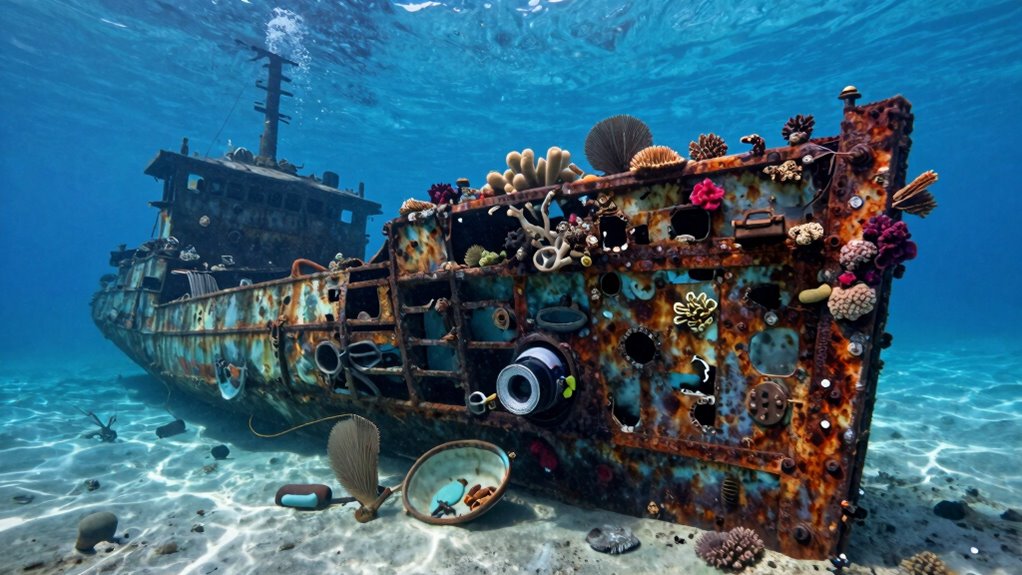
Modern technology has revolutionized the way we study and preserve shipwrecks, providing tools that enhance both discovery and conservation efforts. You can now map wreck sites precisely using advanced sonar and underwater drones, reducing the need for invasive procedures. 3D imaging captures detailed visuals, helping you analyze wreck structures without physical contact. Techniques like marine biology sampling reveal how sea life interacts with wrecks, while understanding ocean currents helps predict erosion and deterioration.
- High-resolution sonar scans for detailed mapping
- Autonomous underwater vehicles for exploration
- 3D modeling for accurate reconstructions
- Marine biology tools to study ecosystems
- Ocean current data to inform preservation strategies
Frequently Asked Questions
How Do Shipwrecks Compare to Terrestrial Archaeological Sites in Preservation?
You’ll find that shipwrecks often preserve history better than terrestrial sites due to the unique conditions underwater, which slow decay. Marine archaeology benefits from preservation techniques that protect these sites from oxygen and bacteria, helping artifacts stay intact longer. Unlike terrestrial sites, shipwrecks are less exposed to weathering and human interference, making them invaluable for studying ancient seafaring and trade. This natural preservation offers a rare glimpse into maritime history.
What Are the Biggest Threats to Underwater Shipwreck Preservation Today?
You face significant threats to underwater shipwreck preservation, mainly from corrosion challenges caused by saltwater and oxygen exposure. Human interference, like vandalism or unregulated tourism, worsens the damage, accelerating deterioration. These factors threaten the integrity of wrecks, making it essential to implement protective measures. By understanding and addressing corrosion and human interference, you can help preserve these underwater sites for future generations to study and appreciate.
Can Shipwrecks Be Safely Explored Without Damaging Their Integrity?
You can explore shipwrecks safely without damaging their integrity by following proper techniques. Corrosion prevention measures, like controlling oxygen and moisture levels, help safeguard the metal structures. Artifact conservation ensures delicate items remain intact during exploration. Using non-invasive tools like underwater drones and ROVs minimizes physical contact. Training divers thoroughly and adhering to established guidelines also prevent harm, allowing you to uncover history while preserving these underwater relics for future generations.
How Do Researchers Locate and Identify Submerged Shipwrecks?
You can locate and identify submerged shipwrecks by using remote sensing technologies like sonar and magnetometers, which detect anomalies on the ocean floor. Researchers also analyze historical records, such as old maps and ship logs, to narrow down search areas. Combining these methods helps you pinpoint wreck sites accurately, ensuring you avoid damaging the fragile structures while gathering valuable data about maritime history.
What Future Technologies Could Revolutionize Shipwreck Preservation?
Future technologies like autonomous drones and AI imaging could revolutionize shipwreck preservation by enabling detailed, real-time scans of underwater sites. You’ll find that drones can access hard-to-reach areas, capturing high-resolution images and data with minimal human effort. AI imaging then analyzes this information to identify fragile structures and assess their condition quickly. This combination improves preservation efforts, making it easier to protect and study shipwrecks for generations to come.
Conclusion
You now know how shipwrecks act like underwater time capsules, preserving history remarkably well. Did you know that over 3 million shipwrecks are scattered across the ocean floor, silently waiting to tell their stories? Thanks to environmental conditions and modern technology, we can uncover these secrets and learn about past cultures and innovations. Each discovery brings us closer to understanding our maritime history, proving that these wrecks truly are treasures frozen in time.