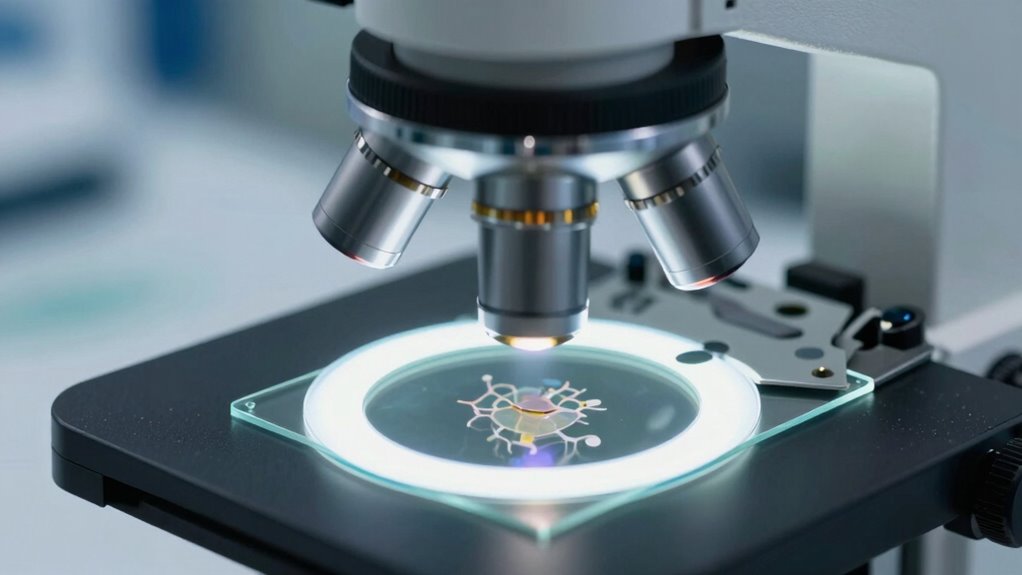

Digital microscopes are best at providing clear, high-resolution images of tiny details with easy controls for quick adjustments. They’re great for inspecting biological samples and small electronic parts, making analysis straightforward and sharing simple. However, they fall short in low-light or reflective environments, and their flat, 2D images limit depth perception. If you’re curious about how to maximize their strengths and overcome their weaknesses, there’s more to discover below.

Prime made for students and young adults
- Fast, free delivery for dorm and study essentials
- Prime Video and Amazon Music included
- Member-only deals
Key Takeaways
- Digital microscopes excel at providing high-resolution, detailed images for easy specimen analysis and sharing.
- They are user-friendly with intuitive controls, making operation accessible for beginners and multiple users.
- They are limited in depth perception, often producing flat, 2D images that hinder 3D assessment.
- Image quality can suffer under low-light or reflective conditions, especially in cheaper models.
- Dependence on electronic components makes them fragile and prone to technical issues over time.
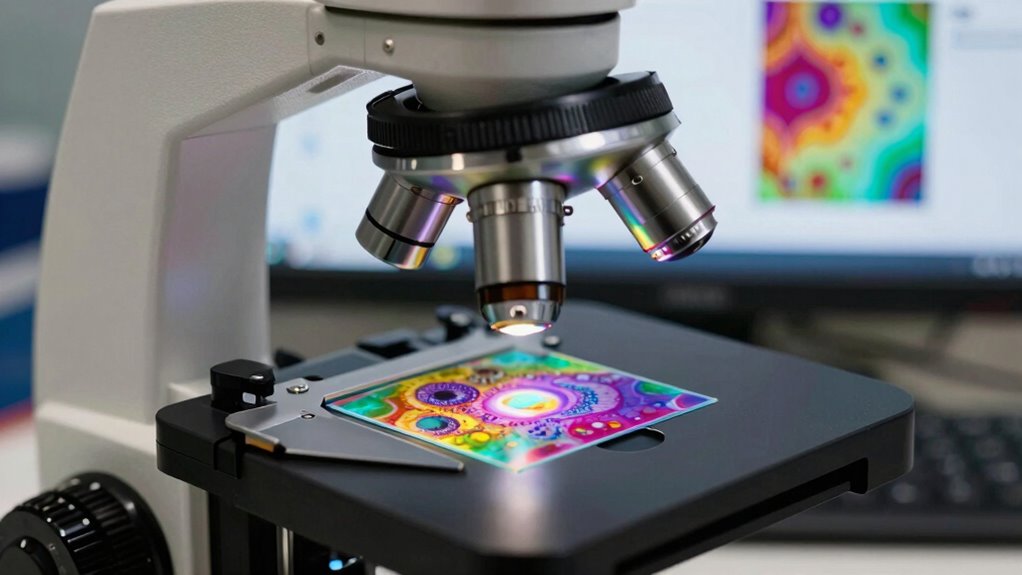
Digital microscopes have become increasingly popular because they offer a convenient way to observe tiny details without the need for traditional eyepieces. Instead of squinting through lenses, you get a clear digital display, making it easier to analyze specimens and share findings. One of the main advantages you’ll notice is the impressive image quality these devices can provide. High-resolution sensors capture detailed, crisp images that reveal intricate features often missed with traditional microscopes. Whether you’re examining biological samples or inspecting small components in electronics, this sharp image quality helps you identify flaws, structures, or patterns with precision.
Digital microscopes offer high-resolution images, making it easier to analyze tiny details and share findings with clarity.
However, the quality of the image isn’t just about resolution. The user interface plays an essential role in your overall experience. Many digital microscopes come with intuitive controls—touchscreens, simple menus, and easy-to-navigate settings—that make operating the device straightforward, even if you’re new to microscopy. A user-friendly interface allows you to quickly adjust magnification, change lighting, or capture images without frustration. This ease of use means you spend less time fiddling with controls and more time analyzing your specimens or conducting experiments. It also helps when working with multiple people, as everyone can understand and operate the device without needing extensive training.
Despite these strengths, digital microscopes do have limitations. The image quality, while generally excellent, can suffer in low-light conditions or when working with reflective surfaces. Some cheaper models struggle to produce consistent clarity, which can hamper detailed analysis. Also, the user interface, though often designed to be simple, varies greatly between brands and models. Cheaper options might have cluttered menus or confusing controls, leading to a frustrating experience. Additionally, digital microscopes rely heavily on electronic components, which means they can be more fragile and susceptible to technical issues compared to traditional microscopes. Moreover, the digital display quality can vary, impacting how well you can interpret details on the screen. Furthermore, many digital microscopes lack advanced features like depth perception, which are often essential in specialized fields. As technology advances, some models are incorporating image stabilization to improve viewing stability, but this feature is not yet standard across all devices.
Another area where they fall short is in depth perception. Unlike traditional microscopes with stereoscopic views, many digital versions provide a flat, two-dimensional image. This limits your ability to gauge the depth or three-dimensional structure of a specimen, which can be critical in certain applications like biological research or material inspection. Some models attempt to compensate with 3D imaging technology, but these are often more expensive and less common. Moreover, the need for a power source and potential latency in live viewing can sometimes hinder real-time examination. Additionally, the absence of tactile feedback can make focusing and adjusting settings less intuitive for some users.
high resolution digital microscope
As an affiliate, we earn on qualifying purchases.
As an affiliate, we earn on qualifying purchases.
Frequently Asked Questions
Can Digital Microscopes Be Used for Professional Laboratory Research?
Yes, you can use digital microscopes for professional laboratory research, especially for remote analysis and sharing findings easily. They often feature user-friendly interfaces that simplify capturing images and data, making complex tasks more manageable. However, their resolution and magnification limitations might fall short for highly detailed, advanced research. So, while great for many applications, they may not replace traditional microscopes for all professional scientific needs.
How Do Digital Microscopes Compare to Traditional Optical Microscopes in Resolution?
Digital microscopes generally offer lower resolution than traditional optical microscopes because of their limited image quality and magnification limits. While they excel in capturing and sharing images digitally, they often can’t match the fine detail and clarity of glass lenses. You might notice a slight compromise in resolution, especially at higher magnifications, making traditional microscopes better suited for detailed scientific research where precision is essential.
Are Digital Microscopes Suitable for Educational Purposes in Classrooms?
Digital microscopes are great for classroom use because they feature an interactive display and a user-friendly interface, making it easy for students to engage and learn. You can share the screen with the class, enhancing group discussions. Their simple controls and instant images help students understand complex details quickly. However, they might lack the high resolution of traditional microscopes, so for advanced studies, traditional tools could still be necessary.
What Are the Maintenance Requirements for Digital Microscopes?
You need to regularly clean the lenses with a soft cloth to maintain calibration accuracy and prevent dust buildup. Check the batteries often to guarantee battery longevity, replacing or recharging as needed. Keep the software updated for peak performance. Store the microscope in a dry, safe place to avoid damage. Periodic calibration checks help maintain image quality, ensuring your digital microscope remains reliable for precise observations.
Do Digital Microscopes Support 3D Imaging or Depth Measurement?
Digital microscopes can support 3D imaging and depth measurement, but it depends on the model. Many high-end versions include stereo lenses or software features that allow you to capture 3D images and analyze depth accurately. However, not all digital microscopes have this capability, especially budget-friendly options. If 3D imaging and depth measurement are essential for your work, make sure to choose a model explicitly designed with those features.
digital microscope with adjustable lighting
As an affiliate, we earn on qualifying purchases.
As an affiliate, we earn on qualifying purchases.
Conclusion
So, if you’re ready to swap your trusty old magnifying glass for a fancy digital microscope, just remember: they’re great for showing off tiny details to your friends and maybe even catching a few sneaky bugs. But don’t expect them to replace a real lab setup anytime soon—unless you’re planning to investigate alien life on a budget. Ultimately, digital microscopes are fun toys, not miracle workers. Happy exploring—just don’t forget your glasses!
USB digital microscope for electronics
As an affiliate, we earn on qualifying purchases.
As an affiliate, we earn on qualifying purchases.
digital microscope with image stabilization
As an affiliate, we earn on qualifying purchases.
As an affiliate, we earn on qualifying purchases.
Halloween Picks
halloween
As an affiliate, we earn on qualifying purchases.


![GPT-5.6 Sol Ultra produces proof of the Cycle Double Cover Conjecture [pdf]](https://curiousminds.info/wp-content/uploads/2026/07/gpt-5-6-sol-ultra-produces-proof-of-the-cycle-double-cover-conjecture-pdf-featured-560x300.jpg)