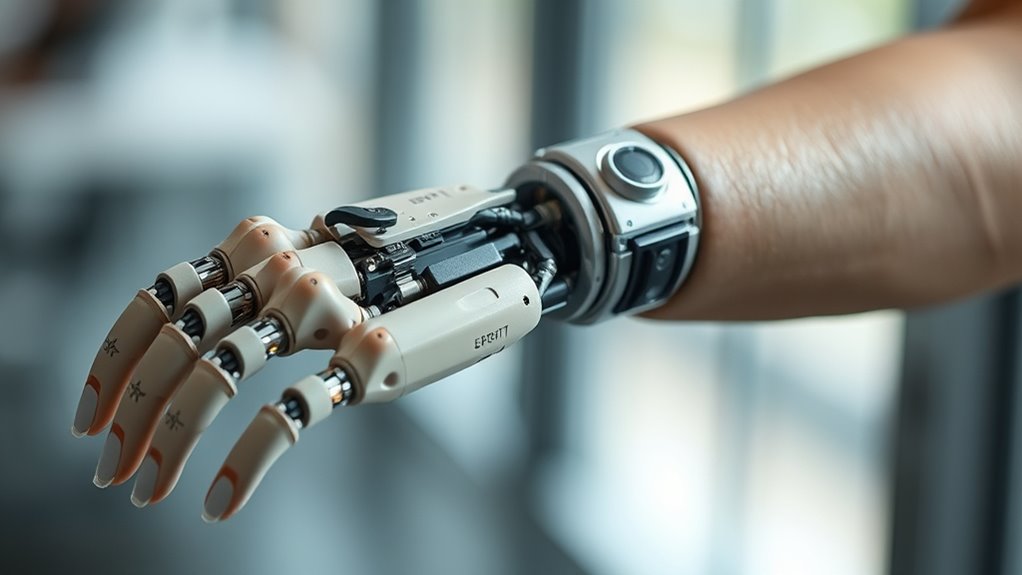

Advances in brain-computer interface technology now allow your prosthetic arm to learn your movements using AI. These systems record electrical signals from your motor cortex and translate them into movement commands, adapting over time to your unique patterns. The AI enhances control, making movements more natural and effortless, and even provides sensory feedback for better fine motor skills. As this technology evolves, your prosthetic becomes smarter and more responsive, helping restore confidence and independence—exploring further reveals how close this is to natural limb function.

Prime made for students and young adults
- Fast, free delivery for dorm and study essentials
- Prime Video and Amazon Music included
- Member-only deals
Key Takeaways
- Neural interfaces record brain signals to control prosthetic movements directly.
- AI analyzes neural data to personalize and adapt to user movement patterns over time.
- Machine learning improves prosthetic responsiveness, making movements more natural and intuitive.
- The system enables complex actions like grasping and typing with sensory feedback integration.
- Continuous AI advancements aim to restore natural limb functions and enhance user independence.
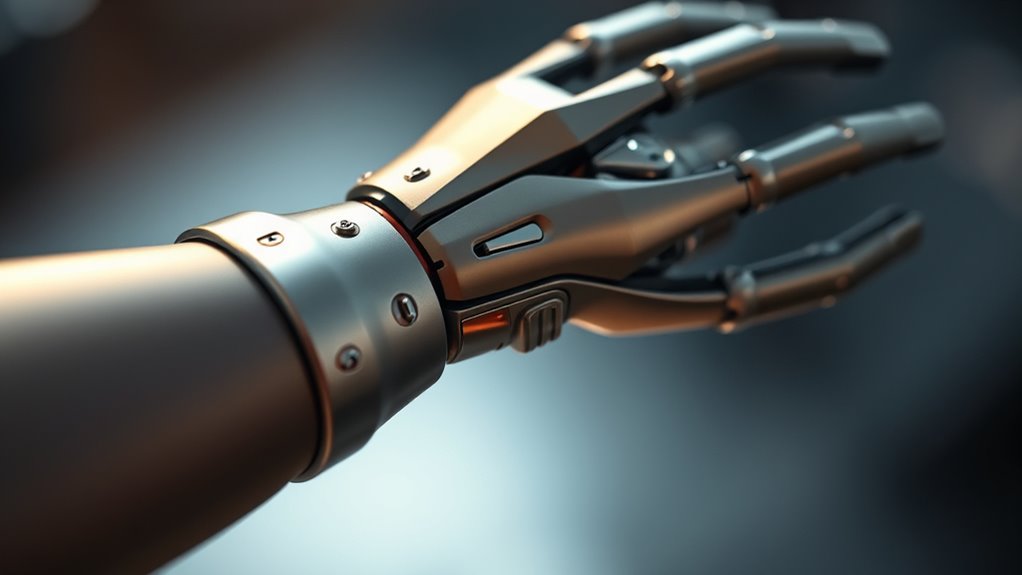
Imagine being able to control a prosthetic arm simply by thinking about movement—that’s the promise of mind-controlled prosthetics. Advances in neural interface technology have brought this vision closer to reality. A neural interface acts as a bridge between your brain and the prosthetic, translating your thoughts into commands that move the robotic arm. This interface records electrical signals from your brain’s motor cortex, which governs movement, and sends those signals to the prosthetic’s control system. The key to seamless operation lies in how well the system interprets your intentions and executes them with precision.
Thanks to artificial intelligence, these systems are now learning your unique movement patterns. As you use the prosthetic, AI algorithms analyze the neural signals, adapting and improving the system’s understanding of your specific commands. Over time, the prosthetic becomes more intuitive to control, mimicking the natural movement you’re accustomed to. This continuous learning process enhances robotic dexterity, giving you smoother, more coordinated actions. Instead of relying on pre-programmed movements or manual controls, you gain a level of fluidity and responsiveness that closely resembles natural limb function.
AI continuously learns your neural signals, making prosthetic movements more natural, responsive, and intuitive over time.
The integration of AI doesn’t just improve control; it also reduces the mental effort required to operate the prosthetic. Early prototypes often demanded significant concentration, which could be exhausting. But as the AI learns your neural patterns, controlling the prosthetic becomes more effortless. You can focus on your task rather than on the mechanics of movement, restoring a sense of normalcy and independence. The system’s ability to adapt to subtle changes—such as fatigue or emotional state—further enhances usability, making the experience more natural.
Furthermore, the development of neural interface technology and AI-driven learning has opened new possibilities for more complex movements and improved sensory feedback, bringing prosthetic capabilities closer to natural limb function. Movements once considered difficult or impossible become achievable. Fine motor skills, like grasping a delicate object or typing on a keyboard, are now within reach. This progress isn’t just about technological innovation; it’s about empowering you to regain control over your daily life. As AI continues to evolve, these prosthetics will become even smarter, more responsive, and better at mimicking natural movement. The future of mind-controlled prosthetics promises a world where your thoughts directly translate into precise, fluid actions, restoring both function and confidence.
As an affiliate, we earn on qualifying purchases.
Frequently Asked Questions
How Long Does It Take to Train the AI for Individual Users?
Training duration for individual users varies but generally takes a few hours to a few days, depending on user adaptation. You’ll notice progress quickly as the AI learns your specific movement patterns. Consistent practice helps the system adapt faster, improving control and responsiveness. Keep in mind, initial training may feel challenging, but as you continue, the prosthetic becomes more intuitive, making everyday tasks easier and more natural for you.
Can the Prosthetic Arm Perform Delicate Tasks Accurately?
You can perform delicate tasks accurately with this prosthetic arm, especially after proper sensor calibration, which fine-tunes its responsiveness. Imagine carefully threading a needle; the AI adapts quickly to your subtle movements, ensuring precision. User comfort is key, so sensors are designed to be minimally intrusive. With ongoing adjustments, this prosthetic becomes highly capable of handling intricate tasks, giving you confidence in daily activities.
What Are the Costs Associated With Acquiring Such a Prosthetic?
The cost considerations for a mind-controlled prosthetic arm can vary widely, often ranging from $50,000 to over $100,000 depending on features and customization. You should check if your insurance coverage helps offset the expenses, as some plans may cover part of the cost for advanced prosthetics. Keep in mind that additional costs might include maintenance, training, and updates, so plan accordingly.
How Durable Is the Prosthetic Arm With Daily Use?
You’ll find your prosthetic arm quite durable with daily use, thanks to high-quality material resilience. It’s designed to withstand everyday activities like typing or light lifting, but regular maintenance is essential to keep it in top shape. Simple cleaning and periodic checks ensure the arm remains reliable, reducing the risk of breakdowns. Overall, with proper care, your prosthetic can serve you consistently, providing confidence in its resilience.
Are There Any Risks of the AI Misinterpreting User Intentions?
Yes, there are risks of AI misinterpreting your intentions, leading to unintended activation. Privacy concerns also arise because the prosthetic constantly processes your neural signals, potentially exposing sensitive data. To minimize these risks, the system uses advanced algorithms and safeguards, but you should stay informed about updates and make sure your device’s security settings are properly configured. Always report any unexpected behavior to maintain safe and effective control.
neural interface prosthetic device
As an affiliate, we earn on qualifying purchases.
As an affiliate, we earn on qualifying purchases.
Conclusion
Think of this new prosthetic arm as a loyal apprentice, enthusiastic to learn your unique dance. With AI as its wise mentor, it gradually masters your movements, becoming an extension of your will. Together, you form a seamless duet, where mind and machine move as one. This breakthrough isn’t just technology; it’s a new chapter where your thoughts guide your world. Soon, you’ll feel like the conductor of your own symphony, perfectly in sync.
As an affiliate, we earn on qualifying purchases.
As an affiliate, we earn on qualifying purchases.
Halloween Picks
halloween
As an affiliate, we earn on qualifying purchases.