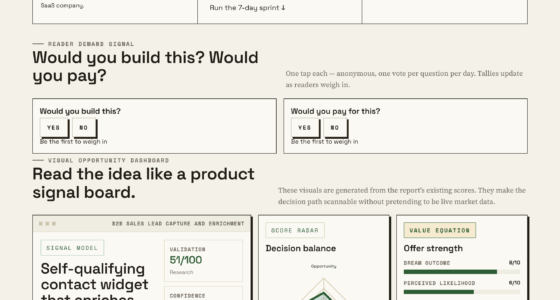

📊 Full opportunity report: Capital: The Lever Beneath the Levers on ThorstenMeyerAI.com — validation score, market gap, and execution plan.

Prime made for students and young adults
- Fast, free delivery for dorm and study essentials
- Prime Video and Amazon Music included
- Member-only deals
TL;DR
In 2026, the largest private AI firms listed publicly, marking a major transfer of risk and capital. The cycle creates circular funding loops that may threaten economic stability.
In June 2026, SpaceX/xAI, Anthropic, and OpenAI listed on public markets, marking the largest wave of AI company IPOs and revealing the scale of capital fueling the sector’s expansion. This development underscores how the flow of investment is shaping AI’s future and exposing systemic risks, making capital the critical but fragile chokepoint beneath AI’s technological levers.
On June 12, SpaceX/xAI debuted on the Nasdaq with a valuation near $1.77 trillion, briefly surpassing $2 trillion in early trading and creating the world’s first trillionaire. The offering was heavily oversubscribed, with about 30% of shares reserved for retail investors, well above typical allocations. Simultaneously, Anthropic filed confidentially with a valuation around $965 billion, and OpenAI is expected to list at between $730 billion and $850 billion. These IPOs represent a combined private value of roughly $4 trillion set to hit public markets within 18 months.
According to Bank of America, this marks a large-scale transfer of risk from early investors to the public, with many insiders, including over 600 OpenAI staff, having already sold billions in stock. The flow of capital is tightly interconnected: major tech firms like Microsoft, Amazon, and Google are investing heavily into Nvidia, which supplies AI hardware, creating a circular funding loop that amplifies demand but also introduces systemic vulnerabilities.
Capital: The Lever Beneath the Levers
Every chokepoint costs money — so whoever can fund the buildout decides who builds at all. In 2026 the bill came due in public: a trillion-dollar IPO wave, financed by a circle of firms paying each other, now sold to everyone else.
The meta-chokepoint: it gates the other five, because you can’t build any of them without clearing the capital bar. A synchronized machine has no natural brake — no one can slow first — and the IPO wave moves the risk to the public as insiders take gains. The hedge is solvency that doesn’t depend on the music playing: sane burn, own what’s cheap, self-host where you can.
Risks of Circular Funding and Market Fragility
This pattern of interconnected investments and circular demand creates a fragile financial structure. It risks triggering cascades of demand reduction if one node slows, and it may lead to mispriced capacity, where companies justify capital expenditure based on internal demand rather than external market needs. The reliance on debt-financed infrastructure and a thin base of paying customers heightens the threat of economic instability if confidence wanes.
As an affiliate, we earn on qualifying purchases.
The Evolution of Capital Flows in AI Development
Historically, AI development was driven by private investment and research, but recent years have seen a shift towards large-scale public funding through IPOs and secondary markets. The recent listings of SpaceX/xAI, Anthropic, and OpenAI reflect a broader trend of private firms moving into public markets, transferring risk and capital into the hands of retail and institutional investors. This cycle is supported by massive infrastructure spending, with estimates of over $3 trillion in global data-center investments planned between 2025 and 2028, much of it debt-funded.
However, the demand for AI products remains limited among consumers, with only about 3% paying for AI services, raising concerns about the sustainability of such high valuations and the potential for systemic shocks if demand falters.
“There is more greed than fear right now, and plenty of liquidity — so long as optimism remains.”
— Goldman’s CEO
AI startup funding analysis reports
As an affiliate, we earn on qualifying purchases.
As an affiliate, we earn on qualifying purchases.
Unclear Risks of Market Collapse and Systemic Shock
While the current cycle of AI IPOs and infrastructure investments is well-documented, it remains uncertain how susceptible the system is to a sudden downturn. The reliance on debt financing, internal demand loops, and limited consumer paying base introduces potential points of failure. Analysts warn of the possibility of a cascade effect if demand drops or if one major node, such as Nvidia or Microsoft, pulls back, but concrete evidence of an imminent crisis is not yet available.
public market investment tools for AI
As an affiliate, we earn on qualifying purchases.
As an affiliate, we earn on qualifying purchases.
Monitoring Market Responses and Infrastructure Spending
The coming months will reveal how the market absorbs these high valuations and whether demand for AI products can sustain the current investment levels. Key indicators include the performance of AI-related stocks, the pace of infrastructure spending, and any shifts in corporate investment strategies. Regulatory and macroeconomic factors may also influence the stability of this interconnected system.
As an affiliate, we earn on qualifying purchases.
Key Questions
Why are AI companies listing publicly now?
They seek to raise capital to fund ongoing development and infrastructure, transferring risk from private investors to the broader public market amid high valuations.
What risks does the circular funding model pose?
It creates a fragile ecosystem where demand and capacity can become misaligned, increasing the risk of cascading failures if one node slows or pulls back.
How much capital is expected to be invested in AI infrastructure?
Estimates suggest over $700 billion will be spent in 2026 alone, much of it debt-financed, with total global data-center spending projected at around $3 trillion between 2025 and 2028.
What could trigger a systemic crisis in this cycle?
A sudden drop in demand, a major technological failure, or a significant pullback by key players like Microsoft or Nvidia could cause a cascade of financial and operational failures.
Source: ThorstenMeyerAI.com
Halloween Picks
halloween
As an affiliate, we earn on qualifying purchases.