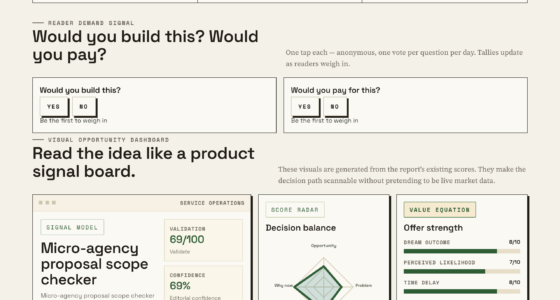

📊 Full opportunity report: Outcome-First Decisions: The Friction Is The Feature on ThorstenMeyerAI.com — validation score, market gap, and execution plan.

Prime made for students and young adults
- Fast, free delivery for dorm and study essentials
- Prime Video and Amazon Music included
- Member-only deals
TL;DR
Outcome-First Decisions is a decision-making tool that emphasizes testing and evidence before planning. It offers five verdicts and a buyer evidence ladder, helping businesses make faster, more reliable choices. This approach aims to reduce wasted time and money on unvalidated ideas.
Outcome-First Decisions is a decision-making approach and open-source skill designed to help businesses validate ideas quickly by focusing on testing and evidence rather than elaborate plans. It aims to prevent costly missteps by forcing clarity and action at every step, making decision processes faster and more reliable.
The framework introduces five verdicts — worth doing, test first, change, defer, drop — each accompanied by plain-language reasoning. It emphasizes that a buyer who pays today is more trustworthy than one who merely expresses future intent, which is reflected in its Buyer Evidence Ladder. The ladder ranks evidence from opinion to repeat purchase, guiding users to test and validate before scaling investments.
Designed as an open-source skill, it integrates with AI agents and industry overlays for sectors like SaaS, healthcare, and e-commerce. Explore how Outcome-First Decisions can enhance your decision processes. The system can also adapt to emergency situations, providing rapid, decisive actions—such as in cash crises—without unnecessary details. The tool logs decisions and calibrates future expectations based on past accuracy, helping users build a more reliable decision track record over time.
The Friction Is the Feature
Most tools help you do more. This one helps you do less — and proves the “less” is the part that earns. It turns a fuzzy decision into a verdict, a one-week proof test, and three actions for today.
Missing one? It doesn’t cheer you forward — it asks the smallest question that fills the gap. When the evidence is an opinion, the answer is “test first,” not a 12-week plan. That’s $250 to learn the truth instead of three months.
A click is not a customer. A “great idea” is not revenue. The skill reads where your evidence sits and designs the cheapest test that moves you up exactly one rung.
So your next “80%” gets discounted accordingly — and the rungs you habitually skip get flagged. You’re not just deciding; you’re building a calibrated instrument out of your own track record.
- Triggered by runway, missed payroll, a lost biggest customer.
- A one-line verdict and three actions with hour-level deadlines.
- The dollar number below which the business closes.
- Scoring tables and framework talk disappear — busywork in an emergency.
- Every active bet with its evidence rung, capacity cost, and kill date.
- At most two unproven bets at once. No bet without a kill date.
- Killed capacity reallocated by name, not vaguely “freed up.”
- Numbers carry provenance — no verdict rides on a half-remembered figure.
mkdir -p ~/.claude/skills && unzip outcome-first-decisions.zip -d ~/.claude/skills/
The honest tradeoff: it will not flatter you. Thin evidence, it says so; an idea that should die, it says so plainly. If you want reassurance, it’s the wrong tool. If you want fewer, better-aimed bets and a verdict you can defend — the friction is the feature.
Independent commentary, produced with AI assistance under human editorial oversight. The views are the author’s own and may change. Outcome-First Decisions is a decision-support tool, not business, financial, legal, or investment advice; its verdicts are one input to your own judgment, not a guarantee of outcomes, and dollar figures are illustrative. Software provided under its stated open-source licence, as-is, without warranty. Product, model, and company names are trademarks of their respective owners; mention does not imply endorsement.
Impact of Evidence-Driven Decision Frameworks on Business Validation
This approach shifts decision-making from intuition and vague optimism to structured, evidence-based validation, reducing the risk of costly failures. It encourages businesses to prioritize testing and real customer proof over elaborate planning, which can often lead to wasted months and resources. Over time, it helps build a calibrated decision record, improving accuracy and confidence in future choices.
By focusing on immediate actions and measurable proof, Outcome-First Decisions can accelerate startup growth, improve resource allocation, and foster a culture of disciplined experimentation. Its industry overlays ensure relevance across sectors, making it adaptable and practical for various business models.
As an affiliate, we earn on qualifying purchases.
Evolution of Business Validation Methods and Decision Tools
Traditional decision frameworks often rely on extensive planning, market research, and assumptions, which can lead to prolonged cycles of uncertainty and sunk costs. Recent trends in lean startup methodologies and agile decision-making emphasize rapid testing and learning. Outcome-First Decisions builds on these principles but formalizes them into a structured, repeatable process that integrates with AI tools and industry-specific metrics.
Since its emergence, the framework has been adopted by early users seeking to reduce wasted effort and improve decision accuracy. Its focus on immediate testing and logging aligns with broader shifts toward data-driven, evidence-based business management.
“Most ideas cost a quarter, and almost none are bad ideas. The real problem is spending three months building before knowing if anyone will pay. Our approach stops that waste at the source.”
— Thorsten Meyer, creator of Outcome-First Decisions
As an affiliate, we earn on qualifying purchases.
Unconfirmed Aspects and Areas for Further Validation
While the framework shows promise, it is still early in adoption. It remains to be seen how well it scales across different industries and company sizes. Its long-term impact on decision accuracy and business outcomes has not yet been rigorously studied or validated through extensive empirical data.
Additionally, the effectiveness of the AI integrations and industry overlays in diverse real-world scenarios requires further testing and feedback from broader user groups.
As an affiliate, we earn on qualifying purchases.
Next Steps for Adoption and Validation of the Framework
Further user adoption and case studies will clarify the framework’s practical benefits and limitations. Developers and early adopters are expected to share results, especially regarding decision accuracy, resource savings, and business growth impacts. Integration with more industries and refinement of the AI overlays are also anticipated to expand its relevance and effectiveness over the coming months.
Expect ongoing updates and community-driven improvements as the open-source skill gains wider use in startup and corporate environments.
product testing tools for startups
As an affiliate, we earn on qualifying purchases.
As an affiliate, we earn on qualifying purchases.
Key Questions
How does Outcome-First Decisions differ from traditional planning tools?
It emphasizes testing and evidence before creating detailed plans, focusing on rapid validation and immediate actions rather than lengthy roadmaps.
Can this framework be used in emergency situations?
Yes, it has a specialized ‘Crisis Mode’ that provides rapid, decisive actions with minimal detail, ideal for urgent business crises.
What industries is the framework most suitable for?
It is designed to be adaptable, with overlays for sectors like SaaS, healthcare, e-commerce, and more, but can be customized for others.
Will this approach replace traditional decision-making processes?
It aims to complement and improve existing processes by adding a rigorous testing mindset, especially for early-stage validation.
How does the framework help improve decision accuracy over time?
It logs decisions and tracks your historical hit rate, calibrating future judgments and reducing bias and overconfidence.
Source: ThorstenMeyerAI.com
Fall Picks
fall essentials
As an affiliate, we earn on qualifying purchases.