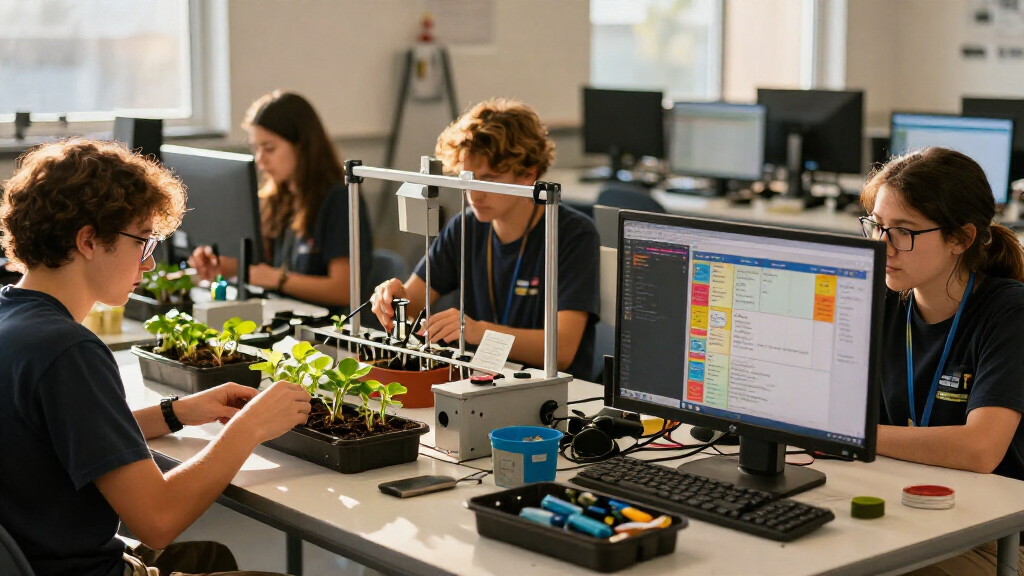
🔍 Read the full analysis: The Three Sectors Behind Jobs: Field, Factory, Office on ThorstenMeyerAI.com

Prime made for students and young adults
- Fast, free delivery for dorm and study essentials
- Prime Video and Amazon Music included
- Member-only deals
TL;DR
ThorstenMeyerAI.com began a 60-episode series on how economies and work have changed, opening with the three-sector model: primary, secondary and tertiary. Its cited figures show a long decline in agricultural employment and a global shift toward services, while noting that sector classifications vary and the data are not directly comparable in every case.
ThorstenMeyerAI.com published the first episode of its planned 60-part series, Work After Work, on Nov. 2, using the three-sector model to explain how employment has shifted from agriculture to manufacturing and services. The episode brings together historical estimates and recent employment data to frame a wider series about how work changes as technology advances.
The episode organizes economic activity into three broad categories: the primary sector, which takes resources from nature, including farming, fishing and forestry; the secondary sector, which makes or builds things, including manufacturing, construction and energy; and the tertiary sector, which provides services such as trade, transport, health care, education and government. Some statistical systems classify mining differently, and the boundaries can also blur for jobs such as software engineering at a manufacturer.
The article cites estimates from economic historian Stanley Lebergott showing that farming accounted for 73.7% of the U.S. labor force in 1800, 54.8% in 1850, 40.2% in 1900 and 12.0% in 1950. It also cites an International Labour Organization modelled estimate that agriculture represented 1.5% of U.S. employment in 2025. These figures use different source series and reference periods, so they should be read as evidence of a long-term shift rather than a single consistent contemporary measurement.
The episode points to other national and global changes. It says China’s primary-sector employment share fell from 83.5% in 1952 to 22.2% in 2024, and Japan’s fell from 53.8% in 1920 to 3.2% in 2020. Citing ILO modelled estimates, the article says services have employed more people worldwide than farming since 2001. The series presents those figures as context for its central question: where workers go when technology changes how goods and services are produced.
Why the Sector Shift Matters
The three-sector model offers a compact way to understand a major change in working life: employment has moved away from farming as productivity and economic activity changed. The shift matters because it helps explain why the composition of jobs can change even when demand for food and other goods continues. Fewer workers may be needed in one sector while employment expands elsewhere.
The model also cautions against treating “factory” and “office” as simple opposites or assuming that falling factory employment means a country no longer manufactures. ThorstenMeyerAI.com says U.S. factory jobs are about 35% below their June 1979 peak, while real manufacturing output in 2025 was about 1.9 times its 1979 level. Those figures use distinct measures: job counts and inflation-adjusted output. They suggest that production and employment can move differently, but do not by themselves explain the causes of that divergence.
For readers following automation and employment, the series’ framework provides a way to track movement between types of work. It does not establish what future technologies will do. The article labels its proposal that automation could become a sector of its own, performing up to 90% of work without a human hand, as the author’s thesis, not a measured forecast or confirmed outcome.
Popular right now

Vitamix 5200 Professional-Grade Blender, 64 oz. Container, Black

Dyson Airwrap i.d. Multi-Styler for Straight and Wavy Hair

Ninja CREAMi 7-in-1 Ice Cream Maker, NC301
As an affiliate, we earn on qualifying purchases.
How Economists Built the Three Sectors
The categories predate their familiar three-part form. In the episode’s account, “primary industry” and “secondary industry” were already used in early 20th-century statistical discussions in Australia and New Zealand. New Zealand economist Allan G. B. Fisher added “tertiary” in work written in 1934 and published in 1935. He later described the shift from primary activities toward secondary and, to a greater extent, tertiary production.
Economist Colin Clark compared employment patterns across countries in The Conditions of Economic Progress, published in 1940. He used the framework to examine movement from agriculture to manufacturing and services, and observed that industry’s share of employment could rise and later fall. French economist Jean Fourastié, writing in 1949, argued that services could absorb workers displaced as technology increased productivity in industry. These were influential interpretations, not guarantees that every country would follow one identical path.
The episode is the opening installment of Work After Work, described by ThorstenMeyerAI.com as a daily series of 60 episodes about how economies are built, how work has moved, and which tasks may remain human as machines take on more work. It says a later installment, episode 48, will examine the author’s automation thesis.
“The three boxes are blunt.”
— Thorsten Meyer, ThorstenMeyerAI.com
Limits of the Employment Comparisons
The figures cited in the episode come from different sources, countries, definitions and years. The U.S. historical figures attributed to Lebergott cover a labor force defined as people aged 10 and older, while the 2025 figure is an ILO modelled estimate. The article does not provide enough detail in the supplied material to reconcile those methods or treat them as one uninterrupted series.
Sector boundaries also differ: the episode notes that mining is counted as primary activity in many statistics but as secondary activity in some classifications. Employment shares describe where workers are categorized, not the full value of output, productivity, wages or job quality. The cited U.S. factory employment and real-output comparison does not identify the causes of the gap between those trends.
The proposed automation sector and the claim that it could perform up to 90% of work are the author’s thesis. The episode does not provide a method, time horizon precise enough to test, or independent evidence establishing that figure. The series says it plans to revisit the idea in episode 48; until then, it remains a claim for discussion rather than a confirmed development.
The Series Turns to Automation
ThorstenMeyerAI.com describes Work After Work as a daily 60-episode series. Its first installment uses the movement among field, factory and office work as the starting point for later discussions of technology and employment. The supplied material does not specify publication dates for individual episodes beyond the launch date.
The site says episode 48 will put Meyer’s automation thesis “on trial.” That installment is the stated next milestone for examining the claim that automation may become a distinct economic sector. Until the episode is published, the evidence and criteria the author will use to test the thesis remain unclear.
Key Questions
What are the three sectors in the episode?
The primary sector takes resources from nature, the secondary sector makes or builds things, and the tertiary sector provides services. The episode notes that classifications can vary, especially for mining and some jobs connected to manufacturing.
What is the main employment change described?
The episode describes a long-term shift from agriculture toward manufacturing and services. It cites Lebergott estimates that farming’s share of the U.S. labor force fell from 73.7% in 1800 to 12.0% in 1950, alongside a separate ILO modelled estimate of 1.5% for U.S. employment in 2025.
Does lower factory employment mean the United States stopped manufacturing?
No. The episode says U.S. factory jobs were about 35% below their June 1979 peak, while real manufacturing output in 2025 was about 1.9 times its 1979 level. The two figures measure employment and inflation-adjusted output, respectively, and do not explain why their trends differ.
Is automation already a fourth economic sector?
The episode does not establish that. Meyer describes automation becoming a sector of its own, potentially doing up to 90% of work without a human hand, as his thesis. The series says episode 48 will examine that claim.
Source: ThorstenMeyerAI.com