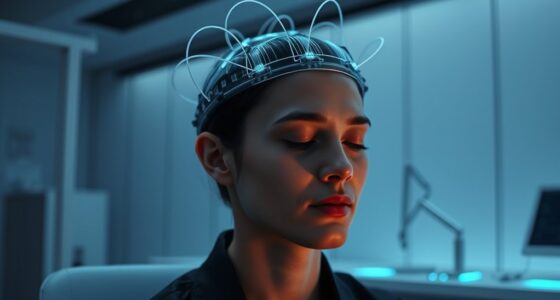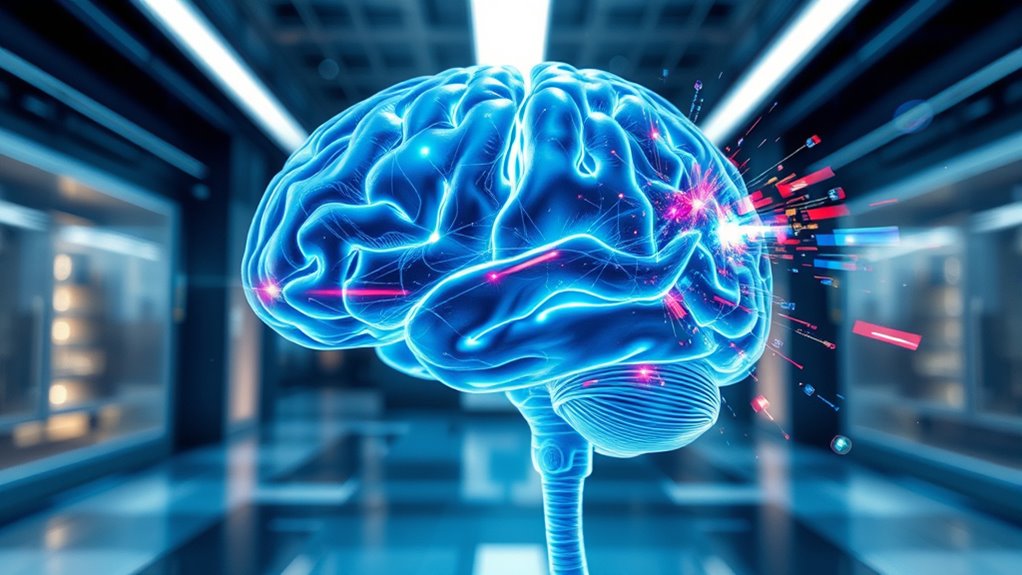

Déjà vu happens when your brain’s neural pathways misfire, making you feel like you’ve experienced something before. This brief glitch occurs because the brain temporarily confuses current sensations with past memories, often due to delays or misfiring in areas like the hippocampus. These neural hiccups are usually harmless and show how delicate and complex your memory system really is. If you want to uncover more about what causes these intriguing momentary glitches, keep exploring the fascinating science behind déjà vu.

Prime made for students and young adults
- Fast, free delivery for dorm and study essentials
- Prime Video and Amazon Music included
- Member-only deals
Key Takeaways
- Déjà vu occurs when neural pathways activate prematurely, creating a false sense of familiarity with current experiences.
- Misfiring or delays in memory-related brain regions like the hippocampus cause brief glitches in memory processing.
- Recognition before detailed recall leads the brain to interpret present stimuli as past memories.
- These fleeting neural misfires reveal the brain’s delicate and complex memory systems.
- Scientific study of déjà vu helps understand normal memory glitches and the brain’s intricate functioning.

Have you ever experienced the strange sensation that a moment you’re living has already happened? That eerie feeling of familiarity can catch you off guard, making you question if you’ve slipped into a déjà vu moment. Scientists believe this sensation stems from how your brain processes memories, particularly through neural pathways that form the basis of memory processing. When you encounter a situation or environment that resembles a past experience, these neural pathways activate, triggering that uncanny sense of familiarity. But sometimes, this activation happens too early or out of sync, creating a glitch in your brain’s normal functioning.
Your brain uses neural pathways to connect bits of information, allowing you to remember past events and make sense of your current experiences. When you see a place, hear a phrase, or feel a certain emotion, these pathways fire to retrieve related memories. In déjà vu episodes, it’s thought that a misfiring occurs—either your brain mistakenly interprets a current situation as a past one, or it briefly confuses the process of memory recognition. This misfiring can happen due to a delay between the neural signals that process familiarity and those that confirm detailed recall. Essentially, your brain recognizes something as familiar before it fully retrieves the specific memory, leading to that fleeting sense of “I’ve been here before.”
Your brain confuses familiarity with memory, causing that fleeting déjà vu sensation.
Memory processing plays a vital role in this phenomenon. Normally, your brain distinguishes between real memories and current experiences, ensuring you don’t confuse the two. However, during a déjà vu episode, the boundary between the two blurs. Your brain’s hippocampus and surrounding regions, which are responsible for encoding and retrieving memories, might get temporarily misaligned. This misalignment causes the brain to interpret current perceptions as familiar memories, even if there’s no real connection to past events. The entire process showcases how intricate and delicate our memory systems are; a tiny glitch in the neural pathways can produce a vivid, yet fleeting, sense of familiarity.
Scientists continue to study these neural and memory-related mechanisms to understand why déjà vu happens. While it’s often harmless and brief, it reveals how complex and fragile our memory processing system truly is. In moments of déjà vu, your brain’s neural pathways temporarily deceive you, making the present feel like a familiar fragment from the past. Recognizing these glitches as normal quirks of memory processing can help you appreciate the fascinating and sometimes mysterious workings of your mind.
memory foam pillow for brain health
As an affiliate, we earn on qualifying purchases.
As an affiliate, we earn on qualifying purchases.
Frequently Asked Questions
Can Déjà Vu Predict Future Memories or Events?
You might wonder if déjà vu can predict future memories or events. While some believe it’s a predictive illusion, research shows it’s more likely a memory illusion caused by the brain misfiring. Déjà vu tricks you into thinking you’ve experienced something before, but it doesn’t actually forecast what’s coming. Instead, it’s a fascinating glitch in your memory system, revealing how your brain sometimes confuses past and present.
Is Déjà Vu Linked to Specific Brain Regions?
Imagine your brain as a bustling city, and suddenly, you feel you’ve been here before. This sensation links to specific brain regions, mainly the hippocampal misfiring within your temporal lobe. These areas coordinate memory formation, and when they glitch, déjà vu occurs. So, yes, déjà vu is tied to these regions, revealing how your brain’s intricate network sometimes misfires, creating that eerie sense of familiarity.
How Often Do People Experience Déjà Vu in a Lifetime?
You probably experience déjà vu roughly 2 to 10 times in your lifetime. This phenomenon occurs due to brief glitches in memory formation and cognitive processes, causing your brain to interpret new experiences as familiar. These episodes are more common than you might think and highlight how your brain continuously works to process and store memories. Understanding this frequency helps you appreciate the complex ways your mind handles memory and perception.
Are There Cultural Differences in Experiencing Déjà Vu?
You might notice that cultural interpretations influence how you perceive déjà vu, shaping whether you see it as a spiritual sign or a mere coincidence. Different cultures experience cross-cultural experiences with déjà vu uniquely, often attributing it to spiritual or supernatural factors. These cultural differences affect how you interpret and respond to the phenomenon, highlighting that déjà vu isn’t just a universal experience but also deeply rooted in cultural beliefs and narratives.
Can Déjà Vu Be a Symptom of Neurological Conditions?
Imagine your brain as a busy city, and sometimes, neural misfiring causes traffic jams. Déjà vu can be a symptom of neurological conditions when the temporal lobe, which processes memories, malfunctions. This misfiring sends false signals, making you feel like you’ve seen a situation before. If you experience frequent déjà vu, it’s wise to consult a doctor, as it might indicate underlying neurological issues needing attention.
As an affiliate, we earn on qualifying purchases.
Conclusion
As you experience déjà vu, remember it’s like a fleeting glitch in your mind’s intricate network, a reminder that your memory can sometimes play tricks on you. These moments reveal how your brain processes familiarity and novelty, blending science and mystery. Just as a song repeats unexpectedly, your brain loops back to a familiar moment, sparking curiosity about the hidden workings of memory. Embrace these glitches—they’re fascinating glimpses into how your mind truly functions.
As an affiliate, we earn on qualifying purchases.
brain memory enhancement devices
As an affiliate, we earn on qualifying purchases.
As an affiliate, we earn on qualifying purchases.
Halloween Picks
halloween
As an affiliate, we earn on qualifying purchases.