

The Infinite Monkey Theorem shows that if you give a monkey unlimited time, it can produce any text or art through random keystrokes, no matter how unlikely. This idea proves that even highly improbable events become inevitable over infinite repetitions. It challenges your traditional ideas of control and creativity, revealing that randomness can lead to order and beauty. Keep exploring, and you’ll discover how probability can truly go bananas in surprising ways.
Key Takeaways
- The theorem states that an infinite number of monkeys randomly typing will eventually produce any text, including Shakespeare’s works.
- It illustrates how improbable events become certain over infinite time due to probability and randomness.
- Random processes can generate complex, meaningful, or artistic outcomes without deliberate intent.
- Infinite repetition ensures that all possible combinations, no matter how unlikely, will occur sooner or later.
- The concept challenges traditional ideas of artistic mastery, highlighting chance as a source of creativity and discovery.
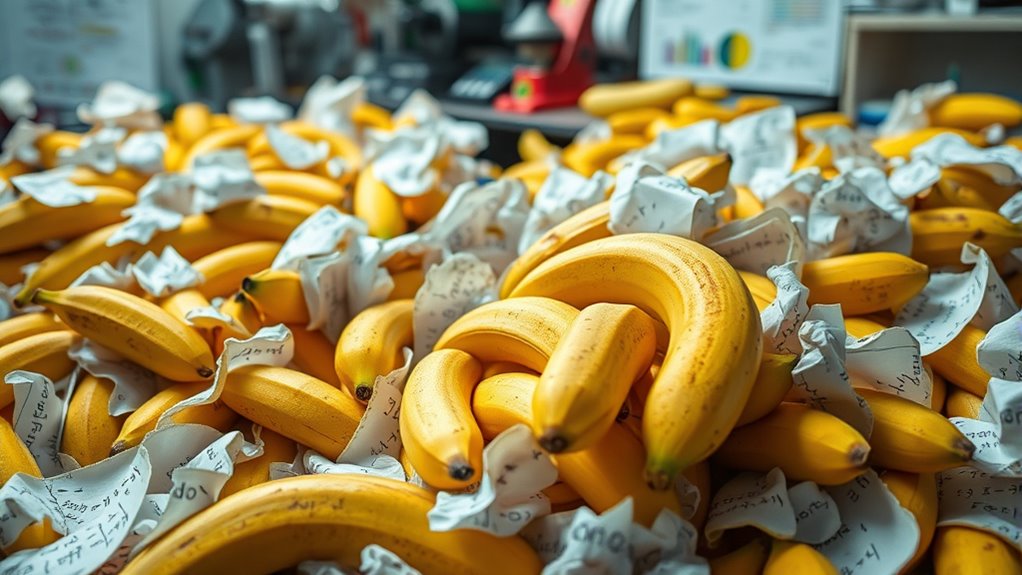
The Infinite Monkey Theorem suggests that, given enough time, a monkey randomly hitting keys on a typewriter would eventually produce any given text, such as Shakespeare’s complete works. At first glance, this idea sounds absurd, but it’s rooted in the mathematics of probability. When you think about it, the theorem exposes some fascinating probability paradoxes—counterintuitive results that challenge your understanding of chance and randomness. For example, it highlights how unlikely events, like a monkey creating perfect literature out of chaos, are actually inevitable over infinite time scales. This paradox deepens your appreciation for the unpredictable nature of randomness in art, where even the most seemingly accidental creations can, in theory, be the product of pure chance given enough repetitions.
In essence, the theorem pushes you to reconsider how randomness influences creativity. It raises questions about whether art is truly a product of deliberate intention or just a fortunate outcome of randomness combined with time. When you look at abstract art or improvisational music, you’re witnessing real-world examples of how chaos and chance can produce meaningful, even beautiful, results. The probability paradoxes embedded in the theorem suggest that, under the right circumstances, randomness isn’t just disorder; it’s a wellspring of potential. Your mind might jump to the idea that a “monkey” randomly producing a masterpiece is impossible—yet, mathematically, it’s not. Over an infinite timeline, every possible combination of characters and ideas will occur, no matter how unlikely.
This concept can be both inspiring and unsettling. It’s inspiring because it implies that creativity can emerge from randomness without direct human intervention. It’s unsettling because it challenges your notion of artistic mastery, suggesting that even the most meticulously crafted works could, in theory, be accidental. The probability paradoxes serve as a reminder that chance plays a more significant role in art and life than you might like to admit. They reveal how randomness in art isn’t just a flaw or a byproduct but a fundamental aspect of creative processes. When you understand this, you see that the beauty of randomness is that it opens endless possibilities—some of which, over time, could lead to astonishing discoveries or creations that seem to come from nowhere.
typewriter for creative writing
As an affiliate, we earn on qualifying purchases.
As an affiliate, we earn on qualifying purchases.
Frequently Asked Questions
How Long Would It Take a Monkey to Type Shakespeare’S Complete Works?
If you wonder how long a monkey would take to type Shakespeare’s complete works, keep in mind that monkey randomness makes it extremely unlikely. With typical typing efficiency, it could take millions of years, as the chances are astronomically low. The more random the typing, the longer it takes. So, realistically, it’s practically impossible, showing just how improbable it is for a monkey to produce perfect, lengthy texts through chance alone.
What Are the Real-World Applications of the Infinite Monkey Theorem?
You might wonder about real-world uses of the infinite monkey theorem. It helps you understand how genetic algorithms work by mimicking random text generation to solve complex problems. This approach is useful in optimizing designs, machine learning, and artificial intelligence. By simulating countless random texts, you can find innovative solutions efficiently, demonstrating how probability principles guide advanced technology development and problem-solving in real-world scenarios.
Can Monkeys Actually Learn to Type Coherent Sentences?
Did you know that studies show some monkeys can learn basic symbols and even communicate with humans? While they can improve their cognition and typing accuracy, they won’t produce coherent sentences like humans do. You might find it fascinating that, despite their intelligence, monkeys lack the complex language skills necessary for meaningful communication. So, no, monkeys can’t learn to type coherent sentences, but their progress in cognition is still pretty impressive.
How Does Probability Theory Support or Refute the Theorem?
You might wonder how probability theory relates to the entropy paradox and combinatorial chaos. It supports the idea that, given enough time, random typing could produce coherent text, but the vast combinatorial chaos makes this incredibly unlikely. The entropy paradox shows how complexity increases unpredictability, challenging the theorem. So, while theoretically possible, probability strongly refutes the practicality of monkeys randomly producing meaningful sentences.
Are There Any Experiments That Have Tested This Theorem Practically?
You might wonder if anyone has tested the theorem practically. While direct experiments are challenging due to the vast number of possibilities, researchers use randomized simulations to explore its concepts. These practical experiments help demonstrate how unlikely it is for random processes to produce complex results like Shakespearean text, supporting the theorem’s principles. Although no real-world experiment has fully verified it, simulations provide valuable insights into probability’s role in such scenarios.
abstract art supplies
As an affiliate, we earn on qualifying purchases.
As an affiliate, we earn on qualifying purchases.
Conclusion
Now, imagine what could happen if those infinite monkeys kept typing. Will they eventually produce Shakespeare’s masterpiece? Or will randomness forever keep us guessing? The infinite monkey theorem hints at endless possibilities, but the real question remains—are we truly close to understanding the limits of probability? As the seconds tick by, the answer becomes even more elusive. And maybe, just maybe, the universe’s greatest secrets are hiding in that infinite, chaotic mess.
improvisational music instruments
As an affiliate, we earn on qualifying purchases.
As an affiliate, we earn on qualifying purchases.
artistic randomness books
As an affiliate, we earn on qualifying purchases.
As an affiliate, we earn on qualifying purchases.