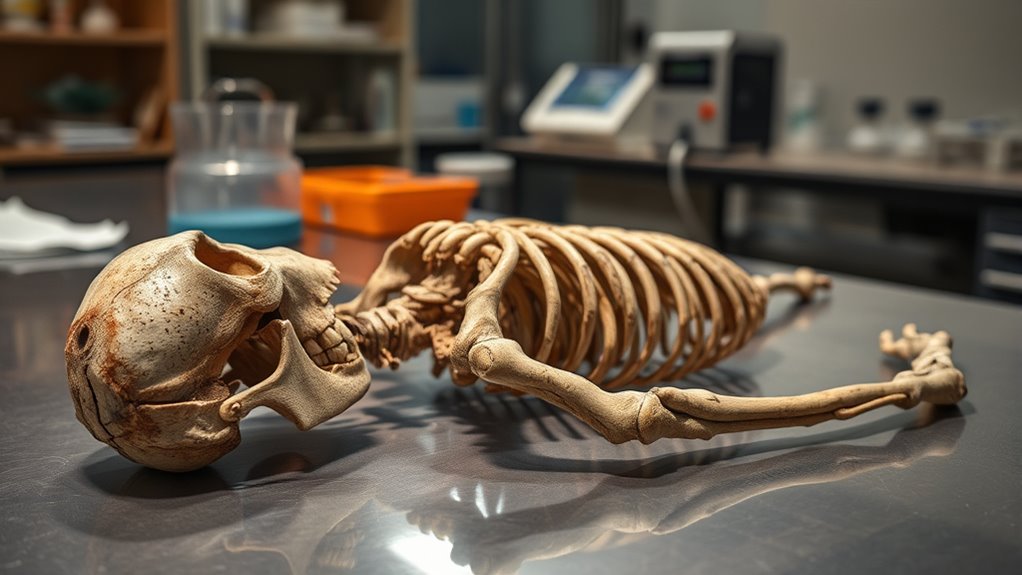

Genetic studies of ancient skeletons show surprising links across continents, revealing a complex web of human migration and interconnection. These analyses uncover unexpected migration routes and connections between distant populations that challenge traditional theories. You’ll see how ancient DNA links groups from different regions, indicating long-distance interactions and multiple migrations over thousands of years. If you keep exploring, you’ll discover even more about how our ancestors moved and mingled across the globe.
Key Takeaways
- Ancient DNA analysis uncovers unexpected genetic connections between distant populations, reshaping migration and ancestry understanding.
- Skeletons from remote regions exhibit genetic markers linking them to populations across continents.
- Advanced sequencing technologies reveal complex migration routes, including multiple waves and cultural exchanges.
- Genetic links between ancient samples and modern populations demonstrate ongoing, dynamic human migrations.
- Discoveries highlight a highly interconnected human history, with ancestors constantly moving and mingling over thousands of years.
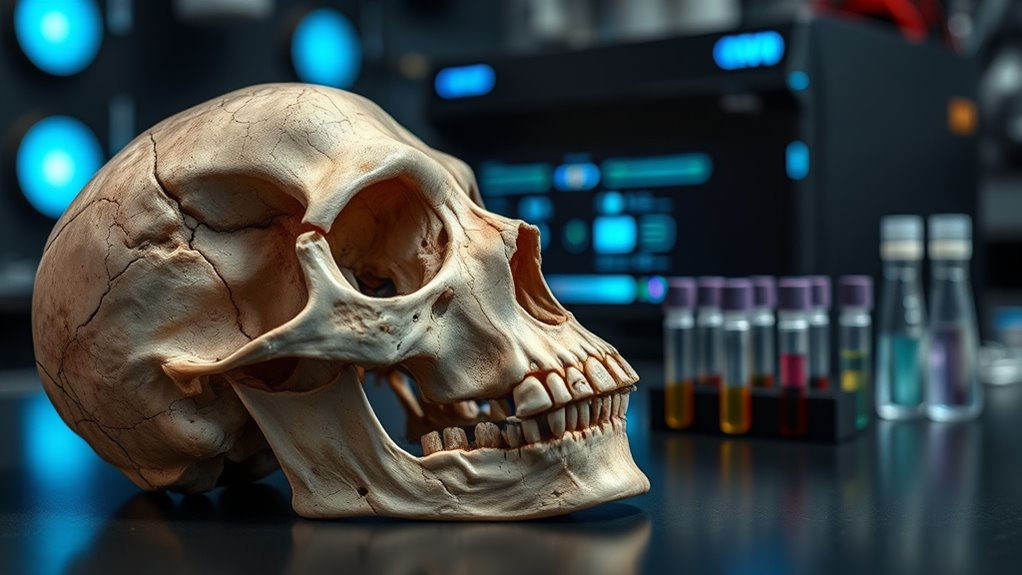
Advances in genetic analysis have revolutionized our understanding of ancient populations by enabling scientists to extract and interpret DNA from centuries-old skeletons. This breakthrough allows you to trace migration patterns and uncover how different groups moved across regions long before written records existed. By analyzing ancient DNA, researchers can piece together connections that were previously hidden, revealing surprising links between distant populations. As you explore these findings, it becomes clear that human history is far more interconnected than once believed, with migrations weaving a complex tapestry of ancestry across continents.
Using ancient DNA analysis, scientists have identified unexpected migration routes that challenge traditional archaeological theories. Instead of simple, linear movements, you see a web of interactions where populations intermingled, exchanged genes, and migrated multiple times over thousands of years. For example, some skeletons from remote regions show genetic markers that originated from distant lands, suggesting migrations that were previously unrecorded or misunderstood. These findings demonstrate that ancient peoples were highly mobile, often traveling vast distances, and that their movement shaped the genetic makeup of modern populations in ways you might not expect.
The ability to analyze DNA from long-deceased individuals allows you to trace ancestral ties across continents. For instance, a skeleton found in Europe may carry genetic signatures linking it to populations in Asia or Africa, rewriting your understanding of migration flows. These links reveal that ancient populations didn’t stay confined to one area but moved and mingled, sometimes over great distances, influencing the genetic diversity you see today. It’s fascinating to see how ancient DNA analysis helps fill in the gaps, revealing a complex history of human movement that spans hundreds or even thousands of years.
Furthermore, advancements in DNA sequencing technology continue to increase the resolution at which you can study these ancient migrations, making the findings even more detailed and accurate. As you explore these studies, you realize that migration patterns are often more intricate than simple migrations from point A to point B. Instead, they involve multiple waves of movement, cultural exchanges, and intermarriages that leave genetic footprints in skeletons. Ancient DNA analysis uncovers these layers, showing that the story of human migration is dynamic and ongoing. Every new discovery adds nuance, showing you that our ancestors were not static but constantly on the move, shaping the genetic landscape of future generations. This ongoing research continues to reshape your understanding of where we come from, highlighting the surprising links that connect distant ancestors through time and space.
Frequently Asked Questions
How Do Ancient DNA Preservation Methods Impact Results?
Ancient DNA preservation methods directly impact your results by influencing contamination risks and preservation challenges. If methods aren’t sterile or properly controlled, contamination from modern sources can skew your data, leading to inaccurate conclusions. Preservation challenges, like DNA degradation over time, can also limit the quality and completeness of your samples. To get reliable results, you must carefully handle samples and use advanced techniques to minimize contamination and maximize DNA recovery.
Can This Study Identify Individual Ancestors?
You can’t expect to identify individual ancestors with certainty, as ancient DNA often provides only broad lineage clues. While this study aids genealogical tracing, it’s more like finding a needle in a haystack. Your best bet is to analyze genetic markers that suggest familial relationships or population origins, but pinpointing exact individuals remains challenging due to DNA degradation and limited data. So, consider it a helpful map, not a detailed street address.
Are There Ethical Concerns With Ancient DNA Research?
Yes, there are ethical concerns with ancient DNA research. You should consider reburial ethics, respecting the wishes of descendant communities, and indigenous rights, which demand proper handling of ancestral remains. Conducting these studies responsibly involves collaboration with indigenous groups, honoring their cultural values, and ensuring that research benefits and respects those connected to the ancestors. Ignoring these concerns can lead to cultural harm and mistrust.
How Does This Change Our Understanding of Migration Patterns?
It’s fascinating how these genetic discoveries reshape your view of migration patterns, revealing unexpected routes and connections across populations. You realize that ancient DNA uncovers greater genetic diversity than previously thought, challenging old assumptions. Coincidentally, these insights help you understand that human migration wasn’t a straightforward journey but a complex web of interactions. This new knowledge deepens your appreciation for our shared history, showing how diverse and interconnected our ancestors truly were.
What Future Technologies Could Improve Ancient DNA Analysis?
You can expect future advancements in DNA sequencing and technological innovations to substantially enhance ancient DNA analysis. These innovations will enable you to recover more complete genomes from degraded samples, improve accuracy, and reduce contamination risks. As technology progresses, you’ll find it easier to study complex migration patterns and ancestral connections, providing a clearer picture of human history and evolution. Staying updated on these breakthroughs will deepen your understanding of ancient populations.
Conclusion
This study is like uncovering a hidden tapestry woven across time, revealing unexpected threads of ancestry. You realize that our past isn’t a straight path but a complex maze of connections, blending different origins in surprising ways. These ancient skeletons remind you that history’s story is richer and more intricate than you might have imagined, showing how our roots are intertwined like a vast, ancient forest where every branch tells a different story.