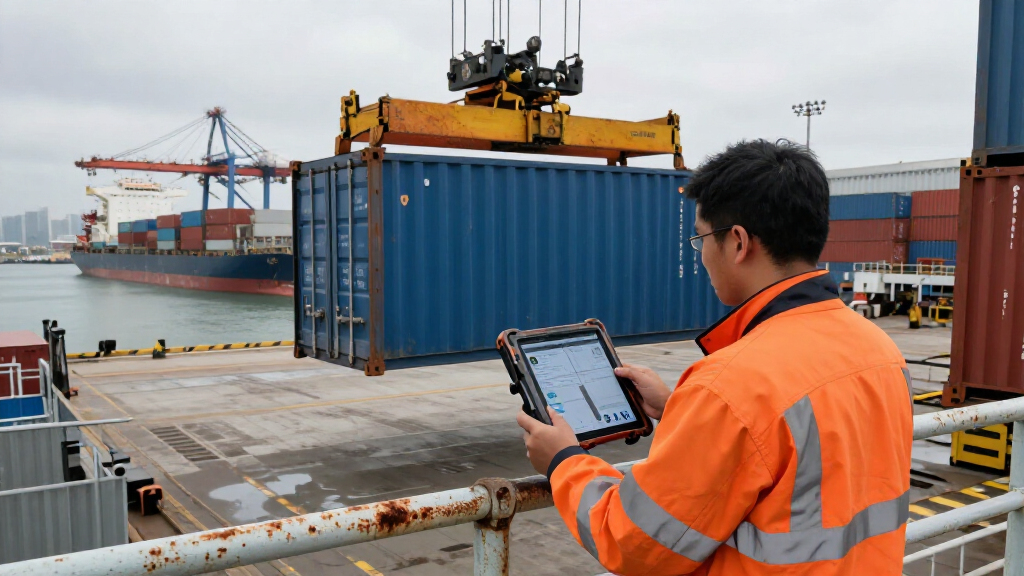

🔍 Read the full analysis: Dockworkers And The Rise Of AI In Shipping on ThorstenMeyerAI.com

Prime made for students and young adults
- Fast, free delivery for dorm and study essentials
- Prime Video and Amazon Music included
- Member-only deals
TL;DR
Containerization sharply reduced the labor and expense involved in moving cargo through ports, while changing dockworkers’ jobs and bargaining power. The source uses that history to frame current automation disputes, including a 2024 East and Gulf Coast strike over wages and automation; it does not report a new AI deployment or a specific current labor agreement.
A historical report published November 23, 2026, examines how the shipping container transformed port work and draws a line to disputes over automation and wages, including a 2024 strike by East and Gulf Coast dockworkers. The account documents the scale of the earlier change but does not describe a newly announced AI system or a current port agreement.
Before container shipping, cargo moved as separate sacks, barrels and crates. Each item had to be transferred between trucks or trains, warehouses and ships, then handled again at the destination. The report uses a 1954 voyage of the freighter Warrior as an example: 194,582 individual packages were loaded for Bremerhaven, and the crossing took ten and a half days. Some cargo spent more than three months in transit overall.
The economics changed when Malcom McLean’s company tested a container system. On April 26, 1956, a crane in Newark loaded 58 truck bodies onto the Ideal X, a tanker modified to carry them. Five days later, the ship arrived in Houston, where trucks were ready to take the containers away. The report says the innovation was not the cargo box itself, which had earlier precedents, but a system that moved sealed boxes across truck, ship and truck without unpacking them.
Drawing on figures cited from historian Marc Levinson’s book The Box, the report compares 1956 handling costs: about $5.83 per ton for loose cargo and 15.8 cents per ton for the Ideal X. It describes the latter as roughly 36 times cheaper, a calculation attributed to the report. It also cites sharp declines in dockworker headcounts: more than 35,000 longshoremen at the Port of New York and New Jersey in the early 1960s, compared with about 3,500 in 2013, according to the Waterfront Commission. Britain’s registered dock workforce fell from 82,000 at its peak to 9,400 in 1989.
Infographic 01 · Before the box
Why the port cost more than the ocean
Before the container, every sack and crate was handled one by one. The port, not the sea, was the expensive part of a trip.
One truckload of medicine, Chicago → Nancy (France) · estimate ca. 1960 · total $2,386
Cost of loading one ton · 1956
Roughly 36 times cheaper to load (5.83 ÷ 0.158, our calculation). The loading figures are from Levinson’s own article; other authors cite them to The Box, 1st ed. (2006), p. 52.
Sources: M. Levinson, The Box, 2nd ed. (Princeton UP, 2016), ch. 1, Table 1, p. 12 (American Association of Port Authorities data); M. Levinson, The Box That Shrank the World, Works That Work No. 2.
Powered by Thorsten Meyer AI
Automation’s Cost for Port Workers
The history shows why automation disputes involve more than the adoption of new machinery. Containerization lowered shipping costs and changed how goods moved, but it also reduced demand for many forms of manual cargo handling. That shift affected jobs, hiring practices and union bargaining, with consequences that lasted beyond the initial introduction of the technology.
The report says West Coast dockworkers negotiated protections in a 1960 agreement, including a $29 million fund, income guarantees for eligible registered workers, retirement benefits and a promise against layoffs caused by mechanization. Those provisions were tied to a defined group of workers; they did not mean every dockworker was protected from lost work. The distinction matters in current debates over AI and automated terminals: who receives the benefits, who bears the job disruption and what safeguards apply are central questions for workers and employers.
Automation also does not guarantee faster operations. The report cites a 2024 U.S. government study that found denser container stacking at some automated terminals but also slower moves and more breakdowns at some facilities. Those findings caution against treating technology’s effects as uniform across ports.
Popular right now

Ninja CM371 Hot & Iced XL Coffee Maker with Rapid Cold Brew

Apple AirPods Pro (2nd Generation) Wireless Earbuds with USB-C MagSafe Charging Case

Roborock Q10 S5+ Robot Vacuum and Mop with 10,000 Pa Suction
As an affiliate, we earn on qualifying purchases.
From Break-Bulk to the Shipping Box
In the break-bulk system, every item was handled separately. The work was labor-intensive and often irregular. The report describes New York’s daily “shape-up,” where workers gathered and a hiring boss selected who would get a shift. The Waterfront Commission, established in 1953, documented how a surplus of labor could give hiring bosses and corrupt union officials power over access to jobs and, in some cases, kickbacks. The 1954 film On the Waterfront helped bring that system to public attention.
McLean’s container operation addressed a cost problem as well as a labor one. An estimate for shipping a truckload of medicine from Chicago to Nancy, France, around 1960 put port costs at $1,163 of a $2,386 total, excluding an additional $95 for local freight near the port. The account says that figure represented 48.7% of the total; ocean shipping was listed at $581. The example illustrates how transfers and handling at ports could account for a large share of a shipment’s bill.
On October 18, 1960, the West Coast longshoremen’s union and the Pacific Maritime Association signed the Mechanization and Modernization Agreement. As summarized in the report, employers gained flexibility to mechanize while registered workers received financial and retirement protections. Dockworkers later struck for 134 days in 1971, and East and Gulf Coast dockers struck in 2024 over wages and automation. The account treats these events as part of a longer labor history, not as evidence that every port or union reached the same terms.
““epochal in the annals of industrial relations””
— U.S. Bureau of Labor Statistics, as cited in the report
What the AI Comparison Leaves Open
The source is a historical account about containerization and labor, not a report of a specific AI rollout. It does not identify a port that has newly adopted AI, describe the technology in use, or give figures for jobs affected by AI. Its reference to the 2024 East and Gulf Coast strike establishes that automation was a subject of labor conflict, but does not provide enough detail to characterize the strike’s outcome or the terms of any settlement.
The reported workforce counts refer to different years and places, and the account does not supply a single method for comparing them. The 2024 government report’s cited findings also apply to some terminals, not necessarily every automated port. The extent to which AI systems will alter staffing, safety, productivity or bargaining arrangements remains unspecified in the material.
The Next Bargaining Questions
The source identifies no scheduled hearing, negotiation or implementation date. The next developments readers would need to track are any specific port or union agreements on automation, including rules for staffing, job retention, retraining and worker protections. Claims about AI’s effects should be evaluated against dated, port-specific evidence rather than assumed from the earlier history of containerization.
For now, the account offers a historical comparison: containerization lowered cargo-handling costs while shrinking demand for some dock work, and labor agreements shaped how those changes were shared. Whether AI produces similar trade-offs—or different ones—cannot be determined from the information provided.
Key Questions
What is the news in this report?
The November 23, 2026, account revisits how containerization changed port work and costs, then connects that history to labor disputes over automation, including a 2024 East and Gulf Coast strike. It does not announce a new AI project.
How did containerization change dock work?
Containers let cranes move cargo in standardized boxes between ships and trucks without handling each item separately. The report says this cut the cost of loading substantially and reduced the need for some kinds of manual cargo handling.
What protections did West Coast dockworkers negotiate in 1960?
The Mechanization and Modernization Agreement gave employers greater scope to mechanize and established financial and retirement protections for registered workers, including a $29 million fund. The guarantees described in the report applied to eligible registered workers, not every person seeking port work.
Does the report show that AI is reducing dockworker jobs now?
No. It does not identify a current AI deployment or quantify jobs affected by AI. It uses the history of containerization to provide context for current automation concerns.
Do automated terminals always move cargo faster?
No such general conclusion is supported by the cited material. The report says a 2024 U.S. government study found denser stacking at some automated terminals, alongside slower moves and more breakdowns at some facilities.
Source: ThorstenMeyerAI.com