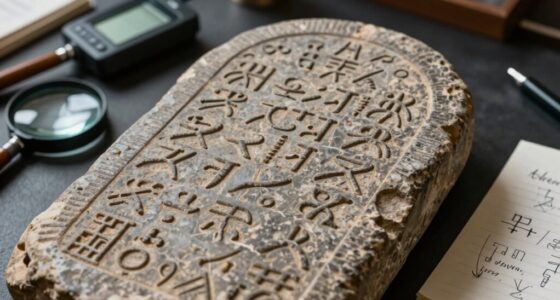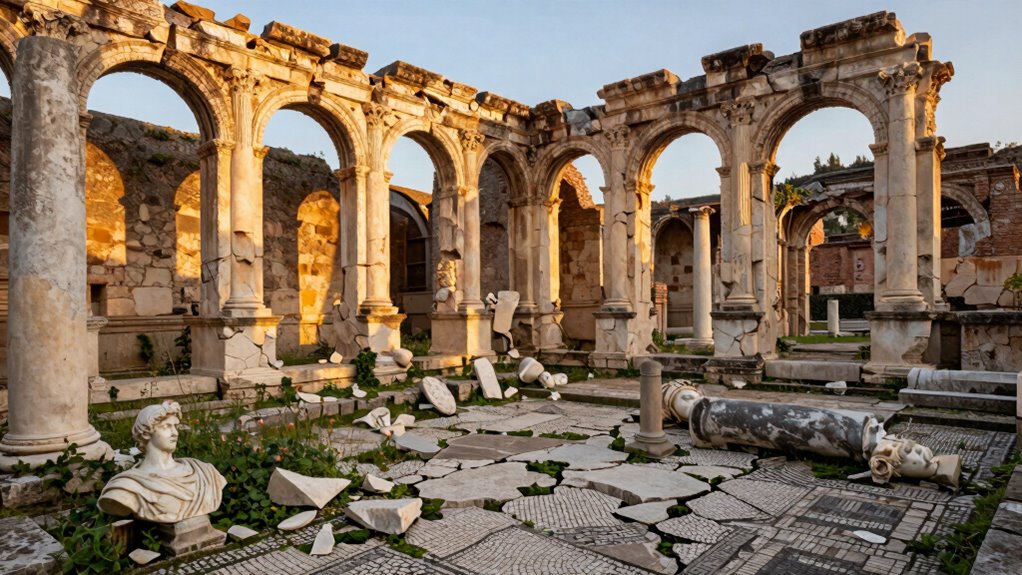

The fall of Rome didn’t happen overnight; it was a slow, complex process driven by political chaos, economic decline, military struggles, and social upheaval. You see, over centuries, weak leadership, corruption, and internal unrest eroded stability, while economic troubles drained resources. Military overreach and external invasions exploited these vulnerabilities, accelerating decline. If you explore further, you’ll uncover how these interconnected issues gradually dismantled the empire’s once-great foundation.
Key Takeaways
- Rome’s decline was a gradual process driven by urban overexpansion, infrastructure decay, and internal societal chaos.
- Political instability, frequent leadership changes, and corruption weakened governance and societal cohesion over centuries.
- Economic decline, currency devaluation, and resource depletion undermined military strength and public infrastructure.
- External invasions by barbarian tribes exploited internal weaknesses, accelerating territorial losses and internal destabilization.
- Cultural shifts and moral decay eroded civic responsibility, culminating in key events like the Sack of Rome and the fall of the Western Empire.
When Did the Fall of Rome Begin?
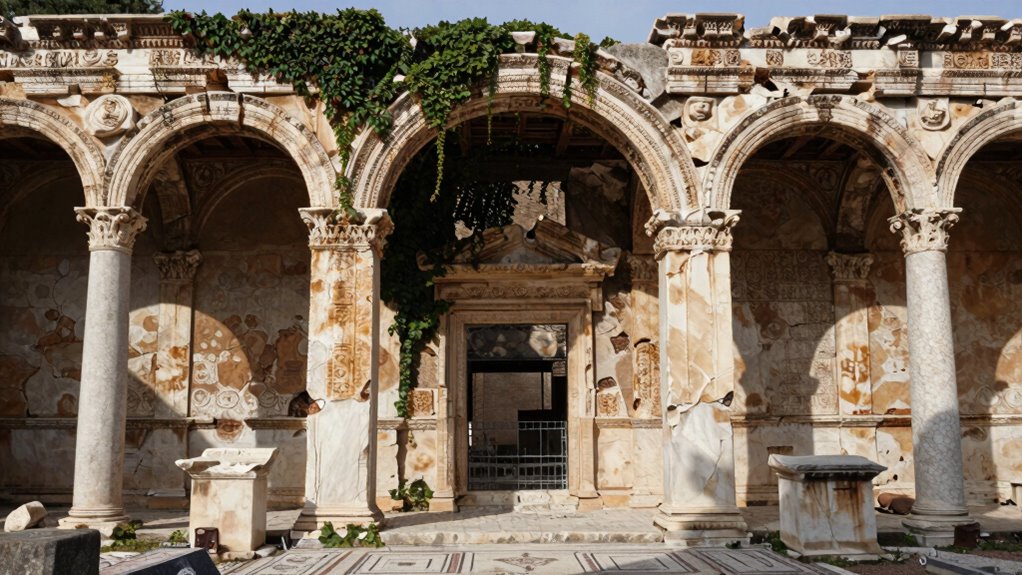
The fall of Rome didn’t happen overnight; it was a gradual process that began long before the city’s final surrender. As Rome expanded, urban sprawl stretched its limits, making it harder to maintain control and infrastructure. This growth prompted architectural innovation, with new building techniques and defenses emerging to accommodate the increasing population. These developments reflected Rome’s attempts to adapt to a growing and changing cityscape. However, the rapid expansion also created vulnerabilities—overcrowded neighborhoods and strained resources. Over time, these issues chipped away at Rome’s stability, setting the stage for further decline. You can see that the roots of collapse extend beyond political chaos, rooted in the city’s own physical and structural transformations. Urban development and infrastructure challenges played a significant role in weakening the empire’s resilience over time. Additionally, the challenges posed by building innovations sometimes inadvertently contributed to structural weaknesses that were difficult to sustain. A closer look at these architectural advancements reveals how innovative design choices, while beneficial in many ways, also introduced unforeseen risks that compounded Rome’s decline. Moreover, the strain on resources due to overpopulation further exacerbated these architectural and infrastructural issues, accelerating the empire’s decline. Furthermore, resource management challenges became critical as the demand for materials and food outpaced supply, intensifying the empire’s vulnerabilities.
How Political Instability Weakened the Empire
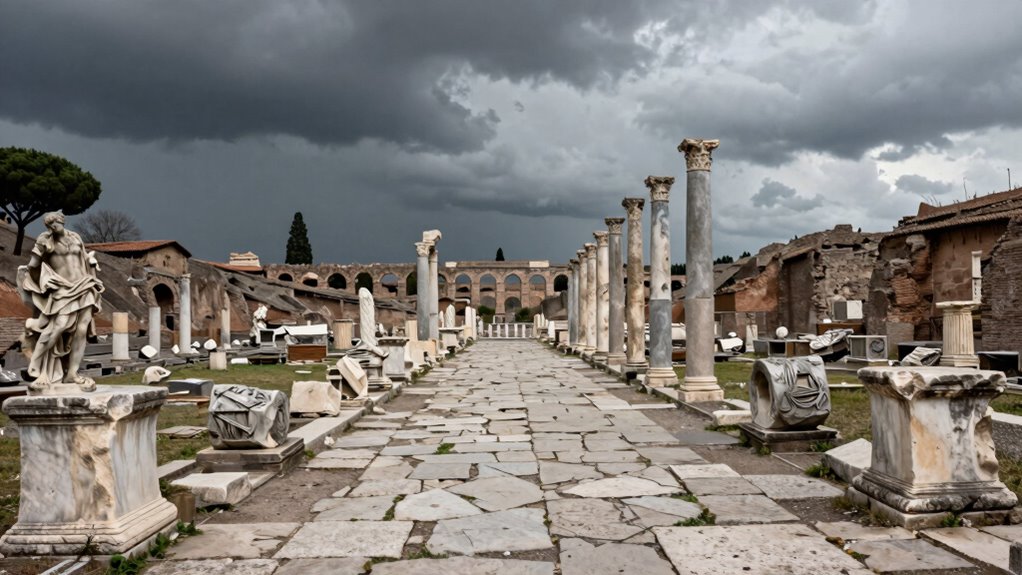
Political instability created chaos at the top, with leadership changing frequently and unpredictably. Corruption spread, eroding public trust and making governance less effective. Power struggles intensified, weakening the empire’s ability to respond to threats and maintain stability. This turbulent environment led to a breakdown in spiritual renewal and collective faith among the populace, further undermining the empire’s cohesion. Additionally, the instability hindered the implementation of effective governance strategies, leaving the empire vulnerable to external pressures and internal decay. Such ongoing turmoil also disrupted administrative structures, making it difficult to coordinate efforts across different regions of the empire. The decline in European cloud innovation during this period exemplifies how internal chaos can stifle progress and adaptation.
Leadership Turnover Crisis
As emperors and leaders changed hands with alarming frequency, the Roman Empire’s stability began to unravel. The constant turnover disrupted the process of imperial succession, making it difficult to establish clear authority. Instead of steady leadership, a leadership vacuum emerged, leaving generals and officials to fill the void unpredictably. This chaos fueled rivalries and power struggles, weakening centralized control. Without consistent leadership, crucial reforms stalled, and military cohesion suffered. Citizens and soldiers lost confidence in their rulers, fueling further instability. Your empire suffered because you couldn’t rely on a stable line of succession or strong leadership to guide it through crises. The rapid turnover didn’t just create short-term uncertainty; it eroded the very foundation needed for long-term stability and growth. Moreover, leadership turnover contributed to a decline in public trust, making it even harder to rally support during times of crisis. A leadership crisis can have far-reaching consequences that threaten the survival of an empire or nation. Additionally, the lack of consistent governance hindered effective decision-making, further accelerating the empire’s decline. The ongoing instability also hampered efforts to implement reforms, which are essential for long-term resilience and recovery. This pattern of instability highlights the importance of energetic alignment and steady leadership in maintaining a resilient society.
Corruption Erodes Trust
When corruption takes root within the Roman government, trust among citizens and soldiers quickly erodes. People lose faith in the civil service’s integrity and question whether tax policies are fair. This skepticism fuels unrest and weakens loyalty to the empire’s leadership. You see officials skimming funds meant for public works, undermining social stability. Corrupt officials manipulate tax collections, burdening honest citizens while enriching themselves. As trust declines, soldiers become disillusioned with their commanders and the system. The government’s inability to enforce honest civil service practices exacerbates instability. Citizens begin to see the empire as corrupt and unreliable, further destabilizing governance. Once trust falters, the foundation of Rome’s strength crumbles, making the empire vulnerable to internal decay and external threats. Additionally, the rise of technological innovations like nanotechnology could have been harnessed to improve transparency and prevent corruption, but the empire failed to adapt, further accelerating its decline.
Power Struggles Escalate
Corruption within the government created a fertile ground for power struggles, as factions vied to control the dwindling resources and influence. Dynastic disputes intensified, with emperors and claimants battling for legitimacy, weakening central authority. Imperial rivalries grew more aggressive, as regional leaders and military generals sought greater independence, often acting without imperial approval. These conflicts diverted attention from external threats and drained the empire’s resources. Political instability became the norm, causing leadership to shift unpredictably. You’d see alliances forming and dissolving rapidly, further destabilizing Rome’s governance. This chaos emboldened enemies beyond the borders and internal factions alike. As power struggles escalated, unity crumbled, making the empire more vulnerable to external invasions and internal collapse. The cycle of disputes eroded the strength needed to sustain Rome’s vast territories.
Why Economic Decline Made Rome Vulnerable
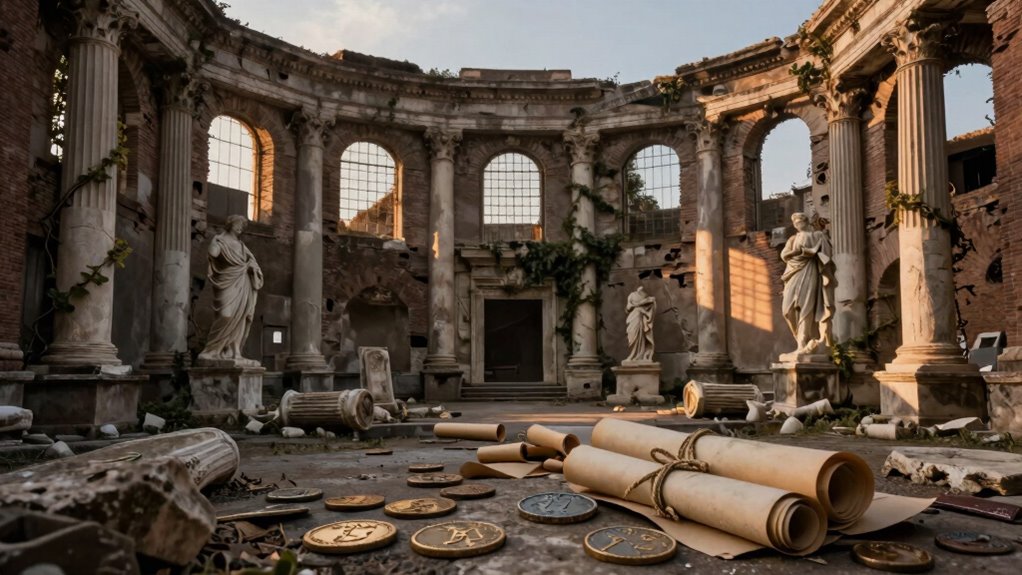
When Rome’s currency lost value, it became harder to pay soldiers and officials, weakening the empire’s stability. As tax revenues declined, the government had less money to fund defenses and public works. This economic strain left Rome more vulnerable to external attacks and internal unrest. Additionally, the decline in economic resources hampered the empire’s ability to maintain aquatic infrastructure, further contributing to its weakening state.
Currency Devaluation Impact
Currency devaluation played a crucial role in weakening Rome’s economy, making it more vulnerable to external threats and internal instability. When the government resorted to coin debasement, the value of Roman currency plummeted. This led to inflation spirals, where prices soared, and trust in money eroded. As coins lost worth, merchants and citizens lost confidence, disrupting trade and daily transactions. You’d see a decline in savings and investments, further destabilizing the economy. The devaluation also made it harder to pay off debts or fund the military, weakening Rome’s defenses. Over time, these issues created a vicious cycle, exacerbating economic instability, amplifying economic decline and opening the door for external enemies to exploit Rome’s weakened state. This erosion of monetary stability was a key factor in Rome’s eventual fall. Understanding economic decline is essential to grasping how interconnected financial stability is with overall societal resilience.
Tax Revenue Decline
As Rome’s economy spiraled downward due to currency devaluation, its ability to generate revenue through taxes also weakened considerably. Tax loopholes became more attractive to the wealthy, allowing them to minimize payments and widen revenue shortfalls. With fewer funds flowing in, the government struggled to maintain military defenses and public infrastructure. The decline in tax revenue meant fewer resources to support critical functions, making Rome more vulnerable to external threats and internal instability. As economic hardship deepened, tax collection efforts faltered, and the state’s financial foundation crumbled further. This decline in tax revenue didn’t just weaken Rome’s treasury; it eroded the very economic stability needed to sustain an empire, accelerating its path toward collapse. Additionally, the decreased tax income limited the empire’s ability to invest in public services, further exacerbating internal unrest and decline. A weakened financial system also diminished Rome’s capacity to implement cybersecurity solutions that could have protected its digital infrastructure from external threats.
How Military Challenges Led to Rome’s Collapse
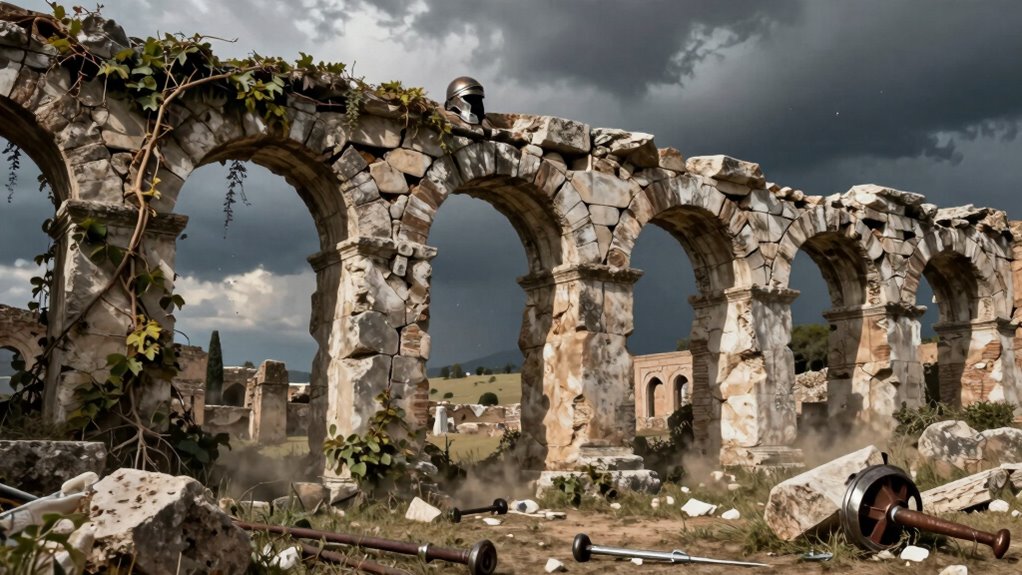
Military challenges played a pivotal role in Rome’s decline, forcing the empire to constantly adapt to external threats. Barbarian invasions intensified, stretching Rome’s defenses thin and exposing weaknesses. To counter these threats, Rome attempted military reforms, but these often led to internal discord and reduced effectiveness. You see, as enemies pressed harder, Rome’s armies struggled to hold the borders. Additionally, the reliance on foreign mercenaries further undermined the loyalty and cohesion of the Roman military forces. The increasing reliance on mercenaries and the difficulty in maintaining a cohesive fighting force contributed significantly to internal tensions. – Barbarian invasions eroded Rome’s territorial integrity. – Military reforms created internal divisions. – The empire relied more on mercenaries, weakening loyalty. – Constant warfare drained resources and manpower. – Defensive strategies became less effective over time. These challenges eroded Rome’s military strength, undermining its ability to defend itself. Furthermore, the empire’s military reforms often prioritized short-term gains over long-term stability, which compromised the integrity of the defenses. The relentless pressure from outside forces and internal military struggles created a cycle that ultimately contributed to the empire’s collapse.
What Social Changes Changed Roman Society
As Roman society changed, traditional values like discipline and civic duty weakened, affecting citizens’ loyalty. You also see power shifting from the Senate to individual leaders, disrupting stability. Meanwhile, economic instability grew, making everyday life more uncertain for everyone. The rise of AI applications in various sectors further transformed societal dynamics during this period.
Decline of Traditional Values
The decline of traditional values in Roman society didn’t happen overnight; instead, it was a gradual process driven by shifting social attitudes and changing priorities. As moral decay set in, people became less committed to family and community. Family breakdown became more common, weakening the social fabric that held Rome together. This erosion of core values affected civic responsibility and respect for authority. You might notice:
- Increased individualism over communal duty
- Decline in respect for elders and traditions
- Rise in superficial pursuits and materialism
- Erosion of religious and moral standards
- Weakening of family bonds and responsibilities
These changes fostered a sense of disillusionment, making it easier for societal structures to weaken. Over time, the loss of traditional values contributed markedly to Rome’s vulnerability and eventual collapse.
Shift in Political Power
Shifts in political power during Rome’s decline were driven by social changes that weakened traditional authority structures. As loyalty to the Senate faded, imperial succession became more unstable, often resulting in violent power struggles. New emperors relied heavily on support from political factions, which constantly jostled for influence. These factions fueled unrest and undermined centralized authority, making leadership less predictable. The rise of military commanders wielding political influence further disrupted the established order, blurring the lines between military and political power. This fragmentation eroded the cohesive political system that once maintained stability. You see, these social changes, from shifting loyalties to factional rivalries, created a chaotic environment where political authority was increasingly fragile, setting the stage for Rome’s broader decline.
Economic Instability Rise
Economic instability grew increasingly severe as social changes disrupted traditional sources of wealth and stability. With trade routes becoming less reliable, your economy faces frequent trade disruptions, reducing essential imports and exports. The inflation surge hits hard, making everyday goods more expensive and straining household budgets. Farmers and merchants struggle to maintain profits, leading to decreased production and economic contraction. Wealth becomes concentrated among the elite, widening social gaps and reducing overall consumer spending. Public funds dwindle as tax revenues decline, undermining state services. These shifts create a cycle of economic decline, weakening society’s foundation and fueling unrest. The combination of trade disruption and inflation surge accelerates societal instability, setting the stage for further political and social upheaval in Rome.
How External Tribes Accelerated Rome’s Fall
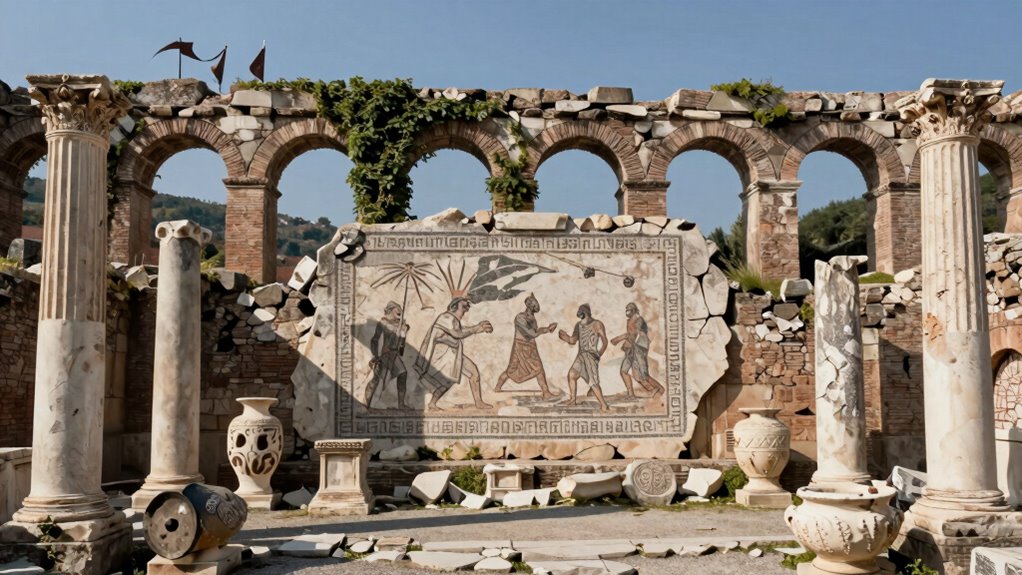
External tribes played a pivotal role in speeding up Rome’s decline, often exploiting weaknesses in its defenses and internal divisions. Barbarian invasions, such as those by the Visigoths, Vandals, and Huns, intensified the pressure on Rome’s borders. These external threats exploited the empire’s weakened military and political instability, forcing costly battles and sapping resources. As Rome struggled to defend its vast frontiers, tribes capitalized on the chaos, raiding and settling within Roman territories. Their invasions not only drained the empire’s military strength but also destabilized internal governance. Over time, these external pressures chipped away at Rome’s cohesion, accelerating its decline and making the fall inevitable. The barbarian invasions were more than just attacks—they were catalysts that hastened Rome’s collapse from within.
How Corruption and Poor Governance Undermined Rome
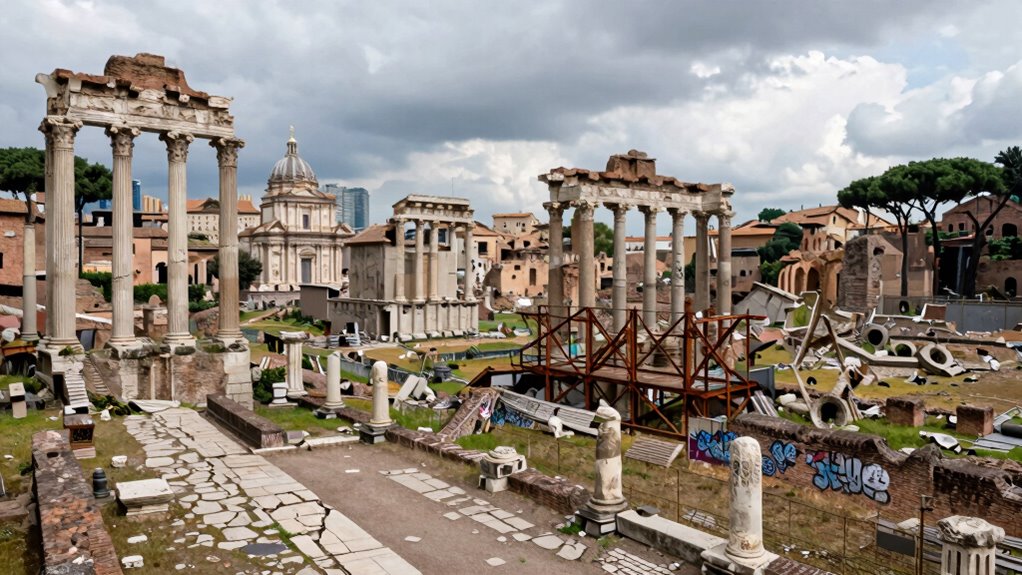
As the Roman Empire expanded and faced increasing challenges, its leadership became increasingly riddled with corruption and mismanagement. Imperial decadence took hold, draining resources and eroding discipline. Bureaucratic corruption grew rampant, leading to inefficient decision-making and favoritism. You’d see officials more focused on personal gain than public service, weakening state stability. Key issues include:
- Embezzlement of funds meant for defense
- Bribery influencing appointments
- Neglect of military and civic duties
- Infiltration of government by corrupt elites
- Erosion of moral authority among leaders
This widespread corruption compromised Rome’s ability to respond effectively to internal and external threats. Instead of unity and discipline, the empire suffered from internal decay, making it vulnerable to collapse from within.
How Economic Problems Crippled Rome’s Infrastructure and Army
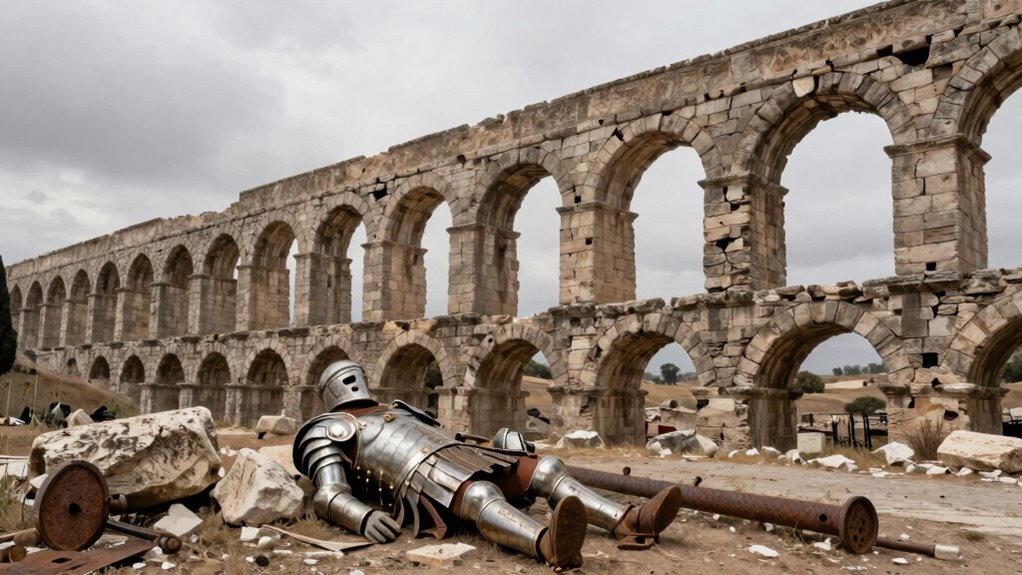
Corruption and mismanagement drained Rome’s resources, leaving its economy strained and fragile. As trade disruption increased, essential supply lines weakened, making it harder to sustain the infrastructure and the army. Cultural shifts, like rising inflation and changing values, further destabilized economic stability. Fewer trade routes meant less revenue, forcing Rome to cut back on public works and military expenses. The empire’s ability to repair roads, aqueducts, and fortifications declined sharply, weakening its infrastructure. Meanwhile, a shrinking treasury limited recruitment and equipment for the army, leaving soldiers ill-equipped and demoralized. These economic hardships created a vicious cycle—resources dried up, trade slowed, and the empire’s capacity to defend itself eroded, accelerating Rome’s decline from within.
Key Events That Signaled Rome’s Final Fall
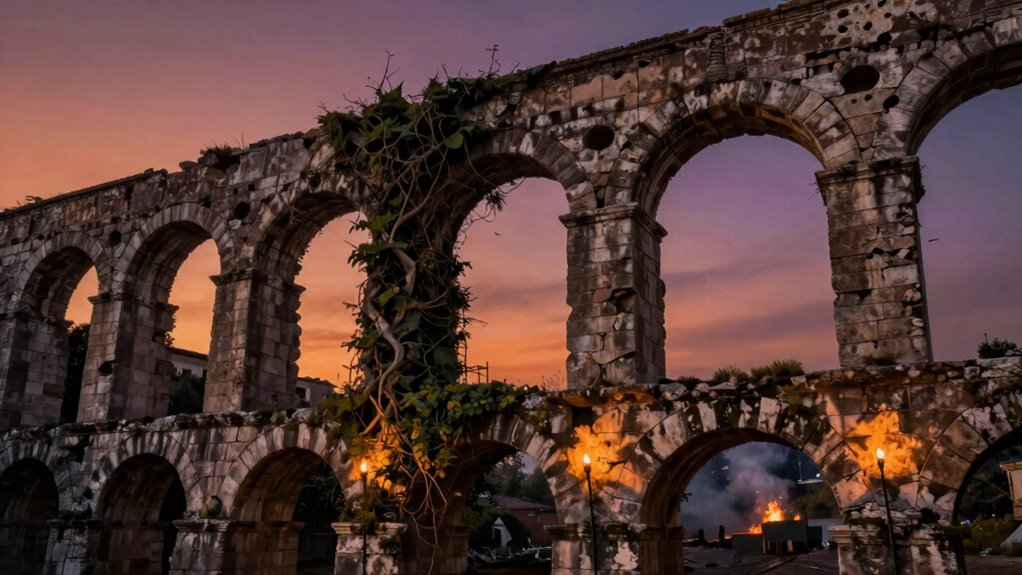
The final fall of Rome was marked by a series of pivotal events that signaled the empire’s imminent collapse. You notice how the grandeur of ancient architecture crumbles, like the Pantheon’s once-imposing dome, now a symbol of decline. Key moments include the sack of Rome by the Visigoths in 410 AD, shattering the myth of Roman invincibility. The deposition of last Western Roman emperor Romulus Augustulus in 476 AD cements the official end. These events echo the fading of Roman mythology’s divine protection, replaced by chaos.
- Sack of Rome by the Visigoths
- Deposition of Romulus Augustulus
- Loss of key territories to barbarian tribes
- Collapse of Roman military power
- Decline of imperial authority across provinces
Why Rome’s Decline Was a Slow, Gradual Process
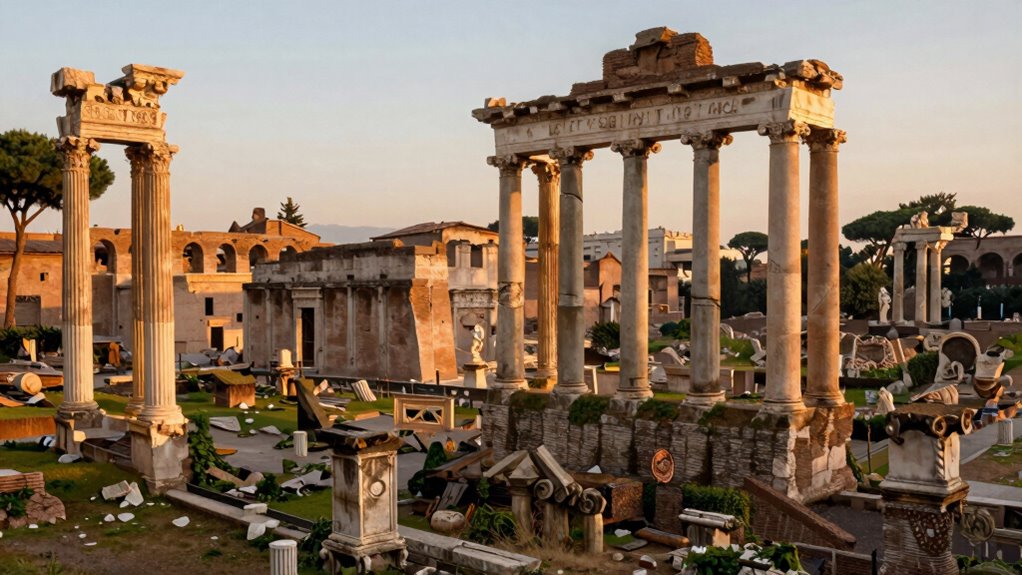
Rome’s decline didn’t happen overnight; instead, it was a slow, relentless process that unfolded over centuries. Urban decay gradually chipped away at the city’s infrastructure, making public spaces less vibrant and economic activity sluggish. As the empire stretched thin, cultural shifts also weakened traditional Roman values, eroding social cohesion. The once-great city faced increasing neglect, with crumbling buildings and declining population. These signs of slow decline weren’t sudden crises but a series of small, persistent issues that compounded over time. You can see how these interconnected factors created a fragile empire, vulnerable to external invasions and internal instability. The process was a drawn-out unraveling, where gradual decay and shifting cultural norms quietly sapped the strength of Rome from within.
Frequently Asked Questions
What Role Did Religion Play in Rome’s Decline?
You see, the religious influence in Rome waned as faith decline grew, weakening societal cohesion. As the traditional Roman gods lost followers, it created divisions and eroded unity. The rise of Christianity shifted focus away from civic duty, impacting the empire’s stability. This shift in religious beliefs contributed to internal strife and a decline in shared values, making Rome more vulnerable to external threats and internal decay.
How Did Climate Change Impact Roman Society and Economy?
Imagine climate change shaking your world to its core—ancient agriculture suffers, crops fail, and food shortages hit hard. You’d see environmental resilience wane, forcing society into chaos and economic decline. Rome’s climate shifts disrupted farming, drained resources, and weakened the empire’s stability. This relentless environmental pressure made it nearly impossible for Rome to sustain its economy, accelerating its decline and pushing it toward collapse faster than you ever imagined.
Were There Any Positive Consequences of Rome’s Fall?
You’ll find that Rome’s fall led to some positive legacy benefits, such as the preservation of knowledge through monasteries and the blending of diverse cultures. This period fostered cultural resilience, allowing new societies to adapt and grow from Roman traditions. These outcomes helped shape medieval Europe and beyond, creating a foundation for future innovations and cultural exchanges that still influence us today.
How Did Internal Cultural Shifts Influence Political Stability?
Internal cultural shifts, like changing values and declining civic pride, weaken political stability. As barbarian invasions increased, these shifts made it harder for leaders to unite people and maintain order. Economic decline further strained the system, reducing resources for defense and governance. You’ll see how these cultural changes, combined with external pressures, created a fragile political environment, ultimately contributing to Rome’s inability to withstand its many challenges.
Could Rome Have Survived if Different Leaders Had Taken Different Actions?
If different leaders had prioritized strong imperial leadership and adapted military strategies, Rome might have survived longer. You could see more unified decision-making and innovative defense tactics that protected borders. Leaders focusing on stability and reform might have prevented internal decay and external invasions. By valuing effective military strategies and maintaining a cohesive empire, Rome’s resilience could have been strengthened, possibly delaying or averting its ultimate collapse.
Conclusion
Remember, Rome didn’t fall overnight—its decline was a slow, steady unraveling. Political chaos, economic woes, and military defeats chipped away at its strength over centuries. If you think of it as “the straw that broke the camel’s back,” you’ll see how each problem added up until the empire couldn’t stand any longer. Stay vigilant to the warning signs—history shows that even great civilizations can fall when the cracks become too deep to mend.