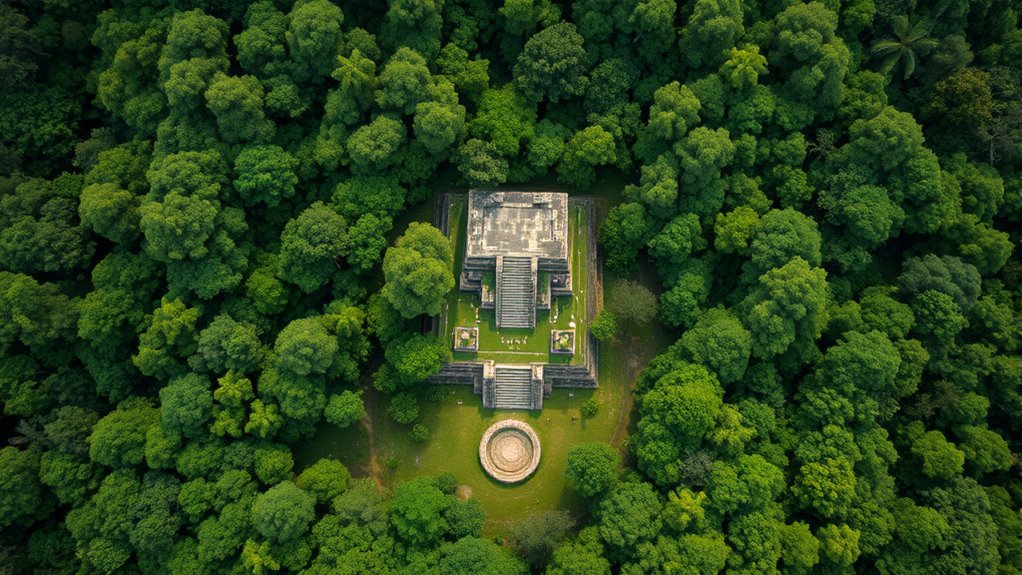

Lidar scans have uncovered dozens of hidden Maya structures deep within the Guatemalan jungle, revealing a more complex urban landscape than previously thought. By sending laser pulses from aircraft, researchers can map buried palaces, plazas, terraces, and causeways without disturbing the environment. This technology exposes ancient city layouts, showing how the Maya designed cities aligned with cosmological and societal purposes. Keep exploring to discover how these findings change our understanding of Maya civilization’s sophistication.
Key Takeaways
- Recent lidar scans in Guatemala revealed dozens of previously hidden Maya structures beneath dense jungle canopies.
- The technology identified extensive urban layouts, including palaces, plazas, causeways, and terraces.
- Findings challenge earlier assumptions, showing Maya cities were larger and more complex than thought.
- The use of lidar combines remote sensing with traditional archaeology, enabling non-invasive discovery.
- These discoveries deepen understanding of Maya urban planning, societal organization, and cultural sophistication.

Thanks to recent lidar scans, archaeologists have uncovered hidden Maya structures buried beneath dense jungle canopies. This groundbreaking technology reveals what was once invisible to the naked eye, opening new doors to understanding how ancient Maya cities were designed and organized. As you explore these discoveries, you realize that the ancient city planning of the Maya civilization was more sophisticated than previously believed. The structures discovered include palaces, plazas, terraces, and causeways, all densely packed within a sprawling urban landscape. These findings challenge earlier assumptions that Maya cities were limited in size or complexity, highlighting their advanced architectural and societal development.
The use of lidar technology exemplifies a cutting-edge archaeological methodology that combines remote sensing with traditional excavation techniques. Instead of invasive digging, lidar sends laser pulses from aircraft, which bounce off the jungle canopy and land, creating detailed 3D maps of the underlying terrain. This allows archaeologists to identify features buried beneath thick vegetation without disturbing the environment. As you look at the detailed maps generated, you see how this methodology accelerates discoveries and enables a more thorough understanding of ancient urban layouts. It’s a game-changer in archaeological research, especially in regions where dense foliage obscures critical structures.
With this approach, you notice how the Maya meticulously planned their cities, aligning buildings and streets according to astronomical events and religious principles. The spatial arrangement suggests a society that prioritized cosmology and social hierarchy, reflected in the placement of temples, ball courts, and administrative centers. The discovery of interconnected causeways indicates a sophisticated transportation network, facilitating movement across the city and connecting different sectors. It’s clear that their city planning was not haphazard but carefully designed to serve political, religious, and economic purposes. These insights deepen your appreciation for the Maya’s ingenuity in urban design and their ability to adapt their environment to their cultural needs.
Finally, as you consider these revelations, you realize that lidar technology has transformed archaeology from a mostly ground-based endeavor into a high-tech discipline capable of uncovering entire civilizations hidden beneath the rainforest. The detailed imagery and data collected give you a window into the past, allowing you to witness the complexity of Maya urban life. By combining ancient city planning principles with innovative archaeological methodology, scientists are rewriting history and revealing a civilization that was far more advanced and organized than ever imagined. These discoveries not only reshape our understanding of Maya society but also showcase how modern technology can reveal the secrets of ancient worlds long hidden beneath the jungle’s canopy. Additionally, the integration of remote sensing techniques demonstrates how technological advancements are revolutionizing archaeological exploration.
Frequently Asked Questions
How Do Lidar Scans Differentiate Between Natural and Man-Made Structures?
You can tell natural from man-made structures using lidar scans by analyzing vegetation density and soil composition. Man-made structures often have minimal vegetation and distinct soil patterns, making them stand out against natural terrain. The lidar’s laser pulses penetrate foliage, revealing underlying shapes. You compare the data for unusual geometric shapes or altered soil layers, which indicate human activity, helping you differentiate between natural features and constructed sites.
What Technological Advancements Made This Lidar Survey Possible?
You benefit from recent advancements in laser technology, which allow for precise data collection from the air. Improved data processing techniques then compile and analyze this information quickly, revealing hidden structures beneath dense vegetation. These technological innovations make lidar surveys more accurate and efficient, enabling you to uncover ancient sites without invasive excavations. This combination of laser technology and data processing revolutionizes archaeology, opening new windows into our past.
Are There Plans to Explore the Uncovered Structures Further?
You’ll be interested to know that future archaeological excavations are definitely planned to explore these structures further. For example, researchers aim to use non-invasive methods to preserve the site’s integrity while uncovering more details. These efforts will enhance preservation efforts and provide deeper insights into Maya civilization. You can expect ongoing studies, combining advanced technology with careful excavation, ensuring that these ancient sites are protected and understood for generations to come.
How Do These Findings Alter Existing Understanding of Maya Civilization?
These findings substantially alter your understanding of the ancient city and its cultural implications. You realize that the Maya civilization was more extensive and complex than previously thought, with numerous hidden structures indicating a sophisticated society. This discovery challenges earlier assumptions, suggesting the city played a larger role in regional politics and culture. You now see the Maya civilization as more interconnected and dynamic, reshaping your perspective on their historical significance.
What Challenges Were Faced During the Lidar Scanning Process?
You face a tough jungle maze, where logistical challenges like rough terrain and dense vegetation test your resolve. Lidar accuracy becomes your guiding star, but equipment malfunctions and limited access complicate the journey. You navigate these obstacles with ingenuity, knowing each hurdle sharpens your skills. Despite these challenges, you push forward, trusting that precise lidar scans will reveal hidden secrets buried beneath centuries of earth and foliage.
Conclusion
As you marvel at these hidden Maya structures unearthed by lidar, you realize technology is rewriting history, revealing secrets long buried beneath the jungle’s embrace. It’s as if ancient civilizations whisper through digital eyes, reminding us that discovery is an unending adventure—like finding a lost smartphone in a Mayan tomb. This breakthrough not only uncovers the past but ignites your curiosity, proving that even in the age of AI, the human spirit’s quest for knowledge remains timeless.