

Scientists have recently detected mysterious neutrino signals from space deep beneath Antarctica’s ice. These ghost particles, or neutrinos, are incredibly elusive but carry essential clues about distant cosmic events like supernovae and black holes. Using advanced detectors embedded in the ice, physicists analyze faint Cherenkov light to trace these signals back to their origins. If you continue exploring, you’ll uncover how these discoveries could transform our understanding of the universe’s most energetic processes.
Key Takeaways
- Antarctic observatories like IceCube detect high-energy neutrinos, often called “ghost particles,” originating from cosmic space.
- Recent unexplained signals suggest the potential discovery of new astrophysical phenomena or sources.
- Neutrino detection involves capturing Cherenkov light produced when neutrinos interact with Antarctic ice.
- These signals are difficult to trace back precisely, prompting further investigation into their cosmic origins.
- Advancements in detection technology aim to clarify the nature of these mysterious space-origin neutrino signals.
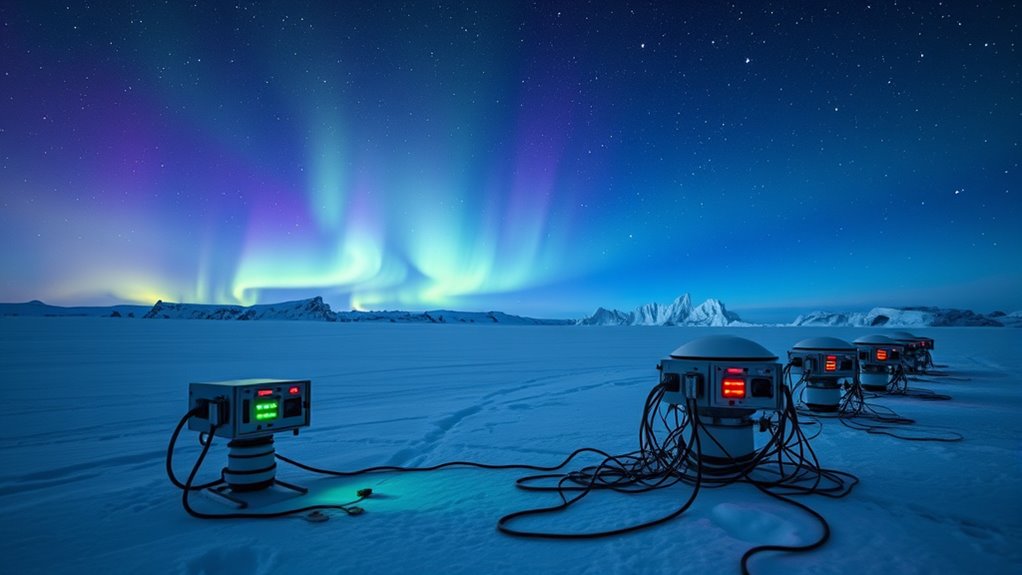
Deep beneath Antarctica’s icy surface, scientists have detected elusive particles known as neutrinos—often called “ghost particles” because they rarely interact with matter. These neutrinos offer a unique window into the universe’s most energetic and distant phenomena. But understanding where these particles come from, their origins, remains a challenge. Researchers believe that neutrino origins lie in some of the universe’s most extreme environments, such as supernovae, black holes, and cosmic ray interactions. When high-energy cosmic rays collide with atoms in Earth’s atmosphere or other cosmic matter, they produce neutrinos that travel across space virtually unimpeded. Tracing these particles back to their sources helps scientists piece together cosmic events that are otherwise hidden from view.
To detect these elusive particles, scientists rely on advanced Antarctic detection techniques. The icy continent provides an ideal environment because its thick ice sheet acts as both a shield against cosmic radiation and a detector medium. The primary method involves embedding arrays of sensors deep within the ice, like those used by IceCube, a massive observatory located at the South Pole. These sensors monitor for tiny flashes of Cherenkov radiation—light produced when neutrinos interact with the ice molecules at extremely high energies. When a neutrino collides with an atom in the ice, it creates secondary particles that move faster than light can travel through the ice, emitting Cherenkov light. The sensors detect these flashes, allowing scientists to determine the neutrino’s direction, energy, and sometimes even its flavor.
Scientists use deep ice sensors at the South Pole to detect neutrinos via Cherenkov radiation.
The Antarctic detection techniques are among the most sophisticated in the world. They involve deploying thousands of optical sensors deep within the ice, forming a three-dimensional array capable of capturing faint signals from neutrino interactions. This setup not only helps distinguish true neutrino signals from background noise but also enables precise tracking of their paths. Because neutrinos can pass through vast amounts of matter without interaction, detecting even a handful of these particles requires such an extensive and highly sensitive system. Advances in sensor technology continue to improve detection capabilities and open new avenues for astrophysical research.
These detection methods have revolutionized astrophysics, allowing you and other scientists to explore the universe in a new way. By studying the origins of neutrinos, you can gain insights into cosmic phenomena billions of light-years away. The combination of understanding neutrino origins and employing innovative Antarctic detection techniques has opened a new frontier in exploring the universe’s most mysterious and energetic events. As research continues, you’ll see more groundbreaking discoveries that deepen our understanding of the cosmos through these ghostly messengers from space.
Frequently Asked Questions
Could These Ghost Particles Be Linked to Dark Matter?
Yes, these ghost particles could be linked to dark matter. Some scientists believe that dark matter interactions might produce cosmic rays or particles similar to what’s been detected. If these signals are connected to dark matter, it could open new doors to understanding this mysterious substance. By studying the particles’ properties, you might uncover clues about dark matter’s nature and its role in the universe, advancing our knowledge profoundly.
How Do Scientists Differentiate Ghost Particles From Background Noise?
You can differentiate ghost particles from background noise by focusing on detector calibration and noise filtering. While it might seem tricky, scientists carefully calibrate detectors to understand their baseline signals, then apply advanced filtering techniques to remove unrelated noise. This process helps guarantee that the signals you observe are genuine ghost particles, allowing researchers to analyze their properties and determine if they originate from space rather than local interference.
What Are the Potential Technological Applications of Detecting Ghost Particles?
By detecting ghost particles through advanced particle detection and signal analysis, you could revolutionize fields like astrophysics and medical imaging. These particles might help develop ultra-sensitive sensors, improve neutrino detection, and enable better understanding of cosmic events. Innovations in signal analysis allow you to filter out noise, making it possible to uncover new phenomena. Ultimately, leveraging ghost particle detection unleashes technological advancements that could impact communication, security, and scientific research worldwide.
Might These Signals Indicate Extraterrestrial Intelligence?
Imagine scientists detect a mysterious signal resembling extraterrestrial signals, suggesting alien communication. While it’s tempting to think these ghost particles could indicate extraterrestrial intelligence, it’s more likely they result from natural cosmic phenomena. However, if verified as alien communication, it would revolutionize our understanding of the universe. You should stay alert for further analysis, as such signals could open new avenues for SETI research and understanding potential extraterrestrial civilizations.
How Long Will It Take to Fully Understand These Mysterious Signals?
It’s hard to say exactly how long it will take to fully understand these signals. You’ll need to analyze the particle lifetime and refine your methods of signal interpretation. This process involves extensive data collection, testing hypotheses, and technological advancements. Expect it could take years or even decades, as scientists work to decode these mysterious signals, determine their origins, and uncover what they reveal about the universe.
Conclusion
As you stand on the edge of discovery, these ghost particles drift like whispers from the cosmos, unseen but full of secrets. Antarctica’s icy silence hides a symphony of signals waiting to be unraveled, inviting you to imagine the universe’s hidden stories. With each mysterious burst, you’re pulled deeper into a cosmic dance, where science becomes a treasure hunt through the stars. The universe’s message is silent, but its wonder echoes loudly in your curiosity.