The story of the Green Children of Woolpit combines medieval folklore with modern scientific theories, sparking curiosity about their origins. You might wonder if they were supernatural beings or individuals with a rare genetic condition like hypochromic anemia that caused their green skin. This mystery highlights how legends and science often intertwine, offering different explanations for unexplained phenomena. If you continue exploring, you’ll discover more fascinating insights into how history and science meet around this intriguing legend.
Key Takeaways
- The Green Children of Woolpit are a medieval legend involving children with green skin speaking an unknown language.
- Folklore suggests supernatural origins, possibly from underground worlds or distant lands, blending myth and mystery.
- Modern theories propose genetic conditions like hypochromic anemia to explain their green skin and unfamiliar customs.
- The story reflects medieval fears and beliefs, symbolizing the boundary between myth and reality, and continues to intrigue today.
- Ongoing scientific research aims to uncover the true origins, illustrating how folklore and genetics intersect in this enduring mystery.
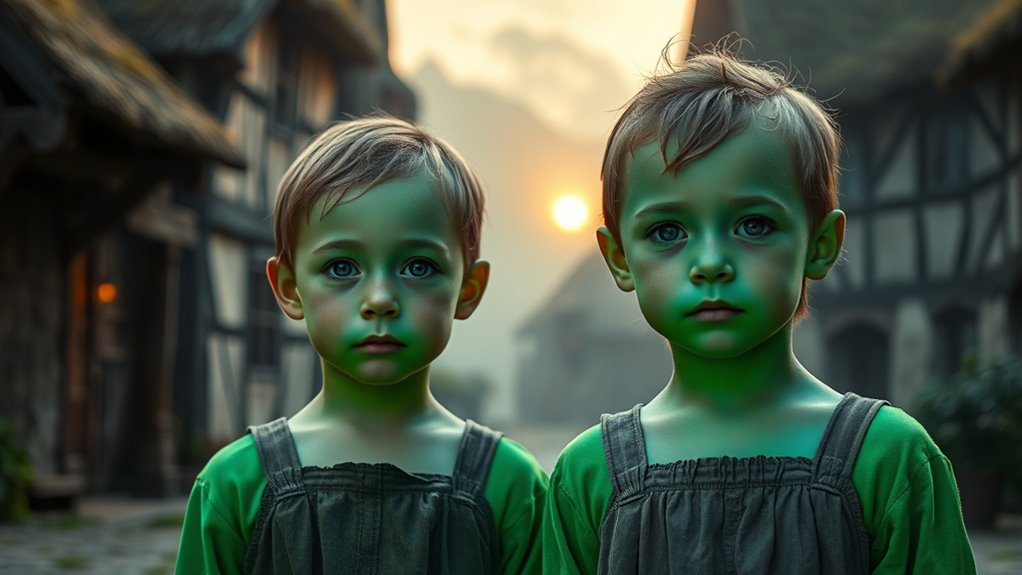
The Green Children of Woolpit are a mysterious pair of youngsters who appeared in the English village of Woolpit during the 12th century. Their sudden arrival sparked curiosity and confusion among villagers, who found the children speaking an unknown language and with skin that shimmered with a distinct green hue. Over the centuries, stories about these children have woven into local folklore, blending medieval legends with attempts to explain their origins through the lens of history and science. Many believe their story is a reflection of medieval legends—tales of supernatural beings and otherworldly visitors that often appeared during times of uncertainty. These legends, rich with mysticism, may have inspired the villagers’ interpretations of the children’s unusual appearance and behavior. Some accounts suggest they came from a subterranean world or a distant land, both ideas rooted in the supernatural themes common in medieval stories. However, modern researchers have also proposed more scientific explanations, including the possibility of genetic anomalies. In particular, some speculate that the children’s green coloration could have been caused by a rare genetic condition affecting skin pigmentation, such as hypochromic anemia or a similar disorder. This explanation aligns with the idea that the children might have been victims of a rare genetic anomaly, which could have caused their unusual skin color and possibly influenced their appearance and health. The children’s inability to speak English and their unfamiliar customs also fueled speculation that they might have been from a different cultural or geographical environment, possibly even a different time or dimension. Despite the many theories, no concrete evidence has ever emerged to definitively explain their origins. Modern scientific investigations continue to explore genetic explanations for their condition, highlighting how advances in science could someday shed light on such mysterious stories. The children’s story has persisted through the centuries, often interpreted as a symbol of the unknown and the mysterious boundaries between myth and reality. Some historians view the tale as a cautionary story or a reflection of medieval fears and beliefs, while others see it as an early encounter with individuals suffering from rare genetic conditions that were misunderstood at the time. Regardless of the explanation, the story of the Green Children continues to fascinate, blending medieval legends with scientific curiosity. It invites you to contemplate how folklore and science intersect and how stories from the past can still resonate today, reminding us that some mysteries defy easy explanation and remain woven into the fabric of local legend.
Frequently Asked Questions
Are There Other Similar Legends From Different Regions?
Yes, you’ll find similar legends from different regions involving fairy encounters and mythical beings. For example, in Ireland, stories of the leprechauns and fairies are common, while in Scandinavia, tales of trolls and elves persist. These legends reflect cultural beliefs and fears, often involving children or humans interacting with these mystical creatures. Such stories reveal how different societies interpret mysterious or unexplained phenomena through mythic beings.
What Modern Scientific Theories Explain the Children’s Origins?
Imagine you’re a scientist in 2024, not medieval times, trying to explain the children’s origins. Modern theories suggest genetic anomalies, like hypopigmentation, could cause their green skin. Environmental factors, such as exposure to certain plants or minerals, might also play a role. These explanations combine genetics and environment, providing plausible reasons for their unusual appearance without resorting to folklore, highlighting how science helps solve age-old mysteries.
How Have Interpretations of the Story Changed Over Time?
You see, interpretations of the story have shifted through historical reinterpretations, blending folklore and evolving cultural perspectives. Initially seen as a mysterious medieval legend, today you recognize it as a folkloric evolution reflecting societal fears and beliefs. Over time, skeptics question its authenticity, while others view it as allegory or symbolic. This dynamic narrative highlights how stories adapt, revealing changing attitudes and understanding across generations.
Are There Any Documented Genetic Studies Related to Woolpit’s Children?
You’ll be glad to know that no definitive genetic analysis or familial studies have been conducted on the Woolpit children. These mysterious figures remain cloaked in enigma, like a locked treasure chest. Researchers haven’t found concrete genetic evidence to explain their condition, leaving their origins open to speculation. Without such studies, their story continues to spark curiosity, like a flame that refuses to be snuffed out.
What Cultural Influences Shaped the Folklore Surrounding Woolpit?
You see, medieval beliefs and local traditions deeply influenced the folklore around Woolpit. People in that era explained the children’s green skin through supernatural or divine causes, reflecting their understanding of the world. Local legends also incorporated stories of otherworldly beings and moral lessons, shaping the narrative. These cultural influences blended with medieval views on nature and the unknown, creating a mesmerizing tale that persisted through generations.
Conclusion
Imagine uncovering the truth behind Woolpit’s green children, blending folklore with genetics. Just like a modern case where genetic conditions explained mysterious symptoms, perhaps these children’s story hints at real biological factors. By exploring both legends and science, you gain a fuller picture of history’s mysteries. So, next time you hear about Woolpit, remember it might be a fascinating mix of myth and biology, waiting to be unraveled with today’s knowledge.