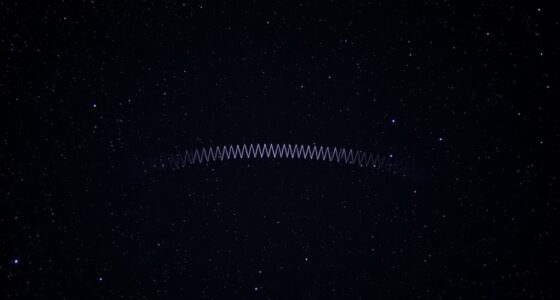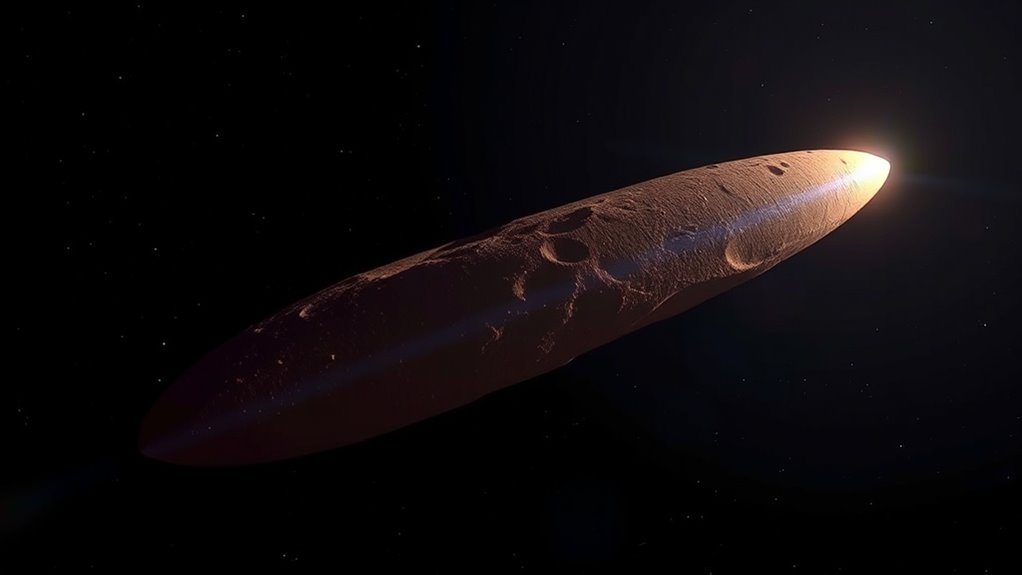

Scientists still debate whether Oumuamua is a natural interstellar fragment or an alien artifact. Its unusual shape, unexpected acceleration, and lack of typical comet activity raise questions. Some think it might be an intentionally created object or spacecraft, while others see it as a natural debris from another star system. Ongoing research and new discoveries continue to shed light on its true nature—if you stay curious, you’ll find out more about this cosmic mystery.
Key Takeaways
- Oumuamua’s elongated shape and unexplained acceleration fueled theories of artificial propulsion, suggesting potential alien technology.
- Natural explanations include it being a fragment from a larger object or shaped by cosmic forces, but lack of typical comet activity complicates this.
- Advances in AI and observational tools are enhancing analysis, helping distinguish between natural origin and artificial design.
- The debate remains open, as no definitive evidence confirms either natural or extraterrestrial origin of Oumuamua.
- Discovering similar objects in the future could provide critical insights into its true nature and origins.
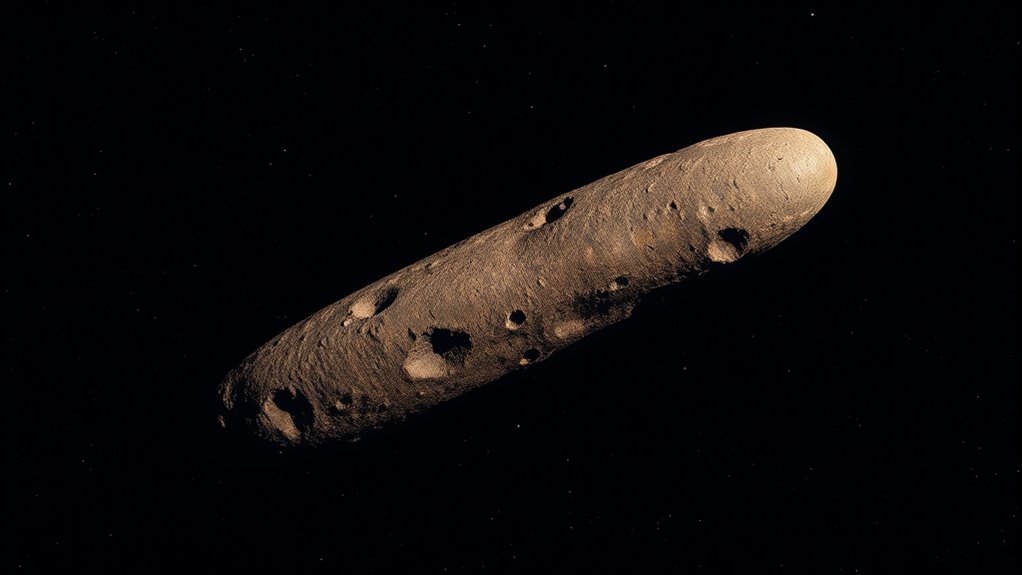
When the mysterious object known as Oumuamua first streaked through our solar system in 2017, scientists were both intrigued and puzzled. Its rapid passage and unusual shape immediately raised questions about its origins. Unlike typical comets or asteroids, Oumuamua’s trajectory suggested it came from beyond our solar system, hinting at an interstellar origin. This unexpected visitor ignited debates about whether it was a natural object or something more extraordinary—perhaps an alien artifact. Its speed, shape, and acceleration without a clear cometary tail left many researchers questioning if it was a product of alien technology or just a rare natural phenomenon. The idea that it might be an interstellar artifact, crafted by an advanced civilization, gained traction among some scientists enthusiastic to explore extraterrestrial intelligence.
Oumuamua’s rapid, unusual journey sparked debates over its natural or alien origins.
Some argue that Oumuamua’s peculiarities align with the possibility of it being an artificial object. Its elongated shape, estimated to be about 400 meters long, is unlike anything typically seen in space rocks. Its acceleration, which couldn’t be fully explained by sunlight’s push alone, suggested an external force—possibly an engineered propulsion system. If it were an alien artifact, it could be a piece of technology designed for interstellar travel or communication, floating through space as a remnant of an advanced civilization’s efforts. These theories, while controversial, are fueled by the notion that detecting such artifacts could offer concrete evidence of extraterrestrial life or technology.
However, many scientists advocate for a natural explanation. They point to the likelihood of Oumuamua being a fragment of a larger object that was broken apart by gravitational forces or collisions in another star system. Its shape might be the result of natural processes, such as erosion by cosmic dust or past activity that caused it to take on an unusual form. The lack of outgassing typical of comets further complicates the picture, but some argue this could be explained by a surface covered with non-volatile material. Additionally, recent advances in AI-driven analysis enable scientists to better model and interpret such anomalies, enhancing our understanding of their origins. In this view, Oumuamua is simply a rare, naturally occurring object, a cosmic oddity that happened to pass through our neighborhood.
Ultimately, the debate continues. Whether a natural anomaly or an alien artifact, Oumuamua’s journey through our solar system challenges our understanding of the cosmos. Its interstellar origin makes it a unique messenger from distant worlds, pushing scientists to keep searching for definitive signs of extraterrestrial life or technology. As we analyze new data and discover more objects like it, we inch closer to answering whether Oumuamua is a natural oddity or a relic of alien innovation.
interstellar object detection telescope
As an affiliate, we earn on qualifying purchases.
As an affiliate, we earn on qualifying purchases.
Frequently Asked Questions
Could Oumuamua’s Trajectory Be Influenced by Unseen Forces?
Yes, Oumuamua’s trajectory could be influenced by unseen forces like magnetic anomalies or gravitational perturbations. These forces might subtly alter its path, making it harder to predict. You should consider that such influences, especially from hidden magnetic fields or minor gravitational effects from unseen objects, could explain unusual deviations in its movement. This possibility keeps the debate open, prompting further investigation into what might be affecting its journey through space.
What Are the Latest Technological Methods Used to Analyze Oumuamua?
Imagine catching a faint flicker of light—scientists use spectral analysis and radar imaging to study Oumuamua’s surface and composition. These methods reveal its material makeup and shape, helping you understand its origins. Spectral analysis examines the light spectrum reflected from the object, while radar imaging sends signals to map its surface features. Together, these tech tools give you a clearer picture of this mysterious interstellar visitor’s nature.
How Does Oumuamua Compare to Other Interstellar Objects?
You notice that Oumuamua stands out from other interstellar objects because it’s likely a comet or asteroid, but its unusual shape and behavior challenge typical classifications. Unlike most comets and asteroids within our solar system, it’s an interstellar object, meaning it originated elsewhere. Its rapid movement and lack of a visible coma make it unique, prompting scientists to reconsider how we classify interstellar objects and what they reveal about distant planetary systems.
Is There Ongoing Research to Determine Oumuamua’s Origin?
While ongoing research subtly explores Oumuamua’s origin, you’d find that planetary geology and astrophysical models are central to this pursuit. Scientists gently probe its unusual trajectory and composition, seeking clues within interstellar space. They continue refining these models, hoping to piece together whether it’s a natural wanderer or something more extraordinary. Your curiosity fuels this scientific curiosity, inspiring further studies that keep the mystery alive and evolving.
What Are the Implications if Oumuamua Is Confirmed as Alien Technology?
If Oumuamua is confirmed as alien technology, you’d realize it’s a sign of Extraterrestrial Intelligence actively exploring or communicating. This discovery would have profound Technological Implications, prompting you to rethink current science and technology, and possibly inspiring new research avenues. It could also shift humanity’s perspective on our place in the universe, encouraging global collaboration to understand and respond to this unprecedented contact.
NASA Lunar Telescope for Kids – 90x Magnification, Includes Two Eyepieces, Tabletop Tripod, and Finder Scope- Kids Telescope for Astronomy Beginners, Space Toys, NASA Gifts (Amazon Exclusive)
INSPIRE CURIOSITY – The NASA Lunar Telescope allows your child to see the moon in incredible detail; the…
As an affiliate, we earn on qualifying purchases.
As an affiliate, we earn on qualifying purchases.
Conclusion
As you ponder Oumuamua’s mysterious journey, remember it’s like a silent messenger from the cosmos, whispering secrets beyond our understanding. Whether a natural wanderer or alien craft, it challenges you to see beyond the horizon, to question what’s possible. Like a lighthouse guiding ships through fog, its enigma urges you to keep exploring, to seek answers in the darkness. The universe’s secrets are waiting—will you be the one to uncover them?

Messier Astrophotography Reference
As an affiliate, we earn on qualifying purchases.
As an affiliate, we earn on qualifying purchases.

Hero Collector Eaglemoss USCSS Nostromo XL Edition | Alien & Predator XL Ship Collection | Model Replica
Produced in a combination of Die-cast and high-quality ABS Plastic
As an affiliate, we earn on qualifying purchases.
As an affiliate, we earn on qualifying purchases.