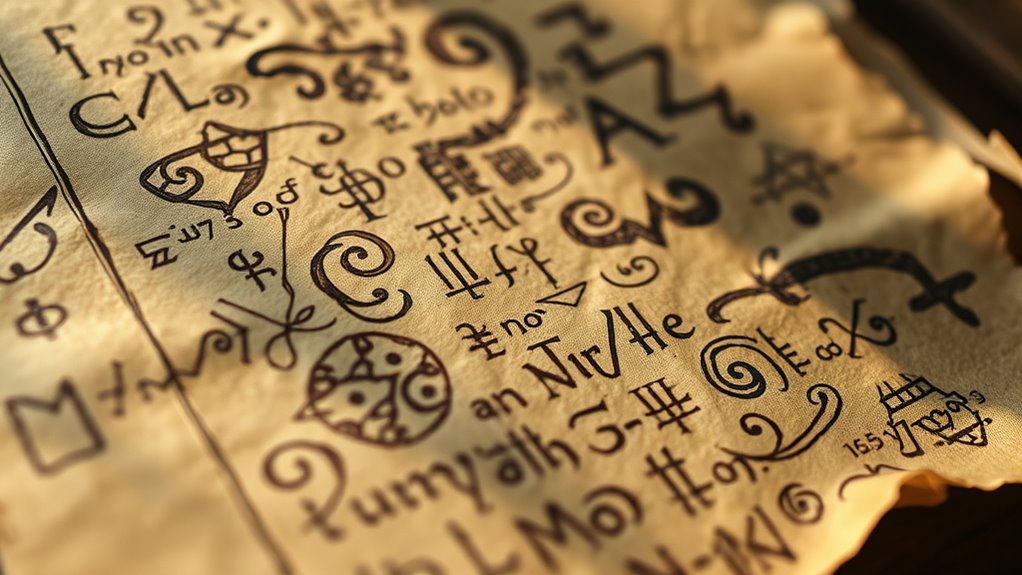

AI holds promise for revealing the Voynich Manuscript’s mysteries by analyzing patterns, symbols, and illustrations. However, its success depends on overcoming challenges like the unknown language, complex visual features, and lack of reference points. While AI can’t yet provide definitive translations, it can help narrow down possibilities and generate hypotheses. If you keep exploring, you’ll discover more about how AI is pushing the boundaries of solving this historical puzzle.
Key Takeaways
- AI employs pattern recognition and probabilistic modeling to analyze the manuscript’s symbols and structure.
- Despite advancements, AI struggles to definitively decode the unknown language due to lack of reference points.
- AI can generate plausible hypotheses but cannot yet provide a confirmed translation of the Voynich Manuscript.
- Interdisciplinary collaboration enhances AI’s ability to narrow down possible meanings and uncover insights.
- The core mystery persists; AI accelerates analysis but cannot fully resolve the enigmatic origins of the manuscript.

Have you ever wondered if artificial intelligence can decipher the secrets of the mysterious Voynich Manuscript? This centuries-old document has puzzled scholars, linguists, and cryptographers alike, resisting all attempts at translation. Its strange illustrations and unknown script make it one of the most intriguing puzzles in history. Now, with advances in AI decoding techniques, there’s hope that machines might finally crack its code. However, this task isn’t straightforward. The cryptography challenges are formidable because the manuscript’s language appears unique, with no known parallels. Traditional methods have fallen short, primarily because we lack a reference point or any confirmed linguistic structure. That’s where AI comes into play, promising new ways to analyze patterns, frequencies, and structures that might be invisible to human eyes. AI decoding techniques utilize machine learning algorithms that can sift through vast amounts of data rapidly, searching for hidden patterns or correlations. These systems can be trained to recognize recurring symbols, identify contextual relationships, and even generate potential translations based on probabilistic models. But the process isn’t simple. The cryptography challenges involve deciphering an unknown script that could be a constructed language, a cipher, or even a complex code. AI models have to overcome the ambiguity of the text and the lack of a known language base. They need to differentiate between meaningful symbols and decorative or filler elements, which is no small feat. Furthermore, the manuscript’s unique visual features further complicate the task. Some AI approaches focus on pattern recognition within the manuscript’s illustrations, hoping that visual clues could inform linguistic analysis. Others attempt to compare the script to known languages or cipher systems, seeking similarities that might unravel its secrets. Still, even with these advanced techniques, AI faces limitations because it relies heavily on existing data and patterns. Without a clear linguistic anchor, the AI’s guesses remain speculative. Despite these hurdles, the combination of AI and cryptography research offers promising avenues for progress. It accelerates the analysis, allowing researchers to test hypotheses more quickly than ever before. In recent years, interdisciplinary collaboration between linguists, cryptographers, and AI specialists has become crucial for progress in understanding complex codes. While AI might not deliver a definitive translation overnight, it could narrow down possibilities or reveal new insights into the manuscript’s structure. Ultimately, the challenge lies in the manuscript’s mystery itself — an unknown language, a unique cipher, or perhaps an entirely new form of communication. AI’s role is to assist, analyze, and hopefully, someday, decode the secrets that have eluded us for centuries.

The Voynich Manuscript
As an affiliate, we earn on qualifying purchases.
As an affiliate, we earn on qualifying purchases.
Frequently Asked Questions
Has AI Ever Decoded a Historical Manuscript Before?
Yes, AI has helped decode some historical manuscripts before. Through cryptographic breakthroughs and advanced linguistic analysis, AI tools have unraveled riddles in texts like the Rohonc Codex and certain ancient ciphers. These successes prove AI’s potential, though the Voynich Manuscript remains a unique challenge. You can expect ongoing developments, as machine learning continues to push the boundaries of deciphering long-lost languages and hidden codes.
Can AI Understand the Manuscript’s Illustrations and Symbols?
AI can assist with understanding the manuscript’s illustrations and symbols through advanced illustration analysis and symbol interpretation techniques. You can leverage machine learning to identify patterns, classify imagery, and interpret complex symbols that might be overlooked by humans. While AI doesn’t fully grasp the cultural context yet, it helps decode visual elements, providing valuable insights that bring you closer to understanding the manuscript’s hidden meanings.
What Are the Main Challenges AI Faces With the Voynich Manuscript?
Imagine you’re trying to decode a secret message with strange symbols, but the text’s meaning depends heavily on context. AI faces major challenges like limited contextual interpretation and complex cryptographic analysis, making it hard to distinguish genuine clues from noise. For example, without enough background, AI struggles to interpret the manuscript’s symbols accurately, hindering progress in revealing its secrets. This complexity keeps the manuscript’s mysteries intact.
How Might AI Influence Future Historical Research Methods?
AI, especially machine learning, will revolutionize your historical analysis by uncovering hidden patterns and connections in vast data sets. You’ll be able to analyze texts, artifacts, and images more efficiently, gaining new insights into history’s mysteries. This tech will make your research faster and more precise, helping you piece together stories from the past that were once impossible to decipher, opening exciting new avenues for discovery.
Are There Ethical Concerns With Using AI on Ancient Texts?
Absolutely, you should consider ethical concerns when applying AI to ancient texts. Privacy concerns may arise if sensitive information is involved, and cultural sensitivity is vital to prevent misinterpretation or misrepresentation. You must guarantee that AI respects the origins and significance of these texts, avoiding harmful biases or cultural insensitivity. Responsible use safeguards historical integrity, honors cultural heritage, and fosters trust in technological advancements.

Codes, Ciphers and Secret Writing (Dover Brain Games & Puzzles)
As an affiliate, we earn on qualifying purchases.
As an affiliate, we earn on qualifying purchases.
Conclusion
As you consider the Voynich Manuscript’s mysteries, it’s fascinating to see how AI might unexpectedly crack its code—just as a chance discovery once uncovered ancient secrets. Sometimes, breakthroughs come when you least expect them, blending technology and history in surprising ways. Perhaps, one day, AI will reveal what’s hidden in those mysterious pages, proving that coincidence and curiosity can unseal even the most enigmatic stories from the past.

Kits, Learn Morse Code, a Telegraph Kit Machine, Electric Circuit Experiment, Morse Code Machine, Morse Code Transmitter, Morse Code Kit
Project: Telegraph Machine – Can you send your friends an "hellow" message in Morse code
As an affiliate, we earn on qualifying purchases.
As an affiliate, we earn on qualifying purchases.

Introduction to Manuscript Studies
As an affiliate, we earn on qualifying purchases.
As an affiliate, we earn on qualifying purchases.