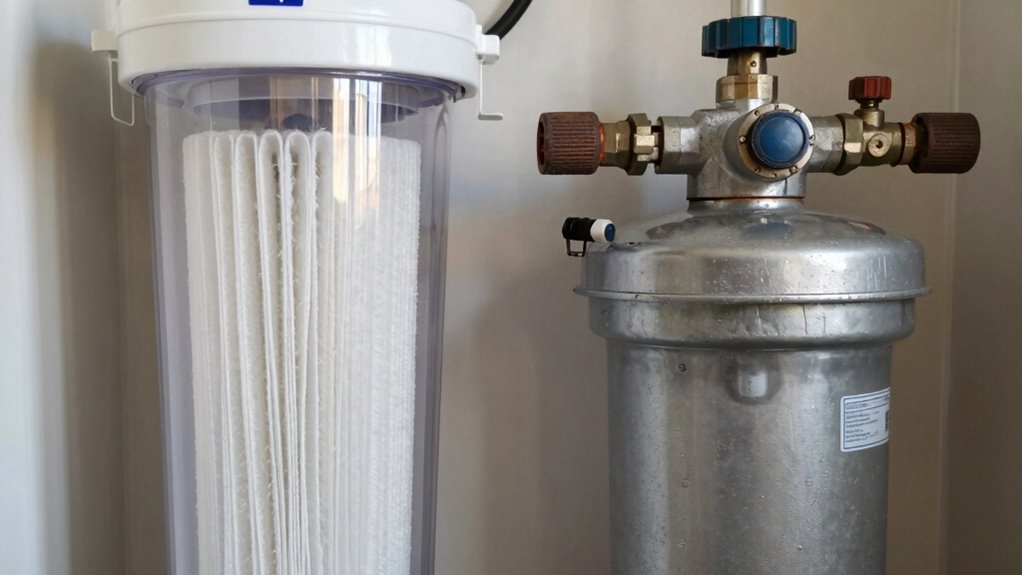

A whole house water filter and a water softener target different issues in your water supply. The filter removes sediment, chlorine, bacteria, and improves taste and safety, while the softener addresses hard minerals like calcium and magnesium that cause scale and stains. Knowing the problem helps you choose the right system. If you keep exploring, you’ll discover how these systems work together to give you better water quality and long-term solutions.

Prime made for students and young adults
- Fast, free delivery for dorm and study essentials
- Prime Video and Amazon Music included
- Member-only deals
Key Takeaways
- Whole house filters remove sediment, chlorine, bacteria, and improve water safety; softeners target mineral hardness, not contaminants.
- Filters enhance water taste and clarity, while softeners prevent scale buildup and appliance damage.
- Filtering systems do not address mineral deposits or hard water issues, which softeners specifically treat.
- Softening does not remove bacteria or chemicals, requiring separate filtration for comprehensive water purification.
- Combining both systems provides a comprehensive solution for multiple water quality concerns.
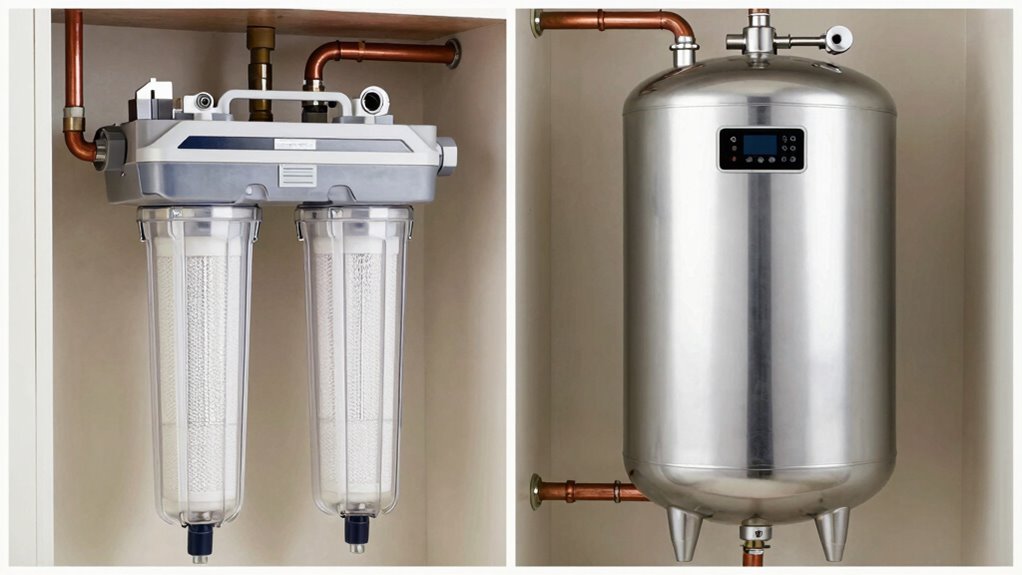
When it comes to improving your home’s water quality, understanding the difference between a whole house water filter and a water softener is essential. These two systems serve distinct purposes, and knowing which one you need depends on your specific water issues. A whole house water filter primarily focuses on removing contaminants like sediment, chlorine, bacteria, and other impurities. Sediment filtration is a key feature here, capturing particles such as dirt, rust, and silt that can clog pipes and damage appliances. This type of filtration improves water clarity and taste, making it safer and more pleasant to use throughout your home. Additionally, some filters include stages for pH balancing, which ensures your water maintains a neutral or slightly alkaline level. Proper pH levels prevent corrosion of pipes and fixtures and can improve water quality for drinking and bathing. It’s also important to consider that a whole house water filter can be customized to target specific contaminants based on your local water supply.
Understanding water filters and softeners helps you choose the right system for cleaner, healthier home water.
On the other hand, a water softener is designed specifically to address hard water, which is rich in minerals like calcium and magnesium. When you have hard water, you might notice mineral deposits on dishes, soap scum on fixtures, or dry skin after showers. A water softener works by exchanging these minerals with sodium or potassium ions, effectively “softening” the water. This process doesn’t remove sediment or contaminants but focuses on preventing scale buildup and prolonging the lifespan of appliances and plumbing. Softening water improves soap lathering and reduces mineral stains, but it doesn’t necessarily improve taste or eliminate bacteria. It’s also worth noting that some homeowners opt for combined systems to tackle multiple water quality issues simultaneously. Understanding the different filtration methods available can help you select the most effective solution for your water concerns. While both systems are installed at the point of entry, their functions are different and often complementary. If your water has high sediment content or poor taste, a whole house filter with sediment filtration and pH balancing capabilities is your best choice. It will clean the water from the source, ensuring it’s free from debris and properly balanced in pH, which is critical for both health and plumbing maintenance. Additionally, considering water testing can help determine exactly which system or combination of systems is needed for your home.
Conversely, if your concern is mineral buildup and you want to protect appliances from scale, a water softener is the way to go. In many cases, homeowners combine both systems to achieve comprehensive water quality improvement. Understanding that a whole house water filter and water softener solve different problems helps you make an informed decision. You get clearer, better-tasting water with a filter, and you prevent damage caused by hard minerals with a softener. Recognizing these differences ensures you choose the right system for your needs, saving money and avoiding unnecessary upgrades.
As an affiliate, we earn on qualifying purchases.
Frequently Asked Questions
Can a House Have Both a Water Filter and Softener?
Yes, you can have both a water filter and a softener in your house. A water filter improves water quality by removing contaminants, while a softener tackles hard water issues. Just make certain system compatibility so they work together effectively. Installing both provides thorough water treatment, giving you cleaner, better-tasting water and preventing mineral buildup. This combination maximizes water quality benefits for your entire household.
How Often Should I Replace My Water Filter or Softener Resin?
Did you know that most water filters last about six to twelve months? You should replace your water filter every six to twelve months to maintain filtration efficiency. For your softener resin, expect a lifespan of around 10 to 15 years, but it depends on water quality and usage. Regularly checking and replacing these components guarantees your system works effectively and prolongs its lifespan.
Do Water Softeners Remove Contaminants Like Bacteria?
Water softeners don’t remove contaminants like bacteria through contaminant removal or bacteria filtration. They mainly target hard minerals such as calcium and magnesium, softening your water. If you’re concerned about bacteria in your water, you need a dedicated water filter or UV treatment system that specifically addresses biological contaminants. Softeners improve water quality but aren’t designed for bacteria filtration or contaminant removal, so consider additional filtration for safety.
Are There Health Risks Associated With Water Softeners?
Imagine running your fingers through silky, softened water—sounds perfect, right? But health concerns can arise if mineral balance shifts too much. Water softeners replace calcium and magnesium with sodium, which might be risky for people on low-sodium diets or with health issues. While generally safe, excessive softening could impact your mineral intake, so it’s wise to monitor your water quality and consult a health professional if you have concerns.
Which System Is More Cost-Effective Long-Term?
A water softener is generally more cost-effective long-term due to lower initial costs and maintenance expenses. Its maintenance costs are predictable, mainly involving salt refills and occasional filter replacements. In contrast, a whole house water filter might have higher upfront costs and more frequent filter changes, increasing long-term expenses. So, if you’re looking for affordability over time, a water softener usually wins out.
As an affiliate, we earn on qualifying purchases.
Conclusion
Think of your home’s water system as a garden. The water filter is your gardener, carefully removing weeds and debris to keep your plants healthy and vibrant. The water softener, on the other hand, is like adding mulch — it prevents certain issues from taking root in the first place. Both tools work together to create a thriving, beautiful garden. Remember, understanding their roles helps you nurture your home’s water just as you would your favorite plants.
sediment and chlorine water filter
As an affiliate, we earn on qualifying purchases.
As an affiliate, we earn on qualifying purchases.
water softener with mineral removal
As an affiliate, we earn on qualifying purchases.
As an affiliate, we earn on qualifying purchases.
Fall Picks
fall essentials
As an affiliate, we earn on qualifying purchases.







![Terence Tao: Math 2.0 [Pdf]](https://curiousminds.info/wp-content/uploads/2026/10/terence-tao-math-2-0-pdf-featured-260x140.jpg)