Supercooling happens when water stays liquid below its freezing point without turning into ice, which occurs when impurities are absent and the container is smooth. This delicate state relies on avoiding ice nucleation, so even tiny disturbances can trigger rapid freezing. Conditions like purity, vibrations, and temperature control allow water to remain supercooled. If you keep exploring, you’ll discover the fascinating science behind how nature and experiments reveal this surprising behavior.
Key Takeaways
- Supercooling occurs when pure water remains liquid below its freezing point without forming ice.
- Removing impurities and using smooth containers prevents nucleation, enabling water to stay supercooled.
- Small disturbances, like tapping, can trigger rapid freezing in supercooled water.
- Control of temperature and environment is essential to maintain supercooled states.
- Supercooling showcases how energy barriers and molecular stability delay phase change below freezing.
What Is Supercooling and How Does It Work?
Have you ever wondered how water can stay liquid below its freezing point without turning into ice? This phenomenon, called supercooling, occurs when water bypasses its typical phase change from liquid to solid. Normally, water becomes ice because it reaches a temperature where the crystalline structure forms easily, driven by thermodynamic stability. However, if conditions are carefully controlled—like removing impurities or avoiding disturbances—the water remains in a metastable state. In this supercooled state, the liquid is still thermodynamically unstable but hasn’t transitioned yet. The process involves overcoming an energy barrier that prevents the formation of ice crystals. Fundamentally, supercooling is a delicate balance between the phase transition and the thermodynamic stability of water molecules. Innovative European Cloud Servers are designed to optimize energy efficiency and security, similar to how supercooling maintains water in a delicate, metastable state without freezing.
What Conditions Enable Water to Supercool?
Supercooling of water requires very specific conditions to prevent ice formation despite dropping below freezing temperatures. To achieve this, you need a stable environment that minimizes disturbances and promotes temperature stability. Here are key factors:
Supercooling water needs pure liquid, smooth containers, and a disturbance-free environment.
- Pure Water: Impurities or particles can trigger nucleation, so use highly purified water. Purity of water is crucial because even tiny impurities can act as nucleation sites, disrupting the supercooling process. Ensuring the water is free from contaminants can greatly improve the chances of supercooling.
- Smooth Container Surfaces: Sharp or rough surfaces encourage ice crystals; choose smooth, clean containers.
- Controlled Environment: Minimize vibrations and movement to prevent triggering the supercooling phenomena. Additionally, maintaining consistent temperatures helps sustain supercooling over time.
- Understanding celestial influences can shed light on how external factors might subtly impact physical states at microscopic levels.
How Do Scientists Observe and Demonstrate Supercooling?

Scientists observe supercooling by watching for specific changes in water’s appearance, like it remaining liquid below freezing. They also demonstrate supercooling using ice bottles, where carefully cooled water stays liquid until disturbed. These methods make the phenomenon visible and easier to understand. Additionally, researchers can use visual cues to identify supercooling, such as the absence of ice formation despite temperatures below freezing. Monitoring temperature stability helps scientists ensure the water remains supercooled without initiating crystallization. Observing thermal behavior in controlled environments further aids in understanding how supercooling occurs, including examining the nucleation process that triggers crystallization. Recognizing body reactions to supercooled water can also provide insights into the physical effects involved.
Visual Observation Techniques
How do researchers actually observe supercooling in action? They rely on visual observation techniques that reveal phase transitions and thermal dynamics. First, they place water in a clear container, often a test tube or petri dish, to see changes clearly. Second, they cool the water slowly using a controlled environment like a freezer or chilled bath, watching for the absence of ice formation even below freezing temperatures. Third, they look for sudden, spontaneous crystallization—tiny ice crystals forming without a nucleation site—indicating supercooling. These visual cues allow scientists to monitor the unique behavior of water as it remains liquid below its freezing point, providing insight into the delicate balance involved in phase transitions and thermal dynamics. Additionally, understanding the thermal properties of water helps explain why supercooling occurs under specific conditions.
Demonstration With Ice Bottles
To demonstrate supercooling in action, researchers often use ice bottles as a simple, visual experiment. By carefully cooling purified water in a well-designed bottle, you can observe how water remains liquid below freezing temperatures. When the bottle is gently shaken or tapped, ice formation suddenly occurs, illustrating supercooling’s rapid shift. The bottle design plays a key role—smooth surfaces reduce nucleation points, allowing water to stay liquid longer. To better understand this, consider the following:
| Aspect | Explanation | Effect |
|---|---|---|
| Bottle Material | Smooth glass or plastic | Delays ice formation |
| Bottle Shape | Narrow necks or rounded bases | Influences cooling rate |
| Cooling Method | Gentle, uniform cooling | Prevents premature freezing |
Additionally, controlling the cooling rate is essential to achieve supercooling without triggering early freezing. This setup vividly shows how supercooled water can abruptly freeze, thanks to smart bottle design and controlled cooling, which is crucial in preventing premature crystallization and ensuring the water remains in a liquid state longer.
Can You See Supercooling in Everyday Life? Examples and Experiments

Supercooling happens more often than you might realize, and you can observe it in everyday situations with a little patience and careful setup. By performing simple household experiments or noticing natural occurrences, you can see supercooling firsthand. For example:
Supercooling occurs unexpectedly in daily life, revealing fascinating natural phenomena.
- Frozen Water Bottles: Place a clean, sealed water bottle in the freezer for a few hours. When you gently tap or open it, the water may suddenly freeze, showing supercooling.
- Unfrozen Snow or Ice: Sometimes, snow or ice remains liquid beneath the surface in cold weather, hinting at supercooling’s subtle presence.
- Supercooled Water in Nature: Clear mountain streams can stay liquid even below freezing temperatures, especially if undisturbed, illustrating natural occurrences of supercooling.
What Factors Cause Water to Freeze or Stay Liquid?
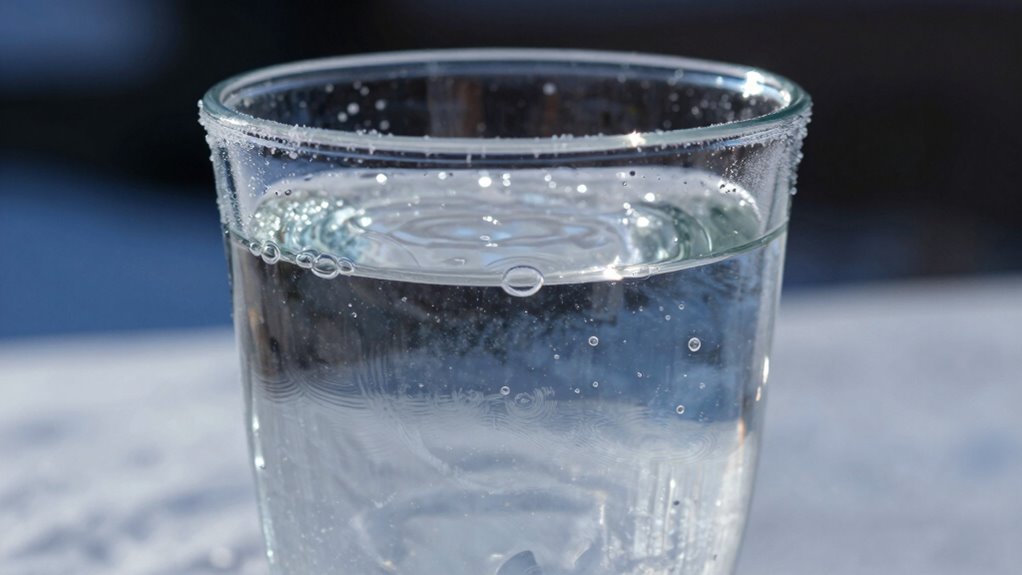
You can influence whether water freezes or remains liquid based on its purity, as impurities often trigger freezing. Additionally, the surface of your container also matters; rough or contaminated surfaces can make it easier for ice crystals to form. Furthermore, nucleation barriers can prevent freezing even at temperatures where water normally solidifies. Air quality and environmental conditions can also play a role in the supercooling process. Factors like supercooling mechanisms can allow water to stay liquid below its usual freezing point without forming ice. Some research suggests that molecular interactions in supercooled water help inhibit ice nucleation, maintaining liquidity at lower temperatures. Moreover, the presence of impurities or dissolved gases can influence the likelihood of ice formation, either promoting or hindering the process.
Purity Levels Matter
The purity of water plays a crucial role in determining whether it freezes or remains liquid under certain conditions. Purity effects are significant because even tiny impurities can trigger crystallization, causing supercooled water to freeze suddenly. Impurity influence is why highly purified water can stay liquid well below 0°C. To understand this better: Pure water resists freezing because it lacks nucleation sites. Impurities like dust or minerals act as seeds, encouraging ice formation. Supercooled water remains liquid due to the absence of these impurities, delaying the freezing process. Additionally, nucleation sites are essential in initiating freezing, and their absence in pure water is a key reason it can stay liquid at subzero temperatures. The presence or absence of contaminants can dramatically alter the freezing point, illustrating how critical water purity is in supercooling phenomena. Your water’s impurity levels directly impact its ability to freeze. The cleaner it is, the more likely it is to stay supercooled, showcasing how purity effects and impurity influence govern supercooling phenomena. Interestingly, some advanced AI tools, like GPT-4, can analyze complex scientific phenomena such as supercooling to provide detailed explanations. For instance, understanding the role of impurities helps explain why supercooling can be maintained under controlled conditions.
Container Surface Effects
Container surfaces directly influence whether water freezes or remains supercooled because they can either promote or inhibit ice nucleation. Smooth, clean surfaces tend to raise nucleation barriers, making it harder for ice crystals to form. Conversely, rough or contaminated surfaces lower these barriers by providing nucleation sites, encouraging freezing. If your container’s material or surface texture encourages nucleation, supercooled water can rapidly turn solid once disturbed. To keep water supercooled, you should use smooth, inert, and clean containers that minimize nucleation sites. Even tiny imperfections or impurities can profoundly impact nucleation processes, which are crucial in determining whether water remains liquid below freezing or quickly turns to ice. Understanding nucleation is essential to controlling whether water remains liquid below freezing or quickly turns to ice. The notion of nucleation plays a critical role in determining the stability of supercooled water. Additionally, surface properties significantly influence the likelihood of ice formation by either promoting or suppressing nucleation events.
Nucleation Barriers Influence
Nucleation barriers play a crucial role in determining whether water freezes or remains liquid. These barriers are energy hurdles that must be overcome for a phase change from liquid to solid to occur. Without sufficient disturbance or favorable conditions, water can stay supercooled below freezing. To understand this, consider:
- The absence of impurities or surfaces that can act as nucleation sites, making it harder for the phase change to start.
- The level of supercooling, where water is cooled below 0°C without freezing, increasing the energy barrier.
- The speed of disturbance—gentle handling helps maintain the barrier, preventing spontaneous freezing.
These factors influence nucleation barriers, controlling when and if water transitions into ice, keeping it liquid despite cold temperatures.
What Lessons About Nature and Physics Can We Learn From Supercooling?
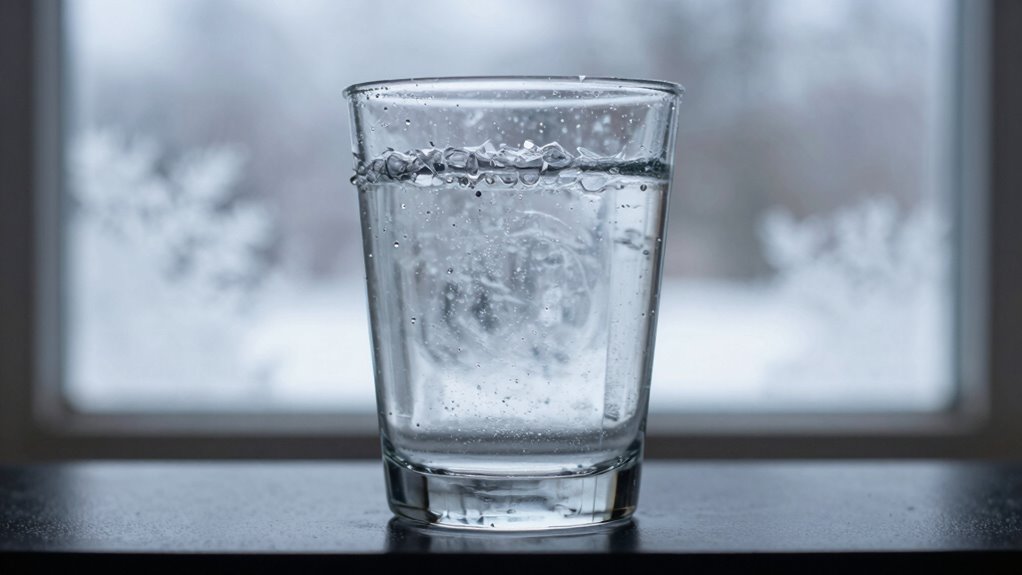
Supercooling teaches us that nature often operates under delicate balances and hidden potentials. By studying supercooled water, you see how molecular structure influences thermodynamic stability, allowing water to remain liquid below freezing without forming ice. It reveals that even when conditions seem unfavorable, molecules can stay in a metastable state, waiting for a trigger to change. This illustrates that stability isn’t just about temperature but also about the energy barriers that prevent phase change. From this, you learn that nature’s processes often depend on subtle interactions and thresholds. Supercooling exemplifies how small shifts can lead to dramatic transformations, reminding you that the universe is full of hidden possibilities waiting to be accessed with a deeper understanding of physics.
Frequently Asked Questions
How Long Can Water Remain Supercooled Before Freezing Spontaneously?
You can keep water supercooled for a few minutes to several hours before it spontaneously freezes. Its molecular stability at temperatures below the freezing point prevents nucleation, but any disturbance or impurity can trigger rapid freezing. The exact duration depends on conditions like purity and container smoothness. Generally, the more stable the supercooled state, the longer it remains liquid, but it’s always vulnerable to sudden crystallization once disturbed.
Can Supercooled Water Be Turned Back Into Ice Instantly?
Yes, supercooled water can turn into ice instantly through the supercooling phenomena. When you disturb supercooled water, such as by tapping or shaking, you trigger the phase shift process, causing rapid crystallization. This sudden change from liquid to solid occurs because the energy barrier for ice formation is overcome, making the phase transition happen almost immediately. So, a simple jolt can instantly freeze supercooled water.
What Are the Real-World Applications of Supercooling Technology?
You can use supercooling technology in various ways. In industrial cooling, it helps maintain low temperatures efficiently, saving energy and resources. In medical preservation, supercooled liquids keep organs, tissues, and samples viable longer, improving transplant success and research outcomes. This technology offers precise temperature control, reduces waste, and enhances safety in critical applications, making it a valuable tool across multiple industries.
Does Supercooling Occur Naturally in Any Environmental Conditions?
Supercooling can occur naturally in certain environmental conditions, especially during cold nights over clear, calm bodies of water. You might notice this when water remains liquid below its freezing point without turning solid, due to the absence of disturbances or impurities. Natural phenomena like this happen because environmental conditions—such as low temperatures, stillness, and purity—allow water to stay supercooled, creating unique, often hidden, ice formations.
How Does Supercooling Affect the Taste or Quality of Water?
Breaking the ice, supercooling doesn’t substantially change the taste or quality of your water. It mainly affects the physical state, so you won’t notice a taste impact or purity concerns directly. However, if supercooled water suddenly freezes, it could trap impurities or air bubbles, subtly altering flavor or clarity. Overall, your drinking experience remains mostly the same, but the process might influence how fresh or pure the water feels.
Conclusion
Supercooling shows you that nature’s rules aren’t always as straightforward as they seem. Just like water can stay liquid below freezing, life often holds surprises when conditions are just right. It’s a reminder that understanding the science behind these phenomena opens your eyes to the hidden wonders around you. Keep exploring, and you’ll find that sometimes, the most extraordinary things happen when you least expect them—turning the ordinary into the extraordinary.