
TL;DR

Prime made for students and young adults
- Fast, free delivery for dorm and study essentials
- Prime Video and Amazon Music included
- Member-only deals
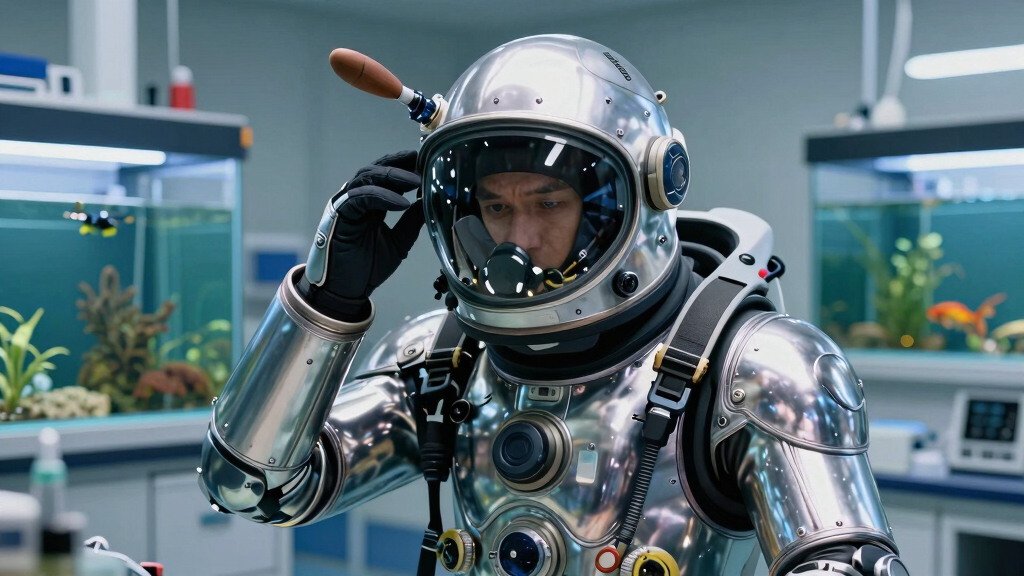
Researchers have created a cyborg insect fitted with an underwater suit, enabling it to dive and move seamlessly between land and water. This innovation could impact environmental monitoring and robotics.
Scientists have unveiled a cyborg insect equipped with an underwater suit that can dive and traverse both land and water environments. This development, announced by the research team at the Institute of Bio-Robotics, marks a breakthrough in hybrid mobility for robotic insects, with potential applications in environmental monitoring and search-and-rescue missions.
The robotic insect, modeled after a beetle, features a lightweight, flexible underwater suit integrated with its exoskeleton. According to the research team, it can dive up to 10 meters deep and navigate aquatic environments while maintaining terrestrial mobility. The suit is equipped with miniaturized thrusters and sensors, allowing the insect to adapt to different terrains and conditions.
During recent tests, the cyborg insect successfully completed a series of tasks, including underwater navigation, surface traversal, and land mobility. The project aims to demonstrate the feasibility of bio-inspired robots capable of multi-environment operation, with the researchers emphasizing its potential for environmental data collection and disaster response.
Potential Impact on Environmental and Disaster Monitoring
This innovation could significantly enhance environmental monitoring by providing access to hard-to-reach aquatic and terrestrial ecosystems. The ability to switch seamlessly between land and water may also improve search-and-rescue operations in flood or disaster scenarios, where traditional robots face limitations. Experts suggest that this development could pave the way for more versatile bio-robotic systems in various fields.
As an affiliate, we earn on qualifying purchases.
Advances in Bio-Robotics and Hybrid Mobility Technologies
The concept of bio-inspired robotics has advanced rapidly over the past decade, with researchers exploring insects and other small creatures as models for mobility and adaptability. Previous efforts focused on terrestrial or aquatic robots separately; this latest project combines these capabilities into a single platform. The development builds on prior work in miniature underwater vehicles and insect-inspired robots, integrating these into a hybrid system.
While similar concepts have been proposed before, the current demonstration marks one of the first successful implementations of a fully functional insect-sized robot capable of both underwater and terrestrial navigation, with real-world testing now underway.
“This cyborg insect demonstrates a new level of adaptability in bio-inspired robotics, capable of operating in diverse environments that were previously inaccessible to small robots.”
— Dr. Laura Chen, lead researcher at the Institute of Bio-Robotics
As an affiliate, we earn on qualifying purchases.
Unanswered Questions About Durability and Practical Deployment
It is not yet clear how durable the underwater suit is under prolonged use or in harsh conditions. The scalability of production and the robot’s autonomy in complex environments remain untested. Researchers have not disclosed detailed performance metrics or long-term operational data, and real-world deployment scenarios are still under development.
As an affiliate, we earn on qualifying purchases.
Next Steps Include Field Testing and Performance Optimization
The research team plans to conduct extensive field tests to evaluate the robot’s durability, autonomy, and effectiveness in real-world environments. They aim to refine the design, improve battery life, and explore integration with autonomous navigation systems. Further studies will assess its potential for practical applications in environmental monitoring, disaster response, and military reconnaissance.
miniature underwater exploration robot
As an affiliate, we earn on qualifying purchases.
As an affiliate, we earn on qualifying purchases.
Key Questions
How does the cyborg insect move underwater?
The insect is equipped with miniaturized thrusters and sensors integrated into its underwater suit, allowing it to propel itself and navigate underwater environments effectively.
What are the main applications of this technology?
Potential applications include environmental monitoring, search-and-rescue operations, and military reconnaissance, especially in scenarios where traditional robots face limitations.
Is this technology ready for commercial or military use?
Not yet. The current development is in the prototype and testing phase. Further testing and refinement are needed before practical deployment can be considered.
What are the limitations of this robotic insect?
Limitations include concerns about durability, battery life, and autonomous operation in complex environments, which are still being addressed by researchers.
Source: hn
Halloween Picks
halloween
As an affiliate, we earn on qualifying purchases.