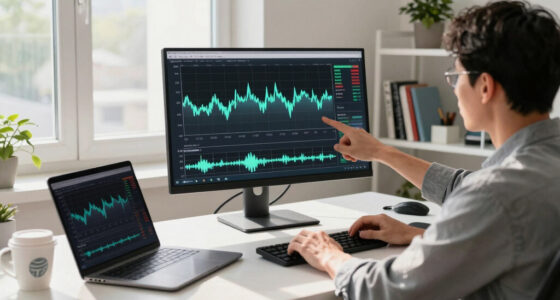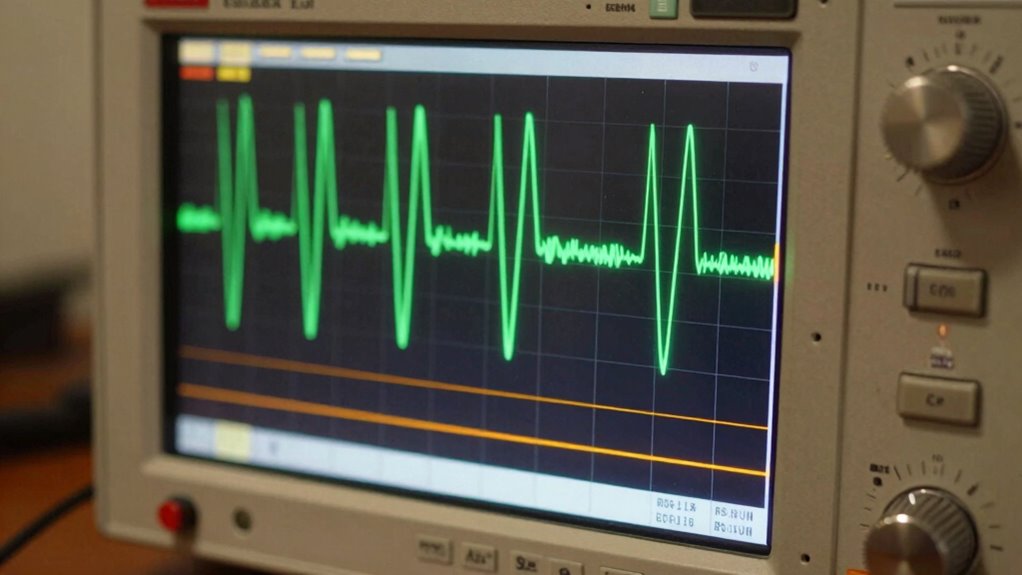

A home lab oscilloscope measures electrical signals by capturing voltage changes over time and displaying waveforms on its screen. It translates analog signals into digital data, allowing you to analyze parameters like amplitude, frequency, and rise time. This helps you understand circuit behavior and troubleshoot issues effectively. If you keep exploring, you’ll discover how to get the most accurate measurements and maintain your scope for reliable results.

Prime made for students and young adults
- Fast, free delivery for dorm and study essentials
- Prime Video and Amazon Music included
- Member-only deals
Key Takeaways
- Measures voltage changes over time in electronic circuits.
- Captures waveforms to analyze signal amplitude, frequency, and timing.
- Converts analog signals into digital data for detailed examination.
- Detects noise, disturbances, and signal integrity issues.
- Verifies circuit performance and troubleshooting through real-time visualization.
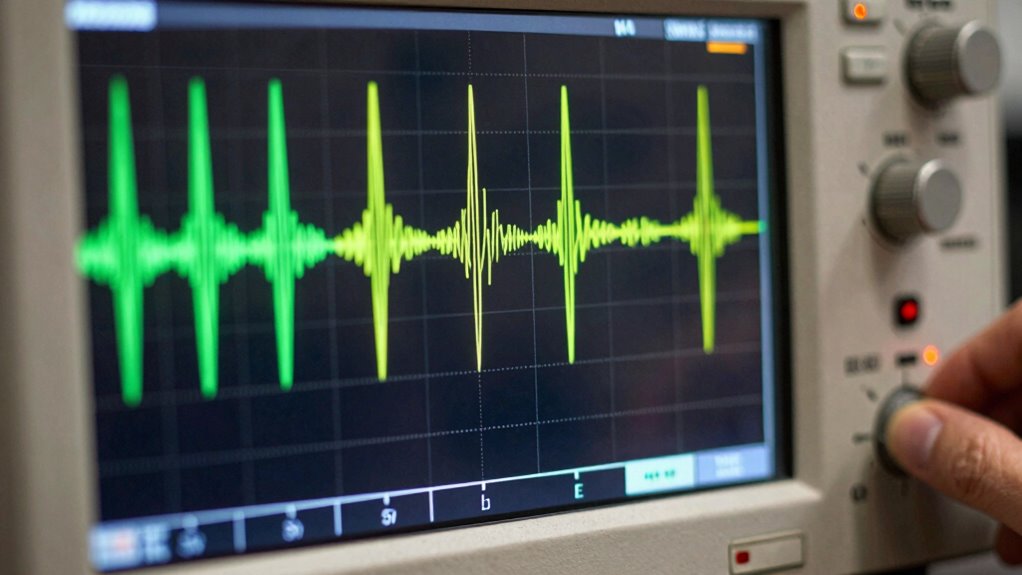
Have you ever wondered how to accurately gauge electronic signals in your home lab? When you connect your oscilloscope, you’re not just looking at pretty waveforms; you’re capturing real electrical activity that reveals essential information about your circuits. But to get meaningful data, you need to understand what your oscilloscope measures and how to guarantee those measurements are accurate. Signal integrity becomes a key concern here because any disturbance or noise can distort what you see, leading to incorrect interpretations. That’s where proper probe calibration comes into play. Calibrating your probes ensures that the signals you observe truly reflect what’s happening in your circuit, not just artifacts introduced by measurement inaccuracies.
Your oscilloscope measures voltage over time, presenting it as waveforms on its display. These waveforms help you analyze the behavior of your electronic components, identify faults, or verify circuit operation. When you probe a circuit, you’re essentially connecting the scope to a tiny window into the electrical activity. The scope then converts the analog voltage signals into digital data, which it displays as traces. To trust what you see, you must understand that the scope measures the instantaneous voltage at the probe tip. But this measurement can be compromised if the probe isn’t properly calibrated or if signal integrity is compromised along the way. Proper probe calibration is vital because it ensures the accuracy of your voltage readings, especially at high frequencies. Regular calibration also compensates for probe drift, which can occur over time due to environmental factors. Additionally, using proper grounding techniques can help prevent measurement errors caused by ground loops or interference. It’s also beneficial to understand how impedance matching impacts signal fidelity, especially at higher frequencies.
Understanding that your scope measures instantaneous voltage at the probe tip is essential for accurate signal analysis.
Probe calibration is essential because it ensures that the voltage levels your scope reports match the actual voltages in your circuit. Over time, probes can drift, or their calibration can become inaccurate due to temperature changes, mechanical wear, or manufacturing tolerances. Regular calibration helps maintain measurement accuracy, which is indispensable when you’re troubleshooting delicate circuits or verifying high-frequency signals. Proper grounding and minimizing cable lengths also improve signal integrity, reducing noise and reflections that could distort your readings. Additionally, verifying your calibration with known reference signals can provide extra confidence in your measurements. Ensuring your testing environment minimizes electromagnetic interference can further improve measurement reliability. When you measure signals, you’re capturing various parameters like amplitude, frequency, rise time, and noise levels. These parameters tell you whether your circuit functions as intended or if there’s a problem. But without good probe calibration and attention to signal integrity, those measurements can be misleading. Always check that your probes are correctly compensated, and use the shortest, most direct connections possible. By doing so, you’ll ensure that your oscilloscope provides reliable, precise insights into your electronic projects, helping you build better circuits and avoid costly mistakes.
digital oscilloscope for electronics hobbyists
As an affiliate, we earn on qualifying purchases.
As an affiliate, we earn on qualifying purchases.
Frequently Asked Questions
How Accurate Are Home Lab Oscilloscopes Compared to Professional Models?
Home lab oscilloscopes are generally less accurate than professional models due to signal resolution and bandwidth limitations. You might notice lower resolution and narrower bandwidth, which can affect your ability to capture rapid signal changes precisely. While they’re suitable for basic troubleshooting and learning, for high-frequency or detailed analysis, professional oscilloscopes provide greater accuracy. You can still get reliable results, but keep in mind their inherent limitations.
Can a Home Lab Oscilloscope Measure Wireless Signals?
Can a home lab oscilloscope measure wireless signals? Absolutely, but with caveats. Wireless signal analysis requires specialized probes and antennas, and you’ll need to employ advanced signal filtering techniques to separate signals from noise. Think of it as tuning a radio—your oscilloscope can visualize the signals, but capturing and interpreting them accurately demands careful setup and some technical know-how, transforming your device into a powerful tool for wireless exploration.
What Is the Maximum Voltage a Typical Home Oscilloscope Can Handle?
A typical home lab oscilloscope can handle voltages up to around 400 volts peak-to-peak, but this varies by model. Always check your device’s voltage limits in the user manual. To stay safe, follow safety precautions like using proper probes, ensuring proper grounding, and never exceeding specified voltage limits. Overloading can damage the scope or cause personal injury, so always operate within the recommended voltage range.
How Often Should I Calibrate My Home Lab Oscilloscope?
You should calibrate your home lab oscilloscope every six to twelve months to guarantee signal stability. For example, if you notice readings drifting or inconsistent waveforms, it’s time to recalibrate. Regular calibration maintains accuracy, especially when measuring critical signals. The frequency depends on usage intensity and precision needs—more frequent calibration ensures reliable measurements and prevents errors in your experiments or projects.
Can Oscilloscopes Measure Temperature or Other Non-Electrical Signals?
Oscilloscopes primarily measure electrical signals, but with the right accessories, you can also perform temperature monitoring and detect some non-electrical signals. For temperature, you’d use a thermocouple or infrared sensor connected to the scope. While they’re not designed for all non-electrical signals, oscilloscopes can handle some non-electrical data, like pressure or sound waves, if you convert these into electrical signals using appropriate sensors.
oscilloscope probe calibration kit
As an affiliate, we earn on qualifying purchases.
As an affiliate, we earn on qualifying purchases.
Conclusion
In essence, a home lab oscilloscope gently reveals the subtle symphony of electrical signals that underpin your projects. While it may not capture every nuance, it offers a refined glimpse into your circuitry’s heartbeat. Embrace its insights as a guiding light, helping you refine your craftsmanship with understated elegance. Ultimately, it’s a trusted companion, subtly illuminating the intricate dance of electrons and guiding your hands toward mastery.
high-frequency oscilloscope with waveform display
As an affiliate, we earn on qualifying purchases.
As an affiliate, we earn on qualifying purchases.
electrical signal testing equipment
As an affiliate, we earn on qualifying purchases.
As an affiliate, we earn on qualifying purchases.
Evergreen bestsellers Picks
bestsellers
As an affiliate, we earn on qualifying purchases.