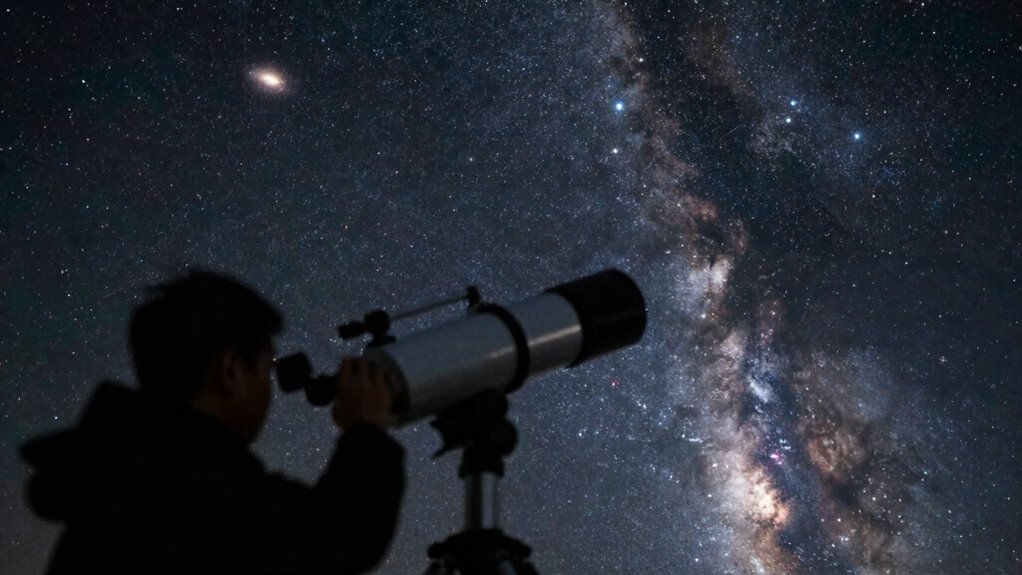
Aperture is more important than magnification for most stargazers because it determines how much light your telescope gathers, which affects how bright and detailed the objects appear. A larger aperture allows you to see fainter, more distant celestial bodies and reveals more features, even at lower magnifications. While high magnifications can make objects bigger, they often introduce fuzziness and distortions if the aperture isn’t big enough. Keep exploring to discover how aperture truly enhances your stargazing experience.
Key Takeaways
- Larger aperture collects more light, revealing fainter celestial objects that magnification alone cannot enhance.
- Aperture determines the potential detail and brightness of images, which magnification cannot compensate for if too high.
- Increasing aperture improves overall image quality, while excessive magnification can cause fuzziness and loss of detail.
- A bigger aperture allows for better contrast and differentiation of celestial features regardless of eyepiece quality.
- Prioritizing aperture ensures more versatile and brighter views, making it more impactful than focusing solely on magnification.
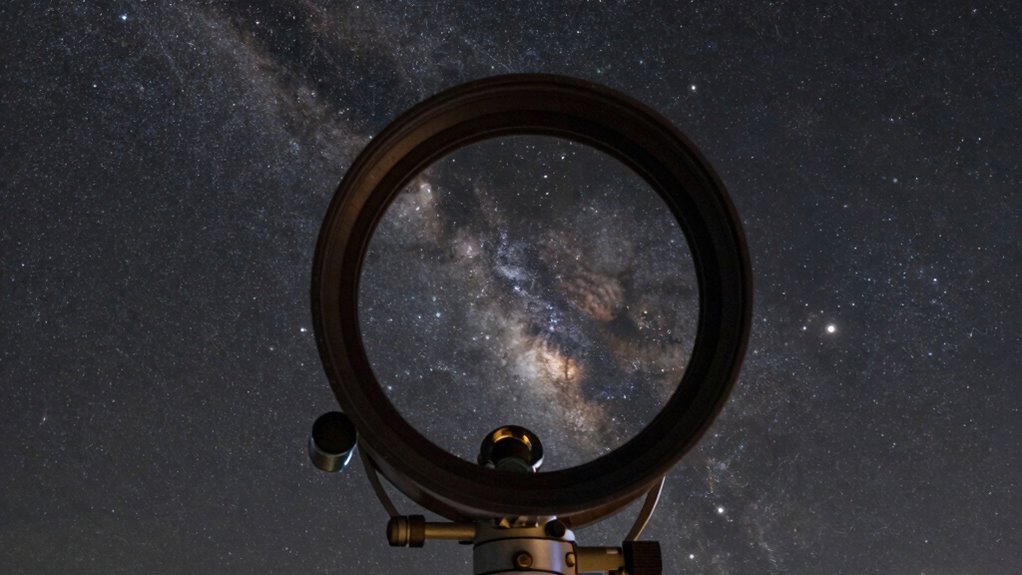
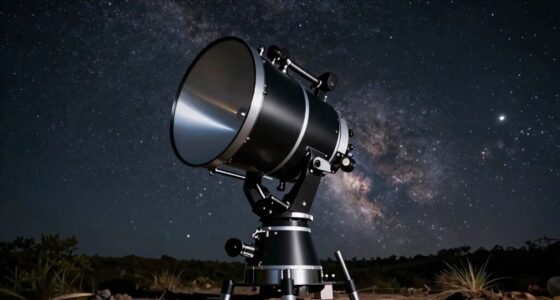
When choosing a telescope for stargazing, understanding aperture and magnification is vital. While magnification often gets the spotlight, aperture plays a far more essential role in what you’ll actually see. Aperture refers to the diameter of your telescope’s main lens or mirror, and it determines how much light your telescope gathers. The more light it collects, the brighter and more detailed the objects you’ll observe. This is especially important in astronomy because most celestial objects are faint, and a larger aperture allows you to see dimmer stars, nebulae, and galaxies. On the other hand, magnification is about enlarging the image, which depends heavily on the eyepiece quality. A high-quality eyepiece with good lens coatings can provide sharper, clearer images at higher magnifications, but if your aperture is small, you’ll hit a limit where increasing magnification only makes the view fuzzier rather than more detailed.
Many beginners believe that cranking up the magnification will reveal more detail, but this often backfires if their telescope’s aperture isn’t large enough. Higher magnification can magnify not only the image but also the imperfections and atmospheric turbulence, leading to a blurry view. Instead, you should focus on choosing a telescope with a larger aperture because it will deliver brighter, more detailed views at lower to moderate magnifications. With a bigger aperture, even with a modest eyepiece, you’ll find that objects appear more distinct and vibrant, making your stargazing experience more rewarding. Additionally, understanding the importance of aperture helps you select a telescope that maximizes your viewing potential from the start. Investing in a larger aperture telescope can also improve your overall viewing experience, especially when paired with quality accessories. Moreover, larger apertures can also help you observe fainter celestial objects, expanding the scope of what you can see in the night sky.
Another vital aspect to consider is the quality of your eyepieces. Good eyepiece quality, especially those with superior lens coatings, can markedly enhance your viewing experience. Lens coatings reduce reflections and glare, ensuring that more light reaches your eye and improves contrast. This means that even if your telescope has a decent aperture, poor-quality eyepieces can limit the clarity and detail of what you see. Investing in high-quality eyepieces with multi-layer coatings can make a noticeable difference, especially when paired with a larger aperture telescope. They allow you to maximize the light-gathering power of your main lens or mirror and see more celestial detail.

Gskyer Telescope, 70mm Aperture 400mm AZ Mount Astronomical Refracting Telescope for Kids Beginners – Travel Telescope with Carry Bag, Phone Adapter and Wireless Remote.
Superior Optics: 400mm(f/5.7) focal length and 70mm aperture, fully coated optics glass lens with high transmission coatings creates…
As an affiliate, we earn on qualifying purchases.
As an affiliate, we earn on qualifying purchases.
Frequently Asked Questions
How Does Aperture Affect Image Brightness in Astrophotography?
Aperture directly affects image brightness in astrophotography through its light gathering ability. The larger your aperture, the more light it captures, leading to brighter, clearer images of faint celestial objects. This improved light collection enhances image clarity, making details more visible. So, when choosing equipment, prioritize a larger aperture to maximize light gathering and achieve brighter, sharper astrophotographs, especially of dim stars and distant galaxies.
Can a Small Aperture Telescope Still Provide Detailed Views?
Like a finely tuned orchestra, your small aperture telescope can still produce detailed views if you choose the right eyepiece and maintain your equipment well. Focus on selecting high-quality eyepieces that maximize your telescope’s potential, and keep your optics clean and aligned. Proper telescope maintenance guarantees your instrument functions effectively, allowing you to enjoy sharp, detailed observations—even with a modest aperture.
Does Magnification Impact the Field of View?
Magnification does impact your field of view; higher magnification narrows it, making objects appear larger but less of the sky visible. Your eyepiece selection influences this, as different eyepieces offer varying magnifications and eye relief. For comfortable viewing, especially during long sessions, choose eyepieces with good eye relief. Balancing magnification and eye relief guarantees you enjoy a broader view while still getting detailed observations.
How Does Atmospheric Conditions Influence Aperture Effectiveness?
Imagine you’re observing the night sky during a high-turbulence storm. Atmospheric conditions like turbulence and light pollution markedly reduce aperture effectiveness, as they scatter and distort incoming light. Larger apertures gather more light, but turbulence can blur images, making details harder to see. On a clear, dark night, your aperture performs best, allowing you to resolve faint objects. So, atmospheric conditions directly influence how well your telescope’s aperture works.
Is Higher Magnification Always Better for Viewing Planets?
Higher magnification isn’t always better for viewing planets, as it can reduce image brightness and sharpness. Instead, focus on selecting the right eyepiece to maximize planetary detail with your telescope’s aperture. Too much magnification can cause image instability and loss of detail, especially if atmospheric conditions aren’t ideal. So, balance your magnification with your telescope’s aperture and atmospheric conditions for the clearest, most detailed planetary views.

Starboosa Complete Telescope Eyepiece Set – Multi-Coated Optics – 1.25 inch Eyepiece Set with 4mm, 10mm, 20mm Lenses, 5X Barlow Lens, 2 Moon Filters, 2 Polarizing Filters
**Comprehensive Eyepiece Set:** This 1.25-inch (31.7mm) eyepiece set is designed for astronomy professionals and beginners alike. It includes…
As an affiliate, we earn on qualifying purchases.
As an affiliate, we earn on qualifying purchases.
Conclusion
Remember, your telescope’s aperture is like a gateway to the universe, inviting more light and revealing distant wonders. While magnification can make objects appear larger, it’s the aperture that truly determines what you can see. Think of it as a flashlight—bigger aperture means brighter and more detailed views. So, focus on choosing a telescope with a generous aperture, and you’ll open the door to countless celestial adventures that await just beyond the darkness.

Educational Insights GeoSafari Starview Telescope – Kids Telescope for Beginner Astronomy, Stargazing & Viewing Planets, Home or Classroom Science Set, Space Discovery & STEM Gifts for Ages 7+
Perfect for beginners: Easy to set up and use, this kids telescope is designed to help kids learn…
As an affiliate, we earn on qualifying purchases.
As an affiliate, we earn on qualifying purchases.

Pirate Spyglass Telescope Pocket Compass Set, Caribbean Collapsible Spyglass Zoomable Pirate Monocular Telescope Handheld Telescope Pirate Spyglass for Bird Watching Hunting Hiking Travelling
☀PREMIUM QUALITY MATERIAL – The portable telescope brass is classically designed with high quality aluminum-alloy plating gold while…
As an affiliate, we earn on qualifying purchases.
As an affiliate, we earn on qualifying purchases.