
Black holes don’t suck in everything like cosmic vacuums. Instead, they pull in matter only when it crosses their event horizon, much like any other massive object’s gravity. Their power lies in warping space and time, which causes matter to spiral inward. Most objects stay safe unless they venture too close. To understand how black holes really work and clear up common misconceptions, keep exploring their fascinating nature and how scientists study them.
Key Takeaways
- Black holes only attract matter that crosses their event horizon; they do not pull in everything from a distance like a vacuum.
- Gravity weakens with distance, so black holes don’t suck in objects unless they are very close.
- Their gravitational influence extends over regions, but objects orbit or remain unaffected unless near the event horizon.
- Black holes’ effects are similar to other massive objects; they do not have an insatiable “vacuum” effect on surrounding space.
- The misconception arises because of their strong gravity, but in reality, they behave like any other gravitational body at a distance.
What Is a Black Hole and How Do They Form?
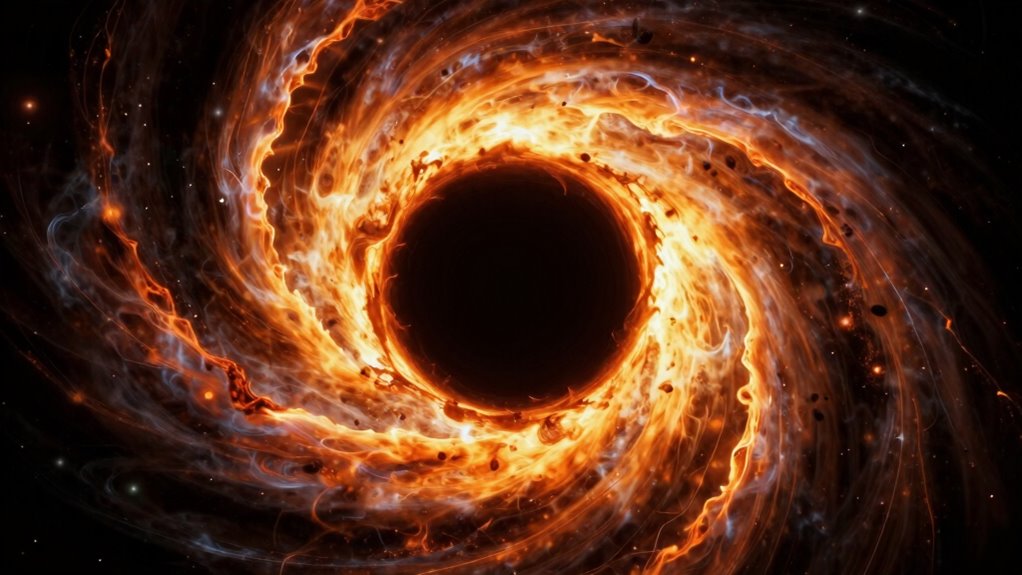
A black hole is an incredibly dense region of space where gravity is so strong that nothing, not even light, can escape it. Black hole formation begins during stellar evolution when a massive star exhausts its nuclear fuel. Without energy to counteract gravity, the star’s core collapses under its own weight. This collapse compresses the core into an extremely small point called a singularity, creating a black hole. The remaining outer layers may explode outward in a supernova, but the core’s gravity pulls everything inward. This process results in a black hole with an event horizon, the point of no return. The process of stellar evolution explains how these cosmic objects come into existence and why they are key endpoints of massive star life cycles. Additionally, the intense gravity near a black hole can distort spacetime, leading to fascinating effects predicted by Einstein’s theory of relativity. Understanding black holes also helps scientists explore the fundamental laws of physics under extreme conditions.
How Do Black Holes Influence Their Surroundings?

Black holes might be known for their intense gravity, but their influence extends far beyond pulling in nearby matter. Once you cross the event horizon, the black hole’s gravitational influence becomes unstoppable, shaping everything around it. You can think of it as a boundary marking the point of no return, yet its effects are felt well outside this line. Here are four ways black holes influence their surroundings:
Black holes influence their surroundings in ways beyond just pulling in matter, shaping stars and galaxies through their powerful gravitational effects.
- They distort spacetime, creating gravitational waves. These ripples in spacetime are often generated during black hole mergers and can be detected by sensitive instruments.
- They can trigger the formation of new stars nearby.
- They influence the motion of stars in their galaxy.
- They generate powerful jets of energy that impact the interstellar environment.
Additionally, the energetic phenomena associated with black holes are often studied using advanced observational techniques to understand their impact on the cosmos. While they don’t suck everything in like a vacuum, their gravitational influence dramatically shapes cosmic neighborhoods.
Are Black Holes Cosmic Vacuum Cleaners?
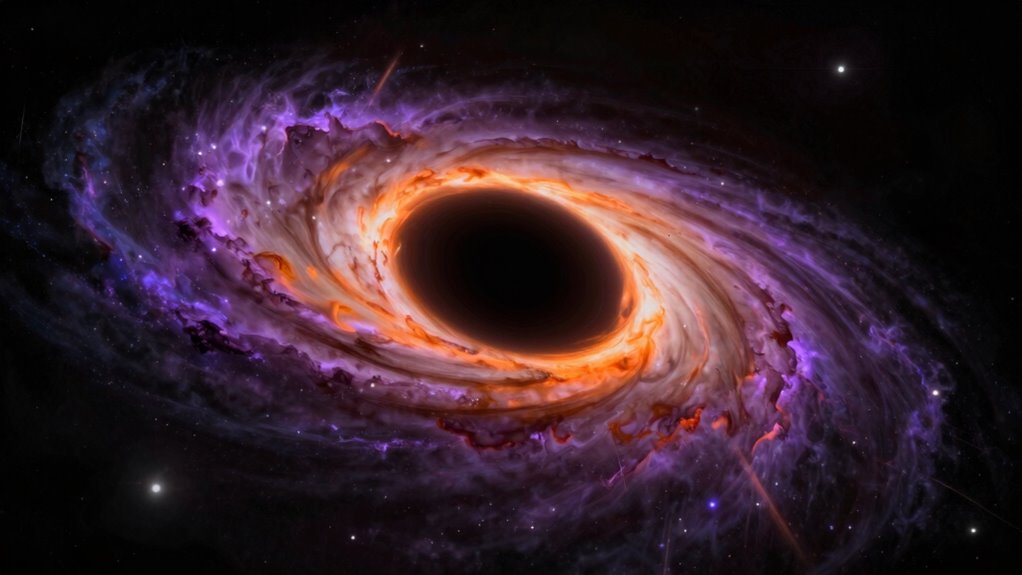
Many imagine black holes as cosmic vacuum cleaners relentlessly sweeping up everything in their path, but that’s a misconception. Black holes don’t operate like vacuums pulling in matter indiscriminately. Instead, they consume material only when it gets close enough, forming an accretion disk that heats up and emits cosmic radiation. As matter spirals inward, it releases black hole energy in the form of high-energy radiation, not by sucking everything nearby. This process is relatively selective, and black holes don’t actively vacuum up distant stars or gas clouds. Instead, their influence depends on proximity and the dynamics of surrounding matter. For example, the accretion process determines how much material a black hole can gather over time. So, while black holes are powerful objects, they aren’t cosmic vacuum cleaners constantly devouring everything in their vicinity.
Common Myths About Black Holes Debunked

Many people believe black holes are cosmic vacuums, but that’s a myth. In reality, gravity pulls objects in, and black holes don’t actively suck everything around them. Understanding their size and the true role of gravity clears up common misconceptions.
Black Holes Don’t Suck
Despite the popular image of black holes as cosmic vacuum cleaners, they don’t actually suck in everything around them. Instead, objects need to cross the event horizon to be pulled in. Outside this boundary, gravity weakens with distance, so you won’t be instantly swallowed just by passing nearby. Remember, the singularity is a point of infinite density at the core, not a place that pulls matter from afar. To deepen your understanding:
- Black holes only affect objects that cross the event horizon.
- Their gravitational pull decreases with distance, like any other mass.
- They don’t actively “suck” in matter; it’s about proximity.
- The event horizon marks the point of no return, not the boundary of a vacuum.
Black holes are not cosmic vacuums—they’re gravitational wells, not space’s ultimate suckers.
Gravity’s Role Clarified
While black holes don’t suck in matter like cosmic vacuums, their intense gravity can still lead to misconceptions about how they influence their surroundings. Their gravity shapes nearby objects and even affects the distribution of dark matter in galaxies. The gravity of black holes also produces gravitational waves—ripples in spacetime detected by instruments like LIGO—that prove their powerful influence without implying vacuum-like sucking. These waves originate from events like black hole mergers, showcasing how gravity transmits energy across the universe. It’s important to understand that a black hole’s gravity diminishes with distance, similar to any other massive object, and doesn’t pull everything inward indiscriminately. This clarifies that black holes are gravitational anchors, not cosmic vacuums, influencing their environment through curvature of spacetime. Understanding black hole gravity helps clarify their role in the cosmos and dispel common misconceptions.
Misconceptions About Size
A common misconception is that black holes are infinitely small points, but in reality, their size depends on their mass and the type of black hole. The idea that they’re tiny is misleading; black hole dimensions vary widely. For example:
- Stellar black holes can be just a few times the Sun’s mass, with a radius of about 10-20 km.
- Supermassive black holes, found at galaxy centers, can have sizes equivalent to our solar system.
- The event horizon’s size isn’t fixed—it scales with mass, meaning bigger black holes have larger horizons.
- The misconception about size misconceptions often leads people to imagine black holes as vacuum cleaners, but their actual size is more nuanced.
Understanding black hole dimensions helps clarify their true nature, beyond common myths.
How Do Scientists Detect and Study Black Holes?

Scientists detect black holes by looking for specific signals they produce, like X-ray emissions from surrounding matter. Observing accretion disks—hot, glowing material spiraling into a black hole—also helps confirm their presence. These methods let you study black holes even when you can’t see them directly. Additionally, noise machines can aid researchers by providing a controlled environment to analyze signals and improve detection techniques. Researchers also use advanced telescopes to capture faint signals that can indicate a black hole’s activity from vast distances. In recent studies, signal analysis techniques have become crucial for distinguishing black hole signals from background noise, enhancing detection accuracy. Furthermore, understanding the power requirements of detection equipment is vital to ensure accurate readings during observations. Incorporating vetted wave and wind data can also help model environmental influences that might affect detection sensitivity.
Detecting Black Hole Signatures
How do astronomers find black holes when they can’t see them directly? They look for the signatures of their presence. One key indicator is the event horizon, the boundary beyond which nothing escapes. You can also detect black holes through gravitational waves—ripples in spacetime caused by black hole mergers. Here are four ways scientists identify black holes:
- Observing stars orbiting unseen objects at high speeds
- Detecting X-ray emissions from matter falling into the event horizon
- Measuring gravitational waves from black hole collisions
- Tracking sudden changes in brightness when black holes interact with their environment
- Understanding the role of Einstein’s general relativity helps scientists interpret the signals and signatures associated with black holes.
These signatures reveal black holes’ existence, even if you can’t see them directly. They allow scientists to study black holes’ properties and confirm their presence in space.
Observing Accretion Disks
Observing accretion disks is one of the most effective ways to detect black holes, as these luminous structures form when matter spirals into the black hole’s gravitational pull during the accretion process. As matter accelerates and heats up, it emits X-rays and other radiation that we can detect with telescopes. By analyzing this light, scientists can infer the presence of a black hole and its properties. The accretion process continues until matter crosses the event horizon, the point of no return. Observing the behavior of the accretion disk’s emissions helps researchers understand the black hole’s mass, spin, and environment. This method provides a window into regions that are otherwise hidden behind the event horizon, offering critical insights into these mysterious objects. Resources for researching specific black hole properties can further enhance our understanding of these phenomena.
What Would Happen If You Fell Into a Black Hole?
Falling into a black hole would be an overwhelming journey through extreme gravity and warped spacetime. As you approach the event horizon, space-time distortion becomes extreme, stretching and twisting your perception of reality. You might experience spaghettification, where tidal forces elongate your body. Inside, quantum effects could influence your fate, potentially creating bizarre phenomena at the singularity. Additionally, the gravity near a black hole is so intense that it can cause significant time dilation, making time appear to slow down dramatically for an observer outside. Here’s what happens:
Entering a black hole warps reality, stretching and twisting perception with extreme gravity and quantum mysteries at the core.
- You cross the event horizon, beyond which nothing escapes.
- Spacetime warps so intensely that your future and past blur.
- Quantum effects might play a role in how matter behaves at the core.
- Ultimately, you reach the singularity, where physics as we understand it breaks down.
Your journey ends in the unknown, governed by the strange interplay of gravity and quantum mechanics.
Frequently Asked Questions
Can Black Holes Eventually Evaporate Completely?
Yes, black holes can eventually evaporate completely through Hawking radiation. As they emit this radiation, they lose mass, causing the event horizon to shrink over time. You might imagine this process as a slow disappearance, with the black hole gradually vanishing once all its mass has radiated away. While this could take an incredibly long time, it’s theoretically possible for a black hole to evaporate entirely.
Do Black Holes Have Different Sizes or Types?
You’ll find that black holes have different sizes and classifications, ranging from small stellar-mass black holes to supermassive ones at galaxy centers. Their size variations depend on how much mass they contain. You can classify black holes into types like stellar, intermediate, and supermassive, based on their mass and size. These classifications help scientists understand their formation and evolution, revealing just how diverse black holes truly are.
Are Black Holes Dangerous to Earth?
Black holes aren’t dangerous to Earth because they’re extremely far away and unlikely to come close. If you did get near an event horizon, you’d be pulled in, but Hawking radiation causes black holes to slowly evaporate over time. The risk is minimal, so you don’t need to worry about black holes threatening our planet. They’re fascinating but pose no immediate threat to your safety.
How Do Black Holes Affect Galaxy Formation?
Black holes wield incredible galactic influence, shaping galaxy formation more than you might imagine. They can trigger or suppress star formation, acting like cosmic engines that drive the growth of galaxies. Their intense gravity pulls in surrounding matter, fueling star birth or halting it altogether. You’d be amazed how black holes act as the universe’s architects, sculpting and guiding galaxy evolution in ways that are both powerful and subtle.
Is There Any Way to Escape a Black Hole’s Gravity?
No, you can’t escape a black hole’s gravity once you pass the event horizon. The gravitational pull becomes so intense that nothing, not even light, can break free. If you approach it, you’ll be pulled inward, unable to escape the black hole’s grasp. The event horizon marks the point of no return, where the gravitational pull is unstoppable, sealing your fate beyond any possibility of escape.
Conclusion
So, now you know black holes aren’t cosmic vacuums sucking everything in. They’re fascinating objects formed by collapsing stars, influencing their surroundings in complex ways. While they don’t “suck” like a vacuum cleaner, their gravity is incredibly strong—enough to stretch and distort anything that gets too close. Understanding the truth helps you see black holes as incredible, mysterious phenomena, not monsters. Keep exploring; the universe still holds many secrets waiting to be uncovered.