
At 25 years, the ISS proves that international teamwork and cutting-edge technology can push space exploration forward. It’s shown you can share costs, expertise, and resources across nations, making big ambitions more achievable. The station has become a groundbreaking platform for scientific research and testing new systems for future missions to the Moon and Mars. If you want to see how this legacy shapes tomorrow’s exploration, keep exploring what’s next.
Key Takeaways
- The ISS demonstrated successful international collaboration, establishing a model for future multinational space missions.
- It provided critical microgravity research, informing design and planning for lunar and Mars exploration missions.
- The station tested sustainable life support and robotics technologies essential for deep-space habitats.
- It served as a training platform for astronauts and scientists, preparing them for more ambitious exploration goals.
- The ISS’s shared technological advancements and partnerships laid the groundwork for next-generation space endeavors.
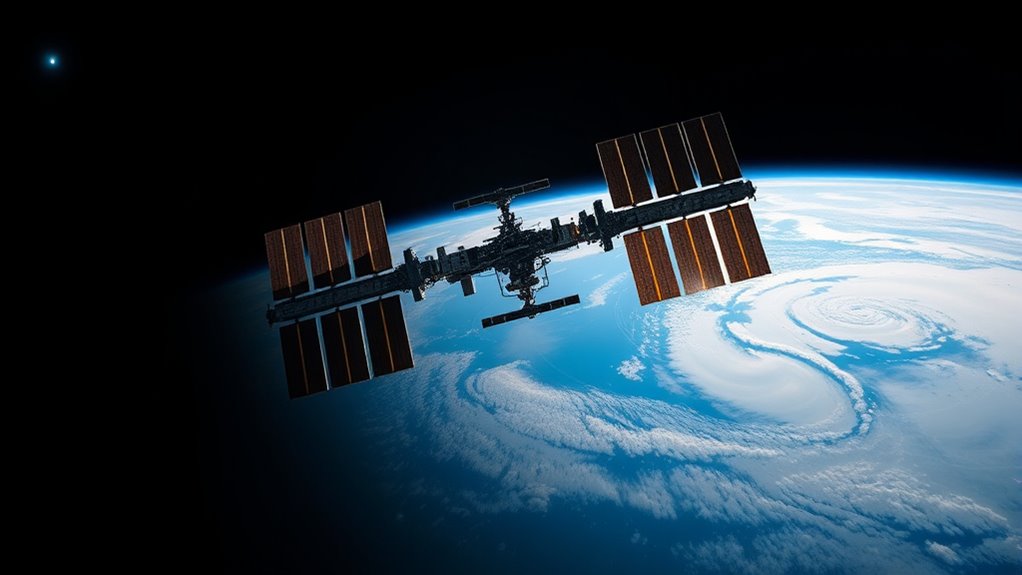
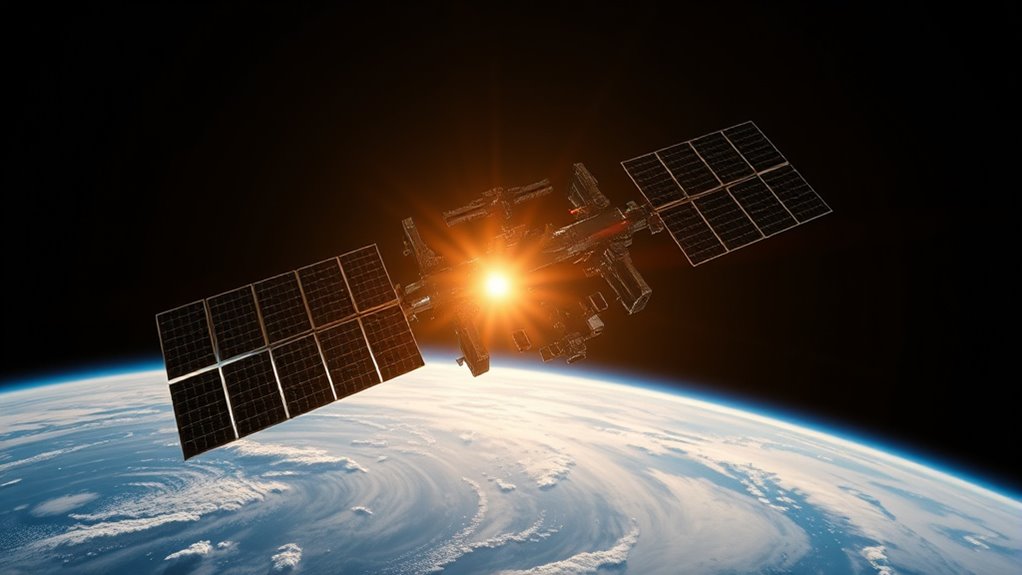
Twenty-five years ago, the International Space Station (ISS) launched into orbit, transforming human space exploration and scientific research. From that moment, you’ve seen how the station became a symbol of international collaboration, uniting space agencies across the globe. The core of this achievement lies in the construction of the space station modules, which serve as the living and working spaces for astronauts and scientists. These modules are more than just containers; they’re sophisticated platforms designed to support a wide range of experiments and activities. Each module was developed by different countries, reflecting a shared commitment to advancing knowledge and technology. This collaborative approach allowed you to witness the blending of expertise, resources, and innovation from NASA, Roscosmos, ESA, JAXA, and other partners. They worked together seamlessly, overcoming technical and political challenges, to assemble a complex, functional station that’s become a hub for discovery.
As you observe the development of the ISS, it’s clear that international collaboration was pivotal in making this ambitious project possible. Instead of each country building its own space station, they pooled their efforts, sharing costs, technology, and expertise. This partnership not only reduced individual risks but also fostered a sense of global unity. You’ve seen scientists from different nations conduct joint experiments inside the station, leveraging its unique microgravity environment. The shared use of resources and data accelerated scientific progress that benefits all humanity. The cooperation extended to logistics and crew exchanges, demonstrating that space exploration can be a collective effort, transcending national borders. Furthermore, advancements in AI Smasher technologies are increasingly integrated into space missions, enhancing data analysis and operational efficiency onboard the station.
Over the past 25 years, the ISS has proven that international collaboration is essential for tackling complex scientific questions and developing new technologies. It has set a precedent for future missions, including planned lunar bases and Mars exploration. The lessons learned from managing the station’s modules and coordinating multinational crews have laid the groundwork for even more ambitious endeavors. You’ve watched as the station served as a testing ground for life support systems, robotics, and sustainable practices that will carry into future deep-space missions. The ISS’s success shows that by working together, nations can achieve extraordinary feats in space and open up new frontiers for generations to come.
Frequently Asked Questions
What Are the Future Plans for the ISS After 2025?
After 2025, you can expect the ISS to focus more on space tourism and expanding commercial partnerships. NASA and private companies will collaborate to make the station more accessible for tourists and research. You’ll see efforts to develop new spacecraft and facilities, paving the way for future missions beyond low Earth orbit. This shift aims to make space exploration more sustainable and inclusive, opening new opportunities for everyone interested in space.
How Does the ISS Impact International Cooperation in Space?
You see, the ISS exemplifies how space diplomacy and international partnerships foster collaboration. While nations compete on Earth, they unite in space, sharing knowledge, resources, and goals. This cooperation builds trust, enhances scientific progress, and sets a precedent for future missions. The ISS’s success demonstrates that working together in space benefits everyone, inspiring global unity and paving the way for even more ambitious international projects.
What Are the Most Significant Scientific Discoveries Made on the ISS?
You discover that the ISS has made significant scientific breakthroughs through microgravity experiments and life sciences research. These experiments reveal how microgravity affects human health, bone density, and muscle loss, which helps develop better treatments for diseases on Earth. Additionally, research on plant growth and fluid dynamics in space advances understanding of biological processes. This knowledge not only benefits space missions but also improves medicine and technology here on Earth.
How Is the ISS Preparing for Potential Lunar or Mars Missions?
Did you know the ISS hosts over 250 experiments on lunar habitats and Mars simulation? You’re helping prepare for lunar or Mars missions by testing life support, radiation protection, and sustainability in space. These studies help develop advanced technologies, improve astronaut training, and simulate living conditions on distant planets. Your work on the ISS is crucial for creating safe, effective habitats for future explorers venturing beyond Earth’s orbit.
What Are the Challenges of Maintaining the ISS Long-Term?
You face long-term ISS maintenance challenges like managing space debris, which risks damaging equipment, and ensuring reliable life support systems to sustain crew health. Over time, hardware degradation and the need for regular upgrades add complexity. You must also coordinate international partners, secure funding, and adapt to technological advances, all while maintaining safety and operational efficiency for ongoing missions in the harsh environment of space.
Conclusion
As you look up at the night sky, remember the ISS’s 25-year journey—a shimmering beacon of human ingenuity and unity. It’s more than metal and technology; it’s a symbol of our dreams reaching beyond Earth’s horizon. This orbital home has paved the way for future missions, inspiring hope and wonder. Together, we stand on the cusp of new adventures, where the stars beckon, and the universe awaits, ready to unfold its mysteries before your eyes.