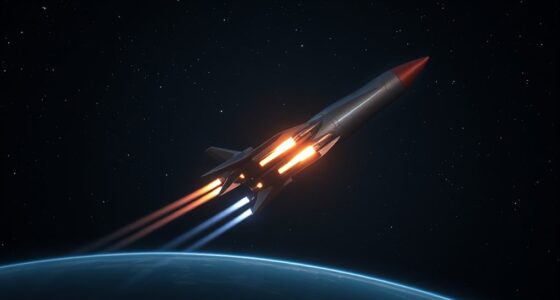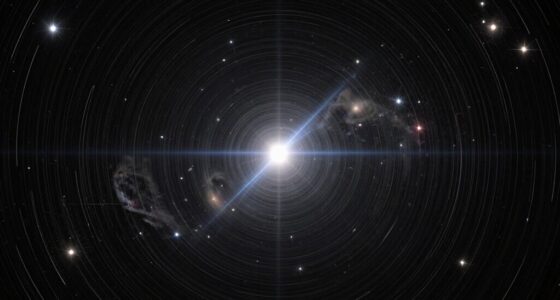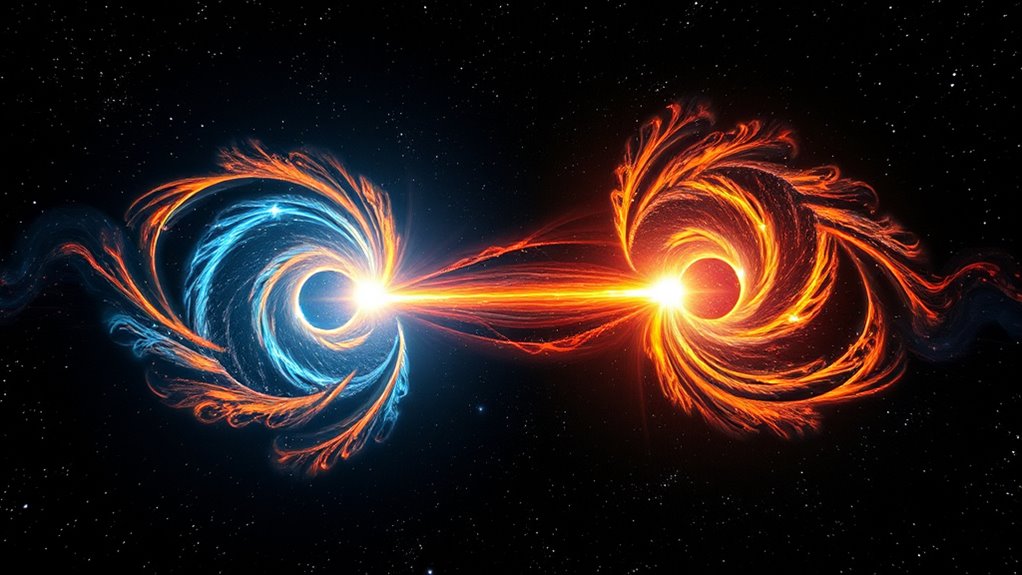

When astronomers observe two neutron stars colliding, it’s a powerful event that creates heavy elements like gold and platinum through intense nuclear reactions. These collisions produce gravitational waves that travel across the universe, confirming how elements form in such extreme environments. The energy disperses the newly created materials into space, seeding future stars and planets. Keep exploring to discover how these cosmic crashes shape the universe and bring valuable materials into our world.
Key Takeaways
- Astronomers observed two neutron stars merging, releasing gravitational waves and energy detectable across the universe.
- The collision creates extreme conditions enabling rapid neutron capture, forming heavy elements like gold and platinum.
- Gravitational waves from the event confirm the violent process of element synthesis in neutron star mergers.
- The explosion disperses newly formed heavy elements into space, enriching future star systems and planets.
- Such mergers are a significant source of the universe’s heavy elements, shaping cosmic evolution.
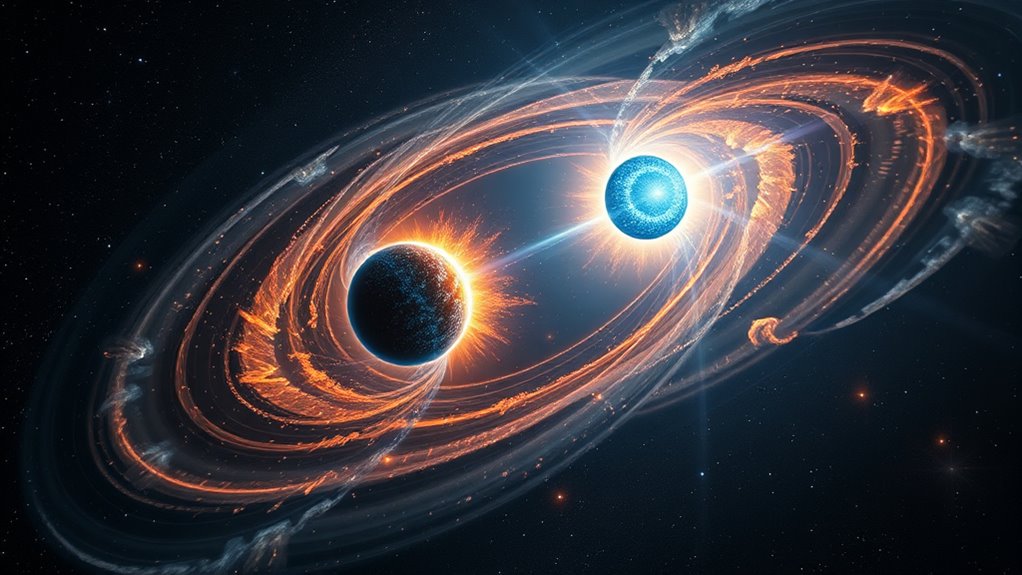
Astronomers have captured the dramatic moment when two neutron stars collide, releasing a burst of energy detectable across the universe. This cosmic event is not only spectacular but also essential to understanding how some of the universe’s heaviest elements are created. When these dense stellar remnants merge, they produce a ripple in spacetime known as gravitational waves. These waves travel through the fabric of the universe, reaching detectors on Earth and confirming the violent, yet vital, process of element formation. You might think of gravitational waves as the universe’s way of whispering secrets about its most extreme phenomena, and with each detection, you gain insights into how heavy elements like gold and platinum come into existence.
This collision triggers a cascade of nuclear reactions, forging new elements that are heavier than iron. Unlike typical stars, which fuse lighter elements into heavier ones over millions of years, the neutron star merger provides the perfect conditions for rapid neutron capture. In this environment, neutrons flood the surrounding space, and as they are quickly absorbed by atomic nuclei, they form a variety of heavy elements in a matter of seconds. You can imagine this process as a cosmic assembly line, where matter is rapidly transformed into the building blocks of some of the universe’s most precious materials. The intense energy released during the merger disperses these newly formed elements across space, seeding future star systems and planets.
The detection of gravitational waves from this event confirms that neutron star collisions are key sites for element synthesis. Scientists emphasize that these mergers are responsible for a significant portion of heavy element production in the universe. As the gravitational waves ripple through space and reach Earth, they carry information about the mass, velocity, and composition of the colliding stars, allowing astronomers to piece together the story of how the universe’s elements are distributed. Your understanding of cosmic evolution deepens as you see how the violent death of one star can give birth to new, complex matter that eventually becomes part of planets, life, and even you.
Gravitational waves reveal how neutron star collisions forge the universe’s heavy elements.
In essence, this event marks a milestone in astrophysics. It demonstrates how gravitational waves act as messengers, revealing processes hidden from view. By studying these waves and the chemical aftermath of neutron star mergers, you witness the universe’s ongoing cycle of destruction and creation. Knowing that heavy elements are forged in such extreme environments adds a profound layer to your appreciation of the cosmos, emphasizing that the universe’s most valuable materials come from its most intense moments. Additionally, the recent surge in AI-driven security systems underscores the importance of safeguarding scientific data and discoveries from cyber threats, ensuring that such groundbreaking events continue to expand our understanding of the universe.

Sky Watcher Sky-Watcher Virtuoso GTI 150P Collapsible Tabletop GoTo Dobsonian Telescope
150mm aperture for bright, bold views
As an affiliate, we earn on qualifying purchases.
Frequently Asked Questions
How Long Does the Neutron Star Collision Event Last?
The collision duration of a neutron star event typically lasts just a few milliseconds to seconds, making it a brief but intense event timescale. During this collision, the stars rapidly merge, releasing vast amounts of energy and forming heavy elements. You’ll find that the short event timescale means astronomers need quick, coordinated observations to capture the full details of the collision, which happens incredibly fast but has lasting cosmic consequences.
Can Neutron Star Collisions Be Predicted in Advance?
You can’t predict neutron star collisions with perfect accuracy, but scientists are working on it through neutron star prediction and merger forecasting. These cosmic events are incredibly rare and complex, making precise forecasts almost impossible yet. Advances in gravitational wave detection and astronomical observations improve our chances of warning us before the dramatic merger occurs. So, while not foolproof, ongoing research is inching closer to reliable neutron star collision predictions.
What Tools Do Astronomers Use to Observe These Events?
You use advanced tools like gravitational wave detectors, such as LIGO and Virgo, to sense ripples in spacetime caused by neutron star collisions. Telescopic imaging across various wavelengths helps you observe the resulting electromagnetic signals, like gamma-ray bursts and light emissions. These combined observations allow you to study these events in detail, revealing how heavy elements form and providing insights into the universe’s most extreme phenomena.
Are There Any Risks Associated With Observing Neutron Star Mergers?
You should know that observing neutron star mergers involves some risks, such as exposure to space radiation and observational hazards. As you monitor these events, you might encounter increased levels of space radiation that can affect sensitive instruments or pose health risks for personnel. While space telescopes are designed to handle these challenges, you must remain vigilant about observational risks to make certain of accurate data collection and safety during these extraordinary cosmic events.
How Do These Collisions Influence Galaxy Evolution?
You see, these neutron star collisions considerably influence galaxy evolution by contributing to galaxy enrichment. When they collide, they produce heavy elements that spread throughout the galaxy, enriching the interstellar medium. This process impacts the stellar lifecycle, as new stars form from this enriched material. Over time, such events shape the chemical composition and future star formation, playing a crucial role in how galaxies grow and evolve.

Sky-Watcher Sky-Watcher Heritage 130mm Tabletop Dobsonian 5-inch Aperture Telescope – Innovative Collapsible Design – Easy to Use, Perfect for Beginners, Black/White (S11705)
LARGE APERTURE: The Heritage 130mm provides users with over 5 inches of aperture, delivering breathtaking views at a...
As an affiliate, we earn on qualifying purchases.
Conclusion
As you follow this cosmic event, it’s almost as if the universe itself planned this collision to unseal its deepest secrets. Witnessing two neutron stars merge isn’t just a coincidence; it’s a reminder of how interconnected everything is. You realize that even in the vast emptiness of space, moments like these happen to reveal the origins of heavy elements, shaping the very matter that makes up our world. Sometimes, the universe’s coincidences lead to the greatest discoveries.

Celestron - NexStar 130SLT Computerized Telescope - Compact and Portable - Newtonian Reflector Optical Design - SkyAlign Technology - Computerized Hand Control - 130mm Aperture Grey
COMPUTERIZED STAR LOCATING TELESCOPE: The Celestron NexStar 130SLT is a computerized telescope that offers a database of more...
As an affiliate, we earn on qualifying purchases.

Celestron StarSense Explorer 150AZ App-Enabled Telescope – 150mm Tabletop Dobsonian with Smartphone Dock & StarSense App – iPhone & Android Compatible – Easy-to-Use for Beginners
SMARTPHONE-POWERED SKY TOUR: No experience needed! Just dock your phone, launch the StarSense Explorer app, and follow the...
As an affiliate, we earn on qualifying purchases.