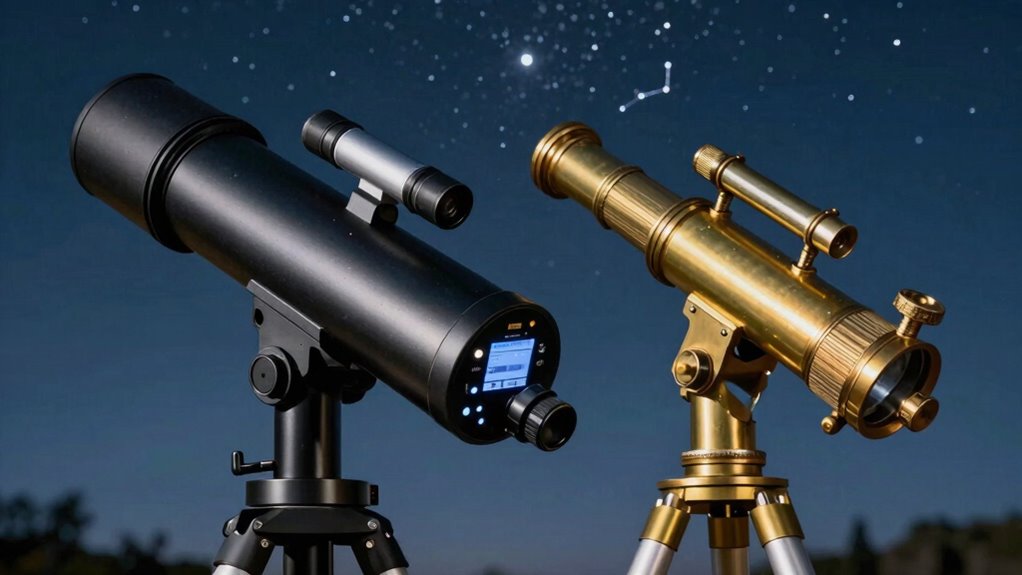
If you’re a beginner, a smart telescope is usually the better choice because it offers user-friendly features like app controls, automatic tracking, and quick setup, making stargazing easier and more enjoyable. Smart models require less mechanical skill and are portable, so you can explore different locations easily. Traditional telescopes, while educational, can be more complicated and heavy to handle initially. Keep exploring to discover how each type can best fit your astronomy journey.
Key Takeaways
- Smart telescopes offer ease of use, quick setup, and app controls, ideal for beginners seeking simplicity.
- Traditional telescopes provide hands-on mechanical learning, suited for those interested in understanding astronomy fundamentals.
- Smart models are portable and great for astrophotography, while traditional ones are bulkier but enhance mechanical skills.
- Beginners prioritizing convenience and quick results may prefer smart telescopes; those wanting educational value may choose traditional.
- Overall, smart telescopes are better for immediate enjoyment; traditional telescopes foster deeper learning.
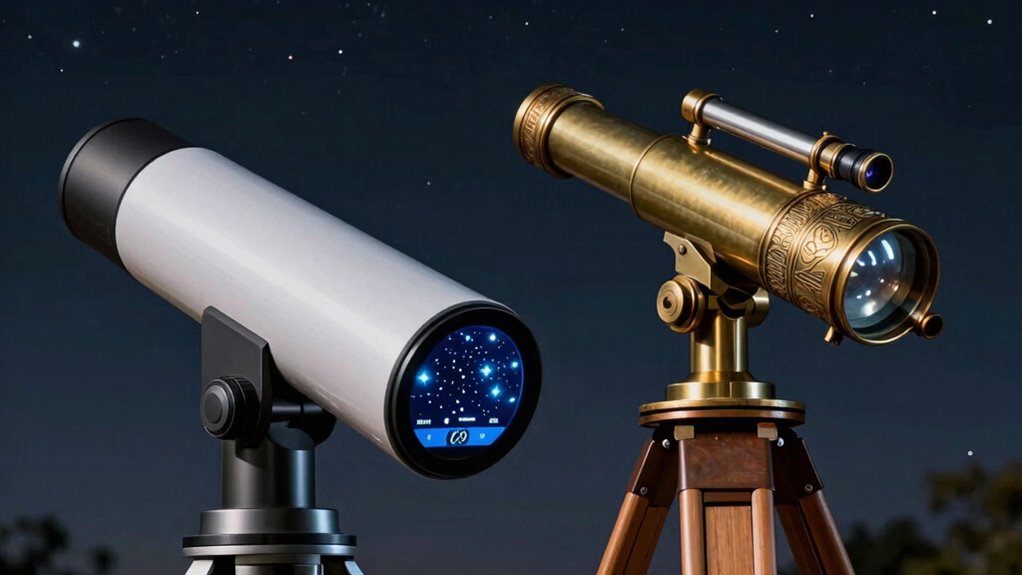
When choosing between a smart telescope and a traditional telescope, understanding their differences can help you make an informed decision. As a beginner, you might wonder which type suits your needs best, especially when considering factors like astrophotography potential, portability, and setup. Smart telescopes are designed with user-friendly features, often equipped with built-in Wi-Fi, automatic object tracking, and app controls. These features make astrophotography more accessible, even if you’re new to the field. You can easily capture images of planets, the moon, or distant stars using your smartphone or tablet, without needing extensive technical knowledge. This makes smart telescopes particularly appealing if your primary interest is astrophotography, as their integrated systems streamline the process, reducing the learning curve.
Portability and setup are also important considerations. Smart telescopes tend to be compact and lightweight, making them highly portable. You can easily pack them in a backpack or carry case, which is ideal if you plan to observe from different locations or take them on trips. Setting up a smart telescope is typically quick and straightforward; many models are designed for one-button operation, often with automated alignment features that save you time and effort. In contrast, traditional telescopes can be bulkier and heavier, especially the larger models that require more space and effort to transport. Their setup process might involve manual alignment, which can be intimidating for beginners but offers a more hands-on experience for those interested in learning the mechanics of astronomical observation. Additionally, traditional telescopes often do not include the integrated tech features found in smart models, which can influence your overall observing experience. Understanding the mechanics of telescope operation can also help you troubleshoot issues more effectively if you choose a traditional model.
While traditional telescopes may lack the integrated tech features of smart models, they often provide a more authentic, tactile experience. You get to learn how to manually find celestial objects, which can deepen your appreciation for astronomy. This hands-on approach can also foster a stronger connection to the fundamentals of astronomy, enhancing your overall knowledge. However, this also means a steeper learning curve and more time spent on setup and alignment. Engaging with manual operation techniques can enhance your understanding of telescope mechanics and celestial navigation, making you a more proficient astronomer in the long run. If you prefer a straightforward, plug-and-play experience, a smart telescope’s automation and connectivity will likely serve you better. Overall, if portability, ease of setup, and astrophotography potential are priorities, a smart telescope offers clear advantages for beginners. It simplifies the process, making stargazing more enjoyable and less frustrating. On the other hand, if you’re enthusiastic to learn the fundamentals of telescope operation and don’t mind a more involved setup, a traditional telescope can be a rewarding choice. Developing practical skills through manual operation can also provide a solid foundation for more advanced astronomy pursuits.
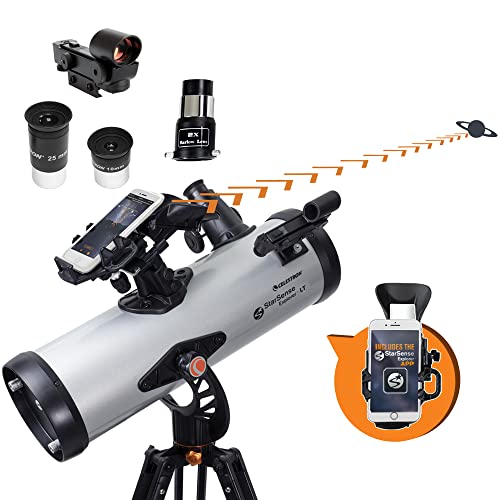
Celestron StarSense Explorer LT 114AZ App-Enabled Telescope – 114mm Newtonian Reflector with Smartphone Dock & StarSense App – iPhone & Android Compatible – Easy-to-Use for Beginners
SMARTPHONE-POWERED SKY TOUR: No experience needed! Just dock your phone, launch the StarSense Explorer app, and follow the…
As an affiliate, we earn on qualifying purchases.
As an affiliate, we earn on qualifying purchases.
Frequently Asked Questions
Can a Smart Telescope Replace Professional Astronomy Equipment?
A smart telescope can’t fully replace professional astronomy equipment, but it’s great for beginners. Its automated alignment makes setup easier, and its user-friendly interface helps you learn quickly. While it offers impressive features for casual stargazing, professional gear provides higher precision and advanced capabilities. So, if you’re starting out, a smart telescope is perfect; for serious research, professional equipment remains essential.
How Durable Are Smart Telescopes in Different Weather Conditions?
Did you know that smart telescopes are often built with weather resistance in mind? You’ll find that their material durability helps them withstand light rain and moderate humidity, but extreme weather can still pose risks. In harsher conditions, these telescopes may struggle without extra protection. So, while they’re designed to be fairly durable, it’s best to store them indoors during storms or heavy snow for longevity and peak performance.
Do Smart Telescopes Require Internet Access to Function Properly?
Smart telescopes don’t require internet access to function properly because they rely on autonomous operation and onboard controls. However, wireless connectivity enhances their capabilities, allowing you to update software, access star maps, and control the telescope remotely via a smartphone app. While internet isn’t essential for basic use, having a connection improves your overall experience, offering more features and easier control without being tethered to a computer.
Are Traditional Telescopes Better for Astrophotography Than Smart Ones?
Traditional telescopes often excel in astrophotography because they allow manual focusing, giving you precise control, and typically offer higher optical quality. Imagine capturing crisp, detailed images of distant galaxies without digital distractions. While smart telescopes are convenient, their reliance on technology can limit customization. For stunning astrophotography, a traditional telescope provides the craftsmanship and control needed to produce breathtaking images, making it the better choice for serious sky enthusiasts.
What Is the Typical Lifespan of a Smart Telescope?
A smart telescope typically lasts around 5 to 10 years, depending on usage and maintenance. You should consider sensor accuracy, as advanced sensors may degrade over time, affecting performance. Battery longevity also matters; many models have rechargeable batteries that last about 6 to 12 hours per charge. Proper care, updates, and careful handling can extend its lifespan, ensuring you enjoy clear views and accurate data for years to come.

Celestron – AstroMaster 130EQ–MD Newtonian Reflector Telescope for Beginners – Aluminized Mirror – Motor Drive to Track Stars – Adjustable Tripod – Includes Eyepieces Plus Astronomy Software Package
POWERFUL TELESCOPE FOR ASTRONOMY BEGINNERS: The AstroMaster 130EQ-MD delivers sharp optics, a stable equatorial mount, motorized tracking, and…
As an affiliate, we earn on qualifying purchases.
As an affiliate, we earn on qualifying purchases.
Conclusion
Choosing between a smart telescope and a traditional one is like deciding whether to walk a well-lit path or venture into the unknown starry night. The smart telescope acts as your guiding star, illuminating celestial mysteries with ease, perfect for beginners seeking instant wonder. Meanwhile, the traditional telescope invites you to explore the universe’s depths at your own pace, like traversing the vast night sky by your own compass. Whichever path you choose, your journey into the cosmos begins with a single step.

DWARFLAB Dwarf 3 Smart Telescope – Portable Astrophotography Camera, Capture Astronomy/Wildlife/Panorama, AZ/EQ Mode, Built-in Processing, 4K Auto-Tracking, Ultra-Light 3lb, Ideal for All Ages
【Ultra-Light Design for All Adventures】Only 3lb/1.35kg – World's Most Portable Smart Telescope! Fits perfectly in standard backpack for…
As an affiliate, we earn on qualifying purchases.
As an affiliate, we earn on qualifying purchases.

Gskyer Telescope, 70mm Aperture 400mm AZ Mount Astronomical Refracting Telescope for Kids Beginners – Travel Telescope with Carry Bag, Phone Adapter and Wireless Remote.
Superior Optics: 400mm(f/5.7) focal length and 70mm aperture, fully coated optics glass lens with high transmission coatings creates…
As an affiliate, we earn on qualifying purchases.
As an affiliate, we earn on qualifying purchases.