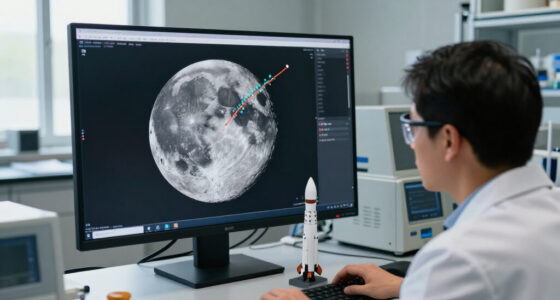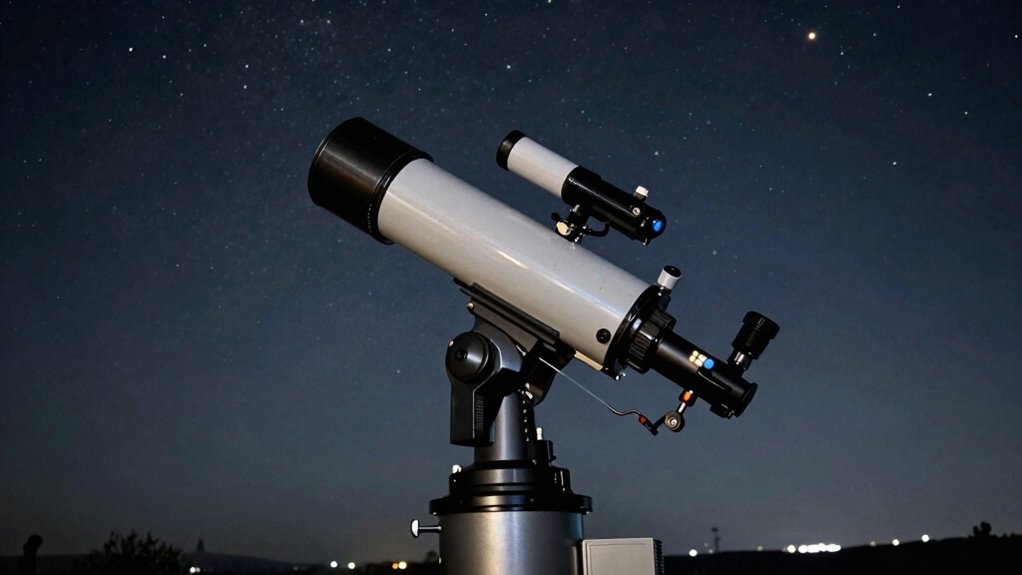

A Go-To mount helps you find and track celestial objects automatically, making stargazing easier and more enjoyable. It saves you from guesswork by pointing directly at stars, planets, or deep-sky objects with the push of a button. With accurate alignment, it keeps objects in your view longer, so you get more observing time. If you want to understand how it improves your experience and simplifies astronomy, there’s more to discover ahead.

Prime made for students and young adults
- Fast, free delivery for dorm and study essentials
- Prime Video and Amazon Music included
- Member-only deals
Key Takeaways
- Automatically locates celestial objects, saving time and effort during observations.
- Simplifies star-hopping by precisely pointing to targets based on initial alignment.
- Ensures accurate tracking of objects, maintaining their position in the eyepiece.
- Reduces the need for manual adjustments through motor calibration and alignment.
- Enhances the overall stargazing experience, especially for beginners, by making target finding easier.
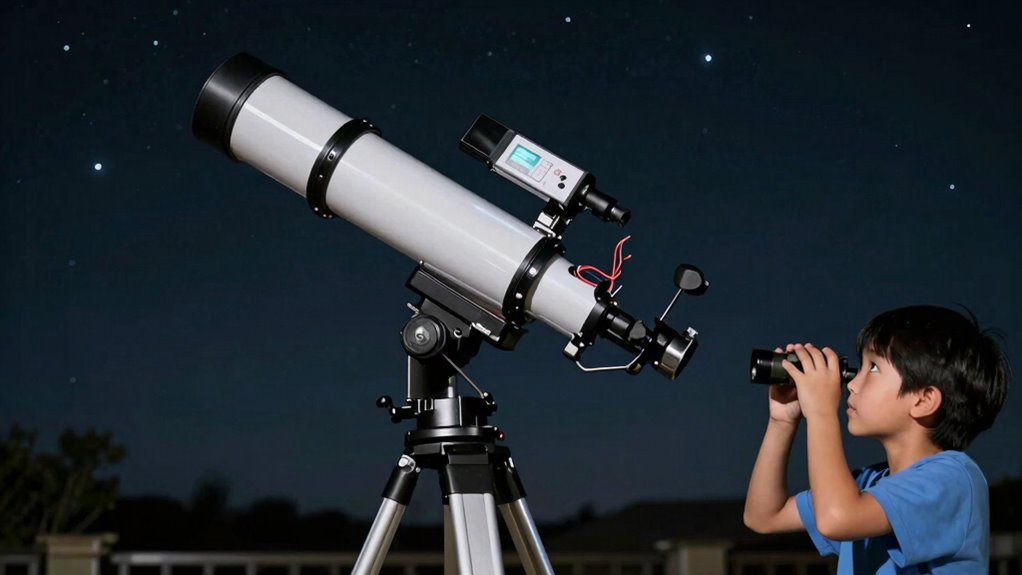
Are you new to astronomy and feeling overwhelmed by finding celestial objects in the night sky? A Go-To mount can be a game-changer, helping you locate stars, planets, and deep-sky objects with ease. It’s designed to take the guesswork out of star-hopping, so you can spend more time observing and less time searching. But how exactly does it do this? The secret lies in its ability to achieve high alignment accuracy and precise motor calibration.
When you set up your Go-To mount, the first step is to align it correctly. This process involves inputting your geographic location and pointing the mount at specific reference stars. The mount’s internal software then calculates its position relative to the night sky. If the alignment is accurate, the mount can calculate where celestial objects should be at any given moment. The more precise your initial alignment, the better your mount’s pointing accuracy will be. This is where alignment precision becomes critical. A well-aligned mount consistently points close to your intended target, reducing the need for manual adjustments.
Proper initial alignment ensures your Go-To mount points accurately, making star-hopping easier and your observations more enjoyable.
Once aligned, the mount’s motors take over. Motor calibration is essential here because it ensures the mount’s motors move accurately according to the commands from the control system. If the calibration is off, the mount might not point exactly where it should, causing frustration. Proper motor calibration involves fine-tuning the movement commands so that the mount’s actual position matches the expected position. This calibration process often includes testing and adjusting the motors to account for factors like gear slippage or mechanical imperfections. When motor calibration is accurate, your mount can smoothly and precisely track objects as they move across the sky, maintaining alignment over long viewing sessions. Additionally, accurate calibration helps in maintaining consistent tracking, which is crucial for astrophotography.
Furthermore, proper calibration is vital for ensuring that the mount can reliably locate objects over time without frequent realignments. Regular maintenance and calibration can help prevent drift and mechanical issues that affect tracking precision. Good alignment accuracy and calibration also help in compensating for mechanical imperfections, which can otherwise affect tracking precision. With good alignment accuracy and motor calibration, your Go-To mount can find objects quickly and track them effortlessly. This means you don’t need to manually search for faint galaxies or precise planets; the mount does the work for you. It’s especially helpful for beginners, who might not yet be familiar with the night sky or how to locate objects visually. Instead of spending time searching, you get to enjoy observing, astrophotography, or just learning about the cosmos.
In essence, a Go-To mount is an intelligent assistant that maximizes your observing experience. Its ability to deliver high alignment accuracy and precise motor calibration guarantees that your telescope points where you want it to, making stargazing more accessible and enjoyable for everyone new to astronomy.
As an affiliate, we earn on qualifying purchases.
Frequently Asked Questions
How Accurate Are Go-To Mounts Over Long Observation Sessions?
Go-to mounts are generally quite accurate over long observation sessions, especially when you guarantee proper alignment accuracy beforehand. While minor errors can occur, most models maintain their precision through tracking adjustments. Your user experience improves as you spend less time manually locating objects, allowing you to enjoy more time observing. Regular calibration and proper setup help keep the mount’s accuracy consistent, making your long sessions smoother and more enjoyable.
What Maintenance Does a Go-To Mount Require?
You need to regularly perform alignment procedures to keep your go-to mount accurate, especially after moving it or changing batteries. Check the mount’s power requirements to guarantee it has consistent power, as low batteries can cause tracking issues. Keep the gears clean and lubricated, and periodically update the firmware if available. Proper maintenance helps your mount stay reliable and precise during long observation sessions, making stargazing more enjoyable.
Can a Go-To Mount Track Objects During Astrophotography?
Yes, a go-to mount can track objects during astrophotography. After you perform star alignment, the mount calculates the position of celestial objects, keeping them centered as Earth rotates. Proper motor calibration is essential; it guarantees smooth, precise tracking. Once aligned and calibrated, your mount will follow stars accurately, allowing you to capture clear, long-exposure images without constant adjustments.
Are Go-To Mounts Suitable for All Telescope Types?
Did you know that over 80% of amateur astronomers prefer go-to mounts for their ease of use? These mounts are generally suitable for most telescope types, offering excellent mount compatibility. They considerably enhance user experience by simplifying object locating, especially for beginners. However, some specialized or very large telescopes might require custom mounts or manual operation. Always check your telescope’s specifications to confirm compatibility before investing.
How Difficult Is It to Learn to Operate a Go-To Mount?
Learning to operate a go-to mount isn’t too difficult. You start with manual alignment, where you input star positions to calibrate the mount’s sensors. Then, you perform motor calibration to guarantee accurate tracking. Once set, it’s mostly about selecting your target, and the mount moves automatically. With a bit of practice, you’ll find it straightforward, even if you’re new to astronomy. Patience and following the instructions make it easier.
automatic star tracker for beginners
As an affiliate, we earn on qualifying purchases.
As an affiliate, we earn on qualifying purchases.
Conclusion
A go-to mount helps you quickly find celestial objects, boosting your confidence and enjoyment during stargazing. While some say it takes the fun out of learning the night sky, research shows it actually accelerates your understanding by saving time and reducing frustration. As a new observer, relying on a go-to mount isn’t cheating—it’s a smart tool that lets you focus on the awe of the cosmos. Embrace it, and your sky adventures will be more rewarding.
astronomy mount with motor calibration
As an affiliate, we earn on qualifying purchases.
As an affiliate, we earn on qualifying purchases.
celestial object locator telescope
As an affiliate, we earn on qualifying purchases.
As an affiliate, we earn on qualifying purchases.
Fall Picks
fall essentials
As an affiliate, we earn on qualifying purchases.