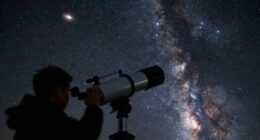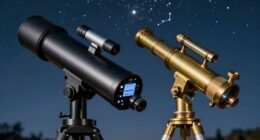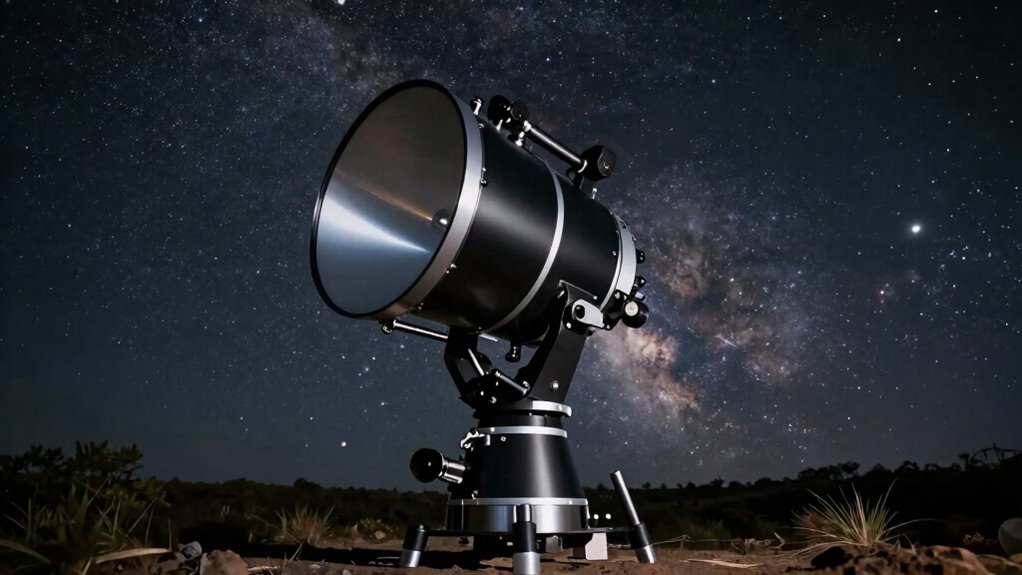

A good telescope for deep sky viewing has a large aperture to gather maximum light, helping you see faint objects like galaxies and nebulae in detail. It should also feature a stable, easy-to-use mount that keeps objects steady during long observations. High-quality optics with well-aligned lenses or mirrors reveal sharper, clearer images. If you want to turn your stargazing into a rewarding experience, understanding these features will guide you toward the right choice.
Key Takeaways
- A large aperture to gather more light for revealing faint deep sky objects.
- A stable, well-designed mount to prevent vibrations and ensure steady observations.
- High-quality optics with proper coatings for sharp, clear images.
- An appropriate optical design, such as an equatorial mount, for accurate tracking of celestial objects.
- Good optical maintenance and collimation to maximize image clarity and detail.
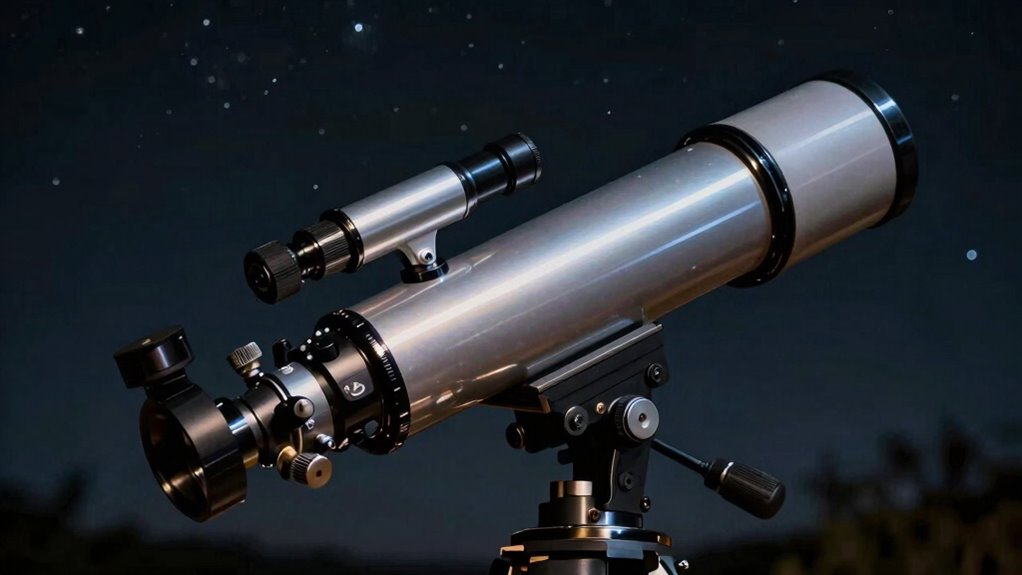
If you’re passionate about exploring the universe beyond our planet, choosing the right telescope is indispensable for deep sky viewing. The first thing to factor in is mount stability. Deep sky objects are often faint and require precise, steady tracking to observe clearly. A sturdy mount prevents vibrations and movement that can distort your view. Look for a telescope with a solid, well-built mount—preferably equatorial or alt-azimuth with good weight distribution—that stays steady even during extended observation sessions. The more stable the mount, the better your chances of capturing sharp images and maintaining focus on distant celestial objects without frustration. Additionally, a well-designed mount can make tracking objects more intuitive, especially when observing through long exposure or high-magnification setups.
Next, pay attention to the eyepiece quality. Your eyepiece is your primary tool for viewing, so high-quality optics make a significant difference. Good eyepieces deliver brighter, clearer images with better contrast, which is essential when viewing faint deep sky objects like nebulae, galaxies, and star clusters. Cheap or low-quality eyepieces tend to produce fuzzy images and reduce your viewing experience. Instead, invest in a few high-quality eyepieces with appropriate focal lengths to expand your field of view and magnification options, allowing you to explore different depths of the night sky. A quality eyepiece also minimizes optical distortions and provides a more comfortable viewing experience. Ensuring proper optical alignment can further enhance the quality of your observations, making it easier to see fine details. Moreover, understanding the importance of collimation can greatly improve image sharpness and clarity during your observations. Proper optical maintenance also plays a crucial role in keeping your telescope in optimal condition for clear viewing.
Furthermore, the telescope’s aperture size plays a key role. Larger apertures gather more light, which is crucial for revealing the faint details of deep sky objects. When combined with a stable mount and good eyepieces, a bigger aperture enhances your ability to see distant objects in greater detail. However, keep in mind that larger telescopes can be heavier and less portable, so balance your needs with practicality. Properly considering aperture size can significantly influence your overall viewing success and satisfaction.
The overall optical quality of the telescope also impacts deep sky viewing. Optics with high-quality lenses or mirrors produce sharper images and reduce chromatic aberrations. Make sure the telescope has well-aligned optics and coatings that maximize light transmission. This will guarantee that your viewing sessions are productive and enjoyable. Additionally, understanding the importance of mount stability can greatly improve your observation experience by ensuring steady, clear views. High-quality optics and coatings complement the other components, creating a more seamless and rewarding stargazing experience.

Dianfan Telescope,90mm Aperture 800mm Telescopes for Adults Astronomy,Portable Professional Refractor Telescope for Beginners,with Stainless Tripod & Phone Adapter,Carry Bag
Superior Optics: Dianfan astronomy telescope features a focal length of 800 mm and a fully coated 90 mm…
As an affiliate, we earn on qualifying purchases.
As an affiliate, we earn on qualifying purchases.
Frequently Asked Questions
What Is the Best Aperture Size for Deep Sky Observation?
The best aperture size for deep sky observation is generally around 8 to 12 inches, providing a suitable size for detailed viewing without being unwieldy. When comparing apertures, larger sizes gather more light, revealing fainter objects. An aperture comparison shows that bigger telescopes offer better clarity and deeper views, making an 8-12 inch aperture ideal for enthusiasts seeking a balance between performance and manageable size for deep sky viewing.
How Important Is Mount Stability for Deep Sky Viewing?
Mount stability is vital for deep sky viewing because it minimizes mount vibration, ensuring clearer, sharper images. A stable mount also enhances tracking accuracy, which is essential for long-exposure astrophotography and detailed observation. When your mount is steady, you’ll experience fewer disruptions and sharper views of distant objects. Investing in a sturdy, well-designed mount makes a significant difference, allowing you to enjoy uninterrupted, high-quality deep sky observations.
Can Beginner Telescopes Efficiently View Faint Deep Sky Objects?
Like a lantern guiding your night journey, beginner telescopes can effectively reveal faint deep sky objects, though with some limits. They excel at lunar observation and planetary imaging, offering bright, detailed views of the moon and planets. While they may struggle with dimmer galaxies or nebulae, steady mounts and proper techniques help you maximize their potential. With patience, you’ll find these telescopes become your trusty companions in exploring the universe’s hidden wonders.
What Accessories Enhance Deep Sky Viewing Experience?
To enhance your deep sky viewing, prioritize high-quality eyepieces for sharper images and greater magnification options. Additionally, using filter options like nebula or light pollution filters can improve contrast, revealing faint details. You should also consider a sturdy mount to keep your telescope steady and accessories like a red flashlight for night vision. These enhancements make your observations more detailed and enjoyable, helping you get the most out of your deep sky explorations.
How Does Sky Darkness Affect Telescope Performance?
Imagine you’re in a galaxy far, far away—your telescope’s performance hinges on sky darkness. Light pollution and increased sky brightness obscure faint deep-sky objects, making viewing difficult. When the sky is darker, your telescope captures more detail and reveals dimmer celestial bodies. So, avoid brightly lit areas; the darker the sky, the better your chances of exploring the universe’s hidden wonders with clarity and precision.

iEXOS-100-2 PMC-Eight Equatorial Tracker System Tripod and Mount for Astrophotography with WiFi and Bluetooth Compatible
Integrated Explore Scientific PMC-Eight system that transcends the industry standard single processor by utilizing eight CPUs that operate…
As an affiliate, we earn on qualifying purchases.
As an affiliate, we earn on qualifying purchases.
Conclusion
When choosing a telescope for deep sky viewing, remember that larger apertures gather more light, revealing faint galaxies and nebulae. Did you know that telescopes with an aperture of 8 inches or more can see objects over 13 billion light-years away? That’s like peering into the universe’s distant past. So, investing in a bigger aperture can dramatically enhance your stargazing experience and bring the cosmos’s most mysterious wonders within your reach.

Celestron – Zoom Eyepiece for Telescope – Versatile 8mm-24mm Zoom for Low Power and High Power Viewing – Works with Any Telescope That Accepts 1.25" Eyepieces
POWERFUL ZOOM EYEPIECE FOR TELESCOPES: Go from low to high power in an instant with this versatile eyepiece….
As an affiliate, we earn on qualifying purchases.
As an affiliate, we earn on qualifying purchases.

Astromania Laser Collimator for Newtonian Dobsonian Marca Telescopes, Telescope Alignment 1.25 Inch with 7 Red Laser Bright Levels, Great Telescope Accessories Laser Alignment Tool for Collimation
Multi-Function: Designed for Reflector telescope; fit for standard 1.25 inch diameter; this sturdy laser unit allows to swiftly…
As an affiliate, we earn on qualifying purchases.
As an affiliate, we earn on qualifying purchases.