TL;DR
Diffusion models are image-generation systems that learn to predict and remove noise added to training images. During generation, they start with random noise and repeatedly refine it, with text prompts steering the process. The method’s limits include unreliable text and object placement, and research has shown that models can reproduce images from training data.
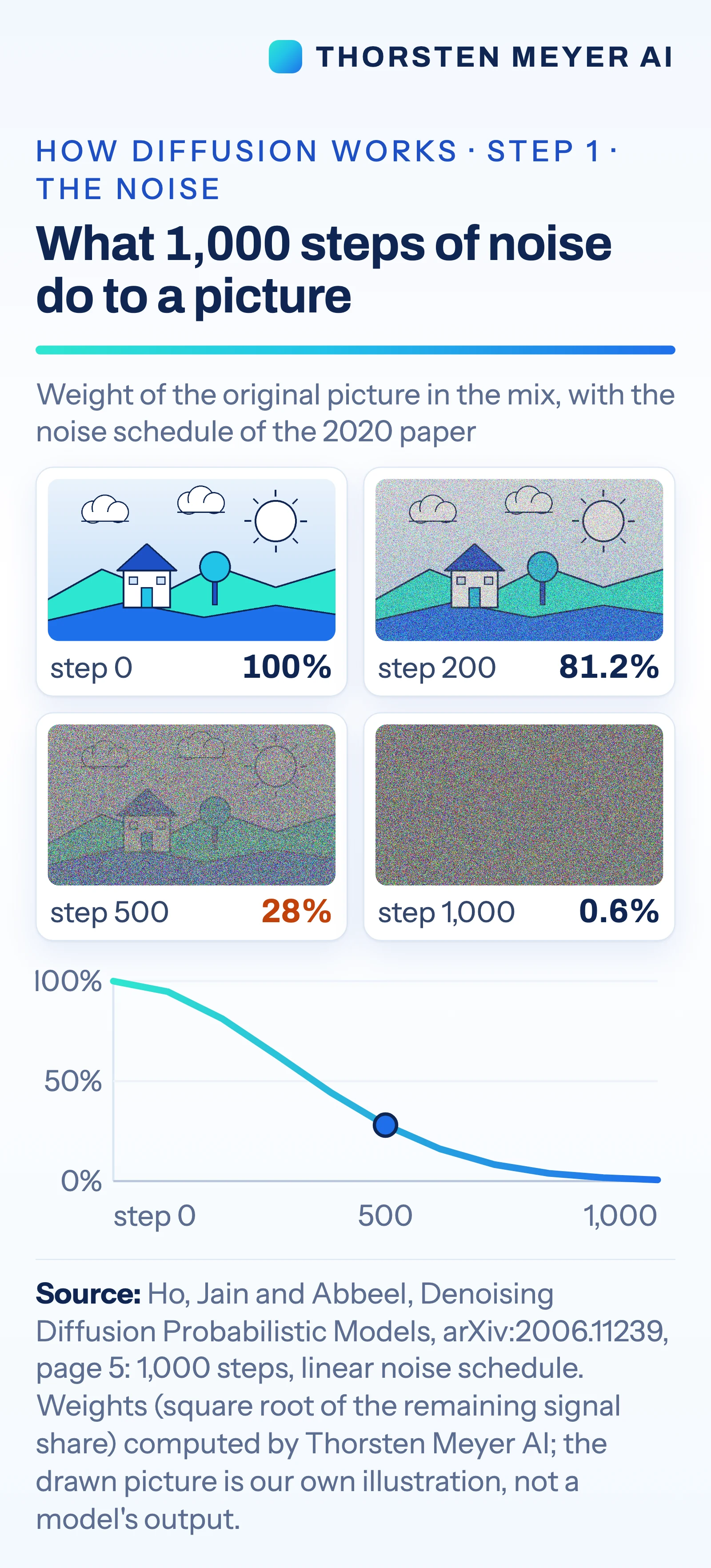
Diffusion models learn from images by gradually adding noise to them during training. A neural network then practices predicting the noise in each partly obscured image. Because the training process knows how much noise it added, it can compare the model’s prediction with the actual noise and improve the model’s estimates.

Prime made for students and young adults
- Fast, free delivery for dorm and study essentials
- Prime Video and Amazon Music included
- Member-only deals
Image generation reverses that process. The model starts with noise and uses its learned predictions to remove some at each step. Broad shapes tend to emerge before finer detail. The explainer cites the 2020 paper Denoising Diffusion Probabilistic Models, by Jonathan Ho, Ajay Jain and Pieter Abbeel, whose experiments used 1,000 steps. It says a common open-source image-generation pipeline uses 50 steps by default; that figure describes the pipeline cited, not every diffusion model.
Many systems reduce the computation by working in a compressed representation called a latent space. The explainer gives Stable Diffusion v1 as an example: a 512-by-512 image is represented with 48 times fewer numbers. A text encoder converts the prompt into numerical representations, and guidance methods use those representations to influence the denoising process. Stronger guidance can bring the image closer to the prompt, though the explainer says this can come at a cost to image quality.
Why Noise Can Produce Useful Images
The process explains both the capability and some familiar weaknesses of image generators. They build an image through repeated estimates of what should remain after noise is removed; they do not follow a human-like plan for drawing each object. That helps explain why small details, exact counts, spatial relationships and lettering can be unreliable, even when the overall scene looks convincing.
Compression also matters. Working in latent space reduces the number of values the model must process, which can make generation more practical. But a lower-cost representation does not guarantee accurate interpretation of every prompt or precise control over the final image.
The explainer also points to research showing that models can reproduce near-copies of images in their training data, raising questions about memorization and copyright. It reports that a UK court ruled in 2025 that Stable Diffusion itself is not an “infringing copy.” That finding addresses the model itself; it does not settle every legal question about training data or particular generated images.
Popular right now

Vitamix 5200 Blender with 64 oz. Container, Black

Shark Navigator Robot Vacuum with 30-Day Self-Empty Base, White (AV2110S)

De'Longhi Magnifica Evo Automatic Espresso Machine with Milk Frother, Silver
As an affiliate, we earn on qualifying purchases.
From Early Theory to Image Tools
The basic idea predates current image generators. In 2015, Jascha Sohl-Dickstein and colleagues described a process that gradually destroys structure in data and learns a reverse process to restore it. Their work framed diffusion as a way to transform a complex distribution into noise and then reverse that transformation.
The 2020 paper by Ho, Jain and Abbeel made a version of the approach practical for image generation. It described a forward process that adds noise in stages until the original signal is effectively lost, and a learned reverse process. The November 2026 explainer uses that research, alongside Hugging Face diffusers documentation, to outline the method. Its diagrams are illustrative, and its numerical examples are tied to the specific research or software versions named.
Text-to-image systems add a text encoder so the generation can respond to a prompt. Attention mechanisms help connect parts of the text representation with image features as denoising proceeds. The explainer treats these as components used by the systems it describes, rather than as a full account of every model architecture.
Limits and Legal Questions Remain
The explanation does not establish that every image model uses the same number of steps, compression method or guidance settings. Those details vary by model and software implementation. The stated 1,000 training steps and 50-step default refer to examples in the cited paper and pipeline, not universal settings.
Generated images may also contain errors or resemble material used in training. The explainer cites research on near-copies but does not specify how often this occurs across models or prompts. It also reports a 2025 UK court ruling about Stable Diffusion itself; the ruling does not resolve all disputes over training data, copyright or responsibility for particular outputs.
What Research and Courts May Clarify
Further research can test how reliably different models follow prompts, where memorization occurs and how generation settings affect image quality. Software documentation will remain the more useful source for model-specific defaults, since step counts and latent representations can differ.
Legal questions will depend on the claims and evidence in each case. The explainer identifies the UK ruling as one development, while leaving broader questions about training material and generated images open. No specific next court decision or research milestone is identified in the source.
Key Questions
What does a diffusion model do during training?
It sees training images with noise added at different levels and learns to predict the noise, so it can estimate how to remove it.
How does it create an image from a prompt?
It starts with random noise and removes noise in repeated steps. A text encoder turns the prompt into a representation that guides those steps.
Why can AI-generated images have garbled text or misplaced objects?
The model refines image patterns through denoising rather than following a precise drawing plan. Lettering, counting and spatial relationships can therefore be difficult to render reliably.
Does every diffusion model use 1,000 steps?
No. The 1,000-step figure comes from the 2020 paper cited in the explainer. The source also gives 50 as a common default for one open-source pipeline; settings differ across systems.
Did a UK court settle copyright questions about Stable Diffusion?
The explainer reports that a UK court ruled in 2025 that Stable Diffusion itself is not an “infringing copy.” It says other questions remain open, including broader issues involving training data and generated images.
Source: Thorsten Meyer AI