

🔍 Read the full analysis: How To Choose An AI Voice Recorder For Meetings And Notes In 2027 on ThorstenMeyerAI.com

Prime made for students and young adults
- Fast, free delivery for dorm and study essentials
- Prime Video and Amazon Music included
- Member-only deals
TL;DR
A buyer’s guide compares 15 recorder listings, from AI-focused Plaud and Anker devices to traditional models emphasizing onboard storage. The guide’s rankings focus on recording-to-notes workflows, storage, offline use and design. It advises buyers to verify exact-model app access, privacy protections and service terms before purchase.
A 2027 buyer’s guide, the original analysis, compares 15 voice recorder listings for meetings and note-taking. The guide ranks the Plaud Note Pro as its best overall pick for buyers seeking a dedicated AI workflow, and identifies the Anker soundcore Work as an option for storage-focused buyers and the iFLYTEK Offline Voice Recorder for those prioritizing offline use. It advises checking transcription, app access and service requirements for the exact model before buying.
According to the guide, its comparison considers the work that happens before and after recording: capturing speech, locating files, creating transcripts or summaries, and exporting notes, including considerations covered in choosing AI meeting transcription software. The guide favors products with a clearly described, repeatable AI note-taking workflow, rather than treating storage capacity or form factor as sufficient on its own. It names the Plaud Note Pro as its top overall choice, with the standard Plaud Note and Anker soundcore Work as alternatives for different feature and storage priorities.
The 15 listings include AI-led devices and conventional recorders. The guide presents Plaud and Anker as tools centered on turning recordings into notes, while EVISTR and Tonfarb listings emphasize onboard capacity and familiar recorder functions. It also includes the Plaud NotePin S, described as a wearable option for hands-free capture, and the iFLYTEK device for buyers seeking offline transcription and playback. The guide cautions that buyers should compare exact model names and stated capabilities, since product names and color variants may be easy to confuse.
The source says it considered transcription and summary features, storage, portability, recording controls, and cloud or offline requirements. It does not establish every product’s subscription terms, language support or app compatibility. These are identified as details for buyers to check, not as features confirmed across all 15 devices.
The 15 picks
- 1
 Plaud Note Pro AI Voice Recorder, BlackView on Amazon →
- 2
 Plaud Note Pro AI Voice Recorder, SilverView on Amazon →
- 3
 Plaud NotePin S AI Voice Recorder, Wearable AI Notetaker, AI Transcribe & Sum…View on Amazon →
- 4
 Pocket AI Voice Recorder with Transcription, 64 GB, Space GreyView on Amazon →
- 5
 Pocket AI Voice Recorder with Auto Transcription, 64 GB, Sierra BlueView on Amazon →
- 6
 Plaud Note AI Voice Recorder, Black, Non-Pro VersionView on Amazon →
- 7
 Anker soundcore Work AI Voice Recorder, 64 GB, MFi-CertifiedView on Amazon →
- 8
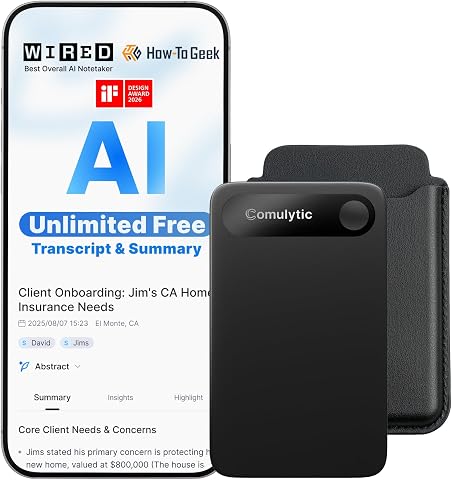 Comulytic Note Pro AI Voice Recorder with Unlimited Transcription and Summari…View on Amazon →
- 9
 Magnetic AI Voice Recorder with Transcription, Summaries, and 64GB StorageView on Amazon →
- 10
 iFLYTEK Offline Voice Recorder with AI Transcription and PlaybackView on Amazon →
- 11
 AI Voice Recorder and Note Taker with 64GB StorageView on Amazon →
- 12
 EurekaMind AI Voice Recorder and Note TakerView on Amazon →
- 13
 EVISTR L359 128GB Digital Voice Recorder with AI TranscriptionView on Amazon →
- 14
 Tonfarb Digital Voice Recorder, 136GBView on Amazon →
- 15
 Elasound Voice Activated Recorder with 128GB Storage and AI Noise ReductionView on Amazon →
The Workflow Matters More Than Capacity
The guide emphasizes what happens to audio after recording. A device’s capacity alone does not establish whether transcripts are searchable, summaries can be edited, or notes can be moved into existing work tools. The guide therefore highlights transcription access, file organization and export options alongside storage.
The source also identifies a privacy and control tradeoff. Cloud-based services may provide access to AI features, while offline recording or transcription may be relevant to people handling sensitive conversations. The guide cautions that offline recording does not necessarily mean AI transcription also works offline, a distinction buyers are advised to check before relying on a device for confidential meetings.
The guide discusses design as a factor in daily use: a wearable can keep hands free, while a pocket device or magnetic design may be easier to carry or position in some settings. It does not present form factor as a guarantee of audio quality; placement, distance and room noise also affect what a recorder captures.
Popular right now

Roborock Qrevo Edge 3 Pro Robot Vacuum and Mop, 36,000 Pa

Vitamix 5200 Professional-Grade Blender with 64 oz Container, Black

DREAME D20 Air Plus Robot Vacuum and Mop with 20,000 Pa Suction
As an affiliate, we earn on qualifying purchases.
How the Guide Compares Devices
The source describes its list as a practical comparison, not a claim that every model offers the same AI functions. It separates dedicated AI note-taking devices from conventional recorders that emphasize storage or familiar controls, then ranks products by how clearly their stated features support a recording-to-notes process. In the guide’s comparison, storage capacity is one factor, not a measure of transcription quality or workflow flexibility.
The guide advises buyers to check how recording, transcription, summaries and exports work on the exact device. It notes that features may depend on an app, account, internet connection or ongoing service, but does not confirm all such terms across the listings. It also recommends considering the recording setting—such as a seated meeting, lecture or walking conversation—when choosing between wearable, pocketable or magnetic designs.
For audio that could include workplace, client, health or personal information, the source recommends checking where recordings and transcripts are processed and stored, along with available deletion and data controls. It also advises following applicable consent rules and organizational policies; the guide does not suggest that device convenience replaces those obligations.
Features Buyers Still Need to Verify
The source does not provide complete, independently verified details for every listing on subscription costs, language support, app compatibility or export options. It also does not establish that each product’s AI functions work offline, or that every recorder labeled for AI offers the same transcript, search or summary capabilities. The guide presents these as purchase checks, not confirmed common features.
The ranking reflects the source’s assessment of listed features, rather than a reported laboratory comparison of recording quality across all 15 devices. The guide does not provide a uniform test method or results for different rooms, microphone distances and background noise. Its ordering should therefore be read as a buying recommendation based on the stated feature set, not a guarantee that one device will perform best in every meeting environment.
Check the Exact Model Before Buying
The guide advises buyers to confirm the model name and included capabilities, then check whether transcription and summaries require an app, account, internet connection or paid plan. It also recommends verifying supported languages, file export, data storage and deletion controls, and whether the selected form factor can be positioned appropriately in the usual recording environment.
For sensitive conversations, the source says to confirm which functions work offline and where cloud-processed audio or transcripts are stored. It also advises reviewing consent requirements and workplace policies before recording. The guide provides a shortlist and selection criteria; current product terms and availability should be verified with the seller or service provider.
Key Questions
Which recorder does the guide rank best overall?
The source ranks the Plaud Note Pro as its best overall choice for buyers seeking a dedicated recorder with an AI note-taking workflow. The ranking reflects the guide’s assessment and is not a claim that the device suits every recording environment.
Does offline recording mean transcription works without internet?
The guide does not establish that. It identifies the iFLYTEK Offline Voice Recorder as an option for people prioritizing offline use, while advising buyers to check which functions, including transcription, work without a network connection.
Is a higher storage capacity enough to choose a recorder?
No. The guide says capacity can reduce file-management chores, but also recommends checking transcription access, organization and export options. Storage alone does not establish the usefulness of an AI workflow.
What should buyers verify about privacy?
The source advises checking where audio and transcripts are processed and stored, what deletion and data controls are available, and whether AI features send files to a cloud service. It also says to follow applicable consent rules and organizational policies before recording sensitive conversations.
Source: ThorstenMeyerAI.com