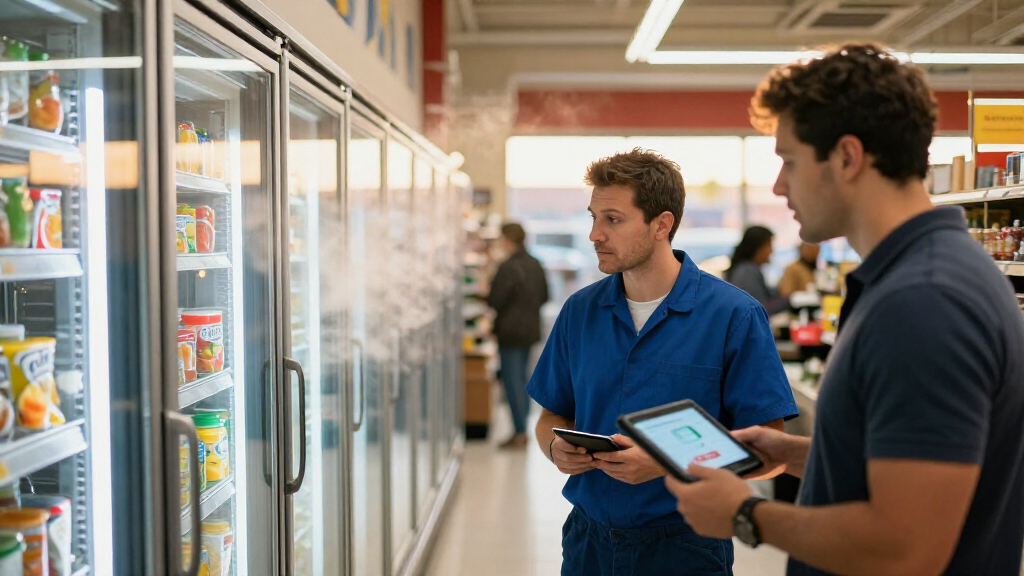
🔍 Read the full analysis: How To Understand AI’s Role In Supermarket Refrigeration Attacks on ThorstenMeyerAI.com

Prime made for students and young adults
- Fast, free delivery for dorm and study essentials
- Prime Video and Amazon Music included
- Member-only deals
TL;DR
Retailers and media reported that supermarket refrigeration controls were remotely switched into defrost or heating modes overnight on Nov. 1–2, affecting more than 115 stores across at least six countries. The method reportedly resembles an October attack in France, but the attacker’s identity and any role for AI remain unknown.
Supermarket refrigeration systems in at least six European countries were reportedly switched into defrost or heating modes overnight on Nov. 1–2, damaging food and disrupting stores, according to retailers, broadcasters and cybersecurity officials. The incidents resemble a wave in France in October, but no source has confirmed that artificial intelligence was used, and investigators have not identified who was responsible.
Reports from Belgium, the Netherlands, Sweden, Luxembourg, Ireland and Estonia describe affected stores; Finnish authorities and retailer Kesko also reported temperature anomalies in a few smaller Finnish shops. BleepingComputer counted more than 115 stores in at least six countries, while reports from different outlets give varying totals. Those figures should be treated as reported counts, not a final audited tally.
Belgian installer Sabcobel said evaporators at affected sites were remotely switched into defrost mode, using a mechanism it described as “exactly the same” as the October incidents in France. Sabcobel chief executive Stephan Moelans told Belgian media that its technicians began disconnecting installations at about 1 a.m. and that internet-reachable store controllers were attacked directly. He said roughly 20 of the several hundred installations his company manages in Belgium were affected; the company itself, he said, was not hacked.
Retailers described damage ranging from malfunctioning units to food losses. A Proxy Delhaize store in Hoepertingen reported freezers at 15 °C and estimated at least €60,000 in discarded food, according to regional reporting cited by VRT NWS. Carrefour Belgium said 15 of its 700 stores were affected, while Swedish Coop reported problems at seven stores and said the situation was contained. In Ireland, 13 SuperValu stores were reported affected. These figures come from separate company and media accounts and may not represent the final total.
Incident Brief · Europe · Reported Nov. 1–2, 2026
How To Understand AI’s Role In Supermarket Refrigeration Attacks
Retail refrigeration controllers were reportedly switched remotely into defrost or heating modes. The disruption is documented in reports; AI use and responsibility remain unconfirmed.
Cold-chain controls became a business risk
Accounts from retailers, broadcasters and cybersecurity officials describe temperature anomalies, disrupted stores and overnight technical response.
Mode changes at a distance
Belgian installer Sabcobel said evaporators at affected sites were remotely switched into defrost mode, describing the mechanism as “exactly the same” as the October France incidents.
Temperature and stock losses
Retailers reported malfunctioning units, food losses and technician callouts. A Proxy Delhaize store in Hoepertingen reported freezers at 15 °C and estimated at least €60,000 in discarded food.
Counts vary by report
Belgium, the Netherlands, Sweden, Luxembourg, Ireland and Estonia were named. Finnish authorities and Kesko also reported anomalies in a few smaller shops.
Separate accounts show uneven impact
Figures below come from individual company and media reports; they are not a reconciled inventory.
Carrefour said 15 of its 700 stores were affected; Coop said seven stores had problems and that the situation was contained.
Not every store had the same outcome
Reported readings varied, including 50 °C in some locations and 15 °C in Hoepertingen. One Antwerp butcher reportedly stopped its systems in time; other businesses reported food losses.
What is known—and what is not
General warnings about AI-related cyber activity do not establish that AI was used in a specific incident.
Controllers were accessed
Accounts describe internet-reachable refrigeration controllers and changes to defrost or heating modes.
AI involvement
No official or company account in the source material says AI played a role in these attacks.
Who did it, and how
No group or individual has claimed responsibility. Investigators have not publicly established the access path for each controller.
“exactly the same”Stephan Moelans · Sabcobel CEO, as quoted by Belgian media
“We have identified an IT incident affecting the refrigeration systems in several dozen stores.”Ahold Delhaize · Statement to BleepingComputer
“currently 15 of our 700 stores are affected, both in Flanders and Wallonia.”Carrefour Belgium · Statement to BleepingComputer
A reported echo of an October incident
Similarity offers context. It does not prove a shared operator or identical compromise across every location.
Earlier refrigeration attacks reported
France’s CERT-FR warned that remote-management interfaces for refrigeration controllers were exposed online in ways that did not follow good practice. The Paris prosecutor’s office was reported to have counted about 700 victims.
New wave of disruptions reported
Sabcobel said the reported mechanism resembled the French incidents. Belgium’s federal prosecutor opened a criminal investigation; no public finding links the episodes to the same actor.
The investigation is still unfolding
Technicians and retailers have responded to reported disruptions, but no timetable for findings or full restoration has been published in the source material.
Containment and investigation
Sabcobel said technicians began disconnecting installations at about 1 a.m. Retailers described some cases as contained or under control. Belgium’s federal prosecutor has opened a criminal investigation.
Scope, access and connection
Authorities and companies have not published one reconciled count, a precise access path for each controller, or confirmation that the French and November incidents share an operator.
Key questions
What the available reporting supports today.
What happened?
Reports say some supermarket refrigeration controllers were remotely switched into defrost or heating modes overnight on Nov. 1–2, causing temperature problems at stores in several countries.
How many stores were affected?
BleepingComputer counted more than 115 across at least six countries. Other reports differ, and a final reconciled count is not available.
Has anyone confirmed AI was used?
No. The source material includes broader warnings about AI-related cyber activity, but no official or company account says AI was used in these incidents.
Who was responsible? Was France connected?
No responsible party has been identified publicly. The reported method resembles the October France episode, but a shared actor has not been established.
Food Losses and Exposed Controls
The incidents show how internet-connected equipment that manages a building’s physical systems can affect ordinary business operations. A change to refrigeration settings can put perishable food at risk, force stores to close or discard stock, and require technicians to respond overnight. The reported losses in Belgium illustrate the potential cost even when an incident is limited to individual stores.
Several retailers said affected locations were independently operated, sat outside central networks or used their own refrigeration equipment. That pattern is relevant to companies whose stores rely on equipment managed separately from corporate IT. It does not establish that independence or older equipment caused the incidents, but it points to a possible gap in how security and remote access are managed across a retail network.
The word “AI” in the topic should not be mistaken for a finding about these attacks. Belgium’s cyber centre has warned of a broader rise in cyberattacks involving AI, according to the source material, but officials and companies have not said AI was used here. The confirmed reporting concerns access to refrigeration controllers and changed operating modes, not an AI-driven method.
Popular right now

Apple AirPods Pro 3 Wireless Earbuds with Active Noise Cancellation

Shark PowerDetect Corded Stick Vacuum with HEPA Filtration, Purple (HZ4001AMZ)

Vitamix Propel Series 750 Professional-Grade Blender, 4 Programs, Black
As an affiliate, we earn on qualifying purchases.
A Similar French Incident
The reported November wave followed attacks on supermarkets in France during the night of Oct. 11–12. France’s CERT-FR warned on Oct. 12 that remote-management interfaces for refrigeration controllers were exposed online in ways that did not follow good practice, and said attack campaigns were “probably still ongoing.” The Paris prosecutor’s office was reported to have counted about 700 victims in the French episode.
That earlier warning and the resemblance in the reported method provide context, but do not by themselves prove the same person or group carried out both waves. The current reports attribute the access to internet-reachable controllers; they do not establish how individual devices were found or accessed, or whether every affected store was compromised in the same way.
The available totals and temperature reports also vary. Accounts cite different numbers for Belgian stores and readings including 50 °C in some locations and 15 °C in Hoepertingen. Store-level damage differs: one Antwerp butcher reportedly stopped its systems in time, while other businesses reported food losses. Authorities and companies have not published a single reconciled inventory.
““exactly the same””
— Stephan Moelans, chief executive of Sabcobel, as quoted by Belgian media
Attribution and AI Use Unconfirmed
No group or individual has claimed responsibility, and the source material reports no attribution by investigators. Belgium’s federal prosecutor has opened a criminal investigation; Belgium’s cyber centre has warned that the attacker may never be identified.
It is also unknown whether AI played any role. General warnings about AI-related cyber activity do not establish its use in a particular incident. The public reporting does not specify the precise access path for each controller, whether all stores were affected through the same technique, or whether the October and November events share an operator.
The number of affected businesses remains unsettled. Media and company reports use different counts and sometimes describe stores, outlets, businesses or refrigeration installations rather than the same unit. Further reporting may revise the totals and clarify the extent of food losses.
Investigators and Retailers Respond
Belgium’s criminal investigation is underway, and affected retailers and refrigeration specialists are responding to the reported disruptions. Technicians have disconnected some installations, while retailers have described cases as contained or under control. The source material does not provide a timetable for investigation findings or a confirmed date for restoring every affected system.
Authorities and businesses may provide clearer figures as they compare incidents and assess losses. Retailers will also need to establish which equipment was affected and whether remote access was secured, but no specific new security measure or official technical finding is confirmed in the material provided. For now, the central unanswered issues are who accessed the controllers, how widely the incidents spread and whether the two waves are connected.
Key Questions
What happened to the supermarket refrigeration systems?
Reports say some controllers were remotely switched into defrost or heating modes overnight on Nov. 1–2, causing temperature problems in refrigeration units at stores in several countries.
How many stores were affected?
BleepingComputer counted more than 115 stores across at least six countries. Other reports give different totals, and Finnish authorities and Kesko also reported problems, so a final reconciled count is not available.
Has anyone confirmed that AI was used?
No. The source material includes general warnings about cyberattacks involving AI, but no official or company account says AI was used in these refrigeration incidents.
Who was responsible, and is this linked to the France attacks?
No responsible party has been identified, and nobody has claimed responsibility. Sabcobel described the reported mechanism as the same as in France, but that does not confirm the same attacker or prove that the incidents are linked.
What is being investigated?
Belgium’s federal prosecutor has opened a criminal investigation. The available reports do not give a final account of how each controller was accessed or a timetable for identifying those responsible.
Source: ThorstenMeyerAI.com