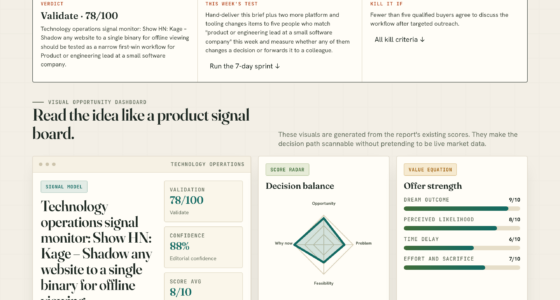

📊 Full opportunity report: The $60 Billion Bargain: Why Cursor Could Be a Steal for SpaceX on ThorstenMeyerAI.com — validation score, market gap, and execution plan.
TL;DR
SpaceX exercised an option to buy AI coding firm Cursor for $60 billion, paying mostly in stock. Despite the high headline price, the deal is strategically valuable due to Cursor’s rapid growth, profitability, and integration potential.
SpaceX has announced it will acquire Anysphere, the maker of the AI coding tool Cursor, for $60 billion paid entirely in SpaceX stock. This move, announced just days after SpaceX’s historic IPO valuation, positions the aerospace company to gain a strategic foothold in AI development and enterprise software, with the deal’s valuation and timing raising eyebrows and questions about its true value.
Despite the headline figure, the deal’s valuation appears more attractive when considering Cursor’s rapid revenue growth and strategic assets. Cursor’s revenue doubled from $2 billion in February to over $4 billion in June, with projections reaching $6 billion by the end of 2026. At that forecasted rate, the valuation multiple drops from 15x to around 10x, and likely to single digits, which is typical for fast-growing AI companies.
Crucially, no cash exchanged hands; SpaceX paid with stock, representing just 3.4% dilution at the IPO valuation, and the company’s stock rose 16% upon announcement, boosting SpaceX’s market cap to nearly $2.94 trillion. The acquisition grants SpaceX a profitable, fast-growing AI business with over a million paying users, including 50,000 enterprise clients, and a proven in-house coding model called Composer.
Furthermore, the deal secures a developer gateway—Cursor’s platform is the interface through which enterprise AI workflows are managed—and prevents competitors like OpenAI and Microsoft from acquiring the asset. SpaceX also gains a proven applied-AI team and a shipping product, with plans to integrate Cursor’s models into its own stack, reducing reliance on third-party API costs and moving toward vertical integration.
The $60B bargain: why Cursor could be a steal
$60 billion for a code editor sounds like a bubble. Look past the headline and the price isn’t the scandal — it’s the discount. Here’s the case that SpaceX got Cursor cheap.
A melting multiple, paid in appreciating paper that cost almost nothing, for the profitable leader of the only AI category reliably making money — plus the missing app layer and an escape from the margin trap. If the growth holds and integration doesn’t break the product, $60B will read like a down payment. The risk isn’t overpaying for what Cursor is — it’s breaking what made it worth buying.
Why the Deal Is a Major Strategic Win for SpaceX
This acquisition is significant because it provides SpaceX with a profitable, rapidly expanding AI business that enhances its technological capabilities and competitive positioning. By owning Cursor’s developer platform and models, SpaceX can control key distribution channels and reduce costs associated with third-party AI APIs. The deal also blocks rivals from gaining a foothold in enterprise AI workflows, which are increasingly critical in the AI arms race.
Moreover, the deal exemplifies how SpaceX leverages its high market valuation to acquire assets cheaply in stock, turning what appears to be a high headline price into a strategic discount. The move signals a broader shift toward vertical integration in AI, with SpaceX aiming to build an in-house stack of frontier models and compute infrastructure, aligning with Elon Musk’s history of building entire ecosystems in-house.
As an affiliate, we earn on qualifying purchases.
Background on Cursor and Its Rapid Growth Trajectory
Cursor, developed by Anysphere, emerged as a leader in AI coding tools with over a million paying users and a strong presence among Fortune 500 companies. Its revenue grew from $2 billion in February to over $4 billion in June, driven by rapid adoption and enterprise expansion. The company also developed Composer, its own AI coding model, which by late 2025 was responsible for most of its output, signaling a shift from reselling models to proprietary development.
Prior to the acquisition, Cursor had turned down offers from OpenAI and Microsoft, asserting its independence and strategic value. Its profitability in enterprise subscriptions and ownership of a proven applied-AI team made it a highly sought-after asset, especially as AI workflows become central to enterprise operations. Meanwhile, its reliance on external API providers was seen as a vulnerability, which SpaceX aims to eliminate through vertical integration.
“This acquisition enhances our AI capabilities and positions SpaceX at the forefront of enterprise AI workflows.”
— SpaceX spokesperson
As an affiliate, we earn on qualifying purchases.
Remaining Questions About the Acquisition’s Long-Term Impact
It is still unclear how effectively SpaceX will integrate Cursor into its existing infrastructure and whether the anticipated cost savings and margins will materialize as planned. The long-term valuation of the deal depends on Cursor’s continued growth and how well SpaceX can leverage its assets in a competitive AI landscape. Additionally, the full strategic implications for rivals and the broader AI industry remain to be seen.
As an affiliate, we earn on qualifying purchases.
Next Steps for SpaceX and Cursor Integration Efforts
SpaceX is expected to begin integrating Cursor’s models and platform into its own AI and software infrastructure over the coming months. The company will likely focus on expanding Cursor’s enterprise footprint, developing proprietary models, and reducing reliance on external AI providers. Monitoring Cursor’s growth and profitability, as well as how competitors respond, will be key in assessing the deal’s success.
As an affiliate, we earn on qualifying purchases.
Key Questions
Why did SpaceX pay so much for Cursor?
SpaceX paid a high headline price, but the deal’s value is driven by Cursor’s rapid growth, profitability, strategic assets, and the opportunity to integrate AI models in-house, which could lead to significant long-term cost savings and competitive advantages.
What does this mean for the AI industry?
The deal exemplifies the trend toward vertical integration and strategic acquisitions in AI, with major tech and aerospace companies seeking to own key workflows and models to maintain competitive edges.
Will this affect SpaceX’s core business of rockets and satellites?
While the acquisition expands SpaceX’s technological scope, its primary focus remains aerospace. The AI assets are viewed as complementary, enhancing SpaceX’s overall ecosystem and operational capabilities.
What are the risks involved?
Risks include integration challenges, whether Cursor’s growth can be sustained, and how competitors will respond. The long-term success depends on SpaceX’s ability to leverage these assets effectively.
Source: ThorstenMeyerAI.com