

The internet relies on a hidden system called the Network Time Protocol (NTP) to keep all devices synchronized to the same clock. This ensures your emails arrive instantly, videos stream smoothly, and online transactions stay secure. NTP works continuously in the background, adjusting clocks across servers and devices for precise timing. Understanding how it operates helps you grasp the importance of this invisible backbone that keeps your digital world running seamlessly. Keep exploring to learn more.
Key Takeaways
- The Internet relies on synchronized clocks to ensure data packets, emails, and streams arrive accurately and instantly.
- NTP (Network Time Protocol) maintains precise timing across servers, routers, and devices worldwide.
- NTP continuously adjusts device clocks using hierarchical time sources like atomic clocks for high accuracy.
- Proper time synchronization prevents errors, delays, and security issues caused by clock mismatches.
- Regular maintenance and secure configurations of NTP ensure reliable, seamless internet communication.
The Internet Runs on Perfect Timing: Meet the Protocol You Never Think About

Have you ever wondered how your emails arrive instantly or how videos stream smoothly without interruption? The answer lies in time synchronization, a crucial aspect of internet communication. Protocol essentials like precise timing ensure that data packets are sent and received accurately, preventing delays and errors. This synchronization keeps all devices on the same clock, coordinating actions across servers, routers, and your device. Without it, your online experience would be chaotic, with mismatched data and lag. The protocol responsible for this seamless coordination operates behind the scenes, ensuring that every part of the network aligns perfectly. It’s the invisible conductor that keeps everything running smoothly, allowing you to enjoy real-time conversations, streaming, and instant updates with no fuss. Accurate timing also depends on specialized synchronization protocols, which maintain the precision needed for flawless digital communication. These protocols are especially vital in European cloud servers, supporting secure and sustainable digital infrastructure worldwide.
What Is NTP and Why Is It Important?
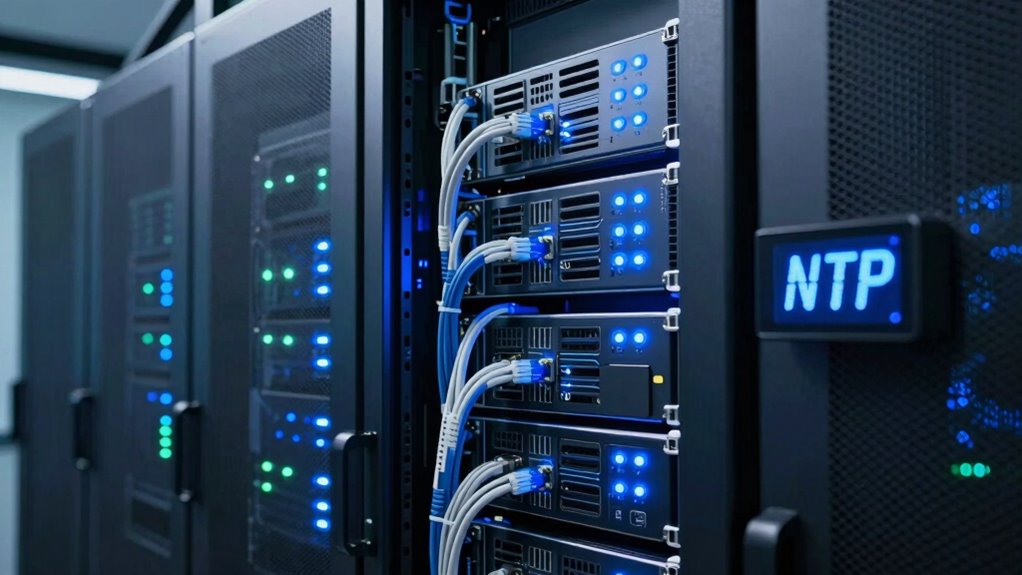
Ever wondered how your devices stay perfectly synchronized across the globe? That’s where NTP, or Network Time Protocol, comes in. Its historical development began in the 1980s, evolving from simple time-sharing systems to a robust protocol that keeps clocks aligned with atomic time sources. NTP’s accuracy is essential for operations like banking, communications, and security, ensuring data integrity. As technology advances, future developments in NTP aim to improve precision, reduce latency, and enhance resilience against cyber threats. These advancements will help maintain synchronization even as networks grow larger and more complex. Without NTP, the internet’s efficiency and security would falter, highlighting its critical role in our digital world. It’s a quiet, yet fundamental, backbone supporting seamless connectivity everywhere.
How Does NTP Synchronize Clocks Across Devices?

You might wonder how NTP manages to keep clocks on different devices synchronized with such precision. It does this by continuously exchanging timing information with dedicated servers, adjusting for network delays. NTP accounts for time zone adjustments and daylight saving changes automatically, ensuring your device displays the correct local time. Additionally, NTP relies on primary time sources like atomic clocks to maintain its high accuracy. Some implementations also incorporate redundant servers to prevent synchronization failures. To enhance reliability, NTP can also utilize stratum levels that define the hierarchy of time sources in the network. Proper security protocols are essential to protect against malicious interference and ensure the integrity of time synchronization.
How Does NTP Work? A Simple Explanation of the Technology

How does NTP manage to keep clocks synchronized across devices with such accuracy? It works by using a hierarchy of time servers to provide precise time signals. Your device sends a request to the NTP server, which responds with the current time. NTP then compares this with your device’s clock to calculate the delay caused by network latency. To guarantee accurate time synchronization, it adjusts your clock based on these calculations, compensating for delays and jitter. Multiple exchanges between your device and servers help refine the estimate, minimizing errors. This process happens continuously, allowing clocks to stay aligned within milliseconds. By accounting for network latency and using sophisticated algorithms, NTP maintains the high level of timing precision essential for internet functions.
How NTP Ensures Accurate Time for Your Internet Activities
When you use the internet, your devices rely on NTP to keep their clocks synchronized. This helps maintain network accuracy and prevents time discrepancies that can cause issues. By ensuring precise timing, NTP supports smooth and secure internet activities. Additionally, smart home devices depend on accurate timekeeping to coordinate automation routines and ensure seamless operation across your connected home ecosystem.
Synchronizing Computer Clocks
Accurate time synchronization is essential for the smooth operation of internet activities, from secure transactions to online communication. When your computer’s clock is off, digital timestamps can become unreliable, leading to issues like failed authentications or data inconsistencies. Network Time Protocol (NTP) keeps your device’s clock aligned with atomic clocks, reducing the effects of time drift—small discrepancies that accumulate over time. NTP continuously adjusts your clock by exchanging time data with servers, ensuring your system stays precise. This process guarantees that all devices on the internet share a consistent timeline, crucial for coordinating activities, validating certificates, and maintaining security. Without proper synchronization, your online experience could become prone to errors, delays, and vulnerabilities.
Maintaining Network Accuracy
Maintaining network accuracy is essential for reliable internet activities, and NTP plays a key role in this process. It constantly corrects time drift, which can cause discrepancies between clocks on different devices. Without proper synchronization, small errors could accumulate, leading to issues like missed deadlines or data inconsistencies. NTP ensures your devices stay in sync by adjusting for these drifts regularly. Additionally, it handles timezone adjustments seamlessly, so your system clock reflects the correct local time without manual intervention. This precise synchronization supports everything from secure communications to financial transactions. By keeping clocks accurate across the network, NTP maintains the integrity and reliability of your internet activities, ensuring that every timestamp is correct and that your digital world functions smoothly. Understanding Free Floating concepts can also help optimize network performance and stability.
Preventing Time Discrepancies
Since even small time errors can cause significant issues in internet activities, NTP actively prevents discrepancies by constantly monitoring and adjusting your device clocks. It minimizes problems caused by time drift and clock skew, ensuring synchronized timing across networks. NTP uses several techniques to maintain accuracy:
- Regularly communicates with accurate time sources, such as atomic clocks or GPS satellites.
- Calculates the difference between your clock and the reference time, correcting for any drift.
- Applies adjustments gradually to prevent sudden changes that could disrupt operations.
- Implements algorithms to detect and compensate for network delays, maintaining precise synchronization. Time synchronization is crucial for the smooth operation of many online systems and services.
How to Set Up and Maintain NTP on Your Systems

Setting up and maintaining Network Time Protocol (NTP) on your systems guarantees that your devices stay synchronized with reliable time sources. Begin by selecting a reputable NTP server, preferably geographically close to reduce latency. Configure your system’s NTP settings to automatically adjust for time zone changes, ensuring seamless updates during daylight saving shifts or travel. Regularly check the synchronization status to confirm your hardware timekeeping aligns with the server, minimizing discrepancies. Keep your NTP software up to date to benefit from security patches and improvements. Proper maintenance involves monitoring logs for errors and verifying that your system’s clock remains accurate. Understanding how synchronization works can help you troubleshoot issues more effectively, and can reveal the importance of time drift in maintaining precise timing. Additionally, being aware of time drift can aid in diagnosing subtle discrepancies that may develop over time. Recognizing the impact of clock skew further emphasizes the need for consistent synchronization to prevent cumulative errors. Monitoring clock drift regularly can help detect early signs of issues before they cause significant problems.
Frequently Asked Questions
Can NTP Prevent All Types of Internet Security Issues?
NTP can’t prevent all types of internet security issues, especially those related to time spoofing or security vulnerabilities. While it helps synchronize clocks, attackers can exploit NTP itself or manipulate time data, leading to potential breaches. You need additional security measures like encryption and authentication to protect against these threats. Relying solely on NTP isn’t enough; it’s part of a broader security strategy.
Is NTP Used in Mobile Devices and Iot Gadgets?
Yes, NTP is used in mobile devices and IoT gadgets. For example, a smart thermostat relies on NTP to keep its clock synchronized, ensuring accurate temperature scheduling. Without proper IoT synchronization, devices might malfunction or miscommunicate. You can think of it like your phone updating its time to match cellular networks—crucial for seamless operation and security, especially in connected environments where precise timing matters.
How Often Does NTP Update the System Clocks?
NTP updates your system clocks typically every few minutes to maintain time accuracy, but it can be configured to sync more or less often based on your needs. The synchronization frequency depends on your device’s settings and network conditions, ensuring your clock stays precise. Regular updates help prevent time drift, which is vital for applications like online banking, communication, and IoT devices that rely on accurate timing.
What Happens if NTP Synchronization Fails Temporarily?
If NTP synchronization fails temporarily, you’ll notice time drift on your system clock. This can cause issues like mismatched timestamps or authentication errors. During a synchronization failure, your clock may gradually drift away from the accurate time until NTP reconnects. To prevent problems, most systems have a buffer or fallback, but prolonged failures can impact applications relying on precise timing. Regular updates help keep your system synchronized and minimize drift.
Are There Alternatives to NTP for Time Synchronization?
Think of alternative protocols as backup dancers stepping in when NTP misses a beat. You can use Precision Time Protocol (PTP) for higher accuracy or Simple Network Time Protocol (SNTP) for simpler needs. These alternatives aid in maintaining precise accuracy, especially in environments demanding tight synchronization. While NTP is the star, these protocols ensure your network stays in sync, even if the main performer stumbles temporarily.
Conclusion
Without you even noticing, NTP keeps everything running smoothly behind the scenes. It’s like that silent friend who keeps everyone on schedule without asking for praise. By understanding how this quiet hero works, you can appreciate the seamless experience you enjoy daily. So, next time your device updates flawlessly or your online activities stay in sync, remember NTP’s gentle, perfect timing—making your digital world just a little more reliable.