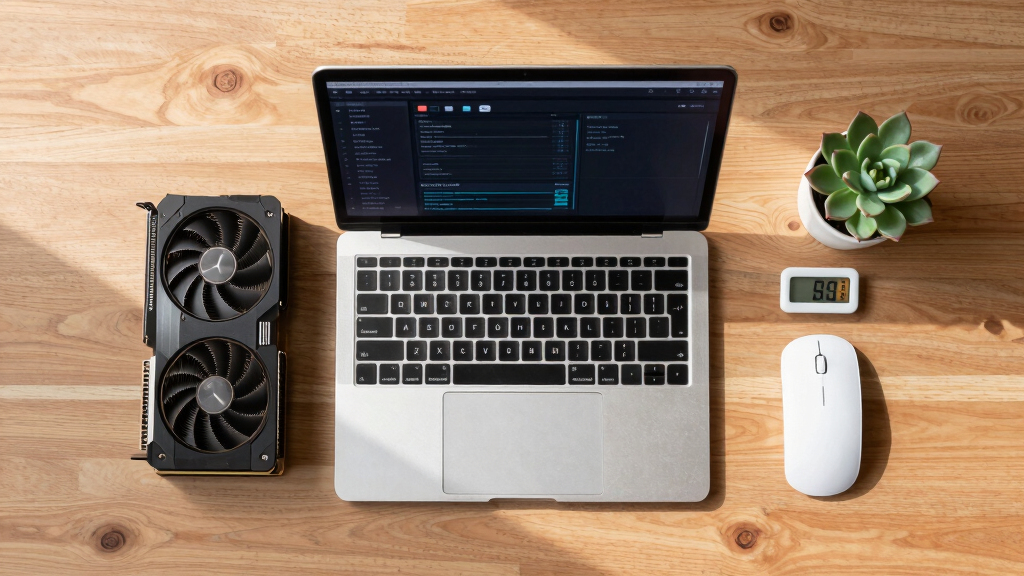

📊 Full opportunity report: Undervolting Your GPU for Local Inference: Lower Heat, Same Tokens/sec on ThorstenMeyerAI.com — validation score, market gap, and execution plan.

Prime made for students and young adults
- Fast, free delivery for dorm and study essentials
- Prime Video and Amazon Music included
- Member-only deals
TL;DR
Undervolting through power limiting allows AI inference GPUs to run cooler and quieter with little performance loss. This method is simple, reversible, and effective for inference workloads.
Recent testing confirms that undervolting GPUs for local inference workloads by applying power limits can substantially lower heat output and noise without sacrificing performance.
Researchers and developers have demonstrated that reducing the power limit on GPUs like the NVIDIA RTX 4090 and RTX 5090 results in a significant drop in power consumption and temperature, with minimal impact on tokens per second during AI inference tasks. The most effective approach is using a simple power limit slider, which is reversible and safe, especially for inference workloads that are memory-bandwidth-bound rather than compute-bound. Data from recent tests show that lowering power to around 50-55% maintains over 90% of the original performance while cutting power draw by approximately 30-40%. This approach reduces heat and noise, making systems more efficient and comfortable for all-day AI tasks.
Undervolt for inference:
lower heat, same tokens/sec.
Local inference is memory-bound — the GPU core spends much of its time waiting on VRAM, not maxing out compute. So when you cap its power, heat falls fast while throughput barely moves. Drag the slider in Part 2 to see the trade for yourself.
(the real limit)
(often waiting)
you pay for in heat
| Power limit | Power draw | Temp | Speed kept | Efficiency |
|---|---|---|---|---|
| 100% (stock) | 390 W | 72°C | 100% | baseline |
| 80% | 330 W | 70°C | 98.6% | +17% |
| 70%recommended | 300 W | 67°C | 93.4% | +22% |
| 60% | 260 W | 62°C | 91.5% | +37% |
| 55%peak efficiency | 240 W | 60°C | 89.2% | +45% |
| 50% | 220 W | 58°C | 82.6% | +46% |
| 40% (too far) | 180 W | 52°C | 61.3% | falls off |
- One slider, 100% → 70%. The card reduces voltage and clocks on its own.
- Can’t damage anything — you’re restricting the card, not pushing it.
- No stability testing needed.
- Captures most of the available benefit.
- Edit the voltage-frequency curve — hold a clock at lower voltage.
- Target around 0.9–0.95V to start; better chips go lower.
- Keeps more performance for the same heat cut.
- Test under your real workload — a curve stable for 10 min can fail on hour 3.
MSI Afterburner (works on any brand). Headless Linux: nvidia-smi or LACT.sudo nvidia-smi -pl 300.Impact on AI Workstation Efficiency and Noise Levels
This development matters because it offers a straightforward way to optimize AI inference setups, reducing heat and noise without compromising speed. For professionals running high-power GPUs continuously, this can translate into lower cooling costs, quieter environments, and longer hardware lifespan. The method is accessible to most users and can be implemented with minimal technical expertise, making it a practical upgrade for AI practitioners seeking better thermal management.
NVIDIA RTX 4090 undervolting software
As an affiliate, we earn on qualifying purchases.
As an affiliate, we earn on qualifying purchases.
GPU Factory Settings and Inference-Specific Tuning
Modern GPUs like NVIDIA’s RTX series ship with conservative factory voltage and clock settings to ensure stability across all units. These settings often include safety margins that produce excess heat and power consumption, especially during inference workloads where the GPU is memory-bandwidth-bound rather than compute-bound. Historically, GPU tuning focused on gaming performance, but recent insights reveal that inference workloads can tolerate significant power and clock reductions without noticeable performance loss, thanks to the bottleneck being elsewhere in the data pipeline.
"Most inference workloads are memory-bandwidth-bound, so reducing power and voltage doesn't impact tokens/sec significantly. It's a simple, effective way to cut heat and noise."
— Thorsten Meyer, AI hardware expert
GPU power limit slider for inference
As an affiliate, we earn on qualifying purchases.
As an affiliate, we earn on qualifying purchases.
Remaining Questions on Long-Term Stability and Compatibility
While short-term tests show promising results, it is still unclear how sustained undervolting and power limiting impact GPU longevity over months or years. Compatibility issues with certain models or BIOS versions have not been fully explored, and some users report variability in results depending on specific hardware configurations. Further testing is needed to confirm the safety and stability of aggressive undervolting across different GPU models and workloads.
GPU temperature monitor for AI inference
As an affiliate, we earn on qualifying purchases.
As an affiliate, we earn on qualifying purchases.
Next Steps for Users and Developers
Users are encouraged to experiment with power limiting settings, starting at around 70%, and monitor stability and performance. Future updates may include more refined undervolting profiles and software tools to automate the process. Hardware manufacturers might also release firmware updates that facilitate safer, more efficient undervolting. Ongoing research will clarify the long-term effects and optimal configurations for various workloads.
As an affiliate, we earn on qualifying purchases.
Key Questions
Does undervolting affect gaming performance?
Yes, in gaming workloads, undervolting can sometimes reduce frame rates because games are often compute-bound. However, for inference tasks that are memory-bandwidth-bound, performance remains largely unaffected.
Is power limiting reversible and safe?
Yes, adjusting the power limit slider is reversible, safe, and does not damage the GPU. It simply restricts the maximum power draw, reducing heat and noise.
What tools are recommended for undervolting and power limiting?
MSI Afterburner is widely used for Windows to adjust power limits easily. For more precise undervolting, editing the GPU's voltage-frequency curve directly is possible but requires more technical skill.
Will undervolting reduce my tokens/sec noticeably?
In most inference workloads, tokens/sec remains nearly the same when applying power limits around 50-70%, because the bottleneck is memory bandwidth, not core compute speed.
Source: ThorstenMeyerAI.com
Fall Picks
fall essentials
As an affiliate, we earn on qualifying purchases.