🔍 Read the full analysis: Which AI Gaming Laptop Fits Your Play Style In 2027? 10 Picks on ThorstenMeyerAI.com

Prime made for students and young adults
- Fast, free delivery for dorm and study essentials
- Prime Video and Amazon Music included
- Member-only deals
TL;DR
A ThorstenMeyerAI.com buying guide compares 10 gaming-laptop listings by their published specifications and the play styles they may suit. It favors the Ryzen 9 ASUS ROG Strix G16 as the most generously equipped all-rounder, while warning that incomplete listings and model variations need checking before purchase.
ThorstenMeyerAI.com has published a 10-laptop buying guide, the original analysis, for players weighing graphics performance, screen resolution, portability and upgrade needs. The guide ranks a Ryzen 9 ASUS ROG Strix G16 first based on its listed RTX 5060, 64GB of RAM and 1TB SSD, but the recommendations rely on product-listing specifications rather than independently reported benchmark results.
The guide names the ROG Strix G16 with Ryzen 9 9955HX as its best overall pick. Its listed 64GB of memory and 1TB SSD are ample on paper, but its WUXGA screen is less sharp than the QHD+ display on the recommended MSI Katana 15 HX. That MSI listing pairs an RTX 5070 with QHD+, a combination the guide says better suits demanding games and players who value visual detail on OLED gaming monitors.
The Acer Nitro V 16S AI is presented as a middle-ground choice, with a listed RTX 5060, 32GB of RAM, 1TB SSD and 180Hz WUXGA display, a refresh rate also relevant when comparing high-refresh gaming monitors. The guide also includes a second ROG Strix G16 listing with an Intel Core i7 and 16GB of RAM, emphasizing that shared model names can conceal materially different configurations. Buyers should compare the exact listing rather than assuming all versions have the same hardware.
The remaining options are framed around differing sizes, graphics tiers and prices, but the supplied source material does not give a complete model-by-model specification table or pricing. It flags the HP Victus listing for its RTX 3050, the KAIGERR LX16PRO for not naming a discrete GPU, and a customized Delca Predator Helios Neo 18 listing for limited configuration detail. Those gaps make direct comparisons less certain.
The 10 picks
- 1
 Acer Predator Helios Neo 18 AI Gaming Laptop (Delca Customized)View on Amazon →
- 2
 ASUS ROG Strix G16 Gaming Laptop, 16" WUXGA 165Hz, AMD Ryzen 9 9955HX, NVIDIA…View on Amazon →
- 3
 MSI Katana 15 HX Gaming Laptop (15.6" QHD+ 165Hz, Intel Core i9-14900HX, NVID…View on Amazon →
- 4
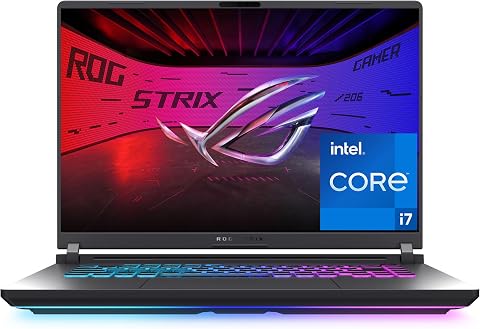 ASUS ROG Strix G16 (2025) Gaming Laptop, 16-inch FHD+ 165Hz, Intel Core i7-14…View on Amazon →
- 5
 GIGABYTE AERO X16 16-Inch Laptop with AMD Ryzen AI 7 350 and GeForce RTX 5070View on Amazon →
- 6
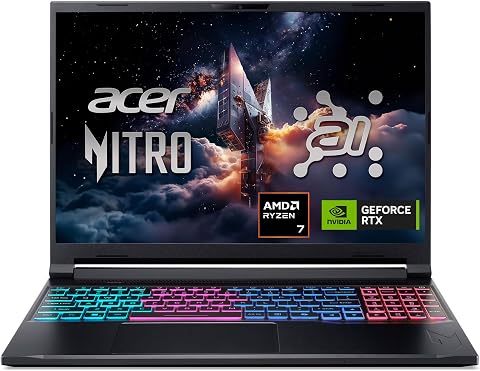 Acer Nitro V 16S AI Gaming Laptop, Ryzen 7 260, RTX 5060, 16-inch WUXGA 180Hz…View on Amazon →
- 7
 MSI Cyborg 17 17.3-inch FHD 144Hz Gaming Laptop, Intel Core 7-240H, NVIDIA Ge…View on Amazon →
- 8
 Alienware 16 Aurora Gaming Laptop, RTX 5050, Intel Core 7 240HView on Amazon →
- 9
 HP Victus 15.6" Full HD 144Hz Gaming Laptop, Intel Core i5-12450H, NVIDIA GeF…View on Amazon →
- 10
 KAIGERR LX16PRO 16-inch Gaming Laptop with AMD Ryzen 7, 16GB RAM, 512GB SSD,…View on Amazon →
Specs Shape the Gaming Tradeoffs
The guide’s main value is its emphasis on configuration over model names. Graphics hardware, screen resolution, memory and cooling all affect the experience, and a laptop’s headline processor or refresh rate does not tell the whole story. A higher-resolution screen can demand more from the GPU; a fast-refresh panel matters most when the system can render enough frames in the games a buyer plays.
For shoppers, the practical consequence is that a “best” laptop depends on priorities. The MSI’s listed RTX 5070 and QHD+ combination may appeal to buyers seeking sharper visuals, while the Ryzen 9 Strix’s larger memory configuration may suit people who keep other applications open or want more headroom. Neither listing, on the information provided, proves how the laptop performs under sustained gaming loads.
That distinction also matters when comparing prices and planning upgrades. 16GB, 32GB and 64GB of RAM are not interchangeable measures of gaming speed, and extra memory may not improve frame rates by itself. Buyers need to weigh the whole configuration and any likely upgrade cost, not simply choose the largest number.
Popular right now

Samsung 48 4K OLED Smart TV (2026) with WireLogic 8ft Ultra High Speed HDMI Cable

Apple AirPods Pro (2nd Generation) Wireless Earbuds with USB‑C Charging, Up to 2X More Active Noise Cancelling, Transparency Mode, Adaptive

DREAME A3 AWD 1000 LiDAR Robot Lawn Mower
As an affiliate, we earn on qualifying purchases.
How the Guide Compares Models
ThorstenMeyerAI.com says it compared the listed processors, graphics chips, memory, storage and displays, then judged how those details match common gaming needs. Its stated approach treats unclear specifications as a drawback rather than assuming missing components. The source also says GPU choice is often a more useful guide to gaming performance than processor branding alone.
The recommendations distinguish WUXGA and QHD+ resolutions and consider refresh rates alongside graphics hardware. They also weigh screen size and portability: larger 17- or 18-inch laptops can provide more viewing area but may be less convenient to carry. The source advises checking independent reviews for cooling, fan noise and sustained performance, since those details are not established by the listed specifications alone.
“The Ryzen 9 ROG Strix G16 leads on listed memory: its 64GB RAM and RTX 5060 make it the most generously provisioned all-rounder here, though the display is WUXGA rather than QHD+.”
— ThorstenMeyerAI.com, in its buying guide
Listings Leave Key Questions Open
The source provides no prices, retailer links, publication date, availability checks or independent benchmark data for the models described. It also does not establish how each laptop performs in particular games, how loud or hot it becomes under sustained load, or the power limits applied to its graphics chip. Those details can change real-world performance even when two laptops list the same GPU.
Some configurations are specifically incomplete or ambiguous. The KAIGERR listing does not identify a discrete GPU, and the Delca-customized Predator listing lacks sufficient detail for a confident hardware comparison. The guide’s product names and specifications should be treated as descriptions of listings, not confirmation that every configuration is available in every market or will remain unchanged through 2027.
Verify Each Configuration Before Buying
The next step for buyers is to check the exact product listing and regional configuration before ordering, including GPU, memory, storage, display resolution and upgrade options. Where possible, compare independent tests of the exact laptop for game benchmarks, temperatures, fan noise and sustained performance. Prices and stock should also be checked with sellers because the source does not report them.
No follow-up tests, price updates or revisions are specified in the supplied material. The guide’s recommendations may be useful as a shortlist, but final choices depend on confirmed configurations, current pricing and the games each buyer intends to play.
Key Questions
Which laptop does the guide rank first?
It names the Ryzen 9 ASUS ROG Strix G16, citing its listed RTX 5060, 64GB of RAM and 1TB SSD. Its WUXGA display is a tradeoff compared with QHD+ alternatives.
Which pick is aimed at sharper, demanding gameplay?
The guide points to the MSI Katana 15 HX, whose listed RTX 5070 and QHD+ screen are positioned for buyers who prioritize graphics capability and visual detail. Independent performance results are not included.
Why compare the exact configuration rather than the laptop name?
Different listings under the same model name can have different components. The guide contrasts two ROG Strix G16 versions with 64GB and 16GB of RAM, respectively, so buyers should confirm the specifications of the item being sold.
Which listings need extra specification checks?
The source flags the KAIGERR LX16PRO because its listing omits a discrete GPU, and the customized Delca Predator Helios Neo 18 because it provides little configuration detail. It also cautions that the HP Victus listing names an RTX 3050.
Source: ThorstenMeyerAI.com