Educational geology rock collection kits differ most in how they teach: some prioritize labeled specimens and reference material, while others add gem digs, geode cracking, or testing tools. My best overall pick is the National Geographic Rock Collection Box with Rocks, Minerals, and Expert Book, which pairs a specimen set with a reference guide for learners who want context as well as rocks. For a larger display and comparison set, the National Geographic Rock, Mineral & Crystal Collection with 200 Specimens stands out; the PIBEX Rock Collection Starter Kit offers a more compact route with identification cards. The main tradeoff is breadth versus depth: more pieces can mean less time spent studying each one, while activity kits may contain fewer specimens. Read on for the full breakdown and guidance on choosing a kit that fits the learner, setting, and kind of geology exploration you have in mind.

Prime made for students and young adults
- Fast, free delivery for dorm and study essentials
- Prime Video and Amazon Music included
- Member-only deals
Key Takeaways
- The best learning kits pair specimens with useful context. The National Geographic Rock Collection Box includes an expert book, making it a stronger starting point for questions about what a specimen is and how it differs from another.
- A high specimen count favors comparison, not necessarily deeper instruction. The 200-specimen National Geographic collection offers breadth for sorting and display, while a smaller, more guided kit may suit focused study better.
- Identification cards can make a compact collection more usable. PIBEX’s 54-piece set gives learners a reference point for each specimen without taking up the space of a very large collection.
- Activity kits teach through doing, but have a narrower focus. Gem digs and break-open geodes offer tactile projects; they are less suited to buyers seeking a broad, ready-to-study assortment.
- Polished stones and raw specimens serve different lessons. The two-pound polished collection is better for handling and visual appeal, while rock, mineral, and fossil sets can introduce more varied specimen types.
| National Geographic Rock Collection Box with Rocks, Minerals, and Expert Book |  | Best Overall for Guided Learning | Brand: National Geographic | Specimens: Over 200 rocks, minerals, and crystals | Geodes: 2 | VIEW LATEST PRICE | See Our Full Breakdown |
| National Geographic Rock, Mineral & Crystal Collection with 200 Specimens |  | Best for Hands-On Specimen Identification | Specimens: 200 genuine rocks, minerals, and crystals | Geodes: 2 break-open geodes and 1 broken geode piece | Included tools: Magnifying glass | VIEW LATEST PRICE | See Our Full Breakdown |
| Toysmith Rock & Mineral Science Kit for Kids, 30 Specimens, Ages 8+ |  | Best for Testing and Classification | Brand: Toysmith | Specimens: 30 total: 15 rocks and 15 minerals | Included tools: Nail, magnifying viewer, and streak plate | VIEW LATEST PRICE | See Our Full Breakdown |
| National Geographic Geology Kit with Crystals, Gem Dig, and Rock Collection |  | Best Multi-Activity Geology Bundle | Brand: Blue Marble | Set name: Geology Bundle | Number of kits: 3 | VIEW LATEST PRICE | See Our Full Breakdown |
| National Geographic Gemstone Dig Kit with 10 Real Gemstones |  | Best Compact Excavation Activity | Brand: Blue Marble | Set name: Super Gemstone Dig Kit | Gemstones: 10 genuine gemstones | VIEW LATEST PRICE | See Our Full Breakdown |
| Rock Collection Kit for Kids, 30 Rocks, Gemstones, and Crystals | 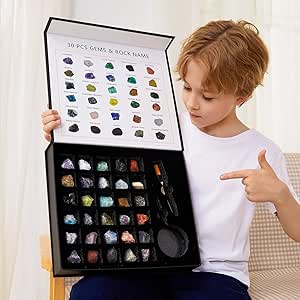 | Best for Named Specimens | Brand: YXZZWL | Model: 105-30YSTZ | Specimens: 30 rocks, gemstones, and crystals | VIEW LATEST PRICE | See Our Full Breakdown |
| Piano Potato Rock and Mineral Kit with 15 Specimens |  | Best Compact Starter Set | Brand: Piano Potato | Model number: EDM017 | Specimen count: 15 | VIEW LATEST PRICE | See Our Full Breakdown |
| Educational Insights Complete Rock, Mineral, and Fossil Collection |  | Best for Classification Activities | Brand: Educational Insights | Model number: 5210 | Specimen count: 57 | VIEW LATEST PRICE | See Our Full Breakdown |
| National Geographic Polished Stones and Crystals, 2 lb Collection |  | Best for Polished Specimens and Crafts | Brand: Blue Marble | Collection: National Geographic Premium Polished Stones | Weight: 2 lb | VIEW LATEST PRICE | See Our Full Breakdown |
| PIBEX Rock Collection Starter Kit, 54 Rocks and Minerals with Identification Cards |  | Best for Mixed Raw and Polished Samples | Brand: PIBEX | Model number: ZS-508 | Set size: 54 specimens | VIEW LATEST PRICE | See Our Full Breakdown |
| Rock Science Kit with 15 Mineral Specimens and Testing Tools |  | Best for Hands-On Identification | Specimens: 15 rock and mineral specimens | Included tools: Two unglazed porcelain streak plates, nail, copper, and hand lens | Case: Lightweight case with organized compartments | VIEW LATEST PRICE | See Our Full Breakdown |
| Geosciences Industries Introductory Earth Science Rocks and Minerals Collection |  | Best for Classroom Earth Science | Sample count: 75 | Sample size: Approximately 1–2 inches | Rock types: Igneous, sedimentary, and metamorphic | VIEW LATEST PRICE | See Our Full Breakdown |
| National Geographic Break Open 10 Premium Geodes Science Kit |  | Best for Geode Discovery | Geodes: 10 natural geodes | Age range: 8 years and up | Included components: Safety goggles, magnifying glass, display stand, and learning guide | VIEW LATEST PRICE | See Our Full Breakdown |
| educational geology rock collection kit | Brand | Recommended age | Model number |
|---|---|---|---|
| National Geographic Rock Colle | National Geographic | 8 years and up | NGRMF200BOOK |
| National Geographic Rock | — | 8 years and up | NGRMF200 |
| Toysmith Rock & Mineral Scienc | Toysmith | 8 years and up | — |
| National Geographic Geology Ki | Blue Marble | 8 years and up | — |
| National Geographic Gemstone D | Blue Marble | 8 years and up | NGGEM10 |
| Rock Collection Kit for Kids | YXZZWL | 6–18 years | — |
| Piano Potato Rock and Mineral | Piano Potato | 6 years and up | EDM017 |
| Educational Insights Complete | Educational Insights | — | 5210 |
| National Geographic Polished S | Blue Marble | 8 years and up | NG34PROCK2LB |
| PIBEX Rock Collection Starter | PIBEX | 6 years and up | ZS-508 |
| Rock Science Kit with 15 Miner | — | — | — |
| Geosciences Industries Introdu | — | — | 13357 |
| National Geographic Break Open | Blue Marble | — | NGGEO10 |
More Details on Our Top Picks
National Geographic Rock Collection Box with Rocks, Minerals, and Expert Book
For a geology kit that pairs a broad specimen assortment with substantial reading, I’d put this set near the top of the roundup. It includes over 200 genuine rocks, minerals, and crystals, plus two geodes that turn crystal formation into a hands-on reveal. The 100-plus-page hardcover earth science book gives curious kids more context than a quick identification sheet can, making this a stronger choice for ongoing study than the focused Toysmith Rock & Mineral Science Kit, which has fewer specimens but includes testing tools. The tradeoff is that the geodes need to be cracked open, so the activity calls for adult oversight and cleanup. I’d choose this for a child ready to browse, sort, and read—not someone who mainly wants a compact set of experiments.
Pros:- Over 200 genuine rock, mineral, and crystal specimens support sorting and comparison.
- Two geodes add a hands-on activity beyond examining the supplied specimens.
- The hardcover book provides more than 100 pages of earth science material.
- Recommended for ages 8 and up and requires no batteries.
Cons:- Opening the geodes requires supervision and can leave fragments to clean up.
- The listed contents do not include a magnifying glass or specimen-testing tools.
- The large collection may be less useful to children who prefer a short, structured activity.
Best for: Families seeking a large specimen collection and a substantial reference book for a child who enjoys reading alongside hands-on discovery.
Not ideal for: Buyers who want ready-to-use testing tools or a no-mess activity; this kit’s standout geode experience involves breaking the geodes open.
- Brand:National Geographic
- Specimens:Over 200 rocks, minerals, and crystals
- Geodes:2
- Book:Absolute Expert: Rocks & Minerals, over 100 pages
- Recommended age:8 years and up
- Educational objective:STEM
- Language:English
- Model number:NGRMF200BOOK
Our verdict“Choose this set for a young rock collector who will use both a sizable specimen assortment and a full-length learning book.”
National Geographic Rock, Mineral & Crystal Collection with 200 Specimens
This collection earns its place for buyers who want a large assortment with simple tools for examining and identifying what’s inside. Alongside 200 genuine specimens, it includes a magnifying glass, a full-color learning guide, and a closable storage bag; that combination makes routine sorting easier than with the book-focused National Geographic Rock Collection Box. Two geodes and a broken geode piece also let kids compare an unopened specimen with an exposed interior. The tradeoff is that breaking the geodes creates a mess and requires adult involvement, while the guide is a lighter reference than the hardcover book in the Rock Collection Box. I’d pick this version when organized handling and close-up inspection matter more than a longer reading component.
Pros:- Includes 200 genuine rocks, minerals, and crystals.
- Magnifying glass and full-color guide support close observation and specimen identification.
- Two break-open geodes and a broken piece offer different views of geodes.
- Closable storage bag helps keep the collection organized.
Cons:- Cracking geodes can create fragments and cleanup.
- The learning guide is less substantial than the 100-plus-page hardcover book in the other National Geographic collection.
- Recommended for children ages 8 and up.
Best for: Children ages 8 and up who want to sort a large collection, inspect samples with a magnifier, and keep the pieces together between sessions.
Not ideal for: Families looking for an extensive printed reference or a clean, ready-to-display collection; this kit includes a learning guide, and its geodes need to be broken open.
- Specimens:200 genuine rocks, minerals, and crystals
- Geodes:2 break-open geodes and 1 broken geode piece
- Included tools:Magnifying glass
- Learning material:Full-color learning guide
- Storage:Closable storage bag
- Featured specimens:Amethyst, aventurine, blue calcite, fluorite, hematite, pumice, selenite, sodalite, tiger’s eye, and others
- Recommended age:8 years and up
- Model number:NGRMF200
Our verdict“Pick this set for a large collection that comes with practical tools for examining and organizing specimens.”
Toysmith Rock & Mineral Science Kit for Kids, 30 Specimens, Ages 8+
The Toysmith kit takes a more classroom-like approach than the large National Geographic collections: it offers 30 real specimens, split evenly between rocks and minerals, plus a nail, magnifying viewer, and streak plate. Those tools make it easier to explore properties and practice classification instead of simply accumulating samples. Compared with the National Geographic Rock, Mineral & Crystal Collection, it gives up breadth and geode activities but adds explicitly listed testing equipment. Its compact trays are useful for keeping the smaller set sorted at home or in a classroom. The limitation is clear: 30 specimens will not satisfy a child seeking a big display collection, and the listed tool set is basic. I’d choose it for guided observation, not for maximum variety.
Pros:- Provides 15 real rocks and 15 real minerals for direct comparison.
- Includes a nail and streak plate for basic property testing.
- Magnifying viewer supports closer specimen observation.
- Compact trays help keep the samples organized.
Cons:- The 30-piece assortment is much smaller than either 200-specimen National Geographic collection.
- Listed tools are limited to a nail, magnifying viewer, and streak plate.
- Recommended for ages 8 and up, so younger children may need adult help.
Best for: Parents and educators who want a compact starter set for teaching children ages 8 and up to observe and classify rocks and minerals.
Not ideal for: Collectors who want hundreds of specimens, geodes, or a wide-ranging take-home collection; this kit contains 30 samples and a small set of tools.
- Brand:Toysmith
- Specimens:30 total: 15 rocks and 15 minerals
- Included tools:Nail, magnifying viewer, and streak plate
- Material:Real rock and mineral specimens
- Recommended age:8 years and up
- Dimensions:7.1 × 1.5 × 4.8 inches
- Weight:0.45 kg
- Manufacturer part number:3958
Our verdict“Choose Toysmith when basic testing and classification matter more than a large specimen count or geode activities.”
National Geographic Geology Kit with Crystals, Gem Dig, and Rock Collection
This bundle stands out for giving children several ways to explore geology in one set: a rock and mineral collection, two break-open geodes, a 15-gemstone dig brick, and a crystal-growing activity. Compared with the single-task National Geographic Gemstone Dig Kit, it offers more variety and a light-up display base for the crystals it grows. That breadth suits a child who enjoys alternating between collecting, excavation, and a guided growing activity. The tradeoff is that the experience is spread across three kits rather than focused on one topic, and some activities require digging or cracking, with the associated mess. Crystal growing is specified for three crystals, so it is a limited activity rather than an ongoing growing project. I’d choose it for variety over depth.
Pros:- Combines three activity kits in one geology bundle.
- Includes hundreds of real rock, mineral, and crystal specimens.
- Adds a 15-gemstone dig brick and two geodes to crack open.
- Crystal-growing activity includes a light-up display base and learning guide.
Cons:- Digging and breaking geodes can require cleanup and adult supervision.
- Crystal-growing activity is limited to three crystals.
- The range of activities may suit variety-seekers better than children wanting a focused study set.
Best for: Families seeking several different geology activities—specimen examination, gemstone excavation, geode cracking, and crystal growing—in one bundle.
Not ideal for: Buyers who want a focused gemstone-identification activity or a low-mess kit; digging and breaking geodes take hands-on setup, and crystal growing covers three crystals.
- Brand:Blue Marble
- Set name:Geology Bundle
- Number of kits:3
- Included activities:Crystal Growing Lab, Mega Gemstone Dig Kit, and Rock, Mineral, and Crystal Activity Set
- Gemstones in dig brick:15
- Geodes:2
- Crystal-growing activity:Grow 3 crystals
- Recommended age:8 years and up
- Dimensions:13.9 × 9.84 × 6.9 inches
Our verdict“Choose this bundle for a child who wants to rotate among collecting, digging, geode cracking, and crystal growing.”
National Geographic Gemstone Dig Kit with 10 Real Gemstones
This kit is the focused choice for children who would rather excavate a small set of named gemstones than sort a large collection. The 10 genuine stones include amethyst, rose quartz, pyrite, and tiger’s eye, with a digging tool, brush, magnifying glass, and illustrated identification sheet to support the activity. Compared with the three-kit National Geographic Geology Bundle, it takes up less space and concentrates on one excavation task; it also has fewer gemstones and no geode-cracking or crystal-growing activities. That narrower scope is its main tradeoff, along with the mess of digging through a brick. I’d choose it as a contained introduction to gemstone discovery, but skip it if the goal is a broad, ready-to-examine specimen collection.
Pros:- Includes 10 genuine gemstones, including amethyst, rose quartz, pyrite, and tiger’s eye.
- Digging tool and brush support the excavation activity.
- Magnifying glass and illustrated identification sheet help children examine and identify the stones.
- More focused and compact than the multi-activity National Geographic Geology Bundle.
Cons:- Excavating the gemstones can be messy.
- The 10-stone assortment is much smaller than the hundreds of specimens in the collection kits.
- Offers a narrower activity range than the Geology Bundle, with no listed geode or crystal-growing activity.
Best for: A child ages 8 and up who enjoys excavation and would benefit from a small, clearly identified gemstone set.
Not ideal for: Collectors seeking a large assortment to inspect immediately or families who want multiple activities; the 10 gemstones must be dug out, and the kit centers on excavation.
- Brand:Blue Marble
- Set name:Super Gemstone Dig Kit
- Gemstones:10 genuine gemstones
- Included gemstones:Amethyst, geode, pyrite, rose quartz, gray agate, green aventurine, green fluorite, snowflake obsidian, sodalite, and tiger’s eye
- Included components:Dig kit, excavation tool, brush, magnifying glass, and identification sheet
- Recommended age:8 years and up
- Dimensions:6.26 × 2.4 × 9.76 inches
- Model number:NGGEM10
Our verdict“Pick this kit for a compact gemstone excavation activity, rather than for a broad rock collection or varied geology program.”
Rock Collection Kit for Kids, 30 Rocks, Gemstones, and Crystals
I’d choose this kit when knowing which specimens are in the box matters as much as having a varied starter collection. Its 30 listed rocks, gemstones, and crystals give young learners a clear set of names to match with the full-color learning guide, while the magnifying glass and brushes encourage closer inspection. Compared with the Piano Potato kit, which lists 15 specimens without naming them, this set offers more variety and better-defined identification targets. Its age range also extends to older learners, though the introductory tools and materials are not a substitute for a detailed geology reference or testing equipment. The tradeoff is a larger, heavier box than a compact starter set, and buyers seeking fossils or a more classification-focused collection should look at Educational Insights’ 57-piece rock, mineral, and fossil set instead.
Pros:- Lists all 30 specimens, giving learners specific names to explore.
- Includes a magnifying glass and brushes for examining and cleaning specimens.
- Full-color learning guide supports introductory geology and mineral learning.
- Includes a mix of rocks, gemstones, and crystals.
Cons:- The guide and accessories support introductory exploration rather than detailed geological testing.
- At 13.5 × 11.5 × 2.3 inches and 1.73 kg, it is less portable than the Piano Potato kit.
- Does not include fossils or a stated specimen classification system.
Best for: Families with children who want a named 30-specimen assortment and simple tools for guided, close-up exploration.
Not ideal for: Learners seeking fossil comparisons, advanced mineral testing, or a highly detailed reference toolset.
- Brand:YXZZWL
- Model:105-30YSTZ
- Specimens:30 rocks, gemstones, and crystals
- Included accessories:Magnifying glass, brushes, and full-color learning guide
- Recommended age:6–18 years
- Educational focus:Geology, mineral education, exploratory skills, and STEM
- Dimensions:13.5 × 11.5 × 2.3 inches
- Weight:1.73 kg
Our verdict“Choose this kit for a named, varied introduction to rocks and crystals, but not for fossil study or advanced testing.”
Piano Potato Rock and Mineral Kit with 15 Specimens
For a first geology activity that needs little storage space, I’d favor the Piano Potato kit’s 15 individually stored specimens and straightforward identification guide. The compartments help keep pieces together between lessons, and the magnifying glass gives children a basic way to examine texture and surface detail. Its 0.23 kg listed weight makes it much lighter than the 30-specimen YXZZWL kit, a practical difference for classroom handling or packing away after a short activity. That compactness comes with a real limit: the product description does not name the specimens, so learners cannot prepare around specific minerals or easily follow a planned comparison. Educational Insights’ 57-piece collection offers broader classification materials and fossils, but takes a more involved approach. This one is better as a modest, organized introduction than as a reference collection.
Pros:- Individual compartments keep the 15 specimens organized.
- Includes a magnifying glass and identification guide.
- Lightweight at 0.23 kg for easy handling and storage.
- Designed for learners ages 6 and up.
Cons:- The individual specimens are not named in the supplied product details.
- Fifteen pieces provide less variety than the YXZZWL 30-specimen or PIBEX 54-specimen kits.
- Does not list additional learning materials such as game cards or a detailed guide.
Best for: Parents or teachers seeking a lightweight first rock-and-mineral set with separate storage spaces for each specimen.
Not ideal for: Buyers who want a published specimen list, a large range for classification, or fossil study.
- Brand:Piano Potato
- Model number:EDM017
- Specimen count:15
- Included accessories:Magnifying glass, rock identification guide, and storage box
- Recommended age:6 years and up
- Educational objective:STEM
- Item weight:0.23 kg
Our verdict“Pick this compact set for an organized first look at rocks and minerals, but choose a larger kit if specimen variety is the priority.”
Educational Insights Complete Rock, Mineral, and Fossil Collection
I rank this collection highest for learners who need to sort, label, and compare, not simply handle a box of stones. Its 57 specimens span rocks, minerals, and fossils, while the identification charts, labels, trays, and information guides turn the assortment into a more structured learning activity. That makes it a stronger fit for classroom stations or a child ready to record differences than the polished National Geographic collection, which is aimed at exploring small stones and crystals and includes fewer stated classification aids. The wider mix also creates more opportunities to discuss how fossils differ from minerals. The tradeoffs are an age recommendation of 8 and up, which may call for adult help with younger children, and a description that does not provide an itemized specimen list. Buyers who want named stones in advance may prefer the YXZZWL 30-piece kit.
Pros:- Includes 57 specimens across rocks, minerals, and fossils.
- Charts, self-adhesive labels, trays, and guides support hands-on classification.
- Storage trays make it easier to keep specimens organized during activities.
- Handpicked pieces offer varied colors, textures, and forms for comparison.
Cons:- Recommended for ages 8 and up, so younger learners may need adult guidance.
- The provided product details do not list the individual specimens.
- The stated warranty coverage is limited to returns for defects.
Best for: Teachers and families with learners age 8 and up who want to practice sorting and labeling rocks, minerals, and fossils.
Not ideal for: Younger children needing a simpler activity, or buyers who want every specimen named before purchase.
- Brand:Educational Insights
- Model number:5210
- Specimen count:57
- Specimen types:Rocks, minerals, and fossils
- Included materials:Identification charts, self-adhesive labels, storage trays, and information guides
- Age range:8 years and up
- Set name:Complete Rock, Mineral, & Fossil Collection
Our verdict“Choose this set for guided classification across rocks, minerals, and fossils, especially for older children or classroom use.”
National Geographic Polished Stones and Crystals, 2 lb Collection
This is the strongest fit for buyers who want geology-themed specimens that can also serve crafts, jewelry projects, or display. The collection supplies 2 lb of polished stones and crystals, with a stated stone size of about 3/4 inch, plus a learning guide and five identification sheets. Those smooth, small pieces offer a different kind of handling and visual comparison from the raw specimens in the PIBEX starter kit, which is better suited to examining unpolished surfaces alongside polished gemstones. The dual use is appealing, but it also changes the learning emphasis: this set focuses on polished examples rather than a broad raw-rock study collection. The exact stones may vary, so it is less predictable than the YXZZWL kit, which names its specimens individually. I’d skip it if larger samples or a fixed specimen list are important.
Pros:- Provides 2 lb of polished stones and crystals.
- Includes a learning guide and five full-color identification sheets.
- Can be used for geology activities, crafts, jewelry projects, aquarium decor, or arrangements.
- Includes examples such as agate, amethyst, quartz, tiger’s eye, sodalite, hematite, and jasper.
Cons:- The specific stones may vary, limiting predictability for planned identification lessons.
- Stones are approximately 3/4 inch, which may be small for close handling or detailed observation.
- Unlike PIBEX, the collection description does not specify a mix of raw and polished specimens.
Best for: Families who want polished stones for both introductory geology activities and supervised crafts or display projects.
Not ideal for: Learners focused on raw rock textures, larger specimens, or a guaranteed list of specific stones.
- Brand:Blue Marble
- Collection:National Geographic Premium Polished Stones
- Weight:2 lb
- Stone size:Approximately 3/4 inch
- Quantity:4500+ carats
- Included components:Polished stones, 1 learning guide, and 5 full-color identification sheets
- Recommended age:8 years and up
- Model number:NG34PROCK2LB
Our verdict“Choose this collection when polished stones and flexible craft use matter more than raw specimens or a fixed assortment.”
PIBEX Rock Collection Starter Kit, 54 Rocks and Minerals with Identification Cards
I’d choose the PIBEX kit for a learner who wants to compare raw specimens with polished gemstones in one collection. Of its 54 pieces, 45 are raw rocks, crystals, and minerals and nine are polished gemstones; the 1–1.5-inch size gives the learner tangible samples to inspect with the included magnifier. Illustrated identification and game cards add a more active learning angle than the YXZZWL kit’s guide-led introduction, while the compartmentalized case keeps pieces sorted and visible. The tradeoff is that individual specimens vary, so buyers should not expect an identical set or a guaranteed named lineup. Its case is also relatively thin at 1.33 inches, making it better for organized storage than for bulky classroom handling. Compared with Educational Insights’ 57-piece collection, PIBEX has fewer specimens but a more explicit raw-and-polished mix.
Pros:- Combines 45 raw specimens with nine polished gemstones.
- Illustrated identification and game cards make learning more interactive.
- Includes a learning book and magnifier for guided examination.
- Compartmentalized case with a transparent lid helps organize and display the collection.
Cons:- Specimens vary in appearance, so the exact assortment is not guaranteed to be identical.
- The 1.33-inch-thick case may feel compact for storing or handling a large collection.
- Does not include fossils, unlike the Educational Insights 57-piece collection.
Best for: Families with children age 6 and up who want to compare raw rocks with polished gems using cards and a magnifier.
Not ideal for: Buyers who need an identical, fully itemized specimen assortment or a collection that includes fossils.
- Brand:PIBEX
- Model number:ZS-508
- Set size:54 specimens
- Specimen mix:9 polished gemstones and 45 raw rocks, crystals, and minerals
- Specimen size:Approximately 1–1.5 inches
- Included components:Learning book, collection box, magnifier, and rock game and learning cards
- Recommended age:6 years and up
- Dimensions:15.55 × 12.71 × 1.33 inches
- Item weight:1.7 lb
Our verdict“Pick PIBEX for a varied raw-and-polished learning set with cards and organized storage, but not for fossils or a fixed specimen list.”
Rock Science Kit with 15 Mineral Specimens and Testing Tools
For learners who want to test specimens rather than just sort them, this compact kit puts identification tools at the center. Its 15 specimens come with two unglazed porcelain streak plates, a nail, copper, and a hand lens, giving beginners several ways to examine visible features and compare hardness or streak. The organized case and instructional guide also make it easier to bring the set to a classroom or field activity. Compared with the Geosciences Industries Introductory Earth Science Rocks and Minerals Collection, it has far fewer samples, but its tool set is more explicitly geared to active testing. The tradeoff is breadth: learners building a broad reference collection may prefer that 75-sample set. At just 7.6 inches long, this is portable, though its compact format can limit specimen size and workspace.
Pros:- Includes 15 specimens alongside streak plates, a nail, copper, and a hand lens for hands-on examination.
- Organized case keeps the small kit easy to store and carry.
- Guide is described as useful for beginners and advanced users.
- Designed for classroom activities, collecting, and fieldwork.
Cons:- Fifteen specimens offer less breadth than the 75-sample Geosciences Industries collection.
- Compact case dimensions may limit specimen size and room for working with the tools.
Best for: Teachers, families, or beginner collectors who want a portable set for practicing basic rock and mineral identification.
Not ideal for: Learners seeking a large reference collection or extensive sample variety; the kit contains only 15 specimens.
- Specimens:15 rock and mineral specimens
- Included tools:Two unglazed porcelain streak plates, nail, copper, and hand lens
- Case:Lightweight case with organized compartments
- Package dimensions:7.6 x 4.49 x 1.65 inches
- Item weight:10 ounces
- Manufacturer:Colidcolor
Our verdict“Choose this kit if portability and specimen-testing tools matter more than having a large collection.”
Geosciences Industries Introductory Earth Science Rocks and Minerals Collection
This collection is the strongest fit here for structured earth science lessons: 75 numbered and identified samples give students a broad set to classify, while the study guide connects specimens to rock groups and the rock cycle. Its streak plate, magnifier, and magnet support hands-on observations instead of making the set a display-only assortment. Compared with the Rock Science Kit with 15 Mineral Specimens and Testing Tools, it offers far more variety and explicit classroom reference material, though the smaller kit includes additional testing tools such as a nail and copper. The tradeoff is portability and sample scale: each piece is about 1–2 inches, and the full collection weighs 3.6 pounds. This is a focused teaching resource, not a general-purpose geology activity set, so it suits curriculum-based study better than casual collecting.
Pros:- Includes 75 numbered and identified samples spanning igneous, sedimentary, and metamorphic categories.
- Study guide includes rock classification and rock cycle charts.
- Streak plate, magnifier, and magnet support practical specimen observations.
- Grade range is specified as 4–12, making it suited to classroom use across several school years.
Cons:- Samples are approximately 1–2 inches, which may feel small for close group demonstrations.
- At 3.6 pounds and 19.3 x 11 inches, it is less convenient to carry than the compact Rock Science Kit.
- Its earth science focus may be limiting for buyers seeking a broader, open-ended geology activity.
Best for: Grade 4–12 teachers and families who want a broad, labeled sample set for classification and rock-cycle lessons.
Not ideal for: Buyers prioritizing a lightweight field kit, larger hand specimens, or geology activities outside earth science study.
- Sample count:75
- Sample size:Approximately 1–2 inches
- Rock types:Igneous, sedimentary, and metamorphic
- Included components:Streak plate, magnifier, magnet, collection index sheet, and study guide
- Study guide content:Rock classification and rock cycle charts
- Educational level:Grades 4–12
- Item dimensions:19.3 x 11 x 1.6 inches
- Item weight:3.6 pounds
- Model number:13357
Our verdict“Pick this collection for classroom-style comparison and classification when sample breadth matters more than portability.”
National Geographic Break Open 10 Premium Geodes Science Kit
This kit takes a narrower, more dramatic approach to geology: children crack open 10 natural geodes to reveal the crystals inside, then use the magnifying glass and display stand to examine and keep the results. The included goggles and full-color guide add safety and an explanation of how geodes form, so the activity connects discovery with a basic geology lesson. Compared with the Geosciences Industries Introductory Earth Science Rocks and Minerals Collection, it offers much less variety for classification but a more engaging reveal centered on one geological feature. The main tradeoff is that opening the geodes requires breaking them, so this is not a ready-to-study assortment of intact specimens. Sizes also vary from ping-pong-ball to tennis-ball size, making the experience less uniform. It suits an activity session better than a broad reference collection.
Pros:- Ten natural geodes create a hands-on reveal rather than a collection limited to visual inspection.
- Safety goggles are included for the cracking activity.
- Magnifying glass and display stand support examining and showing the crystals.
- Full-color learning guide explains how geodes form.
Cons:- The geodes must be cracked open, so the activity changes or breaks the specimens.
- Geode sizes vary from ping-pong-ball to tennis-ball size, making results less consistent.
- Focused on geodes rather than the broad rock and mineral variety offered by the Geosciences Industries collection.
Best for: Families with children aged 8 and up who want a guided, hands-on activity focused on how geodes form and what they contain.
Not ideal for: Students needing a wide range of intact, labeled rock types for ongoing classification or classroom reference.
- Geodes:10 natural geodes
- Age range:8 years and up
- Included components:Safety goggles, magnifying glass, display stand, and learning guide
- Educational objective:STEM
- Geode size:Varies from ping-pong-ball size to tennis-ball size
- Item dimensions:2.75 x 7.75 x 12 inches
- Item weight:2.1 pounds
- Model number:NGGEO10
- Brand:Blue Marble
Our verdict“Choose this kit for a supervised crystal-reveal activity, not as a broad geology reference set.”
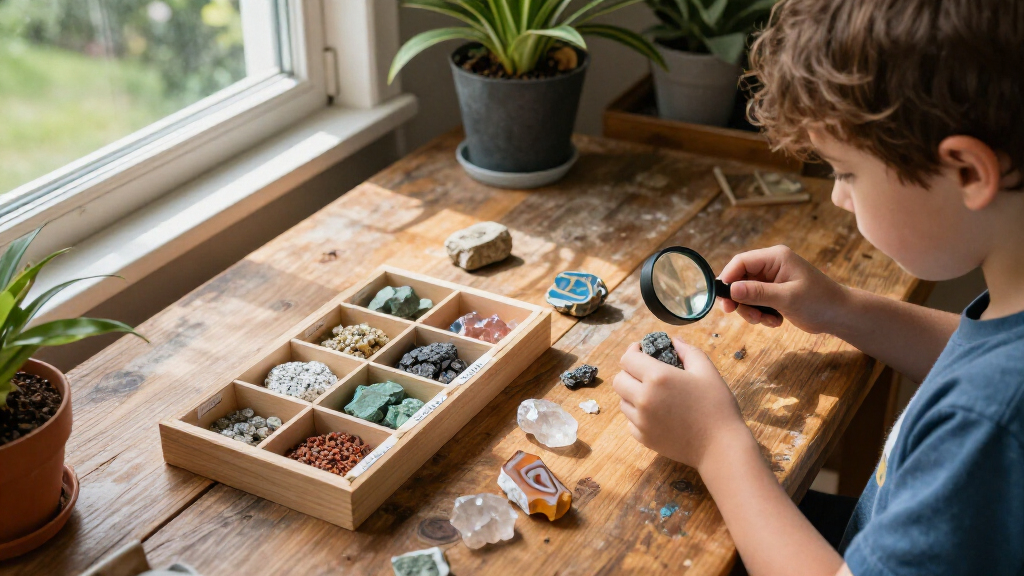
How We Picked
I compared these educational geology rock collection kits by how well their contents support learning, not simply by counting pieces. I looked at specimen variety, whether the kit includes identification or reference material, and whether its activities help explain geology or mainly provide a one-time project. I also weighed usability: age guidance, the ease of handling and organizing specimens, and whether a learner can keep using the set after the first activity.
The ranking favors kits that balance specimens, explanation, and repeat use. That puts a book-supported general collection ahead of kits centered on one activity, while large collections earn a place for breadth but do not automatically rank first if their learning support is less central. Smaller starter kits, testing-tool sets, polished stones, and geode projects each serve distinct needs; their position reflects that narrower role rather than a claim that one format is right for everyone.
Factors to Consider When Choosing Educational Geology Rock Collection Kits
Before choosing among educational geology rock collection kits, decide what the learner should be able to do after opening the box. A collection for identifying and comparing specimens has different needs from a supervised dig activity or a display set. These broader checks can help you choose a kit that gets used beyond its first afternoon.
Choose the Learning Goal Before the Specimen Count
A large assortment can invite sorting, but the number of pieces alone does not tell you whether a learner can identify them or explain how they differ. For a first geology set, prioritize clear labels, a guide, or cards that connect names to visible features. If the goal is variety for a classroom table, a larger collection may support group comparison and discussion. A common mistake is treating a high count as proof of stronger instruction. Check whether the learning material covers the actual specimens in the box, and whether it gives more than names. When the labels are weak, even an impressive-looking set can become a pile of unidentified samples.
Match the Kit to the Learner’s Age and Supervision
Age guidance is only a starting point; consider whether the learner can follow instructions, handle small specimens carefully, and work safely with any tools or break-open activities. A younger child may get more from a modest collection and an adult-led conversation than from many pieces with little guidance. Dig kits and geode projects can add excitement, but they may involve mess, force, or close supervision. Before buying, check the activity instructions and tool requirements rather than assuming the kit is ready for independent use. For a shared family activity, choose something that gives an adult a clear teaching role without requiring specialist geology knowledge. A kit that fits the household’s supervision level is more likely to be used as intended.
Decide Between Raw, Polished, and Activity-Based Specimens
Different specimen formats teach different things. Polished stones make color and pattern easy to see and can be pleasant to handle, but their finish may hide surface texture that helps with identification. Raw minerals can show natural form and rough surfaces, while fossils add a different branch of Earth science rather than another mineral example. A gem-dig kit or geode project focuses attention on discovery and process, not on building a broad reference collection. Think about what the learner wants to observe: appearance, classification, formation, or the reveal of a hidden specimen. Buying a project kit when the real goal is repeated identification practice can leave a gap once the activity ends.
Check Whether the Set Supports Repeat Use
A kit’s long-term value depends on whether it creates activities learners can repeat: sorting by hardness or appearance, matching specimens to cards, recording observations, or comparing similar samples. Testing tools can add hands-on investigation, but buyers should check what each tool measures and whether instructions explain how to use it. Some activities, especially breaking geodes or digging out stones, are naturally one-time experiences. That can be a good fit for a gift or a scheduled project, but less so for a child expecting ongoing study. Keep and organize labels from the start; loose specimens become harder to identify after they are separated from their packaging. The best match depends on whether you want a lasting study set, a memorable activity, or both.
Plan for Storage and Group Learning
Specimens need a place where pieces stay paired with their names and can be handled without getting mixed into toys or household items. Large sets take up more room and may need sorting containers, while a compact starter kit is easier to store but offers less variety for a group. If several learners will share the collection, duplicates and clear identification materials can matter more than an especially broad assortment. For a single learner, fewer specimens may make it easier to study each sample carefully. Consider where the kit will be used, how it will be packed away, and whether cards or labels can stay with each piece. A simple storage plan can protect the educational value of the collection after the first session.
Frequently Asked Questions
Is a larger rock collection better for learning than a smaller one?
Not automatically. A larger collection gives learners more specimens to sort and compare, which can be useful for group activities or building a display. A smaller set with clear names and explanations may be easier for a beginner to study closely. Check whether the included guide or cards identify the specimens and offer details beyond a label. Choose by the learner’s goal: breadth for comparison, or stronger guidance for learning a smaller set well.
Should I choose a specimen collection or a gem-dig and geode kit?
Choose a collection if the priority is ongoing identification, comparison, and reference. A gem dig or break-open geode kit is a better fit when the learner wants a hands-on reveal or a guided activity. Those projects can make geology feel tangible, but they may not provide the breadth of a general rock and mineral set. Think about what should happen after the activity: if the learner will want to keep studying, pair the project with a book-supported collection or identification materials.
Are polished stones useful for teaching geology?
They can be useful for observing color, patterns, and differences among stones, especially for learners who enjoy handling attractive specimens. Polishing can make surfaces easier to inspect visually, but it also changes the natural exterior and may conceal textures present on rough specimens. If the teaching goal is identifying minerals by natural appearance or surface features, include raw samples or a reference source as well. A polished collection works best as one part of a broader learning approach rather than a stand-in for every kind of specimen.
What should I check before buying a geology kit for a child?
Read the age guidance, then check the actual activities and contents for small pieces, tools, or steps that may need adult help. Look for clear instructions and identification support that match the child’s reading level or the amount of guidance an adult can provide. If the kit involves digging or breaking geodes, plan for the work surface, cleanup, and supervision before opening it. For a child new to geology, a collection with a simple reference guide can provide more lasting use than an activity with no follow-up material.
Do I need to buy separate storage for a rock collection kit?
It depends on how the kit packages its specimens and how often they will be handled. The most important task is keeping each sample connected to its name and any identification notes; a container that mixes everything together can undermine the learning value. If the original packaging has separate compartments or can hold the cards alongside the specimens, it may be enough. For a larger set or classroom use, labeled trays or small containers can make sorting easier, but avoid moving specimens until you have a plan to preserve their labels.
Conclusion
For the strongest all-around balance of specimens and learning support, I recommend the National Geographic Rock Collection Box with Rocks, Minerals, and Expert Book as best overall. For broad variety and comparison, choose the National Geographic 200-Specimen Collection; for a compact, organized starting point, the PIBEX 54-specimen kit is the best value-style pick. Beginners who benefit from explanations should favor a book- or card-supported collection over an activity-only kit, while learners who want a memorable project may prefer the National Geographic gem dig or break-open geodes. For a display-oriented collection, the two-pound polished stones set serves a different purpose than raw specimens. Match the choice to the learning goal first, then weigh size, guidance, and how much adult involvement the activities require.