
Educational magic trick kits for kids can build confidence, patience, and presentation skills while giving children a fun way to explore how illusions work. My best overall pick is the National Geographic Mega Magic Kit, which balances a substantial range of tricks with a recognizable learning-focused format. The Klever Kits 180+ Magic Set stands out for step-by-step video lessons, while the National Geographic Science Magic Kit suits children who want experiments alongside performance tricks. The main tradeoff is between a smaller, easier-to-learn set and a larger collection that may take more adult guidance to use well. Read on for the full breakdown, selection advice, and recommendations by age and interest.

Prime made for students and young adults
- Fast, free delivery for dorm and study essentials
- Prime Video and Amazon Music included
- Member-only deals
Key Takeaways
- National Geographic kits offer the clearest learning-focused spread: the lineup includes 45-, 75+-, 100+-, and 175+-trick options, plus a science-centered kit, so buyers can match scope to a child’s interest and attention span.
- Instruction matters as much as the trick count: Klever Kits, Nicella, and the 225+ prop kit call out video lessons or step-by-step video support, which can help children practice without relying on an adult to explain every move.
- More tricks do not automatically mean an easier start: the 208+, 225+, and 300+ trick collections promise breadth, but a younger beginner may get more from clear teaching and manageable practice than from a large count.
- Costume-led kits serve a different purpose: BLOONSY and the wand-and-costume options emphasize the magician role and presentation, while National Geographic and science-focused sets lean more toward structured learning or experiments.
- There are distinct group and science-use picks: Playkidz‘s 12-pack is designed for party favors, while the National Geographic Science Magic Kit pairs magic with experiments rather than focusing only on stage-style tricks.
| BLOONSY Magic Tricks for Kids Age 6-8, Magic Kit with Magician Costume |  | Best for Costume-Led First Performances | Number of tricks: 50+ | Suitable age: 6–8 years | Included costume pieces: Cape, hat, wand | VIEW LATEST PRICE | See Our Full Breakdown |
| Nicella Magic Kit – 208+ Magic Tricks for Kids Age 6-12, Magic Set with Manual and Video for Beginners and Kids |  | Best for a Broad Age Range and Lots of Variety | Brand: Nicella | Age range: 6–12 years | Number of tricks: 208+ | VIEW LATEST PRICE | See Our Full Breakdown |
| Magic Kit with Wand and Costume for Kids Ages 6-12 |  | Best for a Simple Costume-and-Tricks Starter | Brand: Dogern | Age range: 3–18 years listed; title specifies ages 6–12 | Number of packs: 1 | VIEW LATEST PRICE | See Our Full Breakdown |
| National Geographic Mega Magic Kit with 75+ Tricks for Kids Ages 8-12 |  | Best for Older Kids Who Want Specific Illusions | Brand: Blue Marble | Age range: 8 years and up | Number of tricks: 75+ | VIEW LATEST PRICE | See Our Full Breakdown |
| Magic Kit for Kids Age 6+ with 225+ Props, Manual, and Step-by-Step Video |  | Best for Portable, Prop-Rich Practice | Number of props: 225+ | Number of tricks: 25 | Age range: 6+ | VIEW LATEST PRICE | See Our Full Breakdown |
| National Geographic Epic Magic Kit with 175+ Tricks for Kids 8-12 | 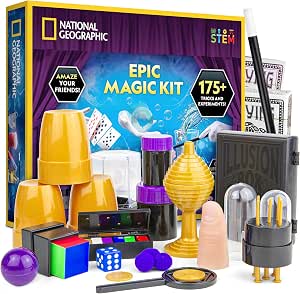 | Best for STEM Learning | Brand: Blue Marble | Age range: 8 years and up | Magic illusions: 75+ | VIEW LATEST PRICE | See Our Full Breakdown |
| Nicella Magic Kit – 300+ Magic Tricks for Kids Ages 6-12 with Video Instructions |  | Best for Trick Variety | Number of tricks: 300+ | Age range: 6–12 years | Included props: 35 magic props | VIEW LATEST PRICE | See Our Full Breakdown |
| Playkidz 12-Pack Magic Trick Set for Kids – Party Favors with Over 15 Tricks |  | Best for Group Activities | Number of packs: 12 | Tricks per kit: 15+ | Age range: 36 months–12 years | VIEW LATEST PRICE | See Our Full Breakdown |
| Klever Kits 180+ Magic Set – My First Magic Trick Kit with Step-by-Step Video Lessons for Kids Aged 6+ |  | Best Guided Starter Kit | Number of tricks: 180+ | Age range: 6 years and up | Included components: Magic cups and balls, magic wand, and illusion props | VIEW LATEST PRICE | See Our Full Breakdown |
| Marvin’s Amazing Magic Tricks Deluxe Edition – 225-Trick Kit, Ages 6+ |  | Best for Putting on a Show | Number of tricks: 225 | Age range: 6 years and up | Included props: Magic cards, mind-reading canisters, magic theatre, and magic wand | VIEW LATEST PRICE | See Our Full Breakdown |
| National Geographic Kids Magic Kit with 45 Tricks for Kids Ages 8-12 |  | Best for Guided Learning | Number of tricks: 45 | Age range: 8 years and up | Item weight: 0.44 kg | VIEW LATEST PRICE | See Our Full Breakdown |
| Kids Magic Kit with Magician Costume, Hat, Wand |  | Best for Pretend-Play Performances | Number of players: 1 | Educational objective: Educational toys | Operation mode: Manual | VIEW LATEST PRICE | See Our Full Breakdown |
| PATIFEED Magic Kit, 50+ Magic Tricks for Kids |  | Best for a High Trick Count | Brand: PATIFEED | Age range: 3 years and up | Number of tricks: 50+ | VIEW LATEST PRICE | See Our Full Breakdown |
| National Geographic Science Magic Kit with 100+ Experiments and Magic Tricks |  | Best for STEM Activities | Number of experiments: 100+ | Age range: 8 years and up | Item weight: 1.5 pounds | VIEW LATEST PRICE | See Our Full Breakdown |
| educational magic trick kits for kid | Age range | Number of tricks |
|---|---|---|
| BLOONSY Magic Tricks for Kids | — | 50+ |
| Nicella Magic Kit | 6–12 years | 208+ |
| Magic Kit with Wand and Costum | 3–18 years listed; title specifies ages 6–12 | — |
| National Geographic Mega Magic | 8 years and up | 75+ |
| Magic Kit for Kids Age 6+ with | 6+ | 25 |
| National Geographic Epic Magic | 8 years and up | — |
| Nicella Magic Kit | 6–12 years | 300+ |
| Playkidz 12-Pack Magic Trick S | 36 months–12 years | — |
| Klever Kits 180+ Magic Set | 6 years and up | 180+ |
| Marvin’s Amazing Magic Tricks | 6 years and up | 225 |
| National Geographic Kids Magic | 8 years and up | 45 |
| Kids Magic Kit with Magician C | — | — |
| PATIFEED Magic Kit | 3 years and up | 50+ |
| National Geographic Science Ma | 8 years and up | — |
More Details on Our Top Picks
BLOONSY Magic Tricks for Kids Age 6-8, Magic Kit with Magician Costume
I’d choose the BLOONSY kit for a child who wants to dress the part as well as learn tricks. Its 50-plus tricks come with a cape, hat, wand, props, step-by-step instructions, and online videos, giving young performers several ways to practice and present a small show. Compared with the Dogern Magic Kit with Wand and Costume, BLOONSY specifies a narrower age range of 6–8 and a larger stated trick count, which may make the intended audience clearer. It also offers fewer tricks than the Nicella 208+ Magic Kit, but that smaller scope may be easier for younger children to tackle. The tradeoffs are indoor-only use, adult supervision for some learners, and possible need for extra space or household items. I’d shortlist it for role-play and guided practice, not for a child seeking advanced puzzles.
Pros:- Includes more than 50 tricks with step-by-step instructions and online videos.
- Cape, hat, and wand support dress-up and performance play.
- Designed for ages 6–8, a more focused age target than broader kits such as Dogern’s.
- Activities are described as supporting problem-solving, memory, critical thinking, and hand-eye coordination.
Cons:- Some tricks may need additional space or items not included.
- Younger children may need adult supervision to learn and perform safely.
- Intended for indoor use, so it offers less flexibility than a kit suited to varied settings.
Best for: Ages 6–8 who want costume-based role-play alongside guided magic practice, with an adult available to help.
Not ideal for: Families looking for outdoor activities or a self-contained kit that never needs extra space or household items.
- Number of tricks:50+
- Suitable age:6–8 years
- Included costume pieces:Cape, hat, wand
- Learning support:Step-by-step instructions and online videos
- Educational objectives:Problem-solving, critical thinking, memory, and hand-eye coordination
- Operation mode:Manual
- Usage:Indoor
- Item weight:0.78 kg
- Item dimensions:10.5 x 8.5 x 5 inches
Our verdict“Pick BLOONSY for a 6–8-year-old who values magician dress-up and guided indoor practice more than the biggest trick count.”
Nicella Magic Kit – 208+ Magic Tricks for Kids Age 6-12, Magic Set with Manual and Video for Beginners and Kids
Nicella’s main advantage is its 208-plus stated tricks and wide 6–12 age range, making it a plausible shared kit for siblings or a child who wants plenty of material to work through. The manual and video tutorials provide more learning support than a bare prop set, while the stated focus on creativity, confidence, and social skills fits kids who want to practice for an audience. Compared with BLOONSY, Nicella offers a much larger trick count but does not list a costume, so it favors variety over show-ready dress-up. It also has a higher stated count than the National Geographic Mega Magic Kit, whose listed props include specific illusions such as cups and balls. Nicella’s tradeoff is that a large assortment may feel like too much for an absolute beginner, and some tricks may need adult help.
Pros:- Offers more than 208 stated tricks for extended practice and variety.
- Manual and video tutorials give children more than one way to learn.
- Broad 6–12 age range can suit households with children at different stages.
- The stated learning aims include creativity, confidence, and social skills.
Cons:- The large trick count may overwhelm absolute beginners.
- Some tricks may require adult supervision, particularly for younger children.
- The listed components identify a user manual but do not specify costume pieces or particular props.
Best for: Families with children ages 6–12, especially siblings who want a large variety of tricks and can share adult guidance.
Not ideal for: A first-time young learner who prefers a small, clearly staged introduction over a large assortment of tricks.
- Brand:Nicella
- Age range:6–12 years
- Number of tricks:208+
- Number of packs:1
- Included component listed:User manual
- Unit count:28
- Model number:030-25B
- ASIN:B0DCBBYF9P
Our verdict“Choose Nicella if a broad age range and a large trick selection matter more than a tightly curated beginner set or costume.”
Magic Kit with Wand and Costume for Kids Ages 6-12
This Dogern set is aimed at children who want a basic introduction to magic with costume play built in. The wand and costume make it easy to frame practice as a performance, while step-by-step visual guides give beginners a route into the tricks. Its product information also cites non-toxic materials, rounded edges, and CPC compliance, details that may matter to parents comparing children’s props. Against BLOONSY, Dogern shares the costume-led appeal but does not state a trick count, so I can’t place its volume on equal footing with BLOONSY’s 50-plus. Compared with the National Geographic Mega Magic Kit, it appears more focused on beginner-level role-play than a named collection of specific illusions. The broad stated age range is also less precise than the 6–12 description, and simple tricks may lose appeal as a child’s skill grows.
Pros:- Combines magic tricks with a wand and costume for imaginative performance play.
- Step-by-step visual guides support beginner learning.
- Product information cites non-toxic materials, rounded edges, and CPC compliance.
- The stated 6–12 audience can suit children across several elementary-school ages.
Cons:- The product details do not state how many tricks are included.
- The described tricks are basic and may become less challenging over time.
- The listed age range of 3–18 is much broader than the 6–12 title and may not give buyers a precise fit.
Best for: A beginner who wants a wand, costume, and visual guidance for putting on simple magic performances.
Not ideal for: Older children seeking a clearly specified large trick collection or more challenging material as their skills develop.
- Brand:Dogern
- Age range:3–18 years listed; title specifies ages 6–12
- Number of packs:1
- Included components:Magic kit, costume, wand
- Learning support:Step-by-step visual guides
- Model number:20TQTBMS
- Manufacturer part number:DOG-20TQTBMS
- ASIN:B0FN6Z6N87
Our verdict“Choose Dogern for a beginner who prizes costume-led imaginative play, but compare trick counts carefully if variety is a priority.”
National Geographic Mega Magic Kit with 75+ Tricks for Kids Ages 8-12
For children ready to move beyond dress-up and simple introductory tricks, this National Geographic kit offers a more defined set of performance props: cups and balls, an illusion box, a ball and vase, a mysterious coin case, and a wand. Its 75-plus tricks and professional-magician video tutorials give kids material to learn and practice, with STEM learning and creativity named as goals. Compared with Dogern’s beginner-focused costume set, this option is better suited to ages 8 and up and centers on particular illusions rather than role-play. It lists more tricks than the National Geographic Kids Magic Kit with 45 tricks, while remaining a smaller stated collection than the National Geographic Epic Magic Kit with 175-plus tricks. The tradeoffs are a narrower age fit, possible adult help for younger users, and prop durability that may vary with use.
Pros:- Includes a defined selection of props, including cups and balls, an illusion box, and a coin case.
- Offers more than 75 tricks with video tutorials from a professional magician.
- Ages 8 and up provide a clearer target than broad age-range starter kits.
- Promotes creativity, STEM learning, and performance practice.
Cons:- Some tricks may require adult supervision for younger children.
- The listed age range may not suit younger beginners or older kids seeking more complex material.
- Prop quality may vary with continued use.
Best for: Children ages 8–12 who want recognizable illusion props and video-led practice for putting together magic shows.
Not ideal for: Younger children who need a costume-centered introduction, or older learners looking for a large, advanced-feeling collection.
- Brand:Blue Marble
- Age range:8 years and up
- Number of tricks:75+
- Included components:Magic kit props, cups and balls, illusion box, ball and vase, mysterious coin case, magic wand
- Number of packs:1
- Model number:NGMAGIC75
- Manufacturer:JMW Sales, Inc.
- UPC:810070620059
Our verdict“Pick this kit for an 8–12-year-old who wants specific illusion props and guided show practice rather than costume-first play.”
Magic Kit for Kids Age 6+ with 225+ Props, Manual, and Step-by-Step Video
This kit is the clearest fit for families who want one portable box of props for practice at home or on a trip. It lists 225-plus props for 25 tricks, with an illustrated manual and step-by-step video tutorials; that distinction matters because the large prop count does not mean hundreds of separate routines. The handle-equipped storage box should make it easier to keep pieces together than a loose collection, while the 6+ age guidance opens it to younger beginners than the National Geographic Mega Magic Kit’s 8-and-up audience. Compared with Nicella’s 208-plus stated tricks, this set emphasizes props and storage rather than a much larger routine count. Its tradeoffs are beginner-level material, plastic components, and possible adult supervision for younger children.
Pros:- Includes 225+ props for 25 stated tricks.
- Illustrated manual and step-by-step videos support learning through print and demonstration.
- All-in-one box with a handle makes storage and transport easier.
- Age 6+ offers an earlier starting point than the National Geographic Mega Magic Kit.
Cons:- The 25 stated tricks are a smaller routine selection than the prop count may suggest.
- Material is listed as plastic, which may not suit buyers seeking other prop materials.
- The tricks are beginner-level, so more experienced children may want greater complexity.
Best for: Families seeking a portable, organized beginner kit for a child age 6 or older who benefits from video and illustrated instructions.
Not ideal for: Experienced young magicians looking for advanced routines, or buyers who equate a high prop count with hundreds of distinct tricks.
- Number of props:225+
- Number of tricks:25
- Age range:6+
- Includes:Manual and video tutorials
- Material:Plastic
- Storage:All-in-one box with handle
Our verdict“Choose this set for organized, portable beginner practice, not for the largest number of distinct routines or advanced magic.”
National Geographic Epic Magic Kit with 175+ Tricks for Kids 8-12
I’d choose this kit when the goal is to connect performance with science, not just collect tricks. Its mix of 75+ illusions, 100+ science experiments, and 75 video lessons gives curious kids more ways to explore how effects work than the performance-focused Nicella 300+ Magic Kit. The full-color guide and included props support hands-on practice, while magician-led videos can help children follow techniques at their own pace. That breadth also asks more of the child: some experiments need adult supervision, and the 8-and-up age guidance makes it less suited to younger beginners than Klever Kits’ 6+ set. The many activities offer variety, but a child mainly seeking polished stage routines may not use the science portion as much.
Pros:- Combines 75+ magic illusions with 100+ science experiments
- Includes 75 video lessons from a professional magician
- Tools, props, and a full-color learning guide are included
- Offers both performance practice and STEM activities
Cons:- Some experiments require adult supervision
- Its age guidance and trick difficulty may challenge younger children
- The large activity count may be less useful to children focused only on stage magic
Best for: Families with children aged 8 and up who want magic practice paired with hands-on physics and chemistry activities.
Not ideal for: Younger children or families seeking a simple, performance-only starter kit with minimal adult involvement.
- Brand:Blue Marble
- Age range:8 years and up
- Magic illusions:75+
- Science experiments:100+
- Video lessons:75
- Included components:Tools, props, and full-color learning guide
- Dimensions:14.75 x 3 x 12 inches
- Weight:3.4 pounds
Our verdict“Choose this for an older child who wants science activities alongside magic, rather than a kit focused mainly on performing tricks.”
Nicella Magic Kit – 300+ Magic Tricks for Kids Ages 6-12 with Video Instructions
Nicella puts sheer variety ahead of a defined STEM curriculum: it lists 300+ tricks and 35 props, plus video instructions, for children aged 6–12. That makes it a better fit for a child who wants a broad menu of beginner illusions than Playkidz, which supplies 12 small kits for sharing but offers less detailed instruction. Video guidance can help a new performer learn without relying entirely on the manual, and the stated smooth, polished edges are a practical point for younger users. The tradeoff is that the activities are described as basic, so the large trick count shouldn’t be read as advanced material. Compared with the National Geographic Epic Magic Kit, Nicella offers more stated tricks but lacks its explicit science-experiment component.
Pros:- Lists more than 300 beginner tricks
- Includes 35 magic props and a user manual
- Video tutorials provide additional learning guidance
- Stated age range covers children from 6 to 12
Cons:- Tricks are described as basic rather than advanced
- Some activities may need adult supervision for younger children
- Does not list a dedicated science-experiment program
Best for: Families with children aged 6–12 who want many beginner tricks and video guidance for home practice.
Not ideal for: Children seeking science experiments or experienced young performers looking for more advanced routines.
- Number of tricks:300+
- Age range:6–12 years
- Included props:35 magic props
- Instructions:User manual and video tutorials
- Model number:030-48B
- Manufacturer:SHANTOU CITY CHENGHAI XINGKUN TOY FACTORY
Our verdict“Pick Nicella for a wide selection of beginner illusions with video instruction, but choose the National Geographic Epic kit for magic tied to science learning.”
Playkidz 12-Pack Magic Trick Set for Kids – Party Favors with Over 15 Tricks
Playkidz is the group-oriented choice here: it supplies 12 portable kits, each with over 15 tricks, so several children can try performing instead of waiting to share one set. That makes it more practical for parties or classroom-style role-play than Marvin’s Amazing Magic Tricks Deluxe Edition, which is organized around one child learning a larger collection. The tradeoff is educational depth. The listing mentions coordination, confidence, and role-play, but also notes that instructions for some tricks are limited; it does not offer the structured video lessons found in Klever Kits. Its broad stated age range begins at 36 months, yet younger children may still need an adult to guide activities. The paper material and compact, portable format suit group distribution better than long-term, in-depth practice.
Pros:- Includes 12 separate kits for sharing with a group
- Each kit contains over 15 tricks
- Portable format suits parties and travel activities
- Magic role-play can encourage coordination and confidence
Cons:- Instructions are limited for some tricks
- Paper is the listed material, which may not suit repeated rough handling
- Some tricks may require adult supervision for younger children
Best for: Parents, teachers, and party hosts who want separate, portable magic sets for a group of children.
Not ideal for: A child who wants detailed step-by-step teaching, a large progression of skills, or a single durable kit for sustained practice.
- Number of packs:12
- Tricks per kit:15+
- Age range:36 months–12 years
- Material:Paper
- Weight:0.67 kg
Our verdict“Choose Playkidz for group participation and party use; choose Klever Kits if one child needs more guided skill practice.”
Klever Kits 180+ Magic Set – My First Magic Trick Kit with Step-by-Step Video Lessons for Kids Aged 6+
Klever Kits makes the most sense for a beginner who benefits from a clear lesson path: its step-by-step video tutorials accompany 180+ tricks and familiar props such as cups, balls, a wand, and illusion cards. The age guidance starts at 6, giving it a younger entry point than National Geographic’s Epic Magic Kit, which is aimed at ages 8 and up and adds science experiments. Compared with Nicella’s larger stated trick count, Klever presents itself more directly as a first kit, with instruction at the center rather than volume alone. Its limits are the basic prop range and plastic construction, which may be less durable than a child wants for repeated shows. It suits learning foundational routines, not progressing into complex sleight of hand.
Pros:- Step-by-step video tutorials support independent practice
- Offers 180+ tricks for beginner exploration
- Includes recognizable starter props such as cups, balls, and a wand
- Compact listed dimensions make it easy to store
Cons:- Plastic props may be less durable with frequent use
- The prop selection is focused on basic magic
- Some tricks may need adult supervision for younger children
Best for: First-time magicians aged 6 and up who learn best by following short, step-by-step video demonstrations.
Not ideal for: Children seeking advanced sleight-of-hand routines, science activities, or props intended for heavy long-term use.
- Number of tricks:180+
- Age range:6 years and up
- Included components:Magic cups and balls, magic wand, and illusion props
- Material:Plastic
- Dimensions:5 x 2 x 7 inches
- Manufacturer:JOVA US INC
- UPC:840332675893
Our verdict“Choose Klever Kits for a young beginner who needs guided lessons, not for a child ready for advanced tricks or science-based activities.”
Marvin’s Amazing Magic Tricks Deluxe Edition – 225-Trick Kit, Ages 6+
Marvin’s is the show-oriented option: its magic theatre, wand, cards, and mind-reading canisters give a child props for building a performance, while picture guides and app videos offer more than one way to learn. At 225 tricks, it sits between Klever Kits’ 180+ and Nicella’s 300+, but the included theatre makes the set feel more geared to presenting routines than simply working through a trick list. That distinction matters for a child who enjoys rehearsing for family. The main drawback is access: app videos require a compatible device, unlike a printed guide that works on its own. The product data also gives little detail about prop durability, and younger children may need adult help. It offers less explicit STEM learning than National Geographic’s Epic kit.
Pros:- Includes a magic theatre suited to performing routines
- Provides 225 tricks with picture guides and app videos
- Beginners can use step-by-step instruction
- Combines several performance props, including cards and a wand
Cons:- App videos require access to a device
- Prop durability is not specified in the supplied product details
- Some tricks may require adult supervision for younger children
Best for: Children aged 6 and up who want props and visual instructions for rehearsing a home magic show.
Not ideal for: Families avoiding app-based instruction, children who want science experiments, or buyers who need clear durability details.
- Number of tricks:225
- Age range:6 years and up
- Included props:Magic cards, mind-reading canisters, magic theatre, and magic wand
- Learning materials:App videos and picture guide
Our verdict“Choose Marvin’s for a beginner who wants to build a show around included props, and choose the National Geographic Epic kit for stronger science-learning content.”
National Geographic Kids Magic Kit with 45 Tricks for Kids Ages 8-12
For kids who want to learn how tricks work as well as perform them, this 45-trick kit pairs props with video instruction from a professional magician. That guided format gives it a clearer learning focus than the PATIFEED Magic Kit, which offers more tricks but relies on an illustrated manual. Its stated emphasis on creativity and STEM learning also suits older children ready to practice presentation and sleight of hand, rather than just try a trick once. The tradeoff is a smaller trick count than the National Geographic Science Magic Kit, which adds experiments alongside magic. Some routines may take repeated practice, and younger users may need adult help. I’d choose this for an 8-to-12-year-old who values instruction over sheer quantity.
Pros:- Includes props and video instruction from a professional magician
- Offers 45 tricks for continued practice
- Designed to encourage creativity, performance skills, and STEM learning
- Age guidance suits school-age children ready to work on sleight of hand
Cons:- Some tricks may take practice before children can perform them smoothly
- Younger users may need adult supervision
- Offers fewer activities than the National Geographic Science Magic Kit
Best for: Children ages 8–12 who want video-led instruction and practice with classic magic and sleight of hand
Not ideal for: Younger beginners who need very simple, quick tricks or families seeking science experiments alongside magic
- Number of tricks:45
- Age range:8 years and up
- Item weight:0.44 kg
- Item dimensions:7.24 x 2.37 x 10 inches
- Materials:Fabric, paper, and plastic
- Operation:Manual
- Theme:Magic
Our verdict“Choose this for a school-age child who benefits from video guidance and wants to build performance skills through practice.”
Kids Magic Kit with Magician Costume, Hat, Wand
This set makes the performance part of magic play tangible: children get a costume, hat, wand, and props, plus illustrated instructions for learning tricks. Compared with the National Geographic Kids Magic Kit, it places less emphasis on video-led skill building and more on dressing up and putting on a show. Its broad stated age range of 3 to 12 may appeal to families shopping for a young child who wants to feel like a magician, though that range does not mean every trick will suit every age. The main tradeoff is its solo-play format; a parent or sibling may need to join in to make performances more social. Kids who mainly want a large collection of tricks may get more mileage from the PATIFEED Magic Kit.
Pros:- Includes a magician costume, hat, wand, and props for role-play
- Illustrated instructions support learning without relying on video
- Encourages creativity and confidence through performance
- Manual operation requires no power source
Cons:- Solo-play design may call for an adult or sibling to join in
- Children may outgrow the costume-and-pretend-play appeal
- The product details do not specify a trick count
Best for: Families with a young child who enjoys costumes, role-play, and performing simple tricks for an audience
Not ideal for: Children focused on learning a large variety of tricks or families seeking a kit designed for group play
- Number of players:1
- Educational objective:Educational toys
- Operation mode:Manual
- Style theme:Promoting creativity and entertainment
- Color:Red
- Material:Plastic
- Item weight:0.9 kg
- Item dimensions:10.24 x 7.87 x 5.31 inches
Our verdict“Pick this for a child whose first priority is dressing up and performing, not maximizing the number of tricks to learn.”
PATIFEED Magic Kit, 50+ Magic Tricks for Kids
When a beginner wants plenty of routines to explore, the PATIFEED kit’s 50-plus tricks make it a strong choice. It includes props and an illustrated manual, so children can work through activities without needing video access. That makes it a simpler, more budget-conscious-in-spirit format than the National Geographic Kids Magic Kit, whose professional video guidance may better support children who need demonstrations. PATIFEED’s stated age range starts at 3, but younger children may still need adult supervision, and the broad age guidance does not guarantee every trick is easy for a preschooler. The main compromise is the plastic construction, which may feel less durable than a kit with sturdier materials. I’d favor it for variety and accessible instructions over polished performance coaching.
Pros:- Includes more than 50 tricks for variety
- Illustrated instruction manual helps children follow along
- Props are included for hands-on practice
- Designed to encourage creativity and confidence
Cons:- Plastic materials may feel less durable
- Younger children may need adult supervision
- Does not list video instruction as part of the kit
Best for: Families seeking a large assortment of beginner tricks with printed, illustrated guidance for children
Not ideal for: Buyers who prioritize durable-feeling materials or professional video demonstrations for learning each trick
- Brand:PATIFEED
- Age range:3 years and up
- Number of tricks:50+
- Item weight:0.47 kg
- Item dimensions:8.66 x 6.3 x 2.95 inches
- Material:Plastic
Our verdict“Choose PATIFEED when trick variety and illustrated instructions matter more than video coaching or a sturdier material feel.”
National Geographic Science Magic Kit with 100+ Experiments and Magic Tricks
This kit is the clearest pick for a child who wants magic tied to hands-on science: it combines 100-plus experiments and tricks with a stated focus on STEM learning. That gives it a broader educational direction than the National Geographic Kids Magic Kit, which centers on classic illusions and sleight of hand with video lessons. The larger activity mix can keep a curious child occupied beyond rehearsing stage routines, though it may be less suited to someone who only wants conventional magic props and performance practice. Some experiments require adult supervision, so the activity count does not translate into fully independent play. Its manual operation avoids batteries, but the supplied details do not list individual experiments or the materials required for each one. I’d choose it for curious kids who enjoy learning through activities, not just performing tricks.
Pros:- Combines more than 100 experiments and magic tricks
- Connects hands-on activities with STEM learning
- Designed for children ages 8 and up
- Manual operation means no batteries are required
Cons:- Some experiments require adult supervision
- The product details do not identify individual activities or their material needs
- Less focused on classic sleight-of-hand instruction than the National Geographic Kids Magic Kit
Best for: Children ages 8 and up who enjoy science activities and want experiments mixed with magic tricks
Not ideal for: Kids seeking a straightforward stage-magic set with a costume, or families wanting activities suitable for unsupervised younger children
- Number of experiments:100+
- Age range:8 years and up
- Item weight:1.5 pounds
- Item dimensions:8.86 x 3.15 x 12 inches
- Materials:Metal and paper
Our verdict“Choose this for a curious child who wants science experiments alongside magic, rather than a kit focused mainly on stage tricks.”

How We Picked
I compared these kits through the needs of a child learning magic, rather than ranking them by the largest advertised trick count. The main criteria were the apparent ease of getting started, the presence of written or video instruction, the range of activities, age fit, and whether the kit supports repeated practice or a clear purpose such as performance, party sharing, or science exploration. I also considered whether a costume or extra props add useful engagement or mainly add bulk.
The ranking favors kits that appear to pair a usable learning path with enough variety to hold a child’s interest. Instruction-rich sets and the National Geographic options rank strongly because their formats suggest a more guided experience; the science kit earns a distinct place for connecting tricks to experiments. Large-count kits can offer variety, but count alone does not establish how easy each trick is to learn. Costume-focused sets and party favors remain useful for specific needs, though they are less broadly suited to a child seeking structured, ongoing learning.
Factors to Consider When Choosing Educational Magic Trick Kits For Kids
Before choosing a kit, I would match its teaching style and intended use to the child, not just compare the number of tricks on the box. These broader checks can help avoid a set that looks exciting but proves hard to learn, awkward to share, or poorly matched to the child’s interests.
Choose instruction that fits the child’s learning style
A child who likes to work independently may benefit from clear video lessons, while another may prefer written steps they can revisit at their own pace. Check whether instructions explain setup, practice, and presentation, not only the secret method. A high trick count can feel overwhelming if the teaching is brief or difficult to follow. Younger children may need an adult nearby even when videos are included. If the child gets frustrated easily, prioritize a guided learning path over a long list of tricks.
Match the kit’s scope to attention and practice time
Large collections make sense for a child who enjoys practicing different effects over time, but they can be a poor fit when the goal is to learn a few tricks for an upcoming event. A compact set may help a beginner build confidence by mastering a small group before adding more. Ask whether the child tends to revisit activities or move quickly from one new thing to another. The advertised total may combine many small effects, so it does not tell you how much setup or rehearsal each one needs. Choose for the kind of play the child will actually sustain.
Look for learning beyond the reveal
Magic practice can involve sequencing, fine motor control, memory, storytelling, and speaking to an audience, but the kit may not teach all of those skills directly. If educational value is the priority, look for instructions that encourage practice, explanation, or experimentation rather than presenting each effect as a secret to copy. A science-oriented kit is a better fit for a child curious about cause and effect than a costume-led set. Parents can add learning by asking the child to explain the steps or invent a short routine. Avoid assuming that a larger kit automatically delivers more educational depth.
Decide whether performance gear will get used
A hat, cape, or wand can make a first performance feel special and may help a child step into the role of magician. Those extras matter less to a child who prefers figuring out how an effect works or practicing privately. Costumes can also take up storage space and may not suit every family’s play style. Think about whether the child enjoys performing for relatives, classmates, or friends before choosing a role-play-focused set. For a shared event, a kit designed for multiple recipients may be more practical than one costume-centered box.
Plan for adult help, storage, and repeat use
Some tricks may require careful setup, small parts, or practice that a child cannot manage alone, so consider the adult time available at home. Video instruction can reduce repeated explanations, but it does not guarantee that every effect is self-guided. Check how props can be kept together between sessions; scattered pieces can make a broad kit less inviting to use again. If the kit is meant for travel or a party, portability and easy distribution may matter more than the depth of its lessons. A set that fits the household routine is more likely to become a lasting activity rather than a one-day novelty.
Treat age ranges as a starting point, not a guarantee
Two children of the same age can differ widely in reading confidence, dexterity, patience, and comfort performing. Use the listed age guidance alongside the child’s ability to follow multi-step directions and handle small props. For a younger learner, simpler instructions and adult participation may matter more than a kit’s upper age limit. Older beginners can still enjoy introductory sets if they want an easy entry into magic, while an experienced child may need greater variety. When in doubt, choose the kit with the clearest teaching support rather than the one that appears most advanced.
Frequently Asked Questions
Is a kit with 200 or more tricks a better choice for a first-time learner?
Not by itself. A large collection can offer more variety, but a first-time learner may benefit more from clear instructions and a manageable first set of effects. Look for whether the kit includes video or step-by-step guidance, then consider how much time the child is likely to spend practicing. If the child enjoys mastering skills gradually, a smaller guided kit may be a better start. A high-count set is more appealing when the child already likes exploring many different activities.
Should I choose a costume kit or one focused on tricks and lessons?
Choose a costume-led set if dressing up and performing are part of the appeal for the child. A lesson-focused kit is often a stronger match when the child wants to learn how effects work and practice at their own pace. Costume pieces can encourage imaginative play, but they do not replace clear teaching or a suitable range of tricks. If you are unsure, consider what the child does with other toys: role-play fans may enjoy the costume, while puzzle-minded children may prefer guided tricks. Some families may value both, but the child’s main interest should guide the choice.
Which type of magic kit is best when an adult cannot help much?
Look for a kit that specifically includes step-by-step video or similarly clear instruction, such as the video-supported options in this roundup. Video can let a child replay a demonstration instead of needing an adult to repeat every step. Still, the presence of a video does not prove that all tricks are easy to set up independently. Consider the child’s reading, coordination, and patience, and be ready to help with the first session. A smaller number of well-explained tricks may be more practical than a much larger collection.
Is the science-focused kit a good substitute for a regular magic set?
It can be a good choice for a child who wants magic connected to experiments and explanations, rather than only stage-style effects. The National Geographic Science Magic Kit is the clearest match in this lineup for that interest. A child mainly seeking costume play or a broad collection of performance tricks may prefer one of the other kits. Before deciding, check whether the child is more motivated by demonstrations, scientific ideas, or presenting tricks to an audience. The best fit depends on which part of magic keeps the child curious.
What should I pick for a birthday party or a group of children?
The Playkidz 12-pack is designed as a party-favor option, which gives it a different purpose from the individual learning kits. It may make distribution simpler when several children should each receive a small magic activity. For a single child who wants ongoing instruction and a wider practice path, a guided kit is likely a better match. Consider whether the goal is a shared party moment or a lasting hobby before choosing. A group activity may also need adult help to demonstrate tricks and keep pieces organized.
Conclusion
For the broadest fit, I recommend the National Geographic Mega Magic Kit as the best overall pick, with a substantial trick selection and a learning-oriented brand format. For beginners who benefit from guided practice, the Klever Kits 180+ Magic Set stands out for its step-by-step video lessons. Buyers seeking a wide collection can compare the Nicella 208+ and 300+ kits with the 225+ prop kit, choosing based on the instruction format and the child’s appetite for variety rather than count alone. For a premium-feeling science and magic activity, choose the National Geographic Science Magic Kit; for party favors, pick Playkidz; and for children motivated by dressing up, consider BLOONSY or a wand-and-costume set. The best choice is the one whose teaching style and purpose match how the child wants to play.
Halloween Picks
halloween
As an affiliate, we earn on qualifying purchases.