

For students who need a microscope kit for real slide work, I’d start with the AmScope M162C-2L-PB10-WM as the best overall pick: its 40X–1000X range suits a wide range of school specimens. The AmScope M150C is a simpler cordless option, while the Herwicm binocular model stands out for students who want two-eye viewing and a mechanical stage. The main tradeoffs are hands-on optics versus a digital screen, and a useful learning kit versus a large accessory bundle that may see little use. Read on for how the 15 options compare and which one fits your student’s age, workspace, and science goals.

Prime made for students and young adults
- Fast, free delivery for dorm and study essentials
- Prime Video and Amazon Music included
- Member-only deals
Key Takeaways
- AmScope M162C-2L-PB10-WM leads as the all-around choice: its 40X–1000X range and kit format make it a stronger fit for varied student slide work than toys focused mainly on starter accessories.
- Binocular viewing and a mechanical stage are purposeful upgrades: the Herwicm and Woehrsh trinocular models add control and viewing flexibility, but make more sense for students ready for careful specimen work.
- Magnification claims do not tell the whole story: a high stated maximum, such as 2000X or 5000X, matters less than usable optics, focusing control, and well-prepared slides.
- Digital viewing serves a different learning style: the OOZSTAR’s built-in display and camera suit shared viewing and image capture, while conventional compound scopes keep attention on direct eyepiece observation.
- Kids’ kits vary most in learning materials and complexity: National Geographic, Emarth, AmScope M30, and the slide-bundle kits emphasize starting activities, while adult-oriented models prioritize microscope controls and specimen viewing.
| AmScope M162C-2L-PB10-WM Compound Microscope Kit, 40X–1000X |  | Best for Structured Student Work | Microscope type: Compound | Magnification: 40X–1000X | Frame: Metal | VIEW LATEST PRICE | See Our Full Breakdown |
| Woehrsh Compound Microscope with WF10x and WF25x Eyepieces |  | Best for Flexible Specimen Viewing | Objective magnifications: 4x, 10x, 40x | Eyepieces: WF10x and WF25x | Listed magnification settings: 40x, 100x, 250x, 400x, 2000x | VIEW LATEST PRICE | See Our Full Breakdown |
| Herwicm Binocular Compound Microscope, 40X–2500X, with Dual LED Lighting and Mechanical Stage | 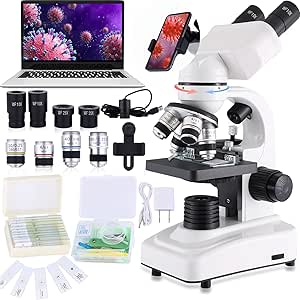 | Best for Binocular Viewing | Magnification: Advertised 40X–2500X; product specifications also state 40X | Eyepieces: WF10x and WF25x | Objective lenses: 4X, 10X, 40X | VIEW LATEST PRICE | See Our Full Breakdown |
| Compound Microscope Kit with 100X–2000X Magnification |  | Best for Phone-Assisted Lessons | Listed magnification settings: 100X, 200X, 250X, 500X, 1000X, 2000X | Eyepiece: WF25X | Objective lenses: 4X, 10X, 40X | VIEW LATEST PRICE | See Our Full Breakdown |
| Uarzt Kids Beginner Microscope Science Kit, 100x–1200x |  | Best for First-Time Student Microscopists | Magnification: 100x, 400x, 1200x | Eyepiece diameter: 18 mm | Lighting: Adjustable LED | VIEW LATEST PRICE | See Our Full Breakdown |
| PalliPartners Compound Microscope for Adults and Students, White |  | Best for Slide-Based Study and Phone Capture | Magnification: 100X–2000X | Objective lenses: 4X, 10X, and 40X | Eyepiece: WF25X | VIEW LATEST PRICE | See Our Full Breakdown |
| National Geographic Dual LED Microscope Science Kit for Kids Ages 8–12 |  | Best First Microscope for Younger Students | Magnification: 20X and 50X | Illumination: Dual LED | Prepared slides: 10 | VIEW LATEST PRICE | See Our Full Breakdown |
| OOZSTAR Digital Microscope with 4.3-Inch Display and 5 MP Camera |  | Best for Screen-Based Viewing | Display: 4.3-inch | Camera: 5 MP | Maximum magnification: 2500x, with listed settings of 100x, 200x, 250x, 500x, 1000x, and 2000x | VIEW LATEST PRICE | See Our Full Breakdown |
| Mileonaim Kids Microscope Kit with Prepared and Blank Slides |  | Best Portable Hands-On Kit | Magnification: 100X, 400X, and 1200X | Set size: 61 pieces | Prepared slides: 12 | VIEW LATEST PRICE | See Our Full Breakdown |
| Wevision M2 Compound Monocular Microscope, 40×–2000× |  | Best for a More Durable Student Setup | Microscope type: Compound monocular | Magnification: 40×–2000× | Eyepieces: 10× and 25× | VIEW LATEST PRICE | See Our Full Breakdown |
| AmScope M150C Compound Biological Microscope, 40X–1000X, Cordless LED |  | Best for Cordless Classroom Use | Microscope type: Compound biological, monocular | Magnification: 40X, 100X, 250X, 400X, 1000X | Illumination: LED | VIEW LATEST PRICE | See Our Full Breakdown |
| Emarth Compound Microscope for Kids and Beginners, 40x–1000x, 52-Piece Kit |  | Best for Exploring Mixed Specimens | Model: 1405 | Magnification: 40x–1000x | Kit contents: 52 pieces | VIEW LATEST PRICE | See Our Full Breakdown |
| AmScope M30-ABS-KT2-W Beginner Microscope STEM Kit, White |  | Best for Guided Starter Activities | Type: Compound microscope | Magnification: 300x, 600x, 1200x | Viewing head: Monocular | VIEW LATEST PRICE | See Our Full Breakdown |
| 58-Piece Kids Microscope Kit with 100X–1200X Magnification |  | Best for Ready-Made Slide Practice | Brand: Uarzt | Kit size: 58 pieces | Magnification: 100X–1200X | VIEW LATEST PRICE | See Our Full Breakdown |
| Woehrsh Trinocular Compound Microscope, 40X–5000X, with Mechanical Stage and USB Camera |  | Best for Shared Teaching and Digital Viewing | Model: RM | Magnification: 40X–5000X | Eyepieces: 2 WF10x and 2 WF25x | VIEW LATEST PRICE | See Our Full Breakdown |
| microscope kits for student | Magnification |
|---|---|
| AmScope M162C-2L-PB10-WM Compo | 40X–1000X |
| Woehrsh Compound Microscope wi | — |
| Herwicm Binocular Compound Mic | Advertised 40X–2500X; product specifications also state 40X |
| Compound Microscope Kit with 1 | — |
| Uarzt Kids Beginner Microscope | 100x, 400x, 1200x |
| PalliPartners Compound Microsc | 100X–2000X |
| National Geographic Dual LED M | 20X and 50X |
| OOZSTAR Digital Microscope wit | — |
| Mileonaim Kids Microscope Kit | 100X, 400X, and 1200X |
| Wevision M2 Compound Monocular | 40×–2000× |
| AmScope M150C Compound Biologi | 40X, 100X, 250X, 400X, 1000X |
| Emarth Compound Microscope for | 40x–1000x |
| AmScope M30-ABS-KT2-W Beginner | 300x, 600x, 1200x |
| 58-Piece Kids Microscope Kit w | 100X–1200X |
| Woehrsh Trinocular Compound Mi | 40X–5000X |
More Details on Our Top Picks
AmScope M162C-2L-PB10-WM Compound Microscope Kit, 40X–1000X
The AmScope M162C-2L-PB10-WM suits students who need more control over specimen positioning than a basic starter microscope provides. Its dual-layer mechanical stage with coaxial X-Y controls lets students move a slide precisely while viewing it, a practical advantage for repeated observations and classroom exercises. The all-metal frame and included slides, tools, case, and microscope book make this a more study-oriented package than the Uarzt Kids Beginner Microscope Science Kit, which puts more emphasis on ready-to-use learning materials. Its 40X–1000X range is ample for many student samples, but it does not reach the higher stated maximums of the Herwicm or Woehrsh models. The main tradeoff is that camera use requires a separately purchased compatible AmScope camera, and the listed 220-volt supply may not suit every setup.
Pros:- Mechanical stage with coaxial X-Y controls supports precise slide positioning.
- All-metal frame is suited to regular student use.
- LED illumination provides built-in lighting.
- Includes slides, specimen tools, a carrying case, and a microscope book.
Cons:- Compatible digital camera is optional rather than included.
- The 40X–1000X range is lower than the stated maximum magnification of the Herwicm and Woehrsh models.
- The listed 220-volt requirement may limit compatibility with some power setups.
Best for: Students who will regularly examine prepared slides and want precise stage movement plus a durable metal frame.
Not ideal for: Beginners who want a camera included or who need a microscope with a power supply matched to a different voltage.
- Microscope type:Compound
- Magnification:40X–1000X
- Frame:Metal
- Light source:LED
- Stage:Dual-layer mechanical stage with coaxial X-Y controls
- Real angle of view:45 degrees
- Included items:Slides, specimen tools, carrying case, microscope book
- Camera compatibility:Optional AmScope digital cameras
- Warranty:5 years
Our verdict“Choose the AmScope if careful slide movement and a sturdier study setup matter more than higher stated magnification or an included digital camera.”
Woehrsh Compound Microscope with WF10x and WF25x Eyepieces
The Woehrsh is the most flexible pick here for students who want to switch between translucent and opaque samples. Dual LED illumination supplies light from above and below, while the 360-degree swivel head can make shared viewing easier in a group. Its WF10x and WF25x eyepieces combine with 4x, 10x, and 40x objectives for listed settings from 40x to 2000x. That makes it a broader stated range than the AmScope M162C-2L-PB10-WM, though the AmScope offers a more clearly specified mechanical stage for precise slide movement. Woehrsh also includes student lab accessories and coaxial coarse and fine focus. The tradeoff is specification uncertainty: the product description’s maximum does not match its listed settings, and the beginner-focused package may not meet the needs of advanced coursework. Its one-year warranty is shorter than the AmScope’s stated five years.
Pros:- Dual LED illumination supports viewing both opaque and translucent specimens.
- WF10x and WF25x eyepieces provide multiple listed magnification settings.
- Coaxial coarse and fine focus offers separate speed and precision adjustments.
- 360-degree swivel head and included lab accessories suit beginner group use.
Cons:- The stated maximum magnification is inconsistent across the product information.
- The one-year warranty is shorter than the AmScope M162C-2L-PB10-WM’s stated five-year warranty.
- The beginner-oriented design may not satisfy advanced students seeking specialized features.
Best for: Beginners or student groups who want top-and-bottom lighting, multiple eyepiece choices, and a swivel head for shared viewing.
Not ideal for: Advanced students who need a clearly documented magnification range, a longer stated warranty, or more specialized equipment.
- Objective magnifications:4x, 10x, 40x
- Eyepieces:WF10x and WF25x
- Listed magnification settings:40x, 100x, 250x, 400x, 2000x
- Lighting:Dual LED illumination
- Focusing:Coaxial coarse and fine focusing
- Power source:Electric; two power supply options
- Dimensions:7 x 6 x 10 inches
- Weight:3.5 lb
- Warranty:1 year
Our verdict“Pick the Woehrsh for beginner-friendly, two-sided lighting and flexible viewing, but choose a more clearly specified model for advanced study.”
Herwicm Binocular Compound Microscope, 40X–2500X, with Dual LED Lighting and Mechanical Stage
The Herwicm stands apart from the monocular options in this group by offering binocular viewing, which may feel more comfortable during longer student sessions. Its two eyepiece options, upper and lower LED lights, and mechanical stage give learners several ways to adapt the view to a sample. Compared with the Woehrsh Compound Microscope, it also lists a mechanical stage with a moving scale, while both models provide dual lighting and coarse and fine focus. The advertised 40X–2500X range is broad, but the product data conflict: a separate specification states 40X as the maximum. I would treat the range cautiously rather than make a purchase decision around the 2500X claim. The corded power requirement also limits where it can be used, and its mix of metal and plastic parts is less uniformly robust than the AmScope’s all-metal frame.
Pros:- Binocular design offers two eyepieces for viewing.
- Upper and lower LED lights accommodate different specimen types.
- Mechanical stage with a spiral moving scale supports adjustable specimen positioning.
- Coaxial coarse and fine focus provides separate focusing adjustments.
Cons:- The advertised 40X–2500X range conflicts with a specification listing 40X as the maximum.
- Requires corded electric power.
- The body and stage combine metal and plastic rather than using an all-metal construction.
Best for: Students and hobbyists who prefer binocular viewing and want a mechanical stage with upper and lower illumination.
Not ideal for: Buyers who need a dependable, consistent maximum-magnification specification or a portable, battery-powered setup.
- Magnification:Advertised 40X–2500X; product specifications also state 40X
- Eyepieces:WF10x and WF25x
- Objective lenses:4X, 10X, 40X
- Lighting:Dual LED, upper and lower
- Stage:Two-layer mechanical stage with spiral moving scale
- Focus:Coaxial coarse and fine focus
- Power:Corded electric, 240 volts
- Dimensions:14.37 × 11.41 × 6.49 inches
- Materials:Glass lenses; metal and plastic body and stage
Our verdict“Choose the Herwicm if binocular viewing and a mechanical stage are priorities, but avoid relying on its stated maximum magnification until the discrepancy is clarified.”
Compound Microscope Kit with 100X–2000X Magnification
This kit is the clearest fit for students who want to document observations with a phone: it includes a cell phone adapter, alongside prepared and blank slides and an 11-piece experiment kit. Its adjustable top and bottom LEDs also let students change how a sample is lit, a useful contrast with the Uarzt Kids Beginner Microscope Science Kit, which includes a learning guide and more slides but does not list a phone adapter. The metal frame and six listed settings up to 2000X give this model a more equipment-focused feel than the Uarzt’s simple three-level setup. Still, the magnification details are inconsistent, so I would not choose it solely for the highest setting. It can run from the included AC adapter or three AA batteries, but the batteries are not included, and the product data do not specify a stage or focusing controls.
Pros:- Includes a cell phone adapter for recording microscope views.
- Adjustable top and bottom LED lighting supports different specimen types.
- Package includes prepared and blank slides plus an 11-piece beginner experiment kit.
- Metal frame and included AC adapter provide a ready-to-power setup.
Cons:- Product descriptions contain inconsistent magnification information.
- Three AA batteries are required for battery operation and are not included.
- Stage and focusing-control details are not provided in the supplied specifications.
Best for: Students who want to photograph observations with a phone and use a mix of prepared and blank slides at home or in class.
Not ideal for: Buyers who need a clearly documented magnification range, detailed stage controls, or battery operation without purchasing batteries separately.
- Listed magnification settings:100X, 200X, 250X, 500X, 1000X, 2000X
- Eyepiece:WF25X
- Objective lenses:4X, 10X, 40X
- Lighting:Adjustable top incident and bottom transmitted dual LED
- Frame:Metal
- Power:Included AC adapter or 3 AA batteries (not included)
- Included accessories:Cell phone adapter, beginner experiment kit with 11 pieces, instructions
Our verdict“Choose this kit for phone-assisted student observations and included experiments, not if you need consistent magnification details or a fully specified control setup.”
Uarzt Kids Beginner Microscope Science Kit, 100x–1200x
The Uarzt is the easiest match for a student taking first steps with slide preparation. Its 13 prepared slides offer immediate examples, while 31 blank slides and a guide with specimen information and slide-making instructions give learners a path from observing to preparing samples themselves. That makes the kit more explicitly instructional than the phone-adapter Compound Microscope Kit, which adds a way to capture views but lists fewer details about teaching materials. The Uarzt keeps the magnification choices simple—100x, 400x, and 1200x—and includes an adjustable LED light. That straightforward range may be less appealing than the broader stated settings on the Woehrsh or Herwicm models, and the supplied data do not specify focusing controls, stage design, or frame material. Its ABS case material also gives less evidence of a study-ready metal build.
Pros:- Includes 13 prepared slides for immediate guided observation.
- Provides 31 blank slides for practicing specimen preparation.
- Learning guide includes specimen information and slide-making instructions.
- Adjustable LED light lets users change illumination.
Cons:- Offers only three listed magnification settings, fewer than the Woehrsh and Herwicm models.
- The supplied product data do not specify stage design or focusing controls.
- ABS case material does not establish the same metal-frame construction listed for the AmScope and other models.
Best for: Children or first-time student users who want prepared examples, blank slides, and guidance for making their own specimens.
Not ideal for: Students who need documented stage and focus controls, a metal frame, or a broader selection of magnification settings.
- Magnification:100x, 400x, 1200x
- Eyepiece diameter:18 mm
- Lighting:Adjustable LED
- Prepared slides:13
- Blank slides:31
- Included guide:Specimen information and slide-making instructions
- Case material:ABS
Our verdict“Choose the Uarzt for a guided first microscope kit centered on slide exploration, but look elsewhere for detailed controls or a more advanced study setup.”
PalliPartners Compound Microscope for Adults and Students, White
The PalliPartners pairs a 100X–2000X range with glass optics and adjustable upper and lower LEDs, giving students room to move from prepared slides to translucent or solid samples. Its 28-slide starter set and phone adapter make it more ready for documenting observations than the National Geographic Dual LED kit, which is aimed at younger users and offers only 20X and 50X. The Bluetooth shutter is a useful extra for taking pictures without touching the phone, while coaxial coarse and fine focus supports more controlled adjustments. The tradeoff is that the high magnification range does not make this an advanced research instrument; it is intended for basic to intermediate learning. Children may also need adult supervision, particularly when handling the included tools and slides.
Pros:- 100X–2000X magnification with three objective lenses and an additional 2X lens
- Adjustable top and bottom LEDs accommodate solid and translucent specimens
- Includes 10 prepared slides, 18 blank slides, a phone adapter, and Bluetooth shutter
- SGS safety certified
Cons:- Designed for basic to intermediate education, not advanced research
- Adult supervision is recommended for children
Best for: Students and families who want a higher-magnification compound microscope, a substantial slide set, and phone-based documentation for home lessons.
Not ideal for: Younger children who need a low-magnification first microscope with a simple guided activity set, or buyers seeking equipment for advanced laboratory work.
- Magnification:100X–2000X
- Objective lenses:4X, 10X, and 40X
- Eyepiece:WF25X
- Additional lens:2X magnification lens
- Illumination:Adjustable top and bottom LED
- Focus:Coaxial coarse and fine focus knobs
- Slides:10 prepared and 18 blank
- Included accessories:Phone clip adapter, Bluetooth camera shutter, and power adapter
- Safety certification:SGS certified
Our verdict“Choose the PalliPartners if slide study and phone capture matter more than the National Geographic kit’s simpler, child-focused magnification range.”
National Geographic Dual LED Microscope Science Kit for Kids Ages 8–12
The National Geographic kit is the most approachable choice here for children who are just starting to explore specimens. Its 20X and 50X optical lenses keep the activity centered on accessible viewing rather than the much higher magnification offered by the PalliPartners or Wevision M2. That modest range is a limitation for detailed cell study, but it suits a first introduction to prepared slides and larger three-dimensional objects. Dual LED lighting lets students switch between slide viewing and illuminated objects such as the included geode, and the learning guide and 50-plus accessories give activities a clear starting point. The tradeoff is less room to grow into serious compound-microscope work; older students seeking fine specimen detail may outgrow it quickly.
Pros:- Dual LEDs support viewing both slides and three-dimensional objects
- Includes 10 prepared slides and 10 blank slides for guided and hands-on activities
- More than 50 accessories, including a geode specimen and learning guide
- Padded storage container helps keep the kit together
Cons:- 20X and 50X magnification cannot match the detailed slide work possible with PalliPartners or Wevision M2
- Limited magnification gives older students less room to progress
Best for: Children ages 8–12 who need a guided first microscope kit for exploring prepared slides and larger objects at home.
Not ideal for: Older students or classroom users who need high magnification for detailed biological slide study; its 20X and 50X options are limited for that purpose.
- Magnification:20X and 50X
- Illumination:Dual LED
- Prepared slides:10
- Blank slides:10
- Accessories:More than 50 pieces
- Included specimen:Geode
- Recommended age:8–12 years
- Warranty:1 year against manufacturer defects
Our verdict“Pick this for an elementary-age beginner who values guided variety over the higher magnification of the PalliPartners and Wevision M2.”
OOZSTAR Digital Microscope with 4.3-Inch Display and 5 MP Camera
The OOZSTAR takes a different route from the monocular PalliPartners and Wevision M2: students can view specimens on a 4.3-inch built-in display and capture them with a 5 MP camera, rather than relying on an eyepiece and a separate phone adapter. That shared-screen format can suit demonstrations or students who prefer not to look through an eyepiece. It also includes slides, specimens, coverslips, and basic lab accessories, so there are materials for getting started. The main caution is specification clarity: the product lists a maximum of 2500x but also gives a set of magnification settings that do not line up cleanly with the listed eyepieces and objectives. Its battery type and runtime are unspecified, too, making powered use less predictable than the Wevision M2’s stated corded-or-battery option.
Pros:- Built-in 4.3-inch display and 5 MP camera support viewing and image capture
- Includes WF10x and WF16x eyepieces with achromatic objective lenses
- Supplied with five specimens, five slides, 100 coverslips, and lab accessories
- Can run from a data cable or batteries
Cons:- Listed maximum magnification conflicts with the stated magnification settings and optical components
- Battery type and runtime are not specified
Best for: Students who want to view and save observations on a built-in screen, especially for shared demonstrations or eyepiece-free viewing.
Not ideal for: Buyers who need clearly consistent magnification specifications or reliable battery planning; the listed settings conflict and runtime is not provided.
- Display:4.3-inch
- Camera:5 MP
- Maximum magnification:2500x, with listed settings of 100x, 200x, 250x, 500x, 1000x, and 2000x
- Eyepieces:WF10x and WF16x
- Objective lenses:4x, 10x, and 40x achromatic
- Light source:LED
- Power:Data cable or batteries; battery type and runtime not specified
- Included accessories:Cell phone holder, five specimens, five slides, 100 coverslips, and lab accessories
Our verdict“Choose the OOZSTAR for its built-in screen and camera, but prefer the Wevision M2 if consistent magnification details matter more.”
Mileonaim Kids Microscope Kit with Prepared and Blank Slides
The Mileonaim is built around quantity of activities and easy storage: its 61-piece kit includes 12 prepared slides, 32 blank slides, basic specimen tools, and a carrying case. Compared with the National Geographic kit, it offers a much higher stated magnification range and more blank slides for making specimens, though it lacks the other kit’s stated age-specific learning guide and geode. Three settings—100X, 400X, and 1200X—give children a simple progression from broad viewing toward finer detail. The phone holder can help with sharing observations, but the description does not specify power requirements, and some slides or accessories are plastic. For families prioritizing a self-contained activity kit, those compromises may be acceptable; buyers seeking clearly documented construction or illumination details should look at better-specified options such as the Wevision M2.
Pros:- Three stated magnification levels: 100X, 400X, and 1200X
- Includes 12 prepared slides and 32 blank slides for repeated specimen-making activities
- Carrying case keeps the 61-piece kit together for storage or transport
- Phone holder and basic tools support hands-on observation
Cons:- Some included slides and accessories are plastic
- Power source is not specified
Best for: Families with children ages 6–12 who want plenty of prepared and blank slides, simple specimen tools, and a case for moving the kit between home and school.
Not ideal for: Buyers who need a clearly specified power source or prefer glass components throughout; the power details are absent and some accessories are plastic.
- Magnification:100X, 400X, and 1200X
- Set size:61 pieces
- Prepared slides:12
- Blank slides:32
- Lighting:LED
- Included accessories:Phone holder, tweezers, dropper, scalpel, and mixing plate
- Storage:Portable carrying case
- Recommended age:6–12 years
- Warranty:2 years
Our verdict“Pick the Mileonaim for a portable, slide-heavy activity kit, but choose the Wevision M2 if build materials and power details are higher priorities.”
Wevision M2 Compound Monocular Microscope, 40×–2000×
The Wevision M2 is the sturdier-feeling choice on paper among these student kits, with a metal frame, achromatic objectives, dual LEDs, and a hard-shell carrying case. Its 40×–2000× range and 10× and 25× eyepieces give students more optical flexibility than the National Geographic kit’s 20× and 50× options, while the PalliPartners offers a similar upper range with its own slide bundle and phone accessories. The M2’s case, sampling tools, and smartphone adapter suit a setup that may move between home, classroom, and field activities. The tradeoff is portability: at 2951 g, it is relatively heavy for frequent carrying. It also depends on corded or battery power, and the listed 120-volt specification may be relevant when planning where it will be used.
Pros:- 40×–2000× magnification with 10× and 25× eyepieces and achromatic objectives
- Metal enclosure and hard-shell carrying case support storage and transport
- Dual LED lighting and included prepared and blank slides suit varied learning activities
- Corded or battery power and a smartphone adapter add setup flexibility
Cons:- Weight of 2951 g may make frequent carrying inconvenient
- Requires corded or battery power rather than operating without a power source
Best for: Students or families who want a higher-magnification compound microscope with a metal enclosure, a storage case, and flexible power options.
Not ideal for: Children who need a lightweight kit for frequent transport, or buyers seeking a binocular viewing setup rather than a monocular microscope.
- Microscope type:Compound monocular
- Magnification:40×–2000×
- Eyepieces:10× and 25×
- Objective lenses:4×, 10×, and 40× achromatic
- Additional lens:2×
- Illumination:Dual LED
- Power source:Corded or battery; 120 volts listed
- Enclosure and dimensions:Metal; 6.3 × 3.9 × 11.7 in
- Weight and included accessories:2951 g; slides, sampling tools, smartphone adapter, and hard-shell carrying case
Our verdict“Choose the Wevision M2 over the lighter, simpler National Geographic kit when durable construction and broad compound-microscope capability matter more than easy carrying.”
AmScope M150C Compound Biological Microscope, 40X–1000X, Cordless LED
The AmScope M150C is a practical pick for students who need standard compound-microscope magnification without being tied to a desk. Its 40X–1000X range covers common prepared-slide work, while the rotatable monocular head makes it easier to share a view around a table. The LED can run from an adapter or three AA batteries, a useful flexibility the Emarth 1405 lacks because it is battery powered only. Its metal frame and achromatic objective favor a sturdier, more classroom-oriented setup than lightweight beginner kits. The tradeoff is a single eyepiece, which can be less comfortable for extended sessions, and cordless use depends on separately supplied batteries. Choose it for regular slide study, not for a large accessory bundle or digital viewing.
Pros:- Five magnification settings from 40X to 1000X suit a range of prepared-slide observations.
- LED illumination works with either the included AC adapter or three AA batteries.
- Metal frame offers a sturdier build than many entry-level plastic kits.
- 360-degree rotatable head helps multiple students share the microscope.
Cons:- Monocular viewing may be less comfortable during longer study sessions.
- Three AA batteries are needed for cordless operation and are not listed as included.
- Does not include the extensive slide-and-tool bundle found with the Emarth 1405.
Best for: Students and teachers who want a sturdy compound microscope that can move between a classroom bench and places without an outlet.
Not ideal for: Beginners seeking a ready-to-use activity bundle, or students who prefer binocular viewing or a built-in digital camera.
- Microscope type:Compound biological, monocular
- Magnification:40X, 100X, 250X, 400X, 1000X
- Illumination:LED
- Power:AC adapter or three AA batteries
- Objective:Achromatic
- Head:360-degree rotatable
- Construction:Metal frame
- Dimensions and weight:10 × 7 × 15 in; 4 lb
- Warranty:5 years
Our verdict“Choose the M150C for flexible, sturdy slide study, but pick a bundled kit if you need more activities straight out of the box.”
Emarth Compound Microscope for Kids and Beginners, 40x–1000x, 52-Piece Kit
The Emarth 1405 earns its place by letting students inspect more than transparent slides: top and bottom LED illumination supports opaque objects as well as translucent specimens. That makes the 52-piece set a broader home-learning starter kit than the AmScope M150C, which is more focused on conventional compound-slide work and has no comparable kit contents listed. Six color filters add a simple way to alter contrast, while the metal frame gives the setup more substance than a toy-like microscope. The stated 40x–1000x range suits beginner exploration, but the product details do not specify discrete magnification steps. It is battery powered, and batteries are not included, so the kit may need a separate supply before the first session.
Pros:- Top and bottom LED illumination accommodates opaque and translucent specimens.
- 52-piece kit includes slides and tools for starting hands-on activities.
- Six color filters give students another way to adjust specimen contrast.
- Metal frame is suited to repeated home or classroom use.
Cons:- Batteries are not included, so the microscope may not be ready to use immediately.
- Battery-only power offers less flexibility than the AC-or-battery AmScope M150C.
- The supplied product details do not list discrete magnification settings or a kit-piece breakdown.
Best for: Families and beginning students who want one kit for prepared slides, translucent samples, and small opaque objects.
Not ideal for: Students who need adapter-powered operation or buyers who want clear information about specific magnification settings before choosing.
- Model:1405
- Magnification:40x–1000x
- Kit contents:52 pieces
- Illumination:Top and bottom LED
- Color filters:6
- Frame:Metal
- Power:Battery powered; batteries not included
- Real angle of view:38 degrees
- Color:Blue
Our verdict“Pick the Emarth 1405 when viewing varied objects matters more than outlet-powered operation or detailed magnification-step information.”
AmScope M30-ABS-KT2-W Beginner Microscope STEM Kit, White
The AmScope M30-ABS-KT2-W is a strong fit for a student whose microscope lessons should begin with activities, not a separate hunt for supplies. Its 52-piece kit includes slides, tools, brine shrimp eggs, and a hatchery, while a hard-sided case makes the set easier to store or carry than the loose accessory collection listed for the Woehrsh trinocular model. LED and mirror illumination plus a color-filter wheel give beginners a few ways to work with lighting and contrast. Its 300x, 600x, and 1200x settings offer fewer choices than the M150C’s five settings, and the M30 relies on coarse focus only. That simpler arrangement may suit introductory use, but students seeking fine adjustment for detailed slide work should look to a model with coaxial fine focus.
Pros:- 52-piece kit includes specimen slides, science tools, brine shrimp eggs, and a hatchery.
- Hard-sided carrying case keeps the kit together for storage and transport.
- LED and mirror illumination provide two lighting options.
- Included batteries and a color-filter wheel support a more immediate first session.
Cons:- Coarse focus only offers less control than the coaxial coarse-and-fine focusing on the Woehrsh RM.
- Three magnification settings provide fewer steps than the AmScope M150C.
- Monocular viewing may be less comfortable for extended observation.
Best for: New students or families who want a portable, activity-rich kit with specimens and basic tools included.
Not ideal for: Students doing detailed, repeatable slide work who need fine focusing or a wide range of intermediate magnification settings.
- Type:Compound microscope
- Magnification:300x, 600x, 1200x
- Viewing head:Monocular
- Focus:Coaxial coarse focus
- Stage:Plain stage with clips
- Illumination:LED and mirror
- Power:2 AA batteries, included
- Kit and case:52 pieces; hard-sided plastic carrying case
- Frame:White metal
Our verdict“Choose this AmScope kit for portable, guided beginner activities, but select a fine-focus model for more controlled slide study.”
58-Piece Kids Microscope Kit with 100X–1200X Magnification
This 58-piece Uarzt kit is aimed at young students who benefit from having specimens and supplies ready before they start. It includes 13 prepared specimens, 31 blank slides, lab tools, and a beginner guide, a more substantial slide-practice assortment than the M30-ABS-KT2-W’s described collection, which emphasizes a hatchery and general tools. The blank slides invite students to prepare their own samples after working through the supplied examples, while the carrying box helps keep the small pieces together. Its 100X–1200X range is broad on paper, but the provided details do not describe focusing controls or illumination beyond LED, so it offers less buying clarity than the Woehrsh RM with specified coarse and fine focus. Two AA batteries are required and not included.
Pros:- 13 prepared specimens give beginners examples to view right away.
- 31 blank slides support follow-up sample preparation and practice.
- Beginner guide introduces basic microscope skills.
- Carrying box and lab tools suit home or classroom activities.
Cons:- Two AA batteries are required but not included.
- Product details do not specify focusing controls, limiting comparison with models that list fine focus.
- Magnification starts at 100X, unlike the 40X starting point on the AmScope M150C.
Best for: Young beginners who want prepared specimens, blank slides, and a guide for practicing basic microscope skills at home.
Not ideal for: Students who need detailed information about focusing controls or an included power supply before setting up.
- Brand:Uarzt
- Kit size:58 pieces
- Magnification:100X–1200X
- Prepared specimens:13
- Blank slides:31
- Lighting:LED
- Power:Two AA batteries required; not included
- Microscope dimensions:4.6 × 2.75 × 8.15 in
- Included accessories:Lab tools, beginner guide, and carrying box
Our verdict“Choose this kit for its ready-made specimens and slide practice, but favor a better-specified microscope if focus control is a priority.”
Woehrsh Trinocular Compound Microscope, 40X–5000X, with Mechanical Stage and USB Camera
The Woehrsh RM is the most advanced teaching-oriented option in this group, with a trinocular head, USB electronic eyepiece, and dual-layer mechanical stage. Those features matter when students need to move slides in a controlled way or share observations digitally; the AmScope M150C is simpler and more portable, but has only a monocular head and no camera listed. Coaxial coarse and fine focus also gives this model more adjustment control than the beginner-focused AmScope M30-ABS-KT2-W. The tradeoff is that its stated 40X–5000X range does not come with detail on image quality at the maximum, and the USB camera resolution is unspecified. Its feature set may be excessive for a student who only needs occasional prepared-slide viewing.
Pros:- Trinocular head and included USB electronic eyepiece support digital sharing.
- Dual-layer mechanical stage helps control slide movement.
- Coaxial coarse and fine focus provides more adjustment control than the AmScope M30.
- Kit includes eyepieces, slides, coverslips, specimens, and assorted tools.
Cons:- USB camera resolution is not specified.
- The stated 5000X maximum is not accompanied by image-quality details.
- The more advanced feature set may be unnecessary for basic student slide activities.
Best for: Teachers and advanced students who want a mechanical stage, fine focus, and a USB eyepiece for group demonstrations or digital observation.
Not ideal for: Young beginners seeking a simple, clearly specified starter kit, or buyers who need confirmed camera resolution and performance at maximum magnification.
- Model:RM
- Magnification:40X–5000X
- Eyepieces:2 WF10x and 2 WF25x
- Objective lenses:Achromatic objectives
- Illumination:LED
- Stage:Dual-layer mechanical stage
- Focusing:Coaxial coarse and fine focusing
- Head:306-degree swivel trinocular head
- Included digital accessory:USB electronic eyepiece; resolution not specified
Our verdict“Choose the Woehrsh RM for teaching and digital sharing, but select a simpler kit if students mainly need straightforward introductory slide viewing.”

How We Picked
I ranked these microscope kits for students by how well their core microscope supports learning, not by the size of the accessory count or the highest magnification printed on the box. I weighed the stated magnification range alongside practical features such as binocular or trinocular viewing, stage control, lighting, cordless operation, and digital display or camera functions. I also considered whether the kit appears suited to a student’s likely experience level, from guided first use to more independent biological slide work.
The order reflects usefulness across common student needs, then narrows toward more specialized picks. Models with a practical compound-microscope setup rank ahead of kits whose main appeal is a large set of starter materials; digital and premium configurations rank for their specific strengths rather than as universal choices. Product descriptions do not establish optical performance or durability under classroom use, so I avoid treating headline magnification or accessory counts as proof of quality. Each pick has a tradeoff: buyers should match the controls and format to the student, rather than assume one kit suits every age and assignment.
Factors to Consider When Choosing Microscope Kits For Students
Before choosing a kit, I’d start with what the student will actually examine and how they will use the microscope. A school assignment involving prepared slides calls for different priorities than a first science activity shared at the kitchen table. These factors help separate useful capability from specs that sound impressive but may not improve the learning experience.
Match the microscope type to the specimens
A compound microscope is the usual fit for thin, translucent samples such as prepared biological slides. It directs light through the specimen, so students can study details that a low-power surface viewer may not reveal. If the main interest is coins, insects, leaves, or other opaque objects, a stereo microscope may be a better match, even though the products here focus mainly on compound models. A common mistake is choosing a kit by its maximum magnification without asking whether the specimen can be lit and focused at that power. For schoolwork, useful low- and mid-power viewing often matters more than an extreme number on the package. I’d check the student’s likely assignments before paying for extra magnification or camera features.
Choose controls the student can manage
Fine focus, a stable stage, and clear labeling help a student make small adjustments without losing the specimen. A mechanical stage can move a slide in controlled directions, which is helpful when locating details at higher power, but it adds controls to learn. A simpler stage may suit a younger beginner who is still practicing safe handling and basic focusing. Binocular eyepieces can make longer sessions more comfortable for some users, while a monocular model keeps the setup simpler. Age alone does not determine the right choice: patience, eyesight, and familiarity with equipment matter too. If possible, prioritize accessible controls over a long list of advanced features the student may not yet use.
Treat magnification as a range, not a score
Headline magnification can distract from whether the view remains bright, sharp, and easy to focus. A kit advertising very high power does not automatically provide more useful detail; at higher magnification, the field of view gets smaller and focusing becomes more exacting. Students often benefit more from learning to find and center a specimen at low power before increasing magnification. Eyepiece and objective combinations determine the available steps, so check how the range is reached rather than comparing maximum numbers alone. Prepared slides and suitable lighting also affect what a learner can see. I’d favor a well-explained, usable range over a single oversized maximum figure.
Decide whether digital viewing adds real value
A built-in screen or camera can let a group view the same specimen and may help a student save images for a project. That can be useful in a classroom or for a learner who finds eyepiece viewing uncomfortable. A screen-based microscope changes the activity, though: students may spend more time framing and capturing images than practicing direct observation. Check whether the display is part of the microscope or depends on a separate device, and consider how images will be stored or shared. A conventional eyepiece model is usually the more direct route for learning microscope basics. Choose digital features when collaboration or documentation is a clear need, not simply because they sound modern.
Look beyond the piece count in a kit
A large accessory count can include useful slides and tools, but it can also bundle items a student rarely uses. For a first microscope, prepared slides can shorten the path to a successful first view; blank slides and basic tools become more useful as curiosity grows. Check what the included materials are meant to teach and whether they match the student’s age and supervision needs. Slides and small specimen tools need careful storage, especially in homes with younger children. It may be better to buy a capable microscope and add a focused set of prepared slides later than to choose a weaker instrument for a larger bundle. Think about the ongoing supplies the student will need, not just what arrives in the box.
Plan for power, storage, and shared use
A microscope that stays on a desk is easier to use regularly than one that is awkward to set up or put away. Cordless operation can help when outlets are scarce or the study space changes, while a powered model may suit a permanent work area. Before buying, check where the microscope will live, how its slides and accessories will be stored, and whether it needs adult help to move. For classrooms or siblings sharing one unit, durable-feeling controls and a simple reset routine may matter more than advanced imaging features. Product descriptions do not always give enough detail to judge long-term toughness, so avoid assuming that a larger kit is automatically sturdier. A realistic storage plan helps protect both the instrument and the student’s specimens.
Frequently Asked Questions
Should I choose a 1000X microscope or one advertised at 2000X or more?
I would not choose by maximum magnification alone. The AmScope M162C and M150C already offer 40X–1000X, a range that covers many common student slide activities. Models listing 2000X or 2500X may appeal to learners seeking more settings, but a higher figure does not by itself confirm sharper or more useful views. At high power, focusing and slide preparation become less forgiving. For most students, dependable low- and mid-power use is a better starting point than chasing the largest number.
Is a digital microscope better for a student than an eyepiece model?
It depends on whether the student needs shared viewing or individual observation. The OOZSTAR’s screen and camera offer a practical route for groups to see a specimen together and save images. A traditional compound microscope, such as the AmScope M150C, gives students direct practice looking through eyepieces and adjusting focus. Digital capture can add steps involving framing, storage, or device use, while eyepiece viewing may take practice at first. Choose the format that supports the assignment and the way the student learns rather than treating either type as universally superior.
Does a mechanical stage justify choosing a more advanced microscope?
A mechanical stage is most helpful when a student needs controlled slide movement, particularly while working at higher magnification or revisiting a specific area. The Herwicm and Woehrsh trinocular models include this kind of more involved setup, which can suit a learner who is ready to work independently. For an early beginner, added controls can make setup and focusing feel busier without helping with basic first observations. The feature is not a substitute for good slides or clear instruction. I’d pay for it when locating and tracking specimen details is a regular part of the student’s work.
Which kind of kit makes the most sense for a child who has never used a microscope?
For a first-time user, I would prioritize approachable controls, useful starter slides, and a setup that an adult can help organize. The National Geographic, Emarth, AmScope M30, Uarzt, and slide-bundle options are positioned toward younger or beginner users, but their included materials and microscope formats differ. A large piece count should not be the deciding factor; check that the slides and tools are age-appropriate and relevant to the child’s interests. Adult supervision is sensible when a kit includes small parts or specimen-handling tools. If the child is already committed to school biology, a more capable compound model may last longer than a very introductory bundle.
When is it worth choosing a trinocular or camera-equipped model?
A trinocular model is most useful when a student has a clear need to connect a camera or share microscope images, rather than simply wanting a more advanced-sounding instrument. The Woehrsh trinocular option combines a camera with a mechanical stage, making it the more specialized choice in this lineup. That added capability can support presentations or documentation, but it may be unnecessary for routine viewing of prepared slides. Before choosing one, check how the camera connects, what software or devices it requires, and whether the student will use image capture regularly. For ordinary home study, a simpler binocular or monocular model may keep attention on the specimen and basic microscope skills.
Conclusion
For the best overall balance for student slide work, I’d choose the AmScope M162C-2L-PB10-WM. The best value-oriented choice is the AmScope M150C if cordless LED operation and a straightforward 40X–1000X setup matter more than a larger accessory bundle. For a beginner, I’d compare the National Geographic, Emarth, and AmScope M30 kits by their included learning materials and the amount of adult help the student will need. The best premium, feature-led option is the Woehrsh trinocular model for students who will use its camera and mechanical stage; the Herwicm is a better fit for buyers who want binocular viewing and controlled slide movement without making camera capture the focus. For shared viewing and image capture, consider the OOZSTAR digital microscope. Match the purchase to the student’s work: a simple, usable microscope is a better first choice than paying for controls or magnification they are unlikely to use.
Fall Picks
fall essentials
As an affiliate, we earn on qualifying purchases.