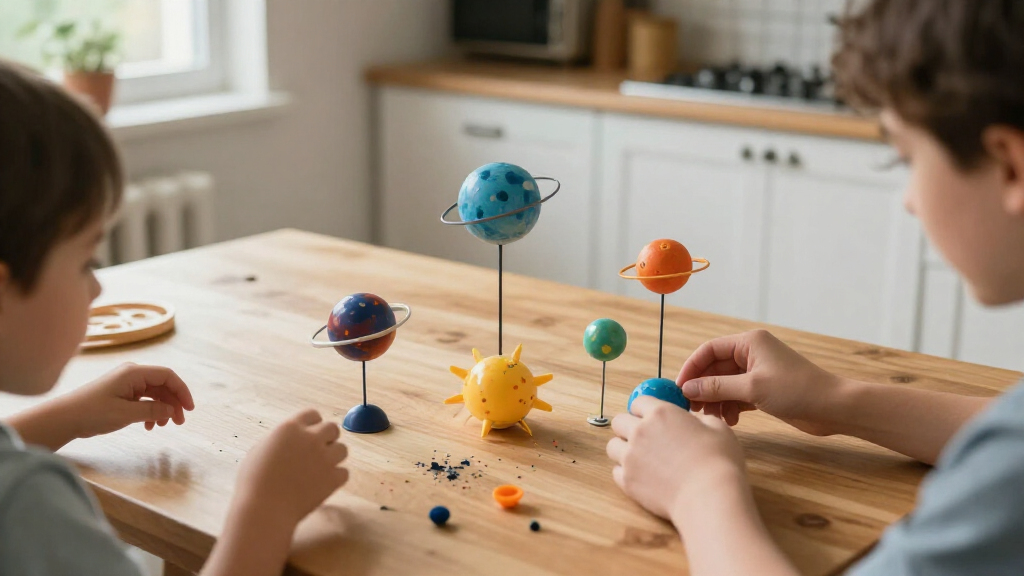

For a hands-on build with room to paint and customize, I’d make the Wookidel Solar System Project Kit my best overall pick, while the Playz Planetarium Projector Kit stands out for kids who want to see the planets projected after assembly. The Smartivity Gear-Driven Solar System Kit is a stronger fit for children who enjoy mechanisms and a more involved STEM challenge. The main tradeoff is between a simple, creative model, a feature-rich learning experience, and a build that asks for more patience and adult help. Check the age guidance, included supplies, and whether the finished model needs display space before choosing. Read on for my full comparison of all 15 solar system model kits for kids.

Prime made for students and young adults
- Fast, free delivery for dorm and study essentials
- Prime Video and Amazon Music included
- Member-only deals
Key Takeaways
- Build style matters more than piece count: paintable foam-ball kits favor creative assembly, while the Smartivity geared model adds moving-part appeal but asks for more building attention.
- Projectors and talking features change the experience: Playz and the Science Can models add ways to learn beyond the finished model, but buyers should check whether they want a display build, an interactive feature, or both.
- Glow-in-the-dark kits suit display-minded kids: the 4M and National Geographic options add a nighttime visual payoff, unlike basic foam-ball sets that focus more on painting and construction.
- Large supply lists can reduce extra shopping: kits such as the 63-piece Pllieay and 64-piece project set bundle many components, but a high piece count alone does not guarantee easier assembly or clearer instructions.
- Display needs separate similar-looking kits: the Pllieay model with a display box offers a defined presentation option, while open-arm orbs and planetarium builds may need more shelf or ceiling space.
| Wookidel Solar System Project Kit for Kids |  | Best for Creative Wall Displays | Brand: Wookidel | Model: WK0033 | Recommended age: 6 years and up | VIEW LATEST PRICE | See Our Full Breakdown |
| Playz Solar System Model Kit for Kids – Planetarium Projector |  | Best for a Motorized Projector Experience | Brand: Playz | Model number: solarsystem | Recommended age: 8 years and up | VIEW LATEST PRICE | See Our Full Breakdown |
| Solar System Model Kit with Foam Balls, Paints, and Astronaut Ornaments |  | Best for a School Science Craft | Brand: PPXMEEUDC | Piece count: 35 | Recommended age: 8–10 years | VIEW LATEST PRICE | See Our Full Breakdown |
| Solar System Model Kit with Foam Balls, Paints, Brushes, and Assembly Supplies |  | Best for Showing Planet Size Differences | Brand: Ourtroness | Total pieces: 48 | Foam balls: 12 in 10 sizes, from 1.4 to 4.4 inches | VIEW LATEST PRICE | See Our Full Breakdown |
| 4M Solar System Planetarium Glow-in-the-Dark Model Kit |  | Best for a Compact Rotating Display | Brand: 4M | Model number: 00-03257 | Recommended age: 8–14 years | VIEW LATEST PRICE | See Our Full Breakdown |
| Smartivity DIY Gear-Driven Solar System Kit for Kids Ages 8–14 |  | Best for Learning How Orbits Move | Brand: Smartivity | Recommended age: 8 years and up | Material: MDF | VIEW LATEST PRICE | See Our Full Breakdown |
| UNGLINGA Solar System Model Foam Ball Kit with 9 Size Foam Balls for Kids |  | Best for Glow-in-the-Dark Crafting | Brand: UNGLINGA | Age range: 3 years and up | Foam balls: 9 | VIEW LATEST PRICE | See Our Full Breakdown |
| Science Can Talking Solar System Model Kit for Kids |  | Best for Screen-Free Space Projection | Brand: Science Can | Model number: 1204732021es0001 | Planets: 8 | VIEW LATEST PRICE | See Our Full Breakdown |
| Pllieay Solar System Model Kit for Kids |  | Best for a Space-Saving Wall Display | Brand: Pllieay | Age range: 8–17 years | Educational objective: STEM | VIEW LATEST PRICE | See Our Full Breakdown |
| National Geographic Glow-in-the-Dark Solar System Model Kit |  | Best for a Movable Painted Display | Brand: Blue Marble | Age range: 8 years and up | Planets: 8 | VIEW LATEST PRICE | See Our Full Breakdown |
| Pllieay 63-Piece Solar System Foam Ball Model Kit |  | Best for Creative Project Builders | Brand: Pllieay | Piece count: 63 | Age range: 8–17 years | VIEW LATEST PRICE | See Our Full Breakdown |
| Science Can Interactive Talking Solar System Model for Kids |  | Best for Ready-to-Use Learning | Brand: Science Can | Age range: 6–12 years | Languages: English and French | VIEW LATEST PRICE | See Our Full Breakdown |
| 64-Piece Solar System Project Kit for Kids |  | Best for Younger Crafters | Brand: wookidel | Set size: 64 pieces | Model number: WK0017 | VIEW LATEST PRICE | See Our Full Breakdown |
| Pllieay 3D Solar System Model Kit with Display Box |  | Best for a Display-Ready Project | Brand: Pllieay | Model: T-044F | Age range: Over 8 years | VIEW LATEST PRICE | See Our Full Breakdown |
| 4M Solar System Planetarium STEM Kit |  | Best for a Glow-in-the-Dark Mobile | Brand: 4M | Model: 3427 | Recommended age: 8 years and up | VIEW LATEST PRICE | See Our Full Breakdown |
| solar system model kits for kid | Brand | Model number |
|---|---|---|
| Wookidel Solar System Project | Wookidel | — |
| Playz Solar System Model Kit f | Playz | solarsystem |
| Solar System Model Kit with Fo | PPXMEEUDC | — |
| Solar System Model Kit with Fo | Ourtroness | — |
| 4M Solar System Planetarium Gl | 4M | 00-03257 |
| Smartivity DIY Gear-Driven Sol | Smartivity | SMRT1313 |
| UNGLINGA Solar System Model Fo | UNGLINGA | — |
| Science Can Talking Solar Syst | Science Can | 1204732021es0001 |
| Pllieay Solar System Model Kit | Pllieay | CR-001FO |
| National Geographic Glow-in-th | Blue Marble | NGSOLARSYS |
| Pllieay 63-Piece Solar System | Pllieay | P-003B |
| Science Can Interactive Talkin | Science Can | — |
| 64-Piece Solar System Project | wookidel | WK0017 |
| Pllieay 3D Solar System Model | Pllieay | — |
| 4M Solar System Planetarium ST | 4M | — |
More Details on Our Top Picks
Wookidel Solar System Project Kit for Kids
Wookidel stands out as a craft-first solar system kit: children paint foam planets, arrange them on a felt board, and can reposition them to explore their paths. That movable layout makes it more adaptable than the fixed, rotating display in the 4M Solar System Planetarium Glow-in-the-Dark Model Kit. The felt board can also be hung up, so the activity leaves behind a changeable room decoration rather than only a tabletop model. Paint, brushes, labels, and adhesive pieces are included, giving kids several ways to personalize the result. The tradeoff is that this is a guided craft, not a ready-to-display model: children need to paint and assemble it, and the description does not provide a motorized or illuminated feature. I’d pick it for younger makers who enjoy decorating as much as learning planet names.
Pros:- Includes a felt board, foam planets, paint, brushes, labels, and adhesive pieces for a complete craft activity
- Movable planets let children rearrange the model after assembly
- Finished board can be hung as room decor
- Paint and labels offer multiple ways to personalize the display
Cons:- Requires painting and hands-on assembly, so it is not a ready-to-display model
- No motorized orbit or projector feature is listed
- The description does not specify the finished board’s dimensions
Best for: Children aged six and up who enjoy painting, rearranging pieces, and displaying a personalized science project on a wall
Not ideal for: Families seeking a quick, low-mess build or a motorized planetarium effect; painting and assembly are part of the activity
- Brand:Wookidel
- Model:WK0033
- Recommended age:6 years and up
- Board:Felt board
- Foam pieces:12 foam hemispheres and 4 foam stars
- Painting supplies:12-color silicone paste, 2 palettes, and 2 brushes
- Other components:Sun, adhesive hooks, hook-side tape, adhesive dots, label stickers, and instruction booklet
- Educational objectives:Hand-eye coordination, imagination, logical thinking, and spatial awareness
Our verdict“Choose Wookidel for a younger child who wants to paint and keep changing a wall-mounted solar system display, not for a mechanical planetarium experience.”
Playz Solar System Model Kit for Kids – Planetarium Projector
Playz is the most feature-rich build in this group, pairing a four-speed orbit motor with a sun projector that displays the eight planets on a surface. That gives it a clear advantage over craft-focused options such as the Solar System Model Kit with Foam Balls, Paints, and Astronaut Ornaments, which emphasize painting and display rather than moving or projected planets. With more than 75 parts, this is better suited to an older child ready for a longer assembly project than to someone seeking a quick activity. The projector adds nightlight-style play, while the choice of paintable or pre-painted planets can change how much customization the build involves. The tradeoffs are its larger 26-by-18-by-11-inch footprint, assembly time, and four AA batteries that are not included. I’d choose it for a child who wants both a working model and a projector feature.
Pros:- Four-speed orbit motor adds movement to the model
- Projector sun displays the eight planets on a surface
- More than 75 parts support a substantial hands-on build
- Paintable or pre-painted planet options allow different levels of customization
Cons:- Four AA batteries are required and not included
- Assembly may take time, particularly for younger children
- The 26-by-18-by-11-inch model needs more display space than a felt-board craft
Best for: Ages eight and up, especially children who enjoy longer STEM builds and want moving or projected planet displays
Not ideal for: Families short on display space or looking for a simple craft; the build is sizable, takes assembly, and needs four AA batteries
- Brand:Playz
- Model number:solarsystem
- Recommended age:8 years and up
- Dimensions:26 × 18 × 11 inches
- Weight:1.38 kg
- Planets:8
- Parts:More than 75
- Motor and power:Four-speed orbit motor; 4 AA batteries required, not included
- Projector:HD projector sun displays the planets on a surface
Our verdict“Pick Playz for an older child who wants motorized orbits and planet projection, and skip it if you need a compact, battery-free craft.”
Solar System Model Kit with Foam Balls, Paints, and Astronaut Ornaments
The three astronaut ornaments give this kit a playful presentation angle that sets it apart from the Wookidel kit, whose emphasis is a movable felt-board display. This 35-piece set supplies foam balls, paint, brushes, stars, and a felt background for children to build and decorate a solar system project; the illustrated instructions help make it workable for home or school activities. The hanging hardware also makes the finished craft easier to display than a loose collection of painted planets. Compared with the Ourtroness Solar System Model Kit, however, the product details do not specify foam-ball sizes, so buyers have less information about how clearly the finished model will show relative planetary scale. Painting and assembly are part of the experience, and the astronauts add a decorative touch rather than a stated mechanical or interactive function. I’d choose it for a classroom craft where presentation and hands-on making matter more than moving parts.
Pros:- 35-piece set includes foam balls, paint, brushes, stars, and a felt display background
- Three astronaut ornaments add a distinctive decorative element
- Illustrated instructions support a guided home or school activity
- Self-adhesive hooks allow the finished project to be displayed
Cons:- Foam-ball sizes are not specified, making relative scale difficult to judge before purchase
- Children need to paint and assemble the model
- No motorized or illuminated feature is listed
Best for: Teachers and caregivers planning an ages-eight-to-ten craft activity that ends in a wall-hung solar system project
Not ideal for: Buyers who want a clearly scaled planetary model or a ready-made display; ball sizes are unspecified and the kit requires painting
- Brand:PPXMEEUDC
- Piece count:35
- Recommended age:8–10 years
- Foam pieces:14 foam balls and 4 foam stars
- Display:Felt background plate
- Painting supplies:12 color pigments, 2 brushes, and palette
- Decorative figures:3 astronaut ornaments
- Other components:Adhesive dot stick, label sticker, 4 self-adhesive hooks, and instruction manual
- Educational objective:Exploratory skills
Our verdict“Choose this kit for a guided classroom-style craft with astronaut accents, rather than for precise planetary scale or interactive movement.”
Solar System Model Kit with Foam Balls, Paints, Brushes, and Assembly Supplies
Ourtroness is the strongest choice here for demonstrating relative planet sizes: its 12 foam balls come in 10 sizes, with listed diameters ranging from 1.4 to 4.4 inches. That is more specific scale information than the PPXMEEUDC Solar System Model Kit provides, since that kit does not list its ball sizes. Paint, brushes, bamboo sticks, and toothpick flags let children turn the pieces into a labeled standing model, which suits a school presentation better than Wookidel’s movable felt-board craft. The tradeoff is a more assembly-focused build: kids must paint and mount the planets, and the set includes small sharp parts. Its warning says it is not suitable for children under four; adult supervision is sensible around the sticks and other small components. I’d favor it when size comparison and a labeled physical display matter more than projection or a simple wall craft.
Pros:- Ten foam-ball sizes, from 1.4 to 4.4 inches, make relative size differences easier to illustrate
- Includes paint, brushes, bamboo sticks, and flags for a labeled model
- Foam rings add materials for planet details
- Hands-on construction supports a school project or guided science activity
Cons:- Small sharp parts make it unsuitable for children under four and call for supervision
- Painting and assembly take more effort than a ready-to-use display
- The listed components do not include a motor or projector feature
Best for: Families or educators helping children build a labeled model that shows differences in planetary size
Not ideal for: Children under four or families who want a low-supervision activity; the kit includes small sharp parts and requires assembly
- Brand:Ourtroness
- Total pieces:48
- Foam balls:12 in 10 sizes, from 1.4 to 4.4 inches
- Foam rings:2
- Bamboo sticks:15, each 7.8 inches long
- Toothpick flags:15
- Paint:12 colors, 5 ml each
- Brushes:2, each 6.5 inches long
- Age warning:Not suitable for children under 4; includes small sharp parts
Our verdict“Choose Ourtroness when showing planetary size differences is the main goal, provided an adult can supervise the assembly.”
4M Solar System Planetarium Glow-in-the-Dark Model Kit
4M offers the most straightforward rotating model in this group: snap-together planets attach to rotating arms, and the 11.8-inch display is smaller than the Playz model’s 26-inch length. That compact footprint makes it easier to fit on a desk or shelf, while the included wall chart and planet facts give the build some learning material beyond decoration. It also avoids glue, a useful advantage for children who want a more direct assembly process than the painting-heavy Wookidel Solar System Project Kit. Painting is still required, and the glow paint is described as an accent rather than a full glow coating, so buyers should not expect every planet to shine. The nine steel bars and rotating parts also mean this is not as simple as a felt-board craft. I’d pick it for ages eight to fourteen when a compact moving display and basic planet reference materials are the priorities.
Pros:- Snap-together assembly does not require glue
- Rotating arms provide visible movement in a compact 11.8-inch model
- Includes planet facts and a wall chart to support learning
- Glow paint adds decorative highlights alongside standard paint
Cons:- Painting and assembly are still required
- Glow paint is described as highlights rather than a full glow finish
- The listed components do not include a motor, so rotation is not described as powered
Best for: Ages eight to fourteen who want a compact rotating solar system model with included planet facts and a wall chart
Not ideal for: Children who want a paint-free activity or a bright, fully glowing display; the kit requires painting and glow paint is for highlights
- Brand:4M
- Model number:00-03257
- Recommended age:8–14 years
- Model size:11.8 inches
- Assembly:Snap-together planets; no glue needed
- Included display parts:Stand, rotating arms, and 9 steel bars
- Painting supplies:Paint pot, glow paint, brush, sandpaper, and Saturn ring template
- Learning materials:Instructions, wall chart, and planet facts
- Language:English
Our verdict“Choose 4M for a smaller, glue-free rotating display with learning materials, but not if a powered model or full glow effect is a must.”
Smartivity DIY Gear-Driven Solar System Kit for Kids Ages 8–14
The gear-driven mechanism gives this kit a more active teaching angle than the Pllieay wall-display model: kids assemble a moving solar system rather than mainly painting and arranging a static one. Turning the planets can make the idea of orbital motion easier to discuss, while the MDF construction adds a satisfying build activity for school-age learners. It is a good fit when the goal is to connect hands-on construction with basic astronomy, not just make a decorative project. The tradeoff is that the supplied description focuses on the rotating model and does not list paints or extra display materials, unlike the National Geographic kit. Its 8-and-up age recommendation also makes it less suited to younger children who may need a simpler, more guided activity.
Pros:- Gear-driven planets provide a tangible way to discuss orbital motion
- Combines model construction with STEM and basic astronomy learning
- MDF construction gives the project a distinct build-focused feel
Cons:- Recommended for ages 8 and up, so younger children may find it difficult
- The listed components do not include paints or additional display materials
Best for: Families with children ages 8 and up who want a build project that demonstrates planetary motion through a working gear mechanism.
Not ideal for: Families seeking a paint-and-decorate kit, a wall-mounted display, or an activity suitable for preschool-age children.
- Brand:Smartivity
- Recommended age:8 years and up
- Material:MDF
- Educational objective:STEM
- Model number:SMRT1313
- Manufacturer part number:SMRT1303
- Dimensions:12.91 x 11.61 x 1.97 inches
- Weight:650 g
Our verdict“Choose this for an older child who will learn more from building and turning a mechanism than from painting a static solar system.”
UNGLINGA Solar System Model Foam Ball Kit with 9 Size Foam Balls for Kids
Where the Smartivity kit emphasizes a moving mechanism, this UNGLINGA set leans into painting, decorating, and display. It includes foam balls, acrylic paints, glitter powder, glow-in-the-dark stickers, wooden sticks, and a base, giving kids several ways to personalize their model without sourcing basic craft materials separately. That makes it a lively option for children who enjoy art as much as space topics. The main limitation is the stated count: it has nine foam balls, so buyers should check the included pieces against their expectations for a complete Sun-and-planets representation. Its small listed package dimensions also suggest a modest project rather than a large room display. Compared with the National Geographic model, this kit adds glitter and glow stickers, while the National Geographic set specifically describes movable arms and a fact poster.
Pros:- Includes foam balls, paints, glitter powder, stickers, sticks, and a base
- Glow-in-the-dark stickers add a decorative nighttime effect
- Combines astronomy-themed play with painting and fine-motor practice
- Multiple craft materials allow children to personalize the finished model
Cons:- Nine foam balls may not match buyers’ expectations for a full Sun-and-eight-planets set
- The small listed dimensions limit its suitability as a large display
- The description does not identify a moving mechanism or a fact poster
Best for: Kids who like painting and decorating, and families wanting an all-in-one craft activity with glow-in-the-dark details.
Not ideal for: Buyers who want a clearly complete, large-scale planet display or a model with a mechanism for moving the planets.
- Brand:UNGLINGA
- Age range:3 years and up
- Foam balls:9
- Materials:Foam balls, acrylic paints, glitter powder, wooden sticks, and a base
- Decorative feature:Glow-in-the-dark stickers
- Theme:Space, astronomy
- Package dimensions:6.1 x 6.1 x 3.94 inches
- Number of packs:1
Our verdict“Pick this for a child who wants a creative, glow-accented craft project more than a mechanically interactive or sizable display model.”
Science Can Talking Solar System Model Kit for Kids
This Science Can kit takes a different route from the paint-and-build projects: its projector turns space images into a wall or ceiling activity. The three slide disks contain 24 images, and the dome can also serve as a night light or flashlight, so it has a use beyond assembling a planet display. English-and-Spanish astronomy facts give families a way to explore space vocabulary in both languages. Compared with the Smartivity gear-driven kit, this one favors viewing and listening over learning through a moving mechanism; compared with the National Geographic model, it projects images rather than leaving a painted model to display. Assembly is described as simple, but the three AA batteries are not included, and projection requires a suitable surface and dim surroundings.
Pros:- Projects 24 space images from three slide disks
- Includes astronomy facts in English and Spanish
- Dome can also be used as a night light or flashlight
- Simple assembly suits younger children better than more involved build kits
Cons:- Requires three AA batteries, which are not included
- Projection is less suited to bright rooms or spaces without a clear viewing surface
- Offers less model-building activity than the Smartivity or National Geographic kits
Best for: Families with children ages 3 to 12 who want a simple astronomy activity with projected images and bilingual facts.
Not ideal for: Buyers seeking a substantial construction project, a durable room display, or a kit that works without separately supplied batteries.
- Brand:Science Can
- Model number:1204732021es0001
- Planets:8
- Projection slides:3 disks with 24 images
- Languages:English and Spanish
- Power:3 AA batteries, not included
- Recommended age:36 months to 12 years
- Included components:Manual, 8 planet axes, planet stickers, projector, and 3 slides
Our verdict“Choose this for a younger child who will get more use from projected space images and bilingual facts than from building a detailed display.”
Pllieay Solar System Model Kit for Kids
The Pllieay kit is the clearest choice here for a project that ends on the wall instead of taking up shelf space. Its felt background plate, foam hemispheres, paints, brushes, and hanging hooks turn the activity into a personalized display, while the 63 listed items give kids several components to assemble and decorate. That makes it more craft-oriented than the Smartivity model, which centers on gears and planetary motion. The tradeoff is that children must paint and assemble the pieces themselves, so this is not a quick, ready-to-show model. It is also designed for ages 8–17, unlike the Science Can projector, which covers younger children and requires less hands-on construction. Buyers should be comfortable with a wall-hung layout rather than a freestanding solar system.
Pros:- Felt backing and adhesive hooks make wall display part of the project
- Includes foam pieces, paints, brushes, palette, and instructions
- Hands-on painting and assembly support creative STEM learning
- Wall-mounted format saves shelf and tabletop space
Cons:- Children need to paint and assemble the model before display
- Recommended for ages 8–17, limiting suitability for younger kids
- Wall display is less flexible than the movable freestanding National Geographic model
Best for: Families with children ages 8–17 who enjoy painting and want a finished solar system display that can hang on a wall.
Not ideal for: Buyers looking for a ready-made, movable model, a freestanding display, or an activity for children younger than 8.
- Brand:Pllieay
- Age range:8–17 years
- Educational objective:STEM
- Number of items:63
- Materials:Foam and felt
- Included components:Felt background plate, 9 foam hemispheres, 4 foam stars, 4 self-adhesive hooks, 2 adhesive dots, label sticker, 2 paintbrushes, 12 color pigments, palette, and instruction manual
- Dimensions:12.99 x 8.46 x 3.34 inches
- Weight:0.4 kg
- Model number:CR-001FO
Our verdict“Choose this for an older child who wants to make and hang a personalized solar system rather than build a moving model.”
National Geographic Glow-in-the-Dark Solar System Model Kit
The National Geographic kit balances a hands-on craft with a display that can be adjusted after assembly. Kids build and paint the Sun and all eight planets, then use the movable arms to change their arrangement; glow-in-the-dark accent paint adds a nighttime detail without making projection or batteries part of the experience. It is a more display-focused choice than the Science Can projector and less centered on mechanical learning than Smartivity’s gear-driven model. The included fact poster and kid-friendly instructions support the project, while paints, brush, palette, and decals give children materials for personalizing it. The tradeoff is that assembly and painting take time, and the supplied description does not specify a gear system or motorized motion. Choose it for an adjustable model, not a demonstration of actual orbital mechanics.
Pros:- Represents the Sun and all eight planets
- Movable arms let kids adjust the planet arrangement
- Includes paints, brush, palette, decals, and kid-friendly instructions
- Glow-in-the-dark accent paint and fact poster add display and learning value
Cons:- Assembly and painting require time and hands-on effort
- The movable arms do not provide the gear-driven motion featured by Smartivity
- Recommended for ages 8 and up, so it is not aimed at preschool-age children
Best for: Children ages 8 and up who want to build, paint, and display an adjustable model with all eight planets.
Not ideal for: Families wanting a quick activity for younger kids, a projection-based experience, or a gear-driven demonstration of planetary motion.
- Brand:Blue Marble
- Age range:8 years and up
- Planets:8
- Included components:6 paint colors, glow-in-the-dark accent paint, brush, palette, decals, fact poster, and instructions
- Item dimensions:7.09 x 2.36 x 12.01 inches
- Item weight:0.3 kg
- Material:Plastic
- Model number:NGSOLARSYS
Our verdict“Pick this for an older child who wants a painted, adjustable solar system display with all eight planets and glow accents.”
Pllieay 63-Piece Solar System Foam Ball Model Kit
The Pllieay 63-Piece Solar System Foam Ball Model Kit suits kids who want to shape and paint a project rather than start with a finished display. Its 26 mixed-size foam balls, paints, bamboo sticks, and planetary distribution map give children materials to build a model and make visual choices along the way. Compared with the Science Can Interactive Talking Solar System Model, this is a craft-first option: it offers more hands-on making, while Science Can is ready to use and focuses on facts, quizzes, and projection. The tradeoff is that painting and assembly take time and may need adult help, especially for younger children. I’d choose this for an arts-and-science activity, not for families seeking a quick, self-guided lesson.
Pros:- Includes foam balls, paint, brushes, sticks, flags, and a planetary distribution map
- Mixed-size balls help distinguish planets in the finished model
- Offers children room to personalize the appearance of their project
Cons:- Painting and assembly require time and may need adult supervision
- The craft-focused kit does not include the interactive facts and quiz features found in the Science Can model
Best for: Families with children ages 8 and up who want a paint-and-build solar system project for home or school
Not ideal for: Buyers seeking a ready-made model or a low-mess activity, since the planets need to be painted and assembled
- Brand:Pllieay
- Piece count:63
- Age range:8–17 years
- Foam balls:26 mixed-size polystyrene balls
- Paint:12 color pigments
- Other components:Palette, 2 brushes, 10 toothpick flags, 12 bamboo sticks, planetary distribution map
- Materials:Polystyrene foam, bamboo, acrylic pigment
- Model number:P-003B
Our verdict“Choose this kit for an older child who wants to make and decorate a solar system model, rather than simply explore one out of the box.”
Science Can Interactive Talking Solar System Model for Kids
The Science Can Interactive Talking Solar System Model is the easiest pick here for children who learn through listening, quizzes, and visual prompts rather than craft work. It needs no assembly and combines 48 space facts, 53 quiz questions, bilingual English and French options, and projection discs showing 24 color images. The sun also lights up to demonstrate how sunlight affects the planets, giving the model an interactive teaching angle that the paint-and-build Pllieay 63-Piece Foam Ball Model Kit does not provide. That convenience comes with a different limitation: children engage with prepared content instead of designing a model themselves. It also requires three AA batteries, which are not included. I’d favor this for a family wanting an immediate learning activity, but not for a hands-on school craft project.
Pros:- Ready to use with no assembly required
- Combines 48 facts with 53 quiz questions
- Offers English and French language options
- Projects 24 full-color space images
Cons:- Requires three AA batteries that are not included
- Offers less hands-on building and creative customization than the foam-ball kits
Best for: Families with children ages 6–12 who want an interactive, bilingual space-learning activity without craft assembly
Not ideal for: Children who want to paint, construct, or customize a physical solar system model
- Brand:Science Can
- Age range:6–12 years
- Languages:English and French
- Knowledge facts:48
- Quiz questions:53
- Projection:3 discs with 24 full-color images
- Power:3 AA batteries, not included
- Assembly:None required
- Dimensions:12.28 x 4.37 x 9.72 inches
Our verdict“Pick this for quick, guided learning and projection, but choose a craft kit if building the model is the main goal.”
64-Piece Solar System Project Kit for Kids
The 64-Piece Solar System Project Kit for Kids has the broadest stated age range among these paint-and-build options, making it a practical choice for children ages 6–12 working at home or in a classroom. Its foam pieces, paints, brushes, bamboo sticks, flags, palette, and instructions supply the basics for a group craft or individual project. Compared with the Pllieay 63-Piece Solar System Foam Ball Model Kit, it is listed for younger children and includes foam discs and a sun alongside foam balls; Pllieay specifies a planetary distribution map and an age range starting at eight. The main compromise is shared by both: children still need to paint and assemble the model, so this is not a ready-made learning aid. I’d choose it for guided creative work, with an adult available to help younger kids follow the instructions.
Pros:- Includes paints, brushes, palette, sticks, flags, and instructions for a complete craft activity
- Foam discs, a sun, balls, and stars provide several model components
- Specified for ages 6–12 and for home or classroom activities
Cons:- Children must paint and assemble the model
- Younger children may need adult help with the project steps
Best for: Parents and teachers seeking a paint-and-assemble solar system activity for children ages 6–12
Not ideal for: Buyers who need a finished display or an activity that avoids setup, painting, and cleanup
- Brand:wookidel
- Set size:64 pieces
- Model number:WK0017
- Age range:6–12 years
- Material:Foam
- Included components:Foam discs, sun, foam balls, foam stars, bamboo sticks, toothpick flags, 12 paints, 2 brushes, palette, instruction
- Item dimensions:10.24 x 8.66 x 3.62 inches
Our verdict“Choose this for a guided classroom or home craft with younger children; pick the Science Can model for immediate, no-assembly learning.”
Pllieay 3D Solar System Model Kit with Display Box
The Pllieay 3D Solar System Model Kit with Display Box stands out for giving the finished project a place to live: its starry-background box can serve as a small space-themed display, rather than leaving a child to find a separate way to present the model. It includes paints and supplies for decorating foam planets, plus screws, sticks, string, labels, and adhesive dots. Compared with the Pllieay 63-Piece Foam Ball Model Kit, this version is more presentation-focused; the 63-piece kit lists 26 mixed-size balls and a distribution map, while this one emphasizes a display box and accessories. That makes the box useful for school-project presentation, but the supplied component list is more specific than a broad set count, so it may offer less emphasis on an expansive build. Painting and assembly are still required, making it less suitable for a quick activity.
Pros:- Starry-background display box gives the completed project a presentation space
- Includes 12 color pigments, brushes, and a palette for decorating
- Supplies include labels, screws, string, sticks, and other assembly accessories
Cons:- Requires painting and assembly before it can be displayed
- The display format is less suited to buyers seeking a larger, open mobile-style model such as the 4M Planetarium kit
Best for: Families with children over eight who want a DIY solar system project that can be displayed after completion
Not ideal for: Buyers who want a ready-made model, minimal craft work, or a kit centered on interactive planet facts
- Brand:Pllieay
- Model:T-044F
- Age range:Over 8 years
- Material:Foam
- Dimensions:13.12 x 6.69 x 4.72 inches
- Display component:1 display box with starry background
- Model pieces:13 foam balls and 4 foam stars
- Paint supplies:12 color pigments, 2 paintbrushes, 1 palette
- Other components:2 adhesive stick dots, 2 label stickers, 1 string, 10 plastic screws, 3 bamboo sticks, instruction manual
Our verdict“Choose this when the finished model needs to double as a compact space-themed display and the child is ready for a hands-on build.”
4M Solar System Planetarium STEM Kit
The 4M Solar System Planetarium STEM Kit is the strongest fit in this group for a child who wants a hanging model with a night-time payoff. Its 16.5-by-16.5-inch glow-in-the-dark mobile differs from the boxed display in the Pllieay kit and the freestanding foam-ball crafts: rods and string turn the planets into a suspended project, while glow paint adds a feature those alternatives do not list. A wall chart and quiz questions also support astronomy learning after assembly, and no batteries are needed. The tradeoff is that this still requires painting and construction, and it includes eight planets without Pluto. Compared with Science Can’s ready-to-use quizzes and projections, 4M asks for more effort but gives kids a physical model they build and can hang.
Pros:- Finished mobile measures 16.5 by 16.5 inches and glows in the dark
- Includes a wall chart and quiz questions for astronomy learning
- No batteries are required
- Combines painting, assembly, and a hanging display
Cons:- Requires children to paint and assemble the mobile
- Includes eight planets and does not include Pluto
Best for: Children age eight and up who want to build a hanging, glow-in-the-dark mobile and learn through a wall chart and quiz
Not ideal for: Families seeking a quick activity, a no-assembly model, or a kit that includes Pluto
- Brand:4M
- Model:3427
- Recommended age:8 years and up
- Educational objective:STEM
- Finished size:16.5 x 16.5 inches
- Planets included:8; Pluto not included
- Included components:Planets, stencils, glow paint pen, rods, string, wall chart, quiz questions, assembly instructions
- Battery requirement:None
- Manufacturer:Toysmith
Our verdict“Choose this for an older child who wants a buildable, glowing mobile; pick Science Can instead for no-assembly lessons and projection.”
How We Picked
I compared these solar system model kits for kids by how clearly each supports its main use: building and painting a model, exploring motion, projecting or displaying planets, or adding interactive information. I also weighed the likely effort involved, the usefulness of included supplies, age fit, finished-model presentation, and whether a kit’s extra features add a distinct learning or play benefit. These criteria help separate a straightforward craft project from a more involved STEM build or an interactive planetarium-style set.
The ranking favors options with a clear purpose and a useful balance of hands-on activity, learning value, and manageable setup. Kits with projectors, talking functions, or moving mechanisms rank higher for buyers seeking more than a static model, while simpler foam-ball sets can be a better match for open-ended painting or group projects. Similar models are distinguished by their stated extras—such as glow-in-the-dark parts, included ornaments, or a display box—rather than piece count alone. Since the product list does not provide consistent details about instructions, dimensions, or exact contents, I recommend checking those specifics on the current listing before buying.
Factors to Consider When Choosing Solar System Model Kits For Kids
Before choosing, decide what the child should be able to do with the finished kit. A model built for painting, a geared demonstration, and a projector-based activity place different demands on space, time, and adult help. These broader checks can prevent a kit from feeling too easy, too fiddly, or poorly suited to the way your family plans to use it.
Match the Build to the Child’s Patience and Age
Age ranges are useful starting points, but patience and fine-motor confidence matter just as much. A younger child may enjoy choosing planet colors and placing prepared pieces, while a gear-driven build is more rewarding for someone ready to follow a sequence and troubleshoot parts. Avoid choosing solely by the promise of a complex STEM activity if the child mainly wants to paint and finish something in one sitting. Check whether adult assembly or supervision is expected, especially when the kit includes small parts or moving components. For a shared project, choose a build where adults can help without taking over the parts the child wants to do independently.
Check What ‘Complete Kit’ Means
A long list of included pieces can still leave out items needed to finish comfortably, such as household tools, batteries, or a suitable workspace. Before ordering, scan the contents and instructions for any mention of extras that must be supplied separately. Paint, brushes, and assembly materials are useful additions, but the amount and range can affect whether the project supports several children or just one. A common mistake is treating a high piece count as proof that a kit is easier or more educational. I’d prioritize clear contents and age-appropriate instructions over a bigger number on the package.
Decide Whether the Model Is for Making, Display, or Both
Some kits are primarily craft projects: the fun is painting and assembling, and the result may need a flat surface or careful storage. Others add a display box, glow effect, projector, or moving mechanism that gives the finished model a second use. Think about where it will live before buying, since a wide orbit layout or hanging setup may not suit a crowded desk. Glow-in-the-dark effects also depend on room darkness and how the pieces are charged by light, so they may be less noticeable in a brightly lit space. If the child wants a model to show at school, check how securely it can be transported as well as how it looks when complete.
Choose the Right Kind of Learning Interaction
Interactive features can help a child revisit the planets after construction, but they are not automatically a better fit than a simple model. A projector emphasizes viewing and presentation; a talking model emphasizes listening and fact recall; gears make motion easier to discuss. Consider which format suits the child’s attention and how the kit will be used once the build is finished. For a child who learns best by making, a feature-rich model may be less engaging than a well-supported painting project. Check what the interactive feature actually explains or demonstrates rather than assuming it covers every solar system concept.
Treat Planet Accuracy as a Separate Check
Many children’s models simplify the solar system so the planets are visible and easy to assemble. Their relative sizes and distances may not match real proportions, especially when all planets must fit on one small display. That does not make a model unsuitable for learning, but it is helpful to explain that a compact kit is a visual aid rather than a scale map. If the child is doing a school assignment, check the assignment requirements before choosing a decorative or interactive set. You can also use the finished build to discuss why planets are spaced much farther apart than a tabletop model can show.
Know When Paying More for Features Makes Sense
Extra mechanisms and interactive elements make sense when the child is likely to use them after assembly, not just admire them once. A basic foam-ball kit may be the better choice for a short classroom activity, a group craft, or a child who likes painting more than operating gadgets. A projector, talking feature, or geared motion can add repeat-use appeal, but it may also bring more setup and more parts to keep track of. Decide which single feature would make the child return to the model; if none stands out, simpler is often the more fitting choice. Check replacement-part and power requirements where relevant before committing to a feature-heavy option.
Frequently Asked Questions
Which type of solar system model kit is easiest for a younger child to complete?
For a younger child, look for a kit centered on a clear, short sequence of steps and familiar hands-on tasks such as painting and placing foam planets. A large set of small parts or a moving gear mechanism can make the activity harder even when the age label seems suitable. Adult help may still be needed for assembly, paint setup, or keeping pieces organized. If the child is new to science kits, a simpler build can leave more time for discussing planet names and colors. Check the instructions and minimum age guidance before choosing.
Should I choose a projector or talking model instead of a basic painted model?
Choose a projector if viewing and presentation are likely to keep the child interested after construction; choose a talking model if listening to facts is a better fit. A painted model is often more suitable when the child wants direct creative control or when several children will share the activity. Interactive features add value only if they will be used repeatedly and fit the family’s available space and setup. It can help to ask whether the child prefers making, watching, or listening before deciding. Also check what the feature covers rather than expecting it to replace a full lesson.
Are glow-in-the-dark solar system kits useful for school projects?
They can work well for a presentation focused on visual appeal or a model that will be displayed in a darkened room. For a project graded on planetary order, labels, or scale, glow effects alone may not meet the assignment requirements. Compact models generally cannot show true distances between planets, so a child may need to explain that limitation. Check whether the kit includes labels or whether the student will need to add them. A glow feature is best treated as an engaging extra, not a substitute for clear scientific information.
What should I check before buying a kit for a classroom or group activity?
Check how many children the supplies can support, whether each child gets a complete set of materials, and how much adult help assembly may require. Paint and small pieces can make a group session messy, so plan for workspace, drying time, and storage. A kit with many components may be better for distributing tasks, but only if the instructions are easy to follow and the parts can be sorted quickly. For a short class period, a project with fewer assembly stages is often a safer choice. Confirm that the kit’s age range suits the youngest participants.
Do solar system model kits show the planets at accurate sizes and distances?
Most tabletop kits simplify the solar system so the planets fit together and remain easy to see. That means planet sizes and orbital distances are usually not shown at a single accurate scale. A model can still teach order, names, and basic structure, but it should not be treated as a precise map of space. If scale is part of a school task, check the kit description and consider adding a separate distance activity. Explaining the simplification can make the model a useful starting point for a deeper lesson.
Conclusion
For the strongest all-around mix of hands-on building and creative flexibility, I’d start with the Wookidel Solar System Project Kit as best overall. For a feature-led alternative, the Playz Planetarium Projector Kit suits kids who want a viewing experience, while the Smartivity Gear-Driven Kit is my pick for children drawn to mechanisms and a more involved STEM build. A basic foam-ball set, such as the Pllieay 63-Piece Kit, is a sensible value direction for buyers who want a supply-rich craft project; the simpler painting kits are also the best starting point for beginners who prefer a direct build. For specific needs, choose a glow-in-the-dark 4M or National Geographic model for a nighttime display, a Science Can talking model for audio-based learning, or the Pllieay Display Box Kit when presentation and storage matter most. Match the feature to the child’s interests, then verify the age guidance, included supplies, and space needed before selecting a kit.