Educational board games for families work best when learning feels like part of the play, not a separate lesson. I’d choose Trivial Pursuit Family Edition as the best overall pick for households with a broad mix of ages, while Scrabble Junior stands out for early reading practice and Race Across the USA for geography. The main tradeoff is between games that build a particular skill and lighter options that make it easier for everyone to join in. Age range, reading confidence, and how much your family enjoys trivia or word challenges can matter as much as the subject. Read on for how all eight picks compare and which one fits your family’s style.

Prime made for students and young adults
- Fast, free delivery for dorm and study essentials
- Prime Video and Amazon Music included
- Member-only deals
Key Takeaways
- Trivial Pursuit Family Edition leads for mixed-age play because its family format makes trivia a stronger shared choice than a game aimed at one skill level.
- Scrabble Junior is the clearest early-literacy pick, while classic Bananagrams suits players ready to build words more independently.
- Race Across the USA gives geography a dedicated role; families who want broader question-based learning may prefer Trivial Pursuit instead.
- Hedbanz and Tapple keep learning social and fast, but their guessing and quick-response formats are less suited to players who prefer quiet, deliberate turns.
- Number Hunter is the focused math option, while I Should Have Known That! rewards general knowledge and playful recall rather than systematic subject practice.
| Hasbro Gaming Trivial Pursuit Family Edition Board Game | 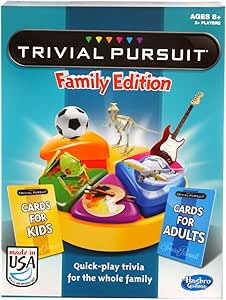 | Best for Mixed-Age Trivia Teams | Brand: Hasbro Gaming | Edition: Family Edition | Players: 2 or more | VIEW LATEST PRICE | See Our Full Breakdown |
| Bananagrams Classic Word Game with 144 Tiles and Banana Pouch |  | Best for Fast, Portable Spelling Practice | Players: 1–8 | Recommended age: 7 years and up | Tiles: 144 letter tiles | VIEW LATEST PRICE | See Our Full Breakdown |
| Spin Master Games Hedbanz Classic Edition Picture Guessing Game |  | Best for Young Question-Askers | Brand: Spin Master Games | Age range: 6 years and up | Players: 2–6 | VIEW LATEST PRICE | See Our Full Breakdown |
| Number Hunter Math Board Game for Kids |  | Best for Hands-On Math Practice | Brand: Clever Fox Play | Game type: Math board game | Players: 2 or more | VIEW LATEST PRICE | See Our Full Breakdown |
| Hasbro Gaming Scrabble Junior Board Game, Ages 5+ |  | Best for Early Readers | Brand: Hasbro Gaming | Players: 2–4 | Recommended age: 5 years and up | VIEW LATEST PRICE | See Our Full Breakdown |
| I Should Have Known That! Trivia Game |  | Best for Older Trivia Fans | Brand: Hygge Games | Model: 21026 | Number of cards: 110 | VIEW LATEST PRICE | See Our Full Breakdown |
| Tapple: The Original Fast-Paced Family Word Game |  | Best for Quick Vocabulary Rounds | Brand: USAOPOLY | Players: 2–8 | Recommended age: 8 years and up | VIEW LATEST PRICE | See Our Full Breakdown |
| Scholastic Race Across the USA Geography Board Game for Kids, Ages 8+ |  | Best for Mixed-Age Geography Learning | Brand: University Games | Game type: Educational board game | Players: 2–4 | VIEW LATEST PRICE | See Our Full Breakdown |
| educational board games for familie | Players | Brand | Recommended age | Included components |
|---|---|---|---|---|
| Hasbro Gaming Trivial Pursuit | 2 or more | Hasbro Gaming | 8 years and up | Gameboard, 100 blue adult cards, 100 yellow kids’ cards, 2 cardholders, 6 scoring tokens, 36 scoring wedges, die, and instructions |
| Bananagrams Classic Word Game | 1–8 | — | 7 years and up | Letter tiles and banana-shaped pouch |
| Spin Master Games Hedbanz Clas | 2–6 | Spin Master Games | — | 6 headbands, 6 headplates, 16 scoring badges, 1 timer, 69 picture cards, 3 sample question cards, and instructions |
| Number Hunter Math Board Game | 2 or more | Clever Fox Play | 5 years and up | Game board, 5 game pieces, 2 number dice, 1 operation die, 50 challenge cards, and game rules |
| Hasbro Gaming Scrabble Junior | 2–4 | Hasbro Gaming | 5 years and up | 1 double-sided gameboard, 4 tokens, 105 letter tiles, and game guide |
| I Should Have Known That! Triv | More than 2 | Hygge Games | 14 years and up | — |
| Tapple: The Original Fast-Pace | 2–8 | USAOPOLY | 8 years and up | Portable Tapple wheel with built-in timer, 36 cards, instructions |
| Scholastic Race Across the USA | 2–4 | University Games | 8 years and up | Game board, cards, airplane pawns |
More Details on Our Top Picks
Hasbro Gaming Trivial Pursuit Family Edition Board Game
Separate adult and kid question decks give this trivia game a practical advantage for families: younger players can answer age-appropriate prompts while adults still get their own challenge. With 1,200 questions across six categories, it offers more subject variety than the focused spelling practice in Bananagrams Classic. Players can compete individually or in teams, and the colored spaces provide a quicker route through the board than a longer traditional trivia session. The tradeoff is that progress depends on recalling facts, so it may frustrate children who prefer learning through word-building or hands-on math. Its indoor board format also takes more setup than portable Bananagrams. I’d choose it for households that enjoy quiz-style competition and want adults and children playing on more even footing.
Pros:- Separate adult and kids’ card decks help balance mixed-age play.
- Six trivia categories provide varied knowledge prompts.
- Supports individual play or teams.
- Colored quick-play spaces can shorten a session.
Cons:- Players must answer trivia questions to make progress, which can frustrate less trivia-oriented children.
- Indoor board play is less portable than Bananagrams Classic.
- Recommended for ages 8 and up, so it may not suit families with younger learners.
Best for: Families with children ages 8 and up who enjoy trivia and want separate question levels for adults and kids.
Not ideal for: Families with younger children or players who find recall-based questions stressful; the game depends on answering trivia correctly to advance.
- Brand:Hasbro Gaming
- Edition:Family Edition
- Players:2 or more
- Recommended age:8 years and up
- Trivia questions:1,200 across 6 categories
- Included components:Gameboard, 100 blue adult cards, 100 yellow kids’ cards, 2 cardholders, 6 scoring tokens, 36 scoring wedges, die, and instructions
- Language:English
- Dimensions:10.51 x 7.87 x 2.24 inches
Our verdict“Choose this for mixed-age households that want competitive trivia with distinct question decks for adults and children.”
Bananagrams Classic Word Game with 144 Tiles and Banana Pouch
Everyone builds at once in Bananagrams, so spelling practice feels like a race rather than a turn-by-turn lesson. Players rearrange letter tiles into crossword grids, making this a livelier option for children who already recognize words than Hedbanz, which builds deduction through spoken yes-or-no questions. Its 144 tiles and banana-shaped pouch also make it easier to pack for trips than the board-and-card setup of Trivial Pursuit Family Edition. The open-ended grid format gives players room to work at their own pace, but it offers less structured instruction than Scrabble Junior’s picture-and-letter matching side. There’s no board, pencil, or paper to manage; the tradeoff is that players need enough spelling confidence to form words independently. Small tiles also require care around children under three.
Pros:- Simultaneous play keeps all players involved rather than waiting for turns.
- Letter tiles support spelling, vocabulary, and anagram practice.
- Portable pouch makes it convenient for travel.
- Requires no board, pencils, or paper.
Cons:- Independent crossword building may be difficult for children still learning basic spelling.
- Small parts make it unsuitable for children under three.
- Less guided for early learners than Scrabble Junior’s picture-and-letter matching side.
Best for: Families with children ages 7 and up who can form basic words and want portable, simultaneous spelling play.
Not ideal for: Families seeking guided early-literacy scaffolding or play with children under three, since the game uses small tiles and requires independent word-building.
- Players:1–8
- Recommended age:7 years and up
- Tiles:144 letter tiles
- Included components:Letter tiles and banana-shaped pouch
- Material:Rubber, wood
- Game type:Word, spelling, and anagram game
- Model number:1295
Our verdict“Pick Bananagrams for families with emerging readers who want a quick, travel-friendly word challenge rather than a guided board game.”
Spin Master Games Hedbanz Classic Edition Picture Guessing Game
Yes-or-no questions turn deduction into a social game in Hedbanz: players use clues from the group to identify the picture on their headband. Its age recommendation of 6 years and up makes it more accessible to younger children than Trivial Pursuit Family Edition, which asks players to retrieve trivia knowledge. The picture prompts also give children a concrete starting point for asking questions, unlike Bananagrams, where players must build words from letters. That accessibility comes with a different learning focus: Hedbanz practices observation and question formation more than spelling, math, or factual recall. The timer adds pace, but players need to feel comfortable speaking aloud and answering in a group. With space for up to six players, it is less accommodating than Bananagrams for larger gatherings.
Pros:- Simple yes-or-no format gives younger players an approachable way to practice deduction.
- Picture cards provide concrete clues for question-building.
- Includes six headbands for group play.
- Works for 2–6 players and is recommended for ages 6 and up.
Cons:- Requires players to ask and answer questions aloud.
- Maximum of six players limits use with larger family groups.
- Focuses on deduction and conversation rather than direct spelling or math practice.
Best for: Families with children ages 6 and up who want a conversational game that practices asking focused questions and using clues.
Not ideal for: Quiet or larger households; players need to ask and answer aloud, and the game accommodates no more than six players.
- Brand:Spin Master Games
- Age range:6 years and up
- Players:2–6
- Included components:6 headbands, 6 headplates, 16 scoring badges, 1 timer, 69 picture cards, 3 sample question cards, and instructions
- Model name:Hedbanz Classic Edition
- Edition:2029 Edition
- Model year:2023
Our verdict“Choose Hedbanz for younger children who learn well through spoken clues and enjoy guessing together.”
Number Hunter Math Board Game for Kids
Addition, subtraction, and even-or-odd challenges give Number Hunter a more focused academic purpose than the vocabulary practice in Scrabble Junior or the broad recall of Trivial Pursuit Family Edition. Players roll dice, solve problems, and move around the board, turning number practice into a shared activity instead of a worksheet. The included 50 challenge cards add prompts beyond the dice rolls, and a listed playing time of about 20 minutes helps families plan a short screen-free session. This is the clearest choice here for a family specifically working on early arithmetic, but its narrow math focus offers less variety than a word or picture-guessing game. It also requires at least two players, and children under five may not be ready for the activities.
Pros:- Practices addition, subtraction, and even and odd numbers.
- Dice, game pieces, a board, and 50 challenge cards provide varied ways to prompt play.
- Screen-free format works at home or in a classroom.
- Listed playing time of 20 minutes suits a short family activity.
Cons:- Requires at least two players, so it is not suited to solo practice.
- The math focus offers less subject variety than Trivial Pursuit Family Edition.
- Activities may not suit children younger than the recommended age of five.
Best for: Families with children ages 5 and up who want a shared, screen-free way to practice basic arithmetic and even-or-odd recognition.
Not ideal for: Solo learners, children under five, or families seeking a game that mixes several subjects rather than centering on math.
- Brand:Clever Fox Play
- Game type:Math board game
- Players:2 or more
- Recommended age:5 years and up
- Edition:Addition and subtraction
- Estimated playing time:20 minutes
- Included components:Game board, 5 game pieces, 2 number dice, 1 operation die, 50 challenge cards, and game rules
- Language:English
Our verdict“Choose Number Hunter when your family wants short, collaborative arithmetic practice rather than broad trivia or wordplay.”
Hasbro Gaming Scrabble Junior Board Game, Ages 5+
A two-sided board grows with a child’s word skills: the picture-and-letter matching side offers a more supported start, while the other side asks players to create their own words. That progression makes Scrabble Junior a stronger fit for early literacy than Bananagrams, which expects players to build crossword grids independently. Its 15-minute playing time and 2–4 player setup also suit a short family session, while Number Hunter is the better match when arithmetic is the learning goal. The main tradeoff is that the advanced side may be a stretch for younger players, and the game is designed for indoor use. Families with children ready for open-ended spelling may eventually want a less guided word game, but the matching side gives newer readers a clear way into play.
Pros:- Two-sided board offers picture-and-letter matching and a more advanced word-building level.
- Supports spelling and vocabulary practice.
- Accommodates 2–4 players.
- Listed playing time of 15 minutes fits a brief family game.
Cons:- The advanced side may challenge younger children who are not ready to create words independently.
- Designed for indoor use, unlike the portable pouch format of Bananagrams Classic.
- Offers less open-ended play than Bananagrams once children can build words confidently.
Best for: Families with children ages 5 and up who are learning letter recognition, spelling, and early vocabulary and benefit from a supported first side.
Not ideal for: Families seeking a travel-oriented game or children not yet ready to create words independently on the advanced side.
- Brand:Hasbro Gaming
- Players:2–4
- Recommended age:5 years and up
- Game type:Word-building
- Gameboard:Double-sided
- Playing time:15 minutes
- Included components:1 double-sided gameboard, 4 tokens, 105 letter tiles, and game guide
- Educational objectives:Spelling and vocabulary
Our verdict“Pick Scrabble Junior for young readers who need a guided path from matching letters to building words.”
I Should Have Known That! Trivia Game
Everyday-fact trivia gives this game a different feel from Trivial Pursuit Family Edition: it tests what players think they already know rather than building around a broader family trivia format. With more than 400 questions on 110 cards, it offers plenty of prompts for lively group play, while losing points for wrong answers makes guessing a risk and can turn mistakes into the joke of the evening. That scoring twist is its clearest strength—and its main tradeoff. Younger players or anyone who dislikes being penalized may find it less welcoming than Race Across the USA, whose grade-level questions support mixed-age play. I’d choose this for families with teens and adults who enjoy quick general-knowledge challenges, not as a first educational game for younger children.
Pros:- More than 400 questions provide variety across repeated game sessions.
- Everyday topics invite broad general-knowledge play rather than focusing on one school subject.
- Point deductions make guessing a distinct strategic choice.
- Designed for group play with more than two participants.
Cons:- The recommended age of 14 and up limits its fit for younger family members.
- Losing points for wrong answers can make the game less encouraging for uncertain players.
- The description does not specify a fixed playing time, which may make session length harder to plan.
Best for: Families with teenagers and adults who want an informal trivia challenge based on everyday knowledge.
Not ideal for: Families with children under 14 or players who prefer cooperative learning, since the listed age guidance starts at 14 and wrong answers subtract points.
- Brand:Hygge Games
- Model:21026
- Number of cards:110
- Number of questions:Over 400
- Players:More than 2
- Recommended age:14 years and up
- Language:English
- Material:Paper
Our verdict“Choose this for teen-and-adult family groups who enjoy trivia and can laugh off penalties, but pick Race Across the USA for more age-adapted play.”
Tapple: The Original Fast-Paced Family Word Game
Tapple turns word recall into a race: players name a word that fits a category, use an available starting letter, and press its tab before the 10-second timer runs out. That makes it more kinetic than Bananagrams, which gives players a different kind of word-building challenge, and more focused on quick association than Scrabble Junior. Its 144 categories and two-to-eight-player range suit lively family gatherings, while the wheel stores the cards for easy carrying and tidier storage. The tradeoff is the timer: quick thinkers may enjoy the pressure, but younger players or anyone who needs extra processing time can feel rushed. I’d pick it for families with children eight and up who want short, energetic vocabulary practice, rather than a quiet or untimed word game.
Pros:- 144 categories give the group many prompts to revisit.
- The timer and letter tabs keep turns active and reinforce rapid word association.
- The wheel stores its cards, making transport and cleanup straightforward.
- Supports two to eight players, suiting both small family games and larger gatherings.
Cons:- The 10-second limit can disadvantage slower processors and less confident readers.
- Fast recall under pressure may matter more than spelling or deeper vocabulary learning.
- The play format can feel hectic for families seeking a relaxed educational activity.
Best for: Families with children aged eight and up who enjoy quick word challenges and want a portable game for gatherings.
Not ideal for: Players who need more thinking time or prefer calm, untimed wordplay, since each answer must be found under a 10-second timer.
- Brand:USAOPOLY
- Players:2–8
- Recommended age:8 years and up
- Playing time:15 minutes
- Categories:144 across 36 cards
- Included components:Portable Tapple wheel with built-in timer, 36 cards, instructions
- Educational objective:Vocabulary and word association
- Materials:Paper, plastic
Our verdict“Choose Tapple for energetic, short vocabulary rounds with a group, but choose Bananagrams or Scrabble Junior for wordplay without its timer-driven pressure.”
Scholastic Race Across the USA Geography Board Game for Kids, Ages 8+
Grade-level questions are what set this geography race apart for families: children in different grades can answer questions matched to their level while sharing the same trip across the United States. Players visit six states and race back to their home state, giving the learning a clear route and goal rather than a succession of disconnected prompts. Compared with I Should Have Known That!, this is much more suited to school-age children; compared with Trivial Pursuit Family Edition, its subject stays focused on U.S. geography. That focus is useful for families who want a specific learning theme, but less appealing if they want broad trivia or global geography. With only two to four players, it also fits smaller groups better than Tapple.
Pros:- Grade-level questions help children in different grades participate together.
- The state-to-state race gives geography questions a clear game objective.
- A listed playing time of about 20 minutes suits shorter family sessions.
- The format is described for family, classroom, and playdate groups.
Cons:- The two-to-four-player limit excludes larger groups from playing at once.
- The U.S.-geography focus offers less subject range than broad trivia games.
- Children need enough familiarity with geography questions to take part, even with grade-level tailoring.
Best for: Families with children in different grade levels who want a short, U.S.-geography-focused game for two to four players.
Not ideal for: Larger families or players seeking broad world geography, since it supports only two to four players and focuses on the United States.
- Brand:University Games
- Game type:Educational board game
- Players:2–4
- Recommended age:8 years and up
- Estimated playing time:20 minutes
- Edition:Standard Edition
- Included components:Game board, cards, airplane pawns
- Language:English
Our verdict“Choose Race Across the USA for a focused geography game that accommodates children in different grades, but choose Tapple for larger groups or broader word skills.”
How We Picked
I ranked these games by how well they combine family accessibility with a clear learning benefit. I looked at the kind of skills each game encourages—such as math, spelling, geography, recall, or verbal fluency—and whether the format gives different ages a reasonable way to participate. I also weighed setup and portability, the amount of reading or subject knowledge a game asks of players, and whether its pace is likely to suit a shared family game night.
The order favors games with a useful balance of educational value, broad age appeal, and straightforward play, rather than treating a narrow academic focus as an automatic advantage. A specialized game can be a better choice for a particular family need, even if it ranks below a versatile pick. Because the lineup ranges from trivia and wordplay to math and geography, each recommendation has a distinct role—and each has a tradeoff, such as reliance on reading skill, timed responses, or a narrower subject.
| educational board games for familie | Brand | Game type |
|---|---|---|
| Hasbro Gaming Trivial Pursuit | Hasbro Gaming | — |
| Bananagrams Classic Word Game | — | Word, spelling, and anagram game |
| Spin Master Games Hedbanz Clas | Spin Master Games | — |
| Number Hunter Math Board Game | Clever Fox Play | Math board game |
| Hasbro Gaming Scrabble Junior | Hasbro Gaming | Word-building |
| I Should Have Known That! Triv | Hygge Games | — |
| Tapple: The Original Fast-Pace | USAOPOLY | — |
| Scholastic Race Across the USA | University Games | Educational board game |
Factors to Consider When Choosing Educational Board Games For Families
Before choosing, I’d match the game to the way your family actually plays. A strong learning theme may not help much if one player is too young to read the cards or the group dislikes time pressure. These broader checks can help narrow the options beyond their individual strengths.
Match the Learning Goal to the Kind of Play
Start with the skill you want to encourage, then ask whether your family enjoys practicing it through play. Word games can support spelling and vocabulary, but they may feel like homework to players who dislike letter challenges. Trivia can prompt recall across many subjects without a single narrow curriculum, though it may reward existing knowledge more than teach new material. Geography and math games offer a clearer subject focus, which can be useful when that is the main goal. A common mistake is choosing the subject that sounds most educational instead of the format your family will want to play again.
Check the Youngest Player’s Real Readiness
Age labels are a starting point, not a guarantee that every child can take part comfortably. Consider whether players need to read cards, spell without help, do calculations, or recall facts under pressure. A child who can join a team may enjoy a game that would be frustrating as an individual competitor. Adults can explain rules, but constant translation or answer assistance can slow the game and reduce a child’s independence. When ages and abilities vary widely, look for formats that allow hints, shared turns, or support from older players.
Choose a Pace Your Household Enjoys
Fast rounds can keep a lively group engaged, but timed or rapid-response play may shut out thoughtful players and younger children. Slower turns give people more time to reason, read, and learn from mistakes, though they can feel less exciting to a group that likes competition. Think about whether your family enjoys shouting out answers, taking turns calmly, or building something at its own pace. If players have different preferences, a game with short rounds can be easier to fit into a busy evening. Don’t assume that a more energetic game is automatically more engaging for every age.
Decide Whether You Want Skill Practice or Shared Knowledge
Some games give players repeated practice with a specific skill, while others draw on what they already know and spark conversation. For targeted practice, consider how directly the game asks players to use that skill during each turn. For general family play, broad trivia and guessing formats can make it easier to contribute without feeling like a lesson is underway. The tradeoff is that a broad game may not build one subject as deliberately as a focused one. Choose based on whether your priority is practice, discovery, or simply a more thoughtful kind of family entertainment.
Think About Replayability and Player Mix
A game’s learning value matters less if its questions or challenges become familiar after a few sessions. Ask whether players can make different choices on repeat plays, or whether the fun depends mainly on seeing new prompts. A title that suits two people may work differently with a larger family, where waiting time and team balance become more noticeable. If relatives or guests often join, flexible participation can matter more than a perfect fit for one age group. For a household that plays often, variety and a workable group size may justify choosing a less specialized game.
Pay More for Fit, Not Just More Components
A higher-cost game is worth considering when it offers a better match for your family’s ages, interests, or repeated use—not simply because it has more pieces. Before buying, check what is included, how the game is stored, and whether small components suit the children who will play. Compact formats can be easier to bring along, while larger boards or more pieces may support a different kind of table experience. Also think about whether the game needs adult facilitation to stay enjoyable. The best value is the option your household will reach for, not the one with the longest feature list.
Frequently Asked Questions
Which game is the best choice when children and adults have very different knowledge levels?
I’d start with Trivial Pursuit Family Edition for a mixed-age group, since its family-oriented format is a more natural fit than a game built around one narrow skill. Even so, differences in trivia knowledge can affect confidence, especially when one person dominates answers. Teams can help younger players contribute alongside an adult, and families can agree to offer hints before revealing answers. If your group prefers play based on clues or word association rather than stored facts, Hedbanz may feel more welcoming.
Should I choose Scrabble Junior or Bananagrams for a child learning to spell?
I’d choose based on how much structure the child needs. Scrabble Junior is the more approachable starting point for early literacy because it is specifically aimed at young players, while Bananagrams asks players to form words more independently. A child who is still building confidence may benefit from the more guided option; an eager reader may enjoy the open-ended challenge of making a word grid. If adults and children play together, consider whether everyone wants the same level of spelling challenge rather than assuming one game will suit every learner equally.
Which option makes the most sense for practicing a specific school subject?
Match the subject to the game rather than expecting every educational title to teach the same way. Number Hunter is the focused choice for math, and Race Across the USA gives geography a central role. Scrabble Junior and Bananagrams lean toward word skills, while trivia games cover a wider range of knowledge. A subject-focused game can offer more direct practice, but it may see less play if the family is not interested in that topic. If you want broad conversation instead of targeted practice, a general trivia format may fit better.
Are fast word and guessing games a good fit for younger or quieter players?
They can be, but the pace and social pressure matter. Tapple centers on quick word responses, and Hedbanz relies on asking and answering clues, so both may feel less comfortable to players who need extra thinking time. Families can soften that pressure by letting younger children team up with an adult or by allowing a little more time between turns. If a player dislikes being put on the spot, a turn-based word or geography game may be a calmer choice. It helps to treat participation and enjoyment as the goal, not speed.
How do I choose between a broad trivia game and a subject-specific learning game?
Choose broad trivia when you want variety and a shared challenge across several kinds of knowledge; choose a subject-specific game when your family wants repeated practice in one area. Trivial Pursuit Family Edition and I Should Have Known That! are better matched to general recall and discussion than to a structured lesson in one subject. A focused math or geography game can make the learning goal clearer, but it is a narrower fit for family interests. If you are unsure, consider which subject your children already enjoy talking about, then choose a game whose turns ask them to use that interest actively.
Conclusion
For the broadest family fit, I’d choose Trivial Pursuit Family Edition as the best overall option. For a focused skill, Number Hunter is my math pick and Race Across the USA is the geography choice; for early readers, Scrabble Junior is the best beginner-friendly starting point. Families seeking lively wordplay can compare Tapple with Bananagrams, while Hedbanz and I Should Have Known That! suit groups who prefer social guessing or broad recall. I can’t name a best-value or best-premium winner from this lineup without reliable price and component-value details, so I’d judge those by the format your family will replay most. Pick the game that fits your players’ ages, confidence, and preferred pace—not simply the one with the strongest academic label.